Category Archives: Plants

Pinus aristata

Lughnasa                                                                   Eclipse Moon

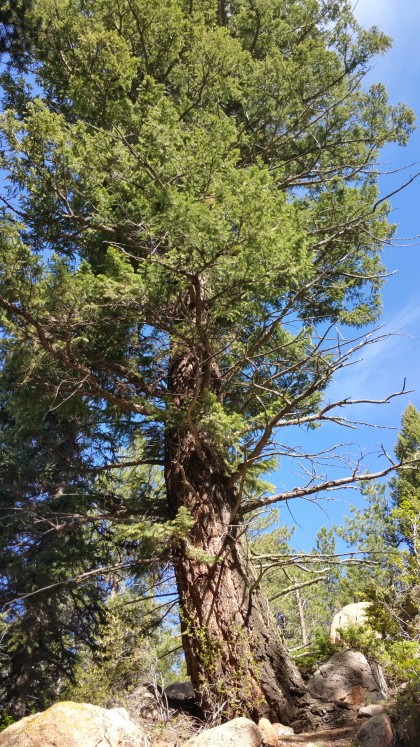
Bristlecone pines fascinate me. One of the subspecies, Pinus longaeva, has the oldest living entity on earth among its members, a tree over 5,000 years old. That puts its lifespan back before the development of Chinese civilization, a very long time ago. Pinus aristata, the Rocky Mountain Bristlecone Pine, can live only about half of that. Even so, 2,500 years is still a long, long time.

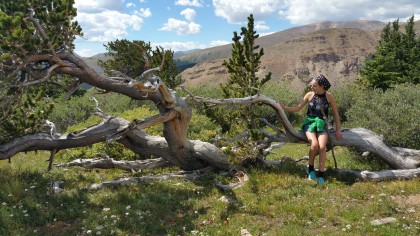
Our guides on Pennsylvania Mountain (see post below) pointed out several Bristlecones on our hike.

20170826_112438

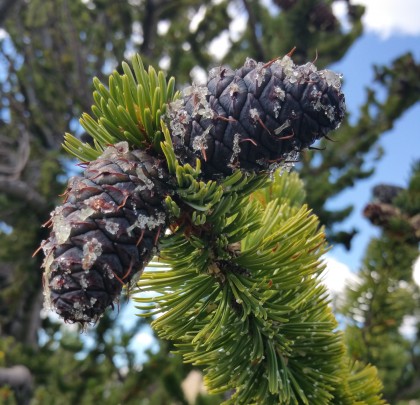
A second year cone
A second year cone, note the bristles
Second and third year cones. Cones have a lot of resin.
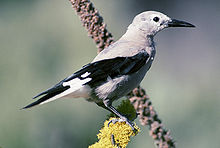
Clark's nutcracker
Clark’s nutcracker

This little bird, the Clark’s nutcracker, sticks its long beak inside the third year cones and pulls out the seed, collecting them in food caches out on the open ground. In the spring when the snow melts and well before anything else is blooming, the Clark’s nutcracker has food for its family. Though it has an excellent memory for its caches, it does occasionally forget one and the bristlecone pine propagates.

If you look carefully at the second picture, you can see small white dots on the needles. These resin dots plus the bristles on the cone are sufficient to identify the species.

When bristlecones die, they can lie for as long as a thousand years before rotting.

Higher Up

Lughnasa                                                                Eclipse Moon

shaggy sheep2Took off yesterday morning about 7:30 am and drove west (or south) on Hwy 285 headed toward Park County, Bailey and Fairplay. I stopped at Grant, a place made visible only by its single, as near as I can tell, business, the Shaggy Sheep. There’s one of those yellow diamond signs just after it with a black silhouette of a bighorn sheep. This is one of several instances of displaced chefs seeking less frenetic lifestyles in the mountains. I mentioned the Badger Creek Cafe in Tetonia, Idaho in my eclipse post. There are others.

The breakfast I had was a deconstructed carnitas hash with green chili and two eggs on top. The deconstructed hash had carnitas laid over cut up chunks of potato, not mixed together as in corned beef hash. It was delicious. While I ate, I read a brand new book by an author from Boulder, Colorado, Megafire. Michael Kodas analyzes the sudden uptick of catastrophic wildfires since the 1970’s and why they’ll keep coming. It pleased me to see that the Shaggy Sheep had opened a second room, meaning they may stay in business, a far from certain conclusion for anything retail up here.

South Park (to the right) from Pennsylvania Mtn.

After breakfast, I drove on toward the Kenosha Pass, a cut through a huge granitic batholith that forms the western boundary of the Front Range. After the 9,997 foot pass, Hwy. 285 descends sharply, a 7% grade, into South Park. Yes, that South Park. At the top of the pass South Park spreads out below, a wide treeless plain that stretches to another range of mountains beyond. They mark the continental divide. That was where I was headed.

A Fairplay favorite, the Java Moose

Fairplay, the county seat of Park County, is a not unusual, for Colorado, meld of old mining town, tourist destination and current mining. A dispute reported in last week’s Flume concerns whether or not to rezone residential plots for mining so a gold mine, yes, a gold mine, can expand its operations.

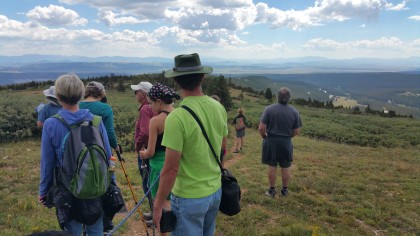
Those of us hiking up Mt. Pennsylvania met at a Sinclair truck stop on the east side of Fairplay. I went in the car with our two guides and Rich Levine, a member of Beth Evergreen and the lawyer who drew up our new estate documents. On the drive we went past the disputed zoning plat. The gold mine, it’s no longer grizzled old men in long underwear with pans and picks, looked more like an aggregate pit.

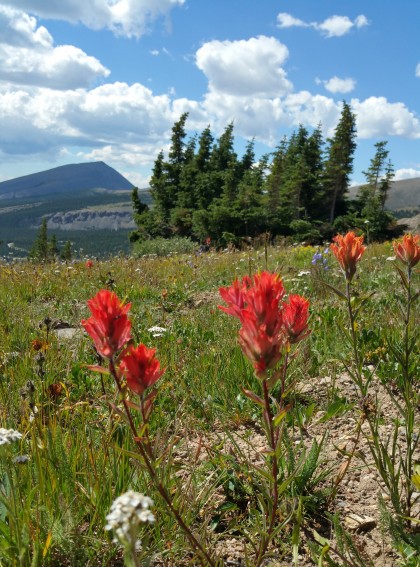
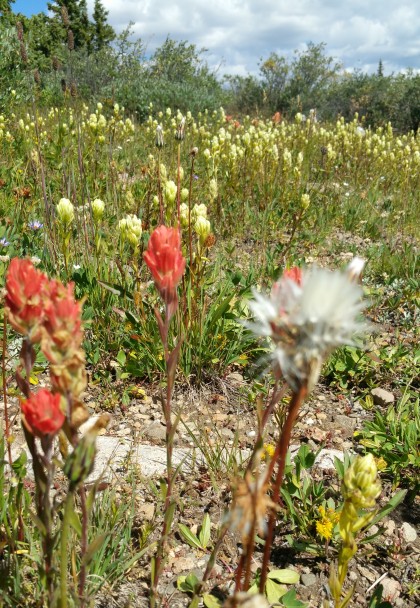
Indian Paint Brush
Indian Paint Brush

At the trailhead we began our hike at 11,700 feet through willow, lodgepole pine and a surprising abundance of wildflowers. The trail meandered a bit while traversing another 500 feet up to 12,200. We passed through the krummholz layer, crooked trees, that mark the tree line. Trees right at the tree line are stunted and crooked due to the inhospitable climate. It’s the tree line, after all.

After the krummholz comes tundra, flat and bare except for plants that hug the ground, mat plants, and a few hardy flowers. The air is thin here on Shadow Mountain at 8,800 feet, but 12,200 is thinner yet. It was a struggle to get to the highest point of the hike, requiring breath breaks for most of us; not, however, Tara’s three teenagers who seemed to run with exasperating ease (to this old guy) up the trail. As did Marley, their dog.

A tree island at the krummholz level

Those of us from Beth Evergreen were there because of the research being done on Pennsylvania Mountain. Forty years worth of investigation has been conducted there into alpine bees and some of the plants that they pollinate. Native dandelions, for instance, may be under threat from the expansion of the familiar, but invasive dandelion probably growing in your yard right now. Unfortunately, the scientists had vacated the site, presumably due to the academic year just getting underway, so we were left mostly with the stunning scenery as a benefit.

There was one other gain. The Beth Evergreen pre-school, now a wholly owned subsidiary of the congregation, has as a theme for the year, Bee Alive. It came up in the conversation that Kate and I have beekeeping experience. Rich has started two hives, which he has very cleverly suspended on steel cable high above the ground to foil bears. Otherwise an electric fence, and a strong one, is necessary. Rich invited me over to his house next week for a pre-school staff meeting. Kate and I may end up sharing some of our equipment and knowledge. Should be fun.

A full day. And a good one.

All That Falls Shall Be Reborn

Lughnasa                                                                 Kate’s Moon

lughnasaOh. Right. Slept in yesterday until 7:30 am. About 2.5 hours past normal rising. The guy from Conifer Gutter came by to give us an estimate on needle guards for our gutters. Then, well, I worked out and forgot to post.

But, here we are on Tuesday, 48 degrees outside after a drippy, Midwest-nostalgia day of rain yesterday. Kate sewed; I dithered. Read a bit more on Dark Ecology and responding to the ecocide. That sort of uplifting thing.

Still don’t have the rhythm of the new workout routine and actual work down. This is because I shifted my workout to mornings-cooler and less likely to get distracted. That’s also my best working time, for writing and research not to mention stuff around the house. I’ll get it eventually, but the herky-jerky rhythm I’ve got now feels, well, herky-jerky.

Went to an energizing lecture titled Fifty Shades of Talmud. Yes, it was about sex in this compilation of commentaries and arguments that created Rabbinic Judaism. The woman who wrote the book, Maggie Anton, spoke about talmud study with an infectious enthusiasm. Made me glad. I love to see people living from their passion, deep into something that fascinates them.

lughnasa1

Kate, for example, loves to sew and quilt. She finished a great wall hanging for me yesterday, four moose prints on a field of green. I’ve long considered the moose my spirit animal. Thanks, sweetheart.

Rigel continues to spend her every outdoor moment yearning after jaws against the flesh of tiny critters. She sniffs under the deck and on the deck, presumably following the movements of whatever is under there. She digs and sniffs and barks under the shed, too. She’s rejuvenated and following her doggy passion. In fact, she’s my new third phase role model. I want to be like Rigel. No, I’m not going to start sniffing the deck, barking under the shed, but I want to live my life like she’s living hers, all in.


Kate, Judaism and Pine Pollen

Beltane                                                                             Moon of the Summer Solstice

20170405_152848Kate continues to struggle with dry mouth, a very sore throat and other symptoms of Sjogren’s syndrome. She’s lost weight as a result. Lab tests don’t suggest anything terminal going on, but her distress is significant. If you know Kate, you know she has an energizer bunny mode, but she’s been on the battery depleted side of that equation for a while now.

Lots of Jewish stuff this week: Star Trek and Judaism on Tuesday, kabbalah on Wednesday, mussar and a meeting with Rabbi Jamie yesterday, and a Grateful Dead shabbat service tonight. I’m learning a lot and slowly integrating into the congregation. When I mentioned the possibility of an Evergreen Forum, a quarterly series of speakers somewhat analogous to the Westminster Forum in Minneapolis, I somehow ended up on the adult education committee, too. In that role I’m now helping coordinate the forum. As I said here earlier, I’m happy to have a place in a religious community with no leadership responsibility. A novel and fun experience for me.

20170613_203228A new seasonal reality for us: pine pollen. All these lodgepole pines insist on involving on us in their reproductive orgy that happens this time of year. A fine yellow dust settles on everything. Coming in easily even through screens, it’s especially apt to settle on things electrical, so the computers and the tv and the microwave all have a coating. It also coats our solar panels, reducing their efficiency. If it rains, a yellow scrim settles over the driveway, pooling where the water does. I wish these pines could figure out a more direct way to make more pines.



Live long

by Gage Skidmore
by Gage Skidmore

Beltane                                                                          Moon of the Summer Solstice

Pushing myself. Up to 10,000 steps on the four days I don’t do resistance work, 5,000 on those days. Feels good, so I’ll probably stay at it. The resistance work is helping, too. Less knee pain, less stiffness, better balance.

Looked at lilacs on Monday. After reading some material online, it looks like Syringa vulgaris (guess what? common lilac) and Syringa x prestonia, a Canadian cultivar, work well at our altitude. Gonna put in two bushes this year and see how they do. If they do well, I’ll add more next year. Cautionary note: don’t add fuel where it might feed a fire in the trees. They both need full sun and at least some amended soil. That we can provide.

Blessing that is the origin of the Vulcan salute
Blessing that is the origin of the
Vulcan salute

Last night I went to an interesting session, Star Trek and Judaism at Beth Evergreen. Several original cast members were Jewish, most prominent among them William Shatner and Leonard Nimoy.

A fascinating take away was the origin of the Vulcan salute. Nimoy, as the sole Vulcan in the main cast, got to have a lot of say about developing Vulcan culture. He attended a service in which the shekinah, the feminine aspect of God, gets invited in. She’s so powerful that everyone shields their eyes and a group of men upfront were wailing, according to Nimoy in a video clip. He decided to peek and noticed that they were holding their fingers in what you would immediately recognize as the familiar Vulcan greeting. It’s the Hebrew letter shin, the first letter of shekinah, shalom, sabbath.


10,000 Things

Beltane                                                                       Moon of the Summer Solstice

Hiking Staunton State Park yesterday launched me on my first day ever of 10,000 steps, actually 11,435. A weird thing to be proud of, I know, but still, I am. My eventual goal is to hit at least 10,000 every day. First though, I had to do it once and yesterday was that day.

A few memories of that hike:

20170610_08375420170610_09011620170610_092514 20170610_094341

Life in the Rockies

Beltane                                                                        Moon of the Summer Solstice

zoharpageHeavy rain yesterday afternoon, felt like being back in the humid East. Black Mountain is no longer white; it’s green with its lodgepole and aspen looking healthy. It’s gone from white haired old man to green man. Good to see. Cub Creek, Maxwell Creek, Bear Creek and Blue Creek are all full. The snowpack is well above average. A much better scenario for this summer. Thankful.

I’m relieved at Kate’s news, again. She’s had a rough time since the second week of my surgery and I hope the ENT doc has her on a path to eating with no pain. This is seven months of up and down health. Tough for her.

Second kabbalah class tonight at Beth Evergreen. I’m beyond fascinated. This Jewish mystical tradition seems to synch up with the way my mind and spirit work. I haven’t been this excited since I began to move toward paganism many years ago. The three main threads in my spiritual life have been, for a long time now, existentialism, paganism and Taoism. Looks like I may be adding a fourth.


Think Again

Beltane                                                                Moon of the Summer Solstice

images (1)Reimagining Faith has been a project of mine since I slipped out of the Unitarian Universalist world leaving behind both Christianity and liberal religion, the first too narrow in its theology, the second too thin a broth. The stimulation for the project lay first in a decision I made to focus on my Celtic heritage for the writing I wanted to do. This commitment led me to the Great Wheel of the Year and its manifestation literally took root in the work Kate and I did at our Andover home.

When we bought the house there, it sat on a lot with the usual scraped earth look of new home construction. It had no lawn, no trees in front, no soil adequate for growing flowers. We hired a landscape architect and added several thousand dollars to the mortgage for his work which included retaining walls, perennial beds, wild prairie on two sides of our house and tiered perennial beds in the back with a patio at their bottom. Our goal was to enjoy the landscaping throughout the time we owned the house. And we did.

2011 10 13_1265In retrospect our request to him to make it all as low maintenance as possible seems laughable. He did as we wanted, putting in such sturdy plants as Stella D’oro, a species of daylily, shrubs, a bur oak and a Norwegian pine, some amur maples, a hardy brand of shrub rose, juniper, yew, a magnolia that Kate wanted, and a river birch. This work included an in-ground irrigation system and the very strange experience of having no lawn until one morning when the sod people came and rolled it out. Then we had a lawn that evening.

2012 05 01_4112We looked at it, saw that it was good and thought we were done. Ha. It began with a desire for flowers. I wanted to have fresh flowers available throughout the growing season, so I studied perennials. At that time I thought I was still holding to the low maintenance idea. I would plant perennials that would bloom throughout the Minnesota growing season, roughly May 15 to September 15, go out occasionally and cut the blooms, put them in a vase, repeat until frost killed them all back. Then, the next year the perennials would return and the process would recur. Easy, right?

No. Gardens are alive. They are dynamic. Species of flowers have very different horticultural needs. Some, like the spring ephemerals, grow early to avoid the shade of leafed out trees and shrubs. Some, like bleeding hearts and hosta, require shade. Others, like iris, a particular favorite of Kate, need an application of a pesticide to eliminate iris borers. Others, like tulips, wear out in the harsh weather cycles common to Minnesota. Trees planted around the beds grow, too, changing the sun and shade areas from year to year. Soil gets depleted as plants take nutrients from it to fuel their growth. Different flowers require different sorts of soil, too.

06 20 10_Garden_0052Once this world opened up to us, we began to enjoy working with all these variables to create beauty around our home. Gardening for flowers, eh? Well, how about some vegetables. This led to a two-year project of cutting down thorny black locust, chipping the branches, then hiring a stump grinder. After this was done, Jon built us several raised beds. We filled them with good soil and compost. Tomatoes, potatoes, beans, garlic, leeks, onions, carrots, beets flourished. Vegetables, eh? Why not fruit and nuts?

400_late summer 2010_0163Ecological Gardens came in with permaculture principles and added apple trees, plums, cherry trees, pears, currants, gooseberry bushes, blueberry bushes and hawthorns. On the vegetable garden site they added raspberries, a sun trap for tomatoes, and an herb spiral. At that point then we were maintaining multiple perennial flower beds, several vegetable beds, fruit trees and the bees that I had started keeping.

We did later add a firepit and picnic area, but those were the main horticultural efforts. This was a twenty year long immersion in plants and their needs, the way the seasons affected them and our human responsibility for their care.

WheelofYear1GIFWhen I stepped away from the Presbyterian ministry after marrying Kate, the Celtic pagan faith reflected in the Great Wheel began to inform my theological bent more and more. What was to come in the place of the Christian path? Perhaps it was a way of understanding our human journey, our pilgrimage as part of the planet on which we live rather than as separate from it or dominate over it.

Wicca, though, and the various neo-pagan movements seemed thin to me, not without merit as earth-based faiths, but often filled with gimcrackery and geegaws rather than guidance for the next phase of human existence here. I began to wonder about an ur-faith, a way of believing, of being religious, that could exist alongside, even below the other faith traditions, some path that could put us back in the natural world (from which we have never actually removed ourselves) and in so doing undergird the kind of compassion for our planet that might save humanity.

This is the concept behind reimagining faith. Is it possible to create a framework for an earth-based faith that respects science, yet offers ritual and private contemplative practices? What would a book look like that attempts to create a theology, conceptual scaffolding for such a faith? I got this far a while ago. But something has stopped me from moving forward. This post is about poking myself to move forward.

HesseI have finished 7 novels and am nearing completion of an 8th. So I can work on a long term project and see it through to completion. I’ve also been part of creating several organizations still in existence in Minnesota, among them MICAH, Jobs Now, and The Minnesota Council of NonProfits (originally the Philanthropy Project). These, too, are long term efforts that I helped see to completion.

Over time I’ve also worked with several other institutions in various roles that lasted for years: the Sierra Club, the Minneapolis Institute of Arts, Citizens for a Loring Park Community, the Stevens Square Community Organization, the West Bank PAC and the West Bank Community Development Corporation, not to mention the Presbyterian Church and the Unitarian-Universalists.

2010 01 19_3455I’ve had less persistence in my two non-fiction writing projects: an ecological history of Lake Superior and Reimagining Faith. Not sure why. Getting started on the research and idea end was not a problem, I have file folders, bookshelves, posts here on Ancientrails and various sketches for outlines. But I’ve never sustained the push to finish.

My now year long immersion in Reconstructionist Judaism, studying first mussar (ethics) and now kabbalah, has caused several sparks to go off for the Reimagining Faith work. I’m beginning to feel the urge to commit substantial writing time, thinking time to this project. What I’d like to do is produce a book that would lay out the skeleton and put some flesh on it. At that point I’d like Reimagining to become a collaborative project with whomever feels an attraction to it.

So let be it said, so let it be done. Yul Brynner, the Ten Commandments.

Ichi-go ichi-e Once in a lifetime

Beltane                                                                                   Rushing Waters Moon

Fog this morning over Black Mountain. It comes in and out of view as the mist moves toward us. Now it’s gone altogether. There’s a thin scrim of icy snow on the solar panels. Colder last night.

Kanō Eitoku (1543–1590), Cypress Trees

My Japanese informed aesthetic often finds resonance here in the mountains. The ponderosa pines that surround Beth Evergreen’s synagogue present heavily crenulated bark, twisted branches and a sturdy calm. From the sanctuary, looking south and east, one window pane has an especially crooked branch that reaches up like a hand. When the snow comes, it looks like a portion of a Kano school gold screen. Ravens and crows land on these branches, too, also emulating the scenery that inspired so many Japanese painters and printers.

Moon watching, a Japanese pastime, has its analogue here as well. The moon rising and setting among the mountain peaks, clouds placing a thin gauze in front of it, the stars as its context, emphasize the moon’s romance. I can stand on my deck here off the loft and watch clouds cross the moon’s face. Its silvered light makes beautiful shadows of the lodgepole pine.

Hokusai (1760-1849), Boats and Moon, an ukiyo-e print

Big eared mule deer and thick, tall elk come down to Maxwell and Cub creeks, lapping up the cold fresh melted snow. Mountain lions slip noiselessly through the undergrowth, lie prone on rock cliffs waiting for them to pass nearby. Bears root up tubers. Minx, bobcats, pine martens, smaller predators, hunt for prey. Rabbits and squirrels and mice feed, look over their shoulder. The web of life is vibrant.

Bull Elk, Evergreen, 2015

Ichi-go ichi-e is a Japanese phrase often associated with the tea ceremony. The tea master arranges art in the tokinama, chooses teas and sweets, decides which tea bowls and tea pots and tea utensils to use, then greets their guests as they arrive, often no more than one or two. He does this to create an ichi-go ichi-e, a once in a lifetime moment or for this moment only. It connotes the treasure of each meeting between or among people.

Each moment of the day Black Mountain offers ichi-go ichi-e to those of us who live near it, if only we stop and look. To appreciate ichi-go ichi-e though we need to pause, or as mussar teaches us, put a space between the match and the flame. If we slow down our glance, our gaze, let it come to rest, if we take a breath and consider what is right there in front of us, then we find once in a lifetime moments happening throughout our day.

Ponderosa Pine, Beth Evergreen, April, 2017

These do not, as you might think, cheapen or dilute over time, rather they enhance our experience of the world. We recognize the fleeting nature of life, of this moment and that moment, of the unique and precious and irreplaceable flavor to each encounter. Nothing is old, all is new, always.

In fact, to the extent that we can gain an appreciation of ichi-go ichi-e, then we never age.


The Vernal Equinox, 2017

Spring                                                                        Anniversary Moon

In the latter half of the 20th century, the spring emergence of leaves, frogs, birds and flowers advanced in the Northern Hemisphere by 2.8 days per decade.”  NYT, The Seasons Aren’t What They Used To Be*, March 19, 2017. See an NYT graphic representation here.

650 2011 04 20_0898


We’re celebrating the spring equinox with yet another red flag warning. We need precipitation. Spring in the mountains is not yet, though the temperatures felt like it this whole last week.

A while ago I asked an entomologist at the Cedar Creek Nature Center in Anoka County what was the key phenological sign of spring. Bloodroot blossoming was his answer. Up here on Shadow Mountain it seems to be pasque flowers and they are blooming. Yet in many years, most years, there would be no pasque flower blooms now due to snow cover.

On the Great Wheel, the spring equinox is the point when the promise of Imbolc’s freshening of the ewes begins to appear in the plant kingdom. Leaves push out. Spring ephemerals hurry up and bloom, getting out ahead of tree and shrub leaf shade. Buds for later blossoms appear. Green pushes out brown. The sound of tractors are heard in the fields.

This storied season has a vital presence in poetry, song and many of the world’s religions. Mother earth seems to defy the fallow season, the cold season by creating life abundant from little more than sun and soil. No wonder the tales of resurrection in Christianity, in the Egyptian legend of Osiris and Isis, and the Greek’s Orpheus and Euridice, Demeter and Persephone have their analogs in spring.

bulbsYet it is not a true analog. Mother earth only seems to defy winter and the fallow time. It is not, in fact, death and resurrection, but a continuum of growth, slowed in the cold, yes, but not stopped forever, then magically restarted. Corms, bulbs, tubers and rhizomes all store energy from the previous growing season and wait only for the right temperature changes to release it. Seeds sown by wind and animal, by human hand are not dead either. They only await water and the right amount of light to send out roots and stalks.

20170318_163044I prefer the actual analog in which human and other animals’ bodies, plant parts and the detritus of other kingdoms, all life, return their borrowed materials to the inanimate cache, allowing them to be reincarnated in plant and animal alike, ad infinitum. Does this deny some metaphysical change, some butterfly-like imaginal cell possibility for the human soul? No. It claims what can be claimed, while reserving judgment on those things that cannot.

After Beth Evergreen’s mediation shabbat service last week, a member of the congregation and I got on to the topic of death. “I think it will be like before I was born,” he said. “Yes, I’m a nihilist, too,” I said. “But, I admit the possibility of being surprised.” He agreed.

Brand-Storytelling-In-The-Post-Truth-EraIt is spring, I think, that gives us this hope, no matter how faint, that death might be only a phase change, a transition from this way of becoming to another. It’s possible.

A necessary complement to the objectivity of science, then, is the subjectivity of experience. An enthusiastic openness to the lives of other species — the timing of tree blooms on city streets, the calls of frogs in wetlands or the arrival of migratory birds — is an act of resistance to deceptions and manipulations that work most powerfully when we’re ignorant. “Post-truth” does not exist in the opening of tree buds.” ibid