Category Archives: Art and Culture

Global

Samhain                                                                 Winter Moon

-12.  81.  72.  34.  35. 14.  Andover.  Singapore.  Muhayil, Saudi Arabia.  Mihailesti, Romania. Montgomery, Alabama.  Denver, Colorado.

Mary and I talked today, she near her bedtime while I ate a quick breakfast.  7:30 am here while 9:30 pm there.  It’s a big planet.

(Thanksgiving 2013, Singapore)

Having close family members scattered around the world affords an occasional window on quirks in places far from the center of North America.  Mary reports that Thanksgiving has taken hold in Singapore, colleagues say to her, “Happy Thanksgiving!” and many Singaporeans celebrate with a big meal.  Thanksgiving has no religious roots and its secular coloring is very faint, the whole pilgrim/indian thing long ago and perhaps apocryphal anyhow. It’s emphasis on food, family and gratitude could travel well into any culture.

Halloween and Christmas are also big in Singapore with Mary reminding me of the lights by Hitachi that go up on Orchard Road, lights that I saw when I visited in early November, 2004.

There is one holiday transfer that puzzles me.  Mary says St. Patrick’s day is big, too.  And, people wear green and go to bars and drink green beer.  In this case Chinese and Indian people, maybe even a few Malays, too.  Maybe it’s seen as a spring holiday?

(St. Pat’s 2013 Singapore)

Mark is in his third week of classes in Muhayil, Saudi Arabia.  He reports that many of his students leave class early to go home and eat kabsa.  “Kabsa (Arabic: كبسة‎ kabsah) is a family of rice dishes that are served mostly in Saudi Arabia — where it is commonly regarded as a national dish. Kabsa, though, is believed to be indigenous to Yemen.”  Wiki.


Switching Rails

Samhain                                                               Winter Moon

In late January when this kind of cold usually comes a few days of it can bring on an intense desire to be outside, be anywhere other than inside.  This is the condition often called cabin fever.

Having this deep, long cold spell come up front in winter, though, has not produced the same kind of grousing and low murmurs as a January dip.  This is still bracing.  Or, well, what do you expect?  We live here, don’t we?  Ruth, our financial advisor, said a mutual friend, Larry Schmidt, the late investigative reporter for WCCO, told her winter cut gang activity out for a season which he said, “Gives us an edge over L.A. and Detroit.”

This kind of seasonal change switches rails in the roundhouse of the mind.  No doubting now that the growing season is far behind us and the earth’s orbit has swung us into different astronomical territory.  We can concentrate on activities like snowshoeing, bird feeding, igloo building, cross-country skiing, ice-fishing, dog-sledding.  There’s even the few, the hardy who have sails rigged on “boats” with ice-skate like runners.  Others will go winter camping, hiking in the boreal forest.  And, yes, there will be snowmobilers, too.

Some will concentrate on feasting, reading, indoor games.  This is the concert and theater and dance season, too.  And all those holidays with their bright lights and festive music and gift giving and family and friend get togethers.

And the cold says winter.  Time for all that winter offers.

In the Palace of Forgotten Memories

Samhain                                                        Winter Moon
Reading a good book about memory, one that Mark Odegard, Ode, recommended, Moonwalking with Einstein.  It’s an excursion into the world of memory champions, or Mental Athletes as they call themselves.

It has brought me back again to the notion of the memory palace.  I first encountered this idea in The Memory Palace of Matteo Ricci, a story about the first Jesuit in China by Jonathan Spence.  It struck me then as important, worth pursuing, but I didn’t do it.  Don’t recall why.

Now I’m thinking I may apply some of these techniques to Latin and poetry, two areas of great interest to me where memorization could make some difference.

In very brief a memory palace is any visual structure you use to “store” items you wish to remember.  A memory coach in the book suggests spending several weeks developing your cache of palaces making them as gritty and as visual as you can.

In my case I chose first 419 N. Canal in Alexandria, where I lived from age 12 til age 17.  I’ve gone on to recall First Methodist Church, the MIA, the Times-Tribune offices, our current home, the Walker, the streets of Alexandria, the Nicollet Mall, the Stevens Square Neighborhood and the West Bank.  Any structure (doesn’t have to be a building) will work.  Vegetable garden, orchard, mountains…all would work.  311 E. Monroe Street will be in there, too, as well as that neighborhood.  I’ve not gotten very far along on this part, but I will.

Falling

Samhain                                                       Winter Moon

Only 4 days into meteorological winter we have significant snow falling and will watch thedecember 4 snow and cold 2013 temperatures plummet starting tonight.  I have a snow day feeling, that sort of enforced healthy hooky moment that comes when you realize transportation just won’t work.

Of course, I have no job to not show up to, no school to miss, but decades of positive experiences in weather like this has me snuggled into the computer, ready for movies and tv, catching up on some reading.  Maybe some snow shoeing.

Speaking of jobs, I forgot to mention meeting Linsey at the Ghorka Palace Monday night. In her last week of a 2 and a half year stint there she told she was looking of internships in museums throughout the state.  An anthropology and Greek major, a visit to the British Museum at the age of 16 focused her.  Her “big dream” is to work there, far far from now, but at some point.  She wants to be a curator.  It was fun to see the vision and hope of a bright young person.  May she do well.

(the rosetta stone at the British Museum)

Lycaon

Samhain                                                              New (Winter) Moon

Today I finished translating the story of Lycaon in Ovid.  Most of it anyhow.  Some still awaits consultation with Greg.  I plan to go back and forth through this story until I have a clean, idiomatic and interesting text.  That’s the next couple of days, maybe more. Probably more.  Lycaon’s tale is the origin of the word Lycanthrope, a coined word for werewolf.  Lycanthropy is the study of werewolves.

In this story Jupiter, angered by an Arcadian king’s (Lycaon) human sacrifices, comes to earth to investigate.  When Lycaon tries to serve him human flesh, a test to see if he is truly divine, Jupiter in a rage turns King Lycaon into a wolf, but a wolf with human feet, eyes, grayish hair and the former king’s wild and fierce countenance.

Translating it word by word, line by line, idea by idea and then going back to create a polished English version is the task I set myself so long ago, producing a translation of Metamorphoses so I can embed these stories in my own consciousness.  Yes, there are over 15,000 verses in total, and I’m only at verse 235 (plus several hundred other verses I translated, stories I chose to keep me interested) but I’m now beginning to see myself as a translator and not only a student.  That’s a big transition.

I will post the text when I finish.


Fed

Samhain                                                     New (Winter) Moon

Drove into Minneapolis in driving snow as far as Coon Rapids, then rain.  The Woolly’s met at Gorkha Palace, a Tibetan-Nepali-Indian restaurant near Surdyk’s Liquor store in Minneapolis.  Tom, Bill, Scott, Mark, Frank, Warren and I had a pleasant meal together.

Each time I go to a meeting I come away nourished in body and soul.  The body is fed.  And so is the soul.  What do I mean by soul?  I mean much the same as I do when I use the word Self, that fluid yet somehow distinct sense that the I in this sentence is a peculiar, particular entity and one always with me, one with me.  That last is tricky because to be one with me implies a separation between me and the I, a separation that does not, I believe, exist.

How does the soul get fed?  By being seen, validated by others who recognize me as a peculiar, particular entity.  It’s important to note though that the soul, the Self that I experience is not the same as the one recognized by others.  Yet, it is fed by others who see me and respond to me as a continuing presence from one time to the next.

It helps the tricky move of the I seeing the Self.  There is a difficulty here.  What part of me sees the Self that is also me?  I know there must be answers to this, but right now they’re escaping me. Ha.

What I’m trying to say here is that this soul is fed by the souls of others, especially others key to his ongoing story.  The Woollys are such people for me as I am for them.  We help each others Selves stay alive and well.


A Puzzle

Samhain                                                                 Thanksgiving Moon

Ongoing puzzle.  How do I continue my immersion in the world of art?  Partly, perhaps mainly, the answer is drivetime.  Get in the Rav4 or on the Northstar, go to the Walker and the MIA, the Russian Museum, the occasional gallery.  There are, too, the valuable online resources like the Google Art Project, websites of various museums and tumblr, which exposes me to a lot of art I would never find on my own.

(Sisyphus Titian)

I want depth in my encounter, depth like I had while a docent, depth that came from wandering the museum, listening to lectures, prepping for tours.  The only way to get there, I know, is to spend the time, do the work, but how can I include these in my week to week, month to month life?  Have not got there yet.  And I want to get there.

Why I Live Here

Samhain                                                             Thanksgiving Moon

I have decided, over and over again, to remain here in Minnesota.  Leaving occurs to me from time to time, more often now the direction considered is north, beyond our borders where the politics, health care and weather all seem more sane.  Even with those attractions, and they are considerable, Minnesota and in particular the Twin Cities Metro always trumps any competition.

The arts here are a wonder.  Having the MIA and the Walker in a small market city like Minneapolis doesn’t amaze us, because, after all, they are here.  But it would if you considered them in a national, even international light.  The Guthrie is only the most visible island of a large theatrical archipelago, boasting more seats than any other metro area in the nation outside of New York City.

The St. Paul Chamber Orchestra is a gem.  Again, nationally.  The Minnesota Symphony used to be an internationally renowned organization, as recently as two years ago, before dimbulbs began a series of self-inflicted wounds.  Dance, local rock music, glass and clay arts, printmakers and galleries all thrive here.  Jazz, supported by KBEM of internet renown, flourishes.

There are substantially more dining options now than when I moved here in 1970.  More than Kate and I can visit before they disappear.

Writers in Minnesota consistently publish and make the national book news.  The Minnesota Center for Book Arts and the Loft provide outside academia support for the literary community.

Healthcare is as good as it gets. Anywhere.  Hawaii and Minnesota are tops in the US and good US healthcare is as good as there is anywhere.

When policy makers divided the land in the Upper Midwest and created Minnesota they included the intersection of three US biomes:  prairie, deciduous forest (Big Woods) and the boreal forest.  The Wisconsin glaciation scoured out numerous lakes and the Great Lakes.  Though flat our terrain is remarkable for its diversity and its  pristine nature in the north where the moose and the wolf still live.  At least for now.

Where else do you get all these things?  Nowhere else.  That’s a large part of why I stay. Another, equally large part, is friends.  The Woolly Mammoths, the MIA docent class of 2005, the Sierra Club and various past political activity has peopled my life with friends. They’re here and I am, too.

In the past, too, I valued the Minnesota political culture which showed compassion to the poor, effectiveness in government and sound stewardship of the state’s natural resources. A long desert of mean policy makers, eyes and hearts captured by the great god money, have devastated much of that culture though I continue to believe it exists.

The common good, defined broadly, is just that.  Our future depends on an educated work force, receiving a decent wage, a hand-up when life turns sour and a healthy environment in which to work and live.  These have seemed and still seem to me the necessary elements of a civil society.

Conservative

Samhain                                                             Thanksgiving Moon


Max Beckman’s “Blind Man’s Buff” is one of the highlights of the MIA’s collections.  His tryptychs are a wonder and the MIA’s may be the best of the batch.  Here’s the fun part. It’s about to undergo conservation and this conservation will not be hidden away in the sub-basement devoted to the Midwest Art Conservation Center, but done right in the gallery over the next few months.

This is an extraordinary opportunity to learn about this painstaking, delicate and sophisticated aspect of museum life.  I’ve had the opportunity to tour the Center twice and heard lectures from them at other times.  Most museum goers don’t know of its existence, I imagine, but it got special attention during the design of the Grave’s Target Wing.  It needed it.  Before it had been jammed into rooms and spaces not being used by the MIA.

Its print and paper conservation room had the most peculiar space up a short flight of stairs and entered through a half-height door.  Here’s an odd bit of history.  An MIA museum guard wrote a successful movie that had this door as a key conceit:  Being John Malkevich. If you saw the movie, you’ll recall that actors entered his brain through a tiny door.

Conservation and restoration are tricky concepts in the world of art and antiquities, the current era different from the near past and very different from the times before that.  In the near past conservation and restoration had a bad time because earlier conservators had sometimes chopped up paintings to fit new frames, filled in colors or removed layers of paint to show an underpainting.  In buildings like those at Angkor the previous era of restoration fixed the buildings, tuning them up to the then current understanding of what they would have looked like.  In both instances conservators and restorers often used permanent materials that could not be distinguished from the original and/or modified the original in substantial ways.

The near past’s reaction against that was to leave objects in their found state, to eschew all but the most necessary (particularly in painting and sculpture) interventions.  The current thinking is to restore, if necessary and deemed advisable, only in concert what the very best investigative work can determine consonant with the original.  And then, here’s a key move, to use only materials easily identified as added and also easy to remove without causing harm to the work or the building.  This allows restorations to reproduce a work’s original look in a way that preserves the artist’s original intent, yet not to alter the original in ways that cannot be undone and undone without injuring the work.  Scholarship in the future may change the view of the object.

We had a large painting conserved by them a few years ago after we ripped it during renovation of our kitchen and living room area.  It was not cheap, but neither was the painting.  They treated our painting with as much care as they would a museums.  The result was quite impressive.  You’d never know it was done.  Which in this case was the point.  They cleaned it, too.


Upset the Apple Tree

Samhain                                                  Thanksgiving Moon

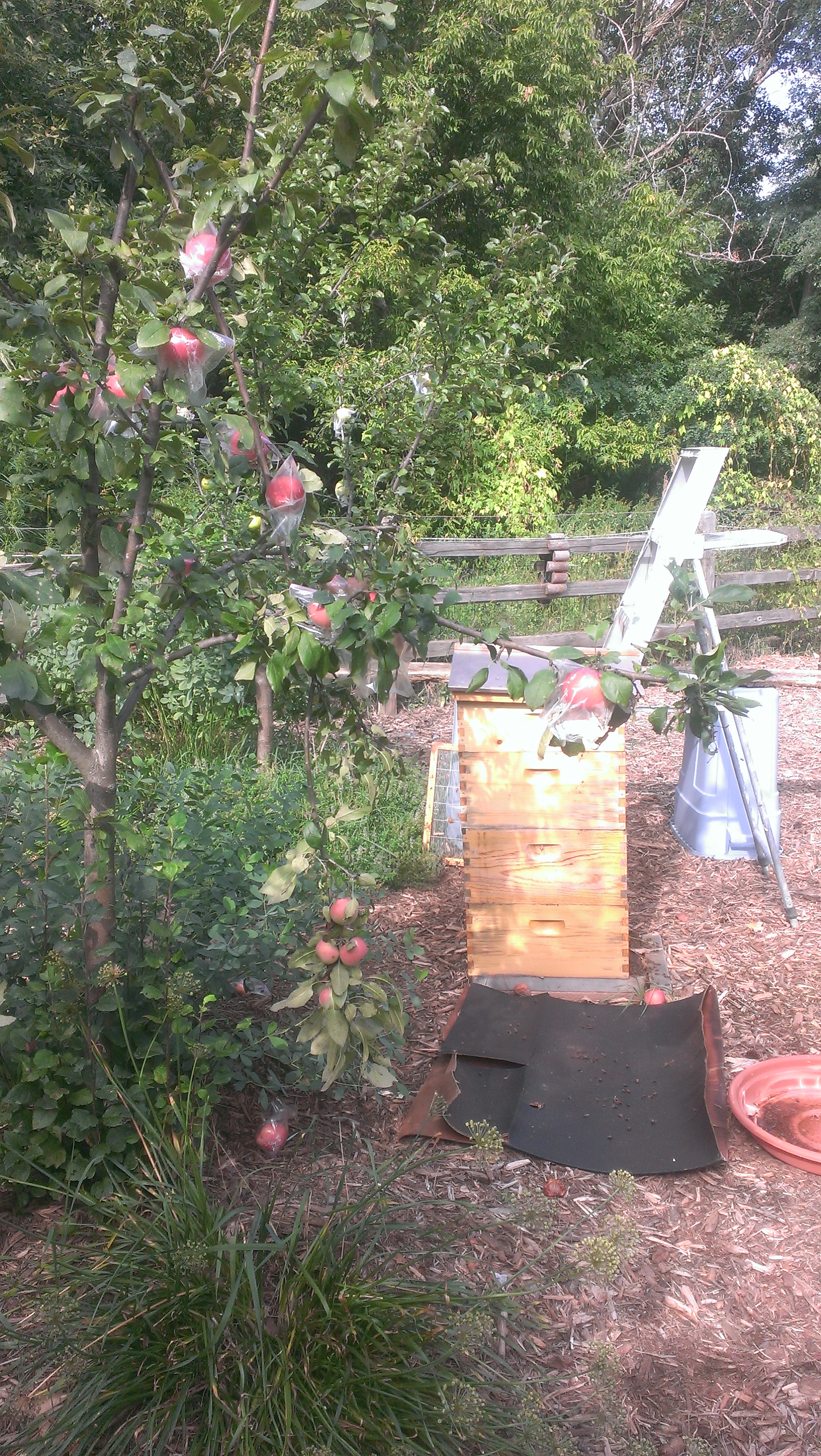
After the heavy snow a week or so ago, I looked out and saw that the bee hive had snow IMAG0929and some leaves on its top.  Odd, I thought, but didn’t go out to investigate.  Our orchard, where the bee hive is, is visible from our kitchen.

Today I went out to hitch up the cardboard sleeve which had slid down to the ground and attach it firmly for the winter.  That snow and some leaves on the bee hive was one of of our apple trees.  It had tipped over from the weight of the snow and landed on the bees.

(It was the tree beyond the bee hive in this picture.)

I cranked it back to vertical, tied it off to the fence with some plastic coated dog leads and realized it would require some more soil and some compacting before the snow flies, probably this week.

The bees now have their winter protection.  The garage is on the way toward reorganization, too.  I spent an hour and a half or so doing this and that, glad to get out of the chair, even though it is a Miller Aeron.

More Latin later.  Translating Lycaon from the Latin while I push the story through different paces in Dramatica.  That’s fun.

I also started reading Robert Silliman’s Alphabet.  He’s a language poet and this is a series of riffs beginning with each of the letters of the alphabet.  It’s a very big book.

(Zeus and Lycaon in Wedgewood)