Category Archives: Garden

In the Garden

Beltane                                                                           New  Garlic Moon

One of those nights last night, unable to get to sleep, still rolling around awake at 1:00 a.m.  Up a little bleary.  Wrote  few e-mails, then out in the orchard, first.  I’ve had tent caterpillars on two trees.  Each time I have removed the tent and stepped on it or crushed the worms.  This is non-chemical pest control, a route I prefer and, as long as I’m not running a commercial operation, one I can pursue.

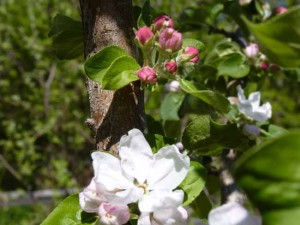
Now I wander in the orchard, looking at seed pods (fruit) beginning to develop from the last of the blossoms which dropped this week.  I’ll try to find worms and moths before they do 2011-05-17_0805early-spring-2011damage and as long as I can I’ll follow pinch and destroy.  After that, I think, right now anyway, that I’ll go with Gary Reuter, the bee rangler for Marla Spivak.  I’ll just put up with wormy apples.  This is partly out of regard for the bees who have enough pressure of them and they don’t need an added pesticide load from our orchard, but it’s more out of a commitment to no pesticides, grow strong plants and let them fend for themselves.  It’s worked reasonably well for me so far.

(before the fall)

After the orchard the potatoes were next.  Now that the soil has warmed up the potatoes have begun to grow, their dark lobe shaped leaves appearing atop a fragile looking stalk.  At this point the basics of potato culture involves mounding earth over the stalk as it grows.  That’s what I did today.  In the long raised bed where I have most of the potatoes this year, I also have a bumper crop of asiatic lilies and tulips.

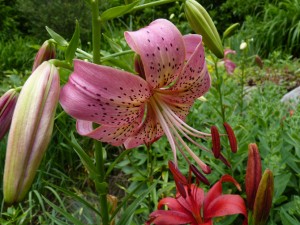
I planted this bed originally as a cutting garden, years ago.  The same fall the bed was built I went out to the Arboretum to a lily growers sale and bought Minnesota hardy bulbs.  They’ve been in that bed ever since, maybe 10 years.  Boy, have they enjoyed that bed.  They’ve started lilies all over the place.  That means that as I mound the potatoes I have to move around the lily bulbs that have generated.  I hate to just throw them away because they’re so hardy and have been with me so long.  I’m trying right now to raise vegetables and flowers in the same bed.  That’s also worked reasonably well for me.06-28-10_earlylilies

I also mounded the leeks as my last action in the garden this morning.  In the case of leeks the mounding blanches the stalk, keeps it white underground and increases the usable part of the leek.

That done, I’ve come inside to work on my Latin.  Pentheus, now, Book III:509-to the end.

Blue Collar Plants

Beltane                                                                          Waning Last Frost Moon

The last day of May.  Where do the good times roll?

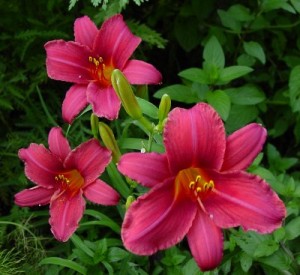
This morning Mark and I worked on digging holes in a front bed (Mark) and digging, weeding and dividing hemerocallis, then transplanting them (me) into the holes dug in the front hemerocallis_just_sobed.  Hemerocallis (day lilies) are the blue collar workers of the perennial beds.  They work hard, are hardy and bloom like crazy in August.  They also have grow out, expanding their territories.  And they never die.  Hemerocallis are forever.

I’ve gone through several different attitudes toward them.  At first I loved their variety and bought several different kinds, putting them in places where I wanted foliage most of the season and blooms during the particular periods when the variety bloomed.  That was good.  Then, they began to spread out, multiply, take up space, crowd out other plants.  That was bad.  So, I began to divide and transplant them, much as I did this morning, but with less thought.  Eventually this meant that I had not solved the problem, but spread it to different areas of the garden.  Duh.  So.  I stopped buying hemerocallis.  That was good.  I have given away dozens of clumps of various varieties and yet I have still more.  You can see  how a nursery person could learn to love hemerocallis.

Now I have what I like to think is a mature attitude toward these sturdy plants.  When I need to crowd out weeds and have a bed that will no longer require attention, I reach into my ample supply of hemerocallis and dig, divide, transplant.  We now have a good working relationship because we understand each other.

An Unforgivable Sin?

Beltane                                                                    Waning Last Frost Moon

“Man is the only creature who refuses to be what he is.” – Albert Camus

Dogs behave like dogs.  Ticks like ticks.  Ravens steal.  Osprey fish.  Shark keep moving.  Even the heart beats, the liver and the kidney detoxify, the stomach and the gut digest and eliminate.  The nose smells.  The ear hears.

We are the only creatures who, at a super-organism level, can refuse to be what we are.  It is both our glory and our damnation.  When we resist the impulse to violence, the credo of self first and the will to domination we become creatures of wonder, covered with grace and filled with light.  When, though, we take more than we can eat, steal more than we need from mother earth, use our evolved brain to imprison other creatures when we do not need them for food, then we walk to the mouth of the River Styx and throw ourselves in Charon’s boat.

Here is the first and greatest sin, perhaps the unforgivable sin.  We imagine ourselves apart from nature, as unique and special beings, exempt from evolutionary history and immune to natural consequences.  While it is true that our great technical and scientific skill seems to partition us off in our own special province, it is not so.  Why not?  Read an article about peak oil.  Consider the consequences of peak water.  Look at the struggle to find precious and rare metals, needed for sophisticated electronic devices.  It leads the Polymet Corporation to the conclusion that not only could they find them in our wonderful northeastern Minnesota, they must mine them.  Must.  Or else.  What?  No more cell phones, laptops, tablets?

Consider the moment of peak rare earths and metals.  What then.  Mother earth only has a certain cache of elements and their combinations, a cache configured in the fires of solar fusion and flung out in the processes that created our solar system and our world.  We do not, can not, make more copper, barium, lithium, nickel.  What gives corporations the arrogant assumption that they can use this store of minerals for their own private purpose?  What gives humanity the temerity to arrogate to our uses all the fossil fuels, all the stored carbon, all the metals gathered in mother earth’s body?  If this question seems naive, then ask how extinction might feel, extinction because we refuse to recognize our limits and our real location in the community of creatures and the world of things?

So, I invite you to go outside this memorial day weekend and find a flower, a tree, a bird, a dog.  Sit with them for a while.  Notice if they try to take more than the universe has allocated for their use?  Notice how they appreciate the water, the sun, the sky, a friend.  Then watch one of us.

Anco Impari (I’m Still Learning. Goya)

Beltane                                                                 Waning Last Frost Moon

We continue sliding toward summer, a cool, moist descent, not at all like the sudden, blazing ascension we often see, usually full on in place by now, with sun screen and hats and pitchers of lemonade set out on patios.  At some point it will warm up, at least I think it will.  There have been years without summer, years when the weather remains much like what we have now, days cool in the morning, warming in the afternoon and falling off to cool nights.  Could be this will be one of those summers.

I’ve worked this morning on Pentheus, the first few verses proving difficult for me, almost as if I’d entered a different text altogether though it’s only 300 verses away from Diana and Actaeon and in the same Book, III of XV.

Something captivates me as I get into the Latin flow, the world tunes out; the text and I begin this tug of war, me digging, using dictionaries and online aids, the text resisting, remaining stubborn, not allowing its meaning to emerge without a struggle.  The tension between the text and me lies in the language of an ancient people and my learning, a tension requiring both, learning and the language.  Without some knowledge, there would be no tension.  If I had no learning, the words in Latin would sit immutable as stone, as strong a barrier to me.  If my learning were to the level of fluency, the text would not be a barrier at all, I would read as I do in English.  Instead, I’m in a middle place, knowing and learning at the same time, so the text became enticing, pulling me further into the journey, not only of Ovid’s texts, but of the others:  Cicero, Caesar, Livy, Martial, Tacitus, Horace, Seneca.

The feeling reminds me of how I reacted to serious study of art history.  At first there was so much information, so many different aspects that I felt overwhelmed, as if I could never get my head above the surface of this great ocean of learning.  As time passed, as I walked the halls of the museum, read texts and looked at more and more art, a shaky gestalt began to form.  There was a rough chronology, even a global chronology.  There were styles and forms and methods and instances of all three.  At some point the Song Dynasty became separate from the Tang and the Han, just as the early Buddha images became distinct from the later ones of Tibet, Thailand, China.  Neoclassicism and impressionism began to tease themselves apart and appear as separate, thought related movements.  Beckman and Kandinsky and Monet and Barye and Poussin and Church and the master of the embroidered foliage sorted out into times and influences and basic tenets.

(of course, like most of us, I’m a combination of autodidact and schooling, but since college, the autodidact part has definitely taken precedence.)

Now I have a scaffolding on which I can hang new learning, it fits in a large gestalt, which, while far from comprehensive, at least describes the outlines, the places where there are gaps and the places where some new learning easily fits.

Right now Ovid and his Metamorphoses are my teachers, aided by my tutor Greg Mambres and my own reading, learning.  My scaffolding is up, but it’s very shaky.  I have verb forms, conjugations, nouns, declensions, adverbs, participles, clauses, imperatives, word meanings, poetic forms but often I revisit and revisit the same learning, still not seeing with clarity where on the scaffold something belongs.

It was the same with the garden, first flowers and then vegetables and is still now with the bees.  Large tracts of unknowing papered over by fragments of knowledge.  In bee-keeping for example I look at cells.  Hmmm. Those look like drone cells but maybe they’re queen cells.  Or maybe not.  Is it time to put on the second hive box?  Or, is it too early?  Should I use full-sized hive boxes or should I switch to honey supers to keep things lighter?  In gardening.  Just try planting garlic in the spring some year.  Won’t work.  It needs to over winter for a late June harvest.  Want a colorful spring and early summer?  Plant in the fall.  In the orchard I’m practicing IPM, integrated pest management, which means at this point, killing bugs by hand.

What I’ve learned is that knowledge accumulates.  New knowledge needs a scaffolding, a chest of drawers, a memory palace so that it can become integrated.

A Sunshiny Day

Beltane                                                                       Waning Last Frost Moon

Weeding, thinning in the vegetable beds.  A soothing practice, sprucing up the rows of beets, carrots, spinach and taking young weeds out now, before they get big.  When I first went outside this morning, in a sweatshirt, I had to go back inside and put on a light jacket.  A friend told me yesterday that an acquaintance, in the BWCA on vacation, woke up to a frozen pond near their campsite.  Minnesota.  A day with sunny skies and cool temps makes gardening a joy.

Buddy Mark Odegard has a new knee.  Here’s to his recovery and regaining the full use of his leg.

Brother Mark has a lot of things to ponder right now.  He’s considering what might be his next move and he has a good number of options.  Making this a bit more difficult is a feeling he has, “I feel like a refugee in my own country.”  He’s been gone 22 years and the contrasting cultural mores of Southeast Asia, especially Thailand, make him a stranger in his own, native land.  A peculiar, rather poignant experience.

When asked what the cues were, he said, “English speaking everywhere.  All the white people.  Americans are more direct, more in your face.”  Wonder if he meant me?  Could be.

Can you believe Memorial Day weekend has arrived?  Things are buzzing back in Speedway, Indiana where the 500 will run for the 100th time.  I haven’t kept up this year though a quick review of the 33 cars shows 4 women in the race including one qualified ahead of Danica Patrick.  When a woman wins the Indy 500, it will be a huge moment in motor sports.

By now in Indiana I would have known the results of time trials, the strategies for the new cars, the old faces and the rookies, new moves for pit crews.  Indy drivers get interviewed on TV and newspapers have separate pages devoted to the race information.  Whether you attend or not, and most don’t, the 500 takes over Indiana life for the month of May.  The May classic.  And it’s back for the 100th time.

Andover Chain Saw Butchery (of a Cedar)

Beltane                                                                      Full Last Frost Moon

Taking the local this morning meant cutting down the second cedar trunk and limbing it.  Mark worked very hard yesterday moving the downed and limbed trunks and branches in the front yard.  He went to bed early and slept hard.  Kate, too.  She weeded and weeded yesterday.  Her body mechanics have gotten better so her glutes tire instead of her back becoming painful.

This run of warm days will accelerate the growth in the garden.  The first planting of lettuce is recognizable now and the spinach almost so.  No potatoes coming through yet but they need a soil temperature of plus 50 degrees, so they’ve probably been tool cold.  Just hope they haven’t rotted.  The beans are up, the onions, carrots, beets and asparagus, too.  A lot of yard clearing work, weeding, maintenance chores have gotten done and will get done over the next few weeks.  Having Mark to help really moves things along.

Now I go see Leslie for our last visit, then a couple of Sierra club meetings in the evening.  The legislature has begun to wind down, but there’s a distinct  possibility that it is not all over.  Not quite yet.

The Chain Saw

Beltane                                                                   Full Last Frost Moon

Instead of opening Ovid this morning, I opened the garage doors and took out the chain saw.  Checked the chain oil, thick almost like grease.  Added some.  Filled a measured quantity of oil in a squeeze bottle, poured into the one gallon gas can, added a gallon of fresh gas, shook the can and put the gas oil mixture in the chain saw.  With the choke out full, I put my toe through the handle, pressing the saw firmly onto the driveway, grabbed the pull and yanked up.  Sputter.  Pulled again.  Nothing.  Pushed the choke half way in, yanked again and that ear-splitting racket that pierces homes and exurban silence whined to life.

With the exception of one cedar trunk I’ve now downed, limbed and cut into smaller sections all of the damage from last November’s early, heavy snow.  The large cedar tree just off our deck is the only tree I’ll miss.  We nurtured it from a small shrub into a magnificent tree.  Though I’ll miss its 17 year journey with us, it does open up a lot of sun for the vegetable garden.  It would have been strategic to cut it down years ago, but it was a friend.

When I finished limbing the first cedar trunk, my arms grew tired.  I quit.  No using chain saws when tired.  Flesh and bone pose no obstacle to these tree fellers.

Horticulture

Beltane                                                              Waxing Last Frost Moon

Gardening commends itself in several ways, but two are most important to me.   Having life tuned to the seasonal and daily rhythms of heat, light, rain, snow, even frost like we have predicted for tonight, grounds me.  If the frost comes and I have nothing outside to protect, it is a passing phenomenon of little interest.  With delicate plants to protect I know what it means, cold enough to cause ice crystals inside plant cells to burst.  Likewise drought is of no notice to me if I live in a condominium or on a city lot where my grass and a tree or two are my only contact with the plant world.  With a vegetable garden, though, the plants dry up, don’t produce.  I have to consider the drought, see that my plants get adequate water.

When the rains come, followed by warming days and the seeds leap up through the soil, when the potato eyes push a stalk and early leaves through to the surface, when those leeks nurtured since early April stand up and begin to fatten, it matters to me.  Their work, much like the bees, comes from their essence, not from anything I do, but, also like the bees, I have a role, to protect them, to see they have what they need.  We work together, the vegetables, the fruit trees, the currant and gooseberries bushes and the bee colonies.

The food that comes from our garden does not see us through the winter, though some of our crops, like potatoes and garlic for example last that long, but eating close to the land, lower down the food chain, happens more naturally when some substantial part of the diet comes from home.  So, the food alone serves as a final link to the growing process, but as a present symbol of the food available in the vegetable world, it paints into our world color that needs to be at our table all year round.

This, then, has come to pass as my new faith, a link with the earth and its fruits, a role in caring for them and the constant reminder of our dependency, our interdependency on it all.  When I began to work with the Sierra Club three plus years ago, I did it to put my political experience to work on behalf of the living world, in part at least as a thank offering for the sustenance I have received from it all these many years.

Bee Diary: May 15

Beltane                                                              Waxing Last Frost Moon

Checked the bees just now.  Each colony queen right, lots of bees and brood.  Still honey in the frames I put in when they arrived, but I did pollen patties today.  These bees are calm, allowing me to check the frames after just a bit of smoke, no attacks so far.  So, the bee season has a good start.  Still planning to try both the old method, take all the honey the colonies produce, and the Furgalas three deep overwintering method.  Not sure which way I’ll way go, 2 old, 1 Furgalas or the other, but I have to decide before I put the third hive box on them.  I’m still thinking whether to use honey supers after the first box, primarily to make each box a bit lighter weight, easier for this old back to handle.

Button down below says frost advisory.  Yike!  Well, it just shows that the averages are what they are for a reason.  I took a chance and I knew it.  Now we have to protect the tomatoes, the herbs, the coleus, maybe some others.