Category Archives: Garden

Integrated Pest Management

Lughnasa                                Waxing Back to School Moon

It’s been a wet, cool few days.  The Apiguard I picked up last night only works above 60 degrees and 70 is better.  It recommends chemical resistant gloves.  I’m using this on two colonies, the parent and the divide.  I tested the divide and its high, putting the colonies winter survival at risk, though I did not test the parent since the divide began with a hive box full of parent colony bees, it seems reasonable to assume it has a high mite count, too.  I don’t like using the medication, but the UofM, which shares my bias toward Integrated Pest Management and leans against treating recommends it.  I did count my mites, too, so I know the divide has a high mite count.  The package colony, which had only 1 mite all together, I will not treat.

The fumigilin-B treats nosema.  In this case the only way to reliably test requires a 400+ microscope, an expensive counter and a bunch of dead bees beat up in a mortar and pestle.  The U, again, recommends treatment this year in particular so I’m following their advice.  Nosema and varroa mites are two of the culprits in colony collapse disorder and often combine to cause the winter loss of a colony.

Integrated pest management for mites and nosema includes using Minnesota hygienic queens, which I have done, and can include use of a drone frame which attracts mites because drones take longer to pupate.  When the drone frame has capped brood cells, the beekeeper removes and freezes it, killing the mites and the drones.  This reduces the overall mite load.

Integrated Pest Management (IPM) has been around for a while.  It’s sort of a middle ground between all organic and contemporary agriculture/horticulture/apiculture techniques.  The idea is to put any chemical treatments as last resorts, utilizing first techniques that either directly mimic nature or are supportive to it.  In gardening, for example, companion planting qualifies.  So does crop rotation.  So does soil improvement.  So does hand picking insects and pruning out diseased branches or plants.  Another involves acknowledging that some level of disease and infestation is a normal part of the natural world.  The problem comes when the level begins to interfere with the plant or animals productive ability or its ability to, say, survive a Minnesota winter in our case.

In apiculture it involves, in addition to what I’ve already mentioned, culling 20% or so of your woodenware as it reaches 5 years of age.  This reduces nosema because the nosema organism lays down spores that can last as long as 75 years.  Another technique involves making sure your colonies have adequate food supplies for the winter.  A colony that struggles for food in early spring has much higher susceptibility to disease.

I use IPM in our perennial flower beds, our vegetable garden and now in the Artemis Hives.  I’ve not started in the orchard yet because fruit trees are still a mystery to me.  Gotta resolve that over the winter.

Waning Day

Lughnasa                     Waning Artemis Moon

The evening of a fine day is a silk garment laid on to welcome the night.  It caresses, soothes.  It wraps itself around the shoulders and extends a brief embrace as light fades and the stars come out.  It is, as my ancestors knew, a sacred time.

These days of September are the evening of the growing season, a transition to the colder, fallow season of late fall and early winter.  I’m glad they’re here.

As with each day, each week, each month of the growing season there are tasks appropriate to the time.  Here are a few of the ones we have left:

Garden

  • put a riser on the irrigation head nearest the deck
  • put composted manure and/or compost on the raised beds
  • Weed  perennials
  • harvest potatoes, beets, greens, tomatoes
  • save seeds:  tomatoes
  • plant bulbs
  • plant garlic
  • transplant:  gooseberries, hosta, bugbane
  • black plastic and mulch along truck path

Bees

  • sample for varroe mites and nosema
  • check honey and pollen supply
  • feed if necessary
  • in november prepare for winter

Sitting Back

Lughnasa                                       Waning  Artemis Moon

The big push on honey extraction, preceded by the push to mulch the orchard and the vegetable garden, has left both Kate and me happy the weather has soured.  She sews, now in the room right above my study, and I tap tap tap away following this lead and that down the cyber rabbit hole.

After reading Romance of the Three Kingdoms and Blind Descent, I’ve veered off into fiction, a sort of relief has taken my reading and I’ve plowed through 2 1/2 novels this last week +.  None of it so far is noteworthy, just pleasant diversions.

Worked this last week on a project for the office of Learning and Innovation at the Museum.  It involved responding to a new exhibition of heads and masks to be installed in the hallway in front of the antiquities galleries.  It’s part of the Art Remix concept.  Thinking in this way, finding connections between the new installation and other parts of the museum, stimulated me, shot off a spark or two.

The Garden in September

Lughnasa                                       Waning Artemis Moon

The onions, red, yellow and white, are in the storage room ready to go on the wooden racks when I have a minute.  The honey, too, is on the bottom row of our shelving unit, collected in canning jars and resting in the boxes that held the canning jars in the store.  Kate’s just put up 7 packages of frozen kale and swiss chard, for use in the dead of winter when greens from the garden seem very special.  She’s also making applesauce from our six apple crop.  I picked them a bit too early for eating.  Chicken breasts and pie dough have been set out to thaw since I will make chicken and leek pot pie later today.  This is a busy time of year, but it is also a fun and satisfying time.

The potato plants have not died back, so they await digging and drying and storage.  The garden of 2010 has begun to wind down.  I still have to plant garlic, mulch a few beds, weed the perennial flower beds and later plant the bulbs, but the number of tasks has begun to dwindle even though the size of some of them make a lot of work still left.

Photo Time: Late Summer

Lughnasa                                            Waning Artemis Moon

cr400_late-summer-2010_0200

Late summer taste treats.  We have red and golden.

400_late-summer-2010_0182

These are the hives with their maximum honey supers.  We extract honey on Monday.

400_late-summer-2010_0181

This is just one of several deep cave descents attempted by the Andover Speleological Society, Rigel and Vega founding members.

400_late-summer-2010_0164

The newly mulched orchard from the perspective of one of our sand cherry bushes.

400_late-summer-2010_0170

Our fruit trees have not really begun to bear yet, but there are six apples on this tree.  More as the years go on.

400_late-summer-2010_0175

Kate spearheaded this project and it looks great.  Not only does it look great, but it is more functional, too, especially from a weed suppression point of view.

400_late-summer-2010_0202

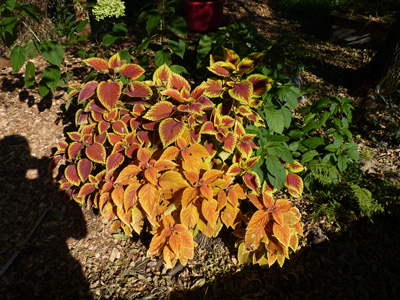
Kate plants coleus all round the yard; they add needed color to shady spots.

08-28-10_late-summer-2010_400

An Aging Bull Moose

Lughnasa                                    Waning Artemis Moon

Easton and Ray, both soon to be seniors at Andover High, worked this morning, moving wood chips, laying them down on the paths Kate and I cleared of weeds yesterday.  Both fit and energetic they kept at it, moving 9 cubic yards of wood chips with a wheel barrow.  That’s minus the maybe one cubic yard I moved to mulch some parts of the further away vegetable patch.  The orchard looks great and completes a job started by Kate a few weeks ago, one she saw through to a beautiful conclusion.  The orchard looks its best ever.  Right after Ecological Gardens finished the installation now 3 years ago, it looked pretty good, but the trees were small and the  plants in the guilds around them were also young.  Now the trees have begun to bear fruit, the guild plants have matured and the place looks like a real orchard.  Pictures tomorrow.

Working alongside the boys made me oddly competitive.  I wanted them to see me as an old man who could really work.  Not quite sure where this came from but it felt like the aging bull moose in the presence of young, high testosterone males.  Instinctive rather than even subconscious.  It passed, though.

Now, after a day and a half of physical labor, I’m weary, in need of a nap.

For Everything

Lughnasa                                      Full Artemis Moon

A full day today and another one tomorrow.  Late August through early September are busy times here at 7 Oaks and Artemis Hives.  Kate’s worked like a Trojan, the Norwegians of Greece, pulling weeds, making piles, churning through task after task.  She wears me out.  And she’s older than I am.

Each month has its own qualities, tasks appropriate to the time of year.  August’s tasks include harvest, weeding, ordering bulbs for fall, considering the garden for next year, mulching, honey extraction.  It also includes getting ready for the busy season at the MIA, the school year when students come through the museum in amazing numbers and the special expeditions go up.  This year we’ll have the Thaw collection of Native American Art, Embarrassment of Riches, a photography show curated by David Little and the Titian Exhibition.  The State Fair begins, kids get their last fond looks at the lake or the backyard or the baseball field, and adults take advantage of the heat.  In Minnesota we know that often the best month of the year lies ahead, either September or October.

Just finished a book, Blind Descent, that narrates the search for the world’s deepest cave.  The story line gripped me from the beginning, especially the technical descriptions of work in super caves.  It recounts the culmination in 2004 of two of the most promising super cavers of the current era:  Bill Stone and Alexander Klimchouk of Georgia.  It was Klimchouk’s work in the Arabika highlands that yielded Krubera, the world’s deepest cave, at over 7,000 feet below the surface.  Worth reading.

Vega and Rigel have a new project.  They have dug several holes, some of them deep enough that their heads disappear in them.  I can only assume they’re chasing something that burrows, probably a gopher.  They seem to be doing a good deal more digging than catching.  It was this kind of behavior last fall that led to the two fences that we have now.  Seeing them dig as Kate and I worked in the orchard, inside one of those fences, I was so happy we had them.  Right now Vega barks in her crate, ready to go back and hunt some more.  We’ll wait her out.

Clearing the Paths

Lughnasa                                  Full Artemis Moon

Kate and I yanked up the carpet under the mulched paths in our orchard, cleaned it off and re-laid it after putting weed seed germination preventer and round-up on the green vegetation in the paths.  These are the only chemicals, with the exception of cygon on my iris, that I use in the garden.  No fertilizers, on pesticides and only these rare instances of herbicide use.  I also use herbicide to kill poison ivy and to prevent stumps from re-growing.  That’s it.

After clearing two paths out of four we went out for lunch, now the nap.  We need to clear one more path and we’ll be ready for the mulch tomorrow.  The other path, along the fence with the wild grapes has not had near as much weedy growth, so it can just take mulch as is.

That Mosque

Lughnasa                                          Full Artemis Moon

Today the orchard, tomorrow…the vegetable patch and the orchard.  Kate and I will take up the carpet laid down for paths in the orchard (it keeps weeds down and mulch gets distributed over it), clean out the weeds that have infiltrated, lay the carpet back down and add any to spots that need it, preparing the whole for the wood chips delivered yesterday morning.  Tomorrow Kate will guide Ray, our lawn mowing Andover junior, while he covers the paths with wood chips.  Meanwhile I’ll mulch the areas in the vegetable garden that Kate and I cleared out over the last week.

Over the weekend we’ll put the honey extractor together  and try it out in advance of our first full day of honey extraction on Monday.  This should be entertaining.  Mark has shrunk our Artemis label by a third and modified the glasses based on his realization last Monday that the specs he’d designed didn’t quite match mine.  I already have the PDF from him with the new design and smaller labels.  He’s a pro.

OK.  I understand that some people on the right believe the mosque near the old World Trade Center is offensive.  They feel it pokes a finger in the eye of the whole country and especially those who lost relatives on 9/11.  Their line is, “Just because you have the right, doesn’t make it right.”  True enough.  Doesn’t make it wrong, either.  So the question comes to down message.  What message will a mosque near the ground zero send?

Will it communicate rank insensitivity and disregard for injured feelings?  Will it intentionally stir the pot of an already angry public?  Or.  Will it communicate, as I said before, that we know the difference between terrorists who use Islam as an ideological justification and those for whom Islam is a religion of moderation and peace?  Will it show that our First Amendment freedoms, those that developed in light of religious persecution in Europe, persecutions that, ironically, sent the first settlers to Massachusetts, apply today as they have for over 200 years?  I know which message I want to send.

Now, having said that, is there a way to ameliorate the inflamed feelings of those who have been led to see this as a provocation, an insult?  I don’t know, but I would hope there is.  Next year will see the tenth anniversary of the World Trade Center disaster, so some concern probably focuses on this upcoming date.  I wish there was a way to sit down and discuss this, acknowledging the feelings of betrayal, anger, incredulity, fear, grief, sharing our mutual dismay at the act and the struggle with the terrorists since then, while allowing the Muslims for whom this was an equal disaster and one compounded by rejection and xenophobic reactions to open up their feelings.

Or, is the gulf between the right and the left so vast that there is no bridge?  Are we so far apart in our partisan camps that dialogue is no longer possible?  If it’s true, and there are times over the last decade when I’ve felt it was, then our country will have succumbed to the terrorists after all because, as Abraham Lincoln said, “A house divided against itself cannot stand.”

I’m not trying to get to a kum by ya moment here.  I would relish, though, genuine conversation between citizens of differing views.  How can it happen?

Here’s an excerpt from a CBS report that gets to where I’d like to go:

Society|Thu, Aug. 26 2010 07:59 AM EDT
Some 9/11 Families Show Support for Mosque Near Ground Zero
By Nathan Black|Christian Post Reporter

A group of religious and civil rights groups and family members of 9/11 victims announced on Wednesday the formation of a new coalition in support of an Islamic community center and mosque near ground zero.

Calling themselves the New York Neighbors for American Values, the coalition stood near City Hall in lower Manhattan defending religious freedom and diversity.

“We share the pain … and yes, even the lingering fear caused by the September 11 attacks. But we unequivocally reject the political posturing, the fear mongering and the crude stereotyping that seek to demonize the project whose goal is to build bridges among the faiths,” said Donna Lieberman, executive director of the New York Civil Liberties Union.

“We are committed to resisting the efforts to push Park51 out of downtown and we reject the refrain of ‘freedom of religion but not in my backyard,'” she added.

Talat Hamdani lost a 23-year-old son, a paramedic, in the 2001 terrorist attacks. But she said supporting the Islamic center and mosque “has nothing to do with religion. It has to do with standing up for our human rights, including freedom of religion,” as reported by The Associated Press.

The Harvest Season

Lughnasa                                               Full Artemis Moon

Ragged.  Bug-ridden.  Tired out.  The garden needs attention, too.  Stole this one from a Star-Trib column this morning.  It’s true, though, that the garden has begun to head toward the compost pile.  That’s what harvest means, the plants die or die back and we take the seed pods or roots or stalks and leaves.  This year the harvest will include honey.

The shiny stainless steel extractor, sans motor which is still on its way, now sits outside on our deck along with the plastic pail with its 200 micron filter and its 600 micron filter.  There is, too, a Rubbermaid commercial product which is an uncapping container over which we remove the covers on the honeycomb.  After uncapping, they go in the extractor.  After the extractor the honey gets filtered twice and then stored in a plastic pail while awaiting bottling.

Also getting a big load of mulch today, more for the orchard and the vegetable garden.