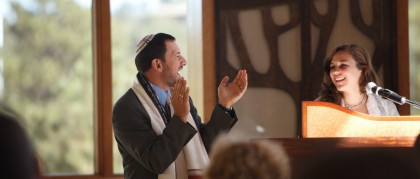
“Look at the candles. Choose one. Focus on receiving the light from the candle. Let your thoughts go. When they intrude, come back to the light of the candle.” Sounds like a meditation seminar. It wasn’t though. The speaker was Rabbi Jamie Arnold at Beth Evergreen last night. This was during last night’s shabbat service.
Had I not attended the kabbalah session on Tuesday I would have missed a key point. Kabbalah originally meant receive. It now has the connotation of tradition, teachings received by students over the centuries from kabbalistic sages.
Too, another key idea of kabbalah is that of a broken world. Shards of light, of divinity, of the sacred scattered from the vessel chosen by God to be the other in a newly created universe. That vessel could not contain the light and shattered into the matter that forms our world. This means that each part of our cosmos contains that light, a spark we can access in our Self, our soul, which is pure awareness. As pure awareness, we can attend to the light of the world.
As masked souls-our always state, we have to learn how to see the light. The service at Beth Evergreen offered mediation styles for that purpose. The second focused on following our breath and punctuating it while visualizing the Hebrew letters forming the tetragrammaton, one of the names of God. This was difficult for me since the shape of the Hebrew letters are distant memories. My Hebrew class was in 1974. Still, the breathing and its pauses on the inhale and exhale was meditative in itself.
I’m staying open to learning from this ancient faith, a tribal religion sustained by its traditions and the difficult history of its people.
Dream last night. Once again in Oklahoma or its inner equivalent, a home place for the Ellises. This time Dad was there, having moved to a house in a city (Oklahoma City?). It was an old house, but well-maintained, with lots of wood detailing, cool even in the summer. It had older, abandoned houses around it though they were undergoing renovation. Dad was cool to me, tolerated me being there, but not much else.
He wanted to move, abandon this house, which I thought was wonderful and would increase greatly in value once the housing around was updated. I expressed my feelings, but he was determined to move.
I cleaned up the downstairs of the house, hoping he would stay.
Before finding Dad in this house, I had discovered a vast underground series of rooms, all devoted to the Ellis clan in Oklahoma. There were lots of people in them, moving around, conducting business (ranching type business), hanging out. I felt uncomfortable down there, though I was also impressed with the size and scope of these various rooms. My discomfort was minimal, but there. I wandered among the rooms for a long time.
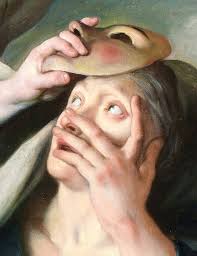
Franz Messerschmidt, sculpltor, (photo) Sailko, CC BY-SA 3.0,
Masks. The sample session about kabbalah has had me focused on masks I wear. Here are a few: grieving son, angry son, abandoned son, skeptic, philosophical analyst, anxious son, anxious man, friend (I think each friendship might prompt a different mask), loving husband, anxious husband, devoted and loyal husband, protective husband, father, proud father, step-father, grandfather, cousin, brother (again, a different mask for Mary and Mark), dog lover, grieving dog lover, gardener, beekeeper, greenman, mountain man, 60’s radical, weary 60’s radical, writer, anxious writer, fearful writer, reader, blogger, Celt, German, Minnesotan, Hoosier, Coloradan, member of Beth Evergreen, anxious member of Beth Evergreen, hiker, traveler, traveler for fun, traveler for self-knowledge, meditator, translator, Latin student, mussar student, fellow traveler of Judaism, driver, angry driver, meditative driver, commuter man, docent, art lover, art critic, poet, exerciser, reluctant exerciser, healthy man, dying man, sick man, indulgent man, poor eater man, healthy eater man, home maintenance scanning man, home maintenance securer, worker supervisor (home maintenance), father-in-law, theater and movie goer, chamber music lover, jazz lover, politically dutiful man. Well, it’s a start.
The idea here is to know your own masks without judgment, then order them from core masks to peripheral. What masks can you not take off without removing some skin? Those are core (actually near core) and the most resistant to change. The core itself, the I am, is pure awareness and has no mask. I have an issue here with the kabbalah, not sure how a soul, a self, the core of me, can put on a mask. The donning of a mask seems contradictory to pure awareness, how would the motivation to mask up occur? How could it be actuated? This is important to my philosophical analyst mask though, as Jamie pointed out, the practical application of these ideas doesn’t require an answer.
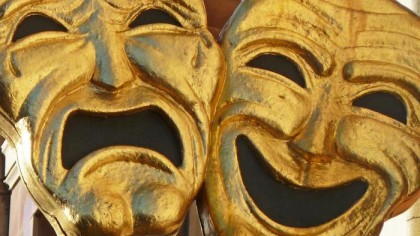
The ultimate goal is to be able to take off and don masks appropriate to each moment. To do this, of course, we have to be self-aware, we have to know what mask we have on. This will take practice.
Kabbalah. Last night at Beth Evergreen we dipped our toes in an ancient lake, one so esoteric that information about it was not written down until the time of the Spanish Inquisition. The kabbalah, it was felt, needed nuanced interpretation and written down it could be read by those who might misunderstand its teachings.
But during the Inquisition so many scholars were killed that many were concerned the teachings might be lost, so books began to be written. The Zohar is the famous Kabbalah text, a central work on Jewish mysticism.
Isaac Luria, a rabbi of 16th century Safed, a town in Galilee, at that time in Syria, is a key figure in contemporary Kabbalah.
Years ago Kate wanted me to go to Hawai’i with her for a continuing medical education event. I said, no thanks. She insisted. I went. My expectations were completely wrong. I had a cheesy hula dancer dashboard ornament, loud shirt, noisy American tourist understanding of Hawai’i. We went to Maui and the Big Island that year. I wanted to stay.
My sense of kabbalah comes from a teeny understanding of it as mysticism and the fact that Madonna got into it some time back. Its popularity among celebrities at that point made me avoid it then and colored my anticipation of what Jamie would have to offer. Last night I wanted to stay.
In kabbalah parlance in both instances I donned a mask of cultured (actually ignorant in these cases) sophistication. This mask has its advantages as it helps me avoid wasting time on matters I don’t consider important. But the instance of Hawai’i and kabbalah teaches me that this mask also excludes rich experiences if I know too little about them.
A key point of kabbalah is awareness of the masks (personas) we use and being able, eventually, to take them off and put them on when appropriate. Sounds like a long ride.
Teeth cleaning a.m. Kate and I now schedule teeth cleaning and annual physicals together. I call it medical entertainment. Just like going to the Tallgrass Spa together. Almost.
Mussar afternoon. Soul cleaning together, too. I’m learning a lot about Judaism with her. And, I’m impressed with what I’m learning. Here’s the key new insight: Judaism has, from a long time ago, insisted that abstract ideas like mercy, compassion, judgment, faith have embodied reality. That’s what all those laws are about, how to make the faith work in daily life.
This is very different from the Christianity in which I was trained. Christianity unhitched this very earthy, practical religion from the notion of embodied abstractions, letting the abstractions become dominant. This led to a growing gap between dogma and actual practice. Of course, many Christians work at making their faith inform their lives, but the tools are not as good the ones in Judaism. It’s not the laws themselves, but the spirit of actively grappling, every day, every moment with what it means to show mercy, to judge, to practice loving kindness, to exhibit patience that gives Judaism its lived flavor.
Rabbie Jamie and congregant
Still don’t want to be a Jew, no interest in converting, but I have a lot of interest in learning how to live from the community of Beth Evergreen. Probably the best religious experience of my life.
While writing the pendulum piece yesterday, I began to consider my inner life in a way I hadn’t before. It occurred to me, probably obvious to you, but not to me, that the inner world is timeless. It’s not part of the body (I’m not sure what I mean by this.) and does not participate in the changes of aging. That world, one we each carry within us (or about us, or as us), is quiet relative to the constantly moving, pulsing, buzzing blooming nature of reality beyond it. (Thanks to William James.)
chalice well, Glastonbury
Perhaps this is what the New Testament means when Jesus says, “The kingdom of God is within you.” Not only is the within timeless, it’s also boundaryless, extending into an infinite realm, not all known, at most partially. That’s not to say it’s static, not at all, just ask your dream life.
This is exciting to me, considering the world within. The weird part, the somewhat new part for me, lies in the metaphysics of the within. As I consider it, feel its reality, my inner world seems separate from the physical realm altogether. I know, in terms of contemporary neuroscience, that this could be challenged; but, in spite of that, this private place seems untethered from both the outer realm and my body and, oddly, my mind.
The mind, in my use of it here, is a tool, a way of managing the interface between my body and my current concerns in the world. It does have a Janus faced quality in that it can look out to the world as the dasein of Heidegger suggests; but, it can also look inward, into my inner world. Using the mind as a point of reference, it becomes a mediator between inside and outside, but, in a manner similar to the inner world, a part of neither.
So, when I say the inner world is not part of my mind, I say that because the mind is the tool I use to know that world, as it is the tool I use to know and interact with the outer world.
Therefore, we can ask, what is the ontological character of the inner world? Does it have being in the way of, say, a rock, a tree, a dog, another person? I don’t know the answer to this question. It is, in the sense of isness, real since it can be perceived as Bishop Berkeley put it, but its isness seems different qualitatively from my body or the world in which it moves and lives and has its being.
This inner world is the homeworld of the imagination, of the interplay between ideas and intuition. It is the realm of memory and the alteration of memory, of the creation of memory. It is the place of fairy tales, of myth, of legend, of gods and goddesses. It can be explored with some difficulty. It often manifests after it has done its own work, throwing up a new way of seeing. In fact, my understanding of it as timeless and spatially infinite is just such a new of way of seeing for me.
Canto 3
I’m not saying this well. What is amazing to me, what is pushing me to explore this idea is the vastness of the inner world and its unique nature for each human being. Maybe for each dog and cat, wombat and shark for all we know. In other words in a room full of people we see them in this familiar world as distinct entities, yes, but still in this world. Yet, each person is a holy well that, like the holy wells of Ireland and Wales, provides entrance to another world, a world sui generis.
So, in fact, that room full of people is not only what it appears to be, but is also a collection of unique worlds, worlds unseen by any eye but each person’s inner eye.
I confess the pendulum powering my inner life has begun to move in eccentric ways since the emergence of the Trump. It swings in its plane, as it always has, tick tocking its energy into the engine of my inner world. Yet the rotating sphere of my inner life, which processes around the poles of birth and death, as the earth rotates around its north and south poles, normally keeping me from stasis in a place where time and space have no purchase, seems to have altered.
This is, for me, a dramatic change and one I have not yet learned to accommodate. The whole circle which the pendulum scribes moves through these points: love, family, nature, writing, reading, travel, dogs, house, mountains, politics, art, science, friends, sleep, body, mind. In its completeness, as its plane touches the ancientrails of my soul/self, I experience those aspects of my inner me that are my unique identity.
Wrinkleberry Lane, North Devon, England
But now, there is some magnetic pull when the plane of the pendulum finds underneath it the ancientrail of politics. The silver ball wobbles slightly, pulled out of its determined arc across the rotation beneath it. It has, so far, always righted itself, the dynamics of its swing returning it to its usual course, but it feels as if the ancientrail of politics has been altered in some dramatic way, as if its path no longer relates to the world in the ways to which I’m accustomed.
In that place, the place of the political, something new has emerged. It is part fear, a new feeling for me relative to the political; it is part anguish, not new, but intensified; it is part disorientation, definitely new; it is part earthquake, the terra firma of the political moving under my feet, all new feeling. The combination of these changes is trying to alter me, to change the rotation which is, really, my life.
bdesham’s mother
In this extended metaphor my life is the rotation of my Self as it processes around the poles. It does not, in other words, move forward or backward, but in a repeating circle which might from the outside look like a spiral moving from Duncan, Oklahoma, where I was born, to that unknown point where, as far as I know, the sphere implodes and the pendulum stills.
Kate’s clear, up and down. Endoscopy and colonoscopy show no problems. That’s a relief. When we came out of Swedish hospital (I know, the Scandinavian touch was right for these two former Minnesotans), the day was one of those gifts Colorado gives frequently bright blue sky, luminous sun, even a bit warm. As in the weather, so in our hearts.
Now, a short rant. Televisions. Every damned where. Waiting rooms, airports, bars, the cafeteria at the hospital. They’re a drug. And, they’re loud, not to mention filled with drivel. Muzak became ubiquitous, too, but noisy colorful images positioned in places where I want peace is an invasion of my inner world and not a welcome one. OK. Rant over. Well, not quite. Plus now most people are looking at their phones while the tv blares. I left the waiting room for a much quieter seat in the hallway. The hallway!
Jon’s grown weary of all the moving, as well he might. Moving stuff carries a physical cost, but even more, it carries a psychological cost. There’s the velveteen rabbit in reverse grief, the burden of baggage, the repetitive actions, but most of it comes from the constant reminder of a huge change. Even when the move is voluntary, the psychological cost is high. When the move has the additional overlay of divorce and animosity, the cost can sometimes exceed our capacity to absorb. That can leave us depleted in heart and body.
Ruth has a phone. She got her dad’s old one when he replaced it. This means I can reach her by text now. She and her friends have a group text that they use a lot sending selfies, pictures of their meals, comments about their day. This is the world of the digital native and it’s different than the one in which I grew up. The communications aspect of it is a cultural transition similar I imagine to the introduction of the telephone in its impact.
But, oddly, instant communication often interferes with the personal, the immediate, as even when they are together, heads and hands are all too often directed towards the phone and away from the flesh and blood presence. Not sure what the implication of this is, but it feels icky to me.
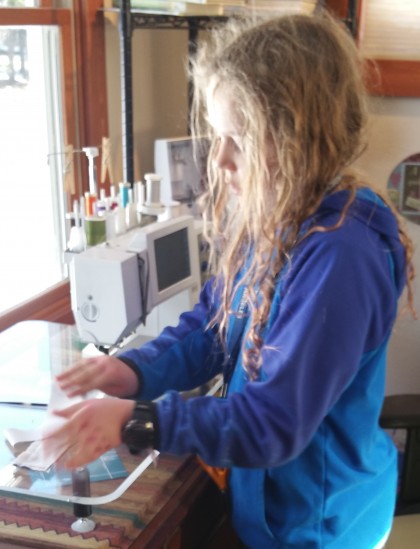
We’re already getting prepared for the Renaissance Fair. We all plan to go in costume. Ruth’s working on her’s. I’m growing my beard and hair so I can be a credible wizard. The Colorado Renaissance Fair is in mid-summer, so it’s a ways away, time for the sewing to get done and my beard to extend.
In the Nix (see post below) the author Nathan Hill takes a side excursion into the difficult, thorny problem of the self. The idea he presents helped me, gave me a middle ground beyond the no-self notions of the Buddha and several contemporary psychologists and philosophers and the Western view of one true self.
The dialectic between no-self and one true self has always found me much closer to the one true self pole. It’s the one that I accept intuitively. In fact, it was the unquestioned truth until mid-college, so unquestioned that any other idea seemed literally absurd.
“Oh, that’s her true self.” We might say this when we see someone angry, apparently peeling back the onion, layers of false selves, to reveal the enduring self located, well, somewhere; or, when some other extreme behavior allows us, or so we think, to peer into the interior of another. This is the radical western reductionist view of the self, perhaps linked to the notion of soul, the essence of a person.
The Buddhist notion, which I don’t pretend to understand well, posits no I, no we, only a consciousness that responds to whatever shows up in the present moment, our self a narrative, a story we tell ourselves, but having no “real” existence.
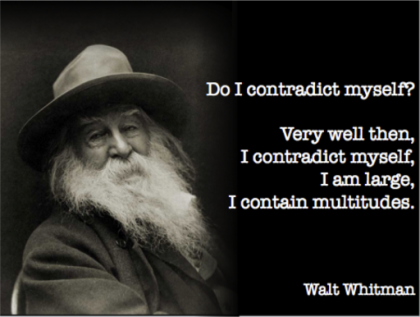
In Hill’s notion there is a third, perhaps a middle way, between these two poles. A character says, oh, her true self has been hidden by false selves. No, Hill’s other character says, not by a false self but by another of her true selves. Ah. Not split personality or multiple personality, not that idea, rather the idea that we each have more than one “true” self.
This makes so much sense to me. The self that writes this blog is the writing me, the self that wants somehow to turn my inside out so others can see in. I have a husband self who acts in relation to Kate and to the history of relationships I’ve had. There is a grandparent self brought into existence by Ruth and Gabe. A Woolly self. A friend self, perhaps as many friend selves as I have friends. There is an art lover self, a physical self focused on the body, a reading self, too, who willingly opens all these selves to influence by another. Each of these true selves, and many others, have their own history, their own agenda. You might call these selves the specific wanderer on each of my several ancientrails.
Given the quote above from Whitman, I’ll call this the Whitman theory of self. It is, for now, the one to which I adhere.
Existentialism is a philosophy for the third phase. No matter what other metaphysical overlays you may have the tick-tocking grows louder as you pass 65. When this clock finally strikes, it will take you out of the day to day. Forever. Strangely, I find this invigorating.
In case you don’t get it the occasional medical bomb will go off to make sure you pay attention. Last year, prostate cancer. This year, that arthritic left knee. Kate goes in for an endoscopy on January 3rd. She’s waiting approval for a biologic drug to help her rheumatoid arthritis. All these are true signs of the pending end times, but they are not the end itself. These medical footnotes to our lives press us to consider that last medical event.
I’ve followed, off and on, the Buddhist suggestion about contemplating your own corpse. I imagine myself in a coffin, or on a table somewhere prior to cremation. This is the work of Yamantaka, the destroyer of death, in Tibetan Buddhism. I’m not a Buddhist, nor do I play one on TV, but I became enamored of Yamantaka while learning about the art of Tibet and Nepal at the Minneapolis Institute of Art.
yamantaka-mandala
This mandala is a profound work of art on view in the South Asia gallery (G212). Adepts of Tibetan Buddhism use this mandala as a meditation aid to make the journey from samsara, the outer ring representing the snares that keep us bound to this world, and the innermost blue and orange rectangle where the meditator meets the god himself. The impact this work and the portrait of Yamantaka that hangs near it have had on me is as intimate and important as works of art can evoke.
Death is more usual, more understandable, more definitive than life. Life is an anomaly, a gathering of stardust into a moving, recreating entity. Death returns us to stardust. Yamantaka encourages us to embrace our death, to view it not as something to fear but as a friend, a punctuation point in what may be a longer journey, perhaps the most ancientrail of all. Whatever death is, aside from the removal of us from the daily pulse, is a mystery. A mystery that has served as muse to artists, musicians, religions and poets.
Yamantaka has helped me accept the vibration between this life and its end. That vibration can be either a strong motivating force for meaningful living (existentialism) or a depressive chord that drains life of its joy. I choose joy, meaningful living. Perhaps you do, too.