
Jazz Noir

Spring                                                                                       Planting Moon

And some rain.  Ta dah!

The Hamm Building in downtown St. Paul anchors a vibrant outdoor cafe scene.  A week ago today the snowplows would have been roaming St. Peter, tonight young couples sat at tables, drank beer, ate, talked.  The energy was good.

The Artist’s Quarter formerly of 26th and Stevens in Minneapolis, formerly of Lowertown St. Paul, is now in the basement of the Hamm Building.  A room light on decor, with lots of black it feels like a jazz joint.

The play tonight, the radio drama, broadcast live over KBEM to what is now its international audience, was a period piece set in 1929 just before and just after the crash, most of the play taking place in a boarding house run by Avon Davis and her Dad.  On Rondo Avenue, now under Highway 94.
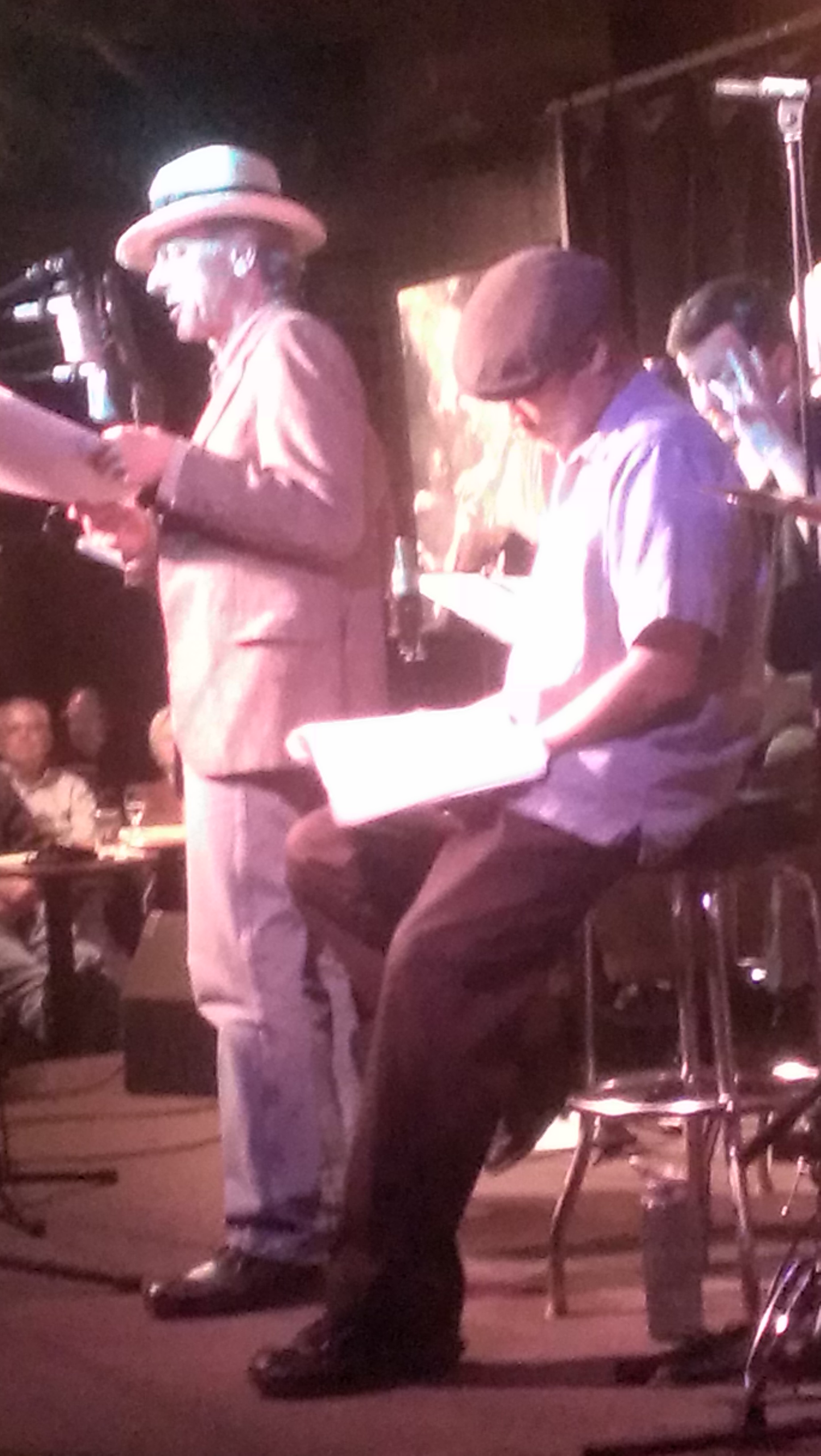
It didn’t shy away from identifying Avon’s grandparents as former slaves or the pride Avon’s father had in owning and operating his own business.

Avon was a budding talent on the jazz piano, encouraged by a novelist and week by week resident of the boarding house who had been working on his novel for 17 years and now needed J. Beam to achieve the mood to write.

It was fun.  The audience had a part.  When the applause sign lit up, we shouted or spoke lines from one of two colored handouts.  “That’s hot.”  “She sure can play that thing.”  “Oh, baby.”

The place had all chairs and tables filled and it felt like the start of something, something uniquely Minnesota, yet going out to the nation and the world.


And Now For Some Rain. Please.

Spring                                                              Planting Moon

Thunder, a quick shower.  Rain tonight, I hope.  Back to wanting the weather to turn seasonal, open the spigots, irrigate the crops.  Our irrigation system is not turned on yet and we have no way to get water to the onion sets, leeks, beets, cucumbers and sugar snap peas we’ve placed in the soil.  They need it.

My mood has begun to rise.  As the back pain recedes (far from gone, but no longer the first thing I think about when I move) and my body returns to a rested state after the stress of the last week, my work begins to come to the fore.  I’ve set aside the Ovid, Missing, exercising, Reimagining for time and space to heal.  It was necessary and good.

Now though those higher level needs, self-actualization, begin to kick back in, assert their right to time and attention.  And I’m glad they do.  Tomorrow I should be back at it, and, in case you hadn’t already noticed this, being back at it is where I like to be.

We’re going to the production and broadcast of a radio drama at the Artist’s Quarter tonight:  Jazz Noir.  I mentioned it earlier in the week.  This is the first of 5. I’ll let you know how it goes.

My Lady Is Compared To A Young Tree

Spring                                                                                  Planting Moon

Vachel Lindsay was born in Springfield, Illinois on November 10, 1879. He was known as the Prairie Troubadour because he integrated music into his poems and performed them theatrically. He died in 1931

My Lady Is Compared to a Young Tree
by Vachel Lindsay

When I see a young tree
In its white beginning,
With white leaves
And white buds
Barely tipped with green,
In the April weather,
In the weeping sunshine–
Then I see my lady,
My democratic queen,
Standing free and equal
With the youngest woodland sapling
Swaying, singing in the wind,
Delicate and white:
Soul so near to blossom,
Fragile, strong as death;
A kiss from far-off Eden,
A flash of Judgment’s trumpet–
April’s breath.

A Conductor Filled With Rain

Spring                                                                             Planting Moon

As I pushed leek plants into the soil this morning, I saw my dream night in a different way. Each spring the dead earth, the decayed plants and animal carcasses join together, strike up a symphony for life that waits only the warmth of the audience hall and a conductor filled with rain.

Then, that terrible moment of late fall or early winter when everything becomes dormant, goes chthonic, or dies, gives witness to its eventual purpose.   A work of music so vital, so alive that it will fuel a whole growing season, bringing movement after movement after movement until the applause dies down in late October.

(Persephone_Opens_Likon_Mystikon–a mystic winnowing fan.)

That icy hand of death in whose grasp I felt my soul earlier can be seen, perhaps ought to be seen, as the hand that turns the compost barrel, keeping the fertile loam of humanity rich and ready for the next season.  A season in which I can rise again, vital and alive, a movement, another movement, in another season.

These times between the seasons have abundant mythological content, gathered in by poet harvesters and folklore gleaners, just so we will not forget what is so obvious.  That death is not an end, not an end no more than birth is a beginning.  They are, rather, rests in the music of the spheres.

The Other Side

Spring                                                              Planting Moon

The rest of the night went well.  I dreamt of Gods and movement among the gods, adventures on strange landscapes.  There was, too, a series of dreams that saw fruit as the clear solution to most problems.  Sounds hokey I know, but it was more a healthful living trumps disease sort of thing.  And last a way to attain enough resources to always be ready.  For anything.

(Edward Robert Hughes, On the Wings of Morning)

As I write this list, I can see that my mind moved from the pit to the heavens, from the thin dressing of soil over the chthonic to life on the plains of this earth, our place, our true heaven, not far away and out there, but here among the fruits and resources and gods we already have.

It’s not, you see, that those first dreams had it wrong.  Death is a trapdoor that opens beneath each one of us, dropping us either out of existence altogether or into the next realm.  And the unknowable aspect of death bares the teeth of an unseen beast, whether friendly or not, we do not know.

It is not death itself that is the source of the fear, though it seems so.  Rather, it is the fear of what death brings in its wake.  And that fear is ours.  Not essential.  And since it is ours we can head into it, face it, embrace it and be lifted up.  If we dare.

Night Terrors

Spring                                                                                  Planting Moon

Night terrors.  Slivers of dreams with metaphors like the trapdoor of life being opened as I fell through it.  Others, not so specific, but the same existential dread.  The mind trying to come to grips with the ungrippable, because it is the moment of letting go, not holding on.

That dread, the one that lurks beneath many, if not all of our fears, reveals us as the special animals we are.  Not only do we know their is an end, we know that it comes for us, waits around the bend of lives, just out of sight.  Until it isn’t.

(Arnold Bocklin, the Tomb)

As the New Testament says, we know not the day nor the hour.  And goes on to urge getting right with God.  Here on the plains of earth where God is still the one who invented death in the Garden, getting right is no surcease of sorrow, brings no balm to the wounded soul.

What can?  I’m inclined to go with the Tibetan Buddhists on this one, Yamatanka shows us the way.  We imagine our death, see it, embrace it, accept it.  Only in this way can the dread become knowing, become a doorway rather than a wall of fear.  How to do this?  A very good question.

One I’ve obviously not answered yet.  I’ve been thinking about visiting the Tibetan monastery here, the one supported by my friend Gyatsho Tshering.  See if I can learn more.

Right now I only know that death reached out its icy hand and squeezed my soul tonight.  And it scared me.