Gong Fu Cha diary: 1st tea

Lughnasa                                                             Harvest Moon

OK.  I have my yixing teapots made from the special clay of that region.  I have seasoned them both in the removing of the wax and boiling them in a pot full of the type of tea they will make.

Finally this afternoon I felt I had the uninterrupted time to begin learning this ancient art.  It was the Chinese monks of Chan Buddhism who introduced cha or tea to visiting Japanese monks in the 12th century.  The tradition in China was old, very old, at that time.  The character for tea, thought to have originated in Burma, was simplified in the 8th century BC.

The Chan monks practiced a Taoist influenced Buddhism that would translate itself in Japan into Zen Buddhism.  They used tea to help them stay awake in all night meditation settings.

Here are the steps according to the guide I’m using right now.   First, fill the teapot with boiling water of the right temperature.  This heats the pot.  Pour this water off.  Then, add the amount of tea appropriate for your teapot.  In my case three large Chinese tea scoops or approximately three Western tablespoons.

Add boiling water to the pot, letting it run over the top until clear.  Then pour off the water immediately.  This is rinsing the leaves.  Tilt the lid on the pot so the heat does not cook the leaves.  Now add water again, again letting it run over the top.  Put the lid back on and count 6 seconds, pouring boiling water over the pot to equalibrate temperatures.

At the end pour the tea into a small pitcher.  Serve.

One of the aspects of gong fu cha that differs from all other tea making methods I know is that you reuse the tea leaves as many as six times.  The process repeats but the steeping times vary from pour to pour, going down for the second and then up slowly through the 5th or sixth.

When I finished this process this afternoon, I couldn’t honestly tell whether all of that was helpful.  I have several different kinds of tea and many tea pots so I’ll try different teas in different pots with different methods.  I’ll eventually hit on a method that makes my palate happy.
 

Prospective Nostalgia

Lughnasa                                                             Harvest Moon

Do you ever have a twinge of regret or a moment of disappointment about all the things you won’t be able to read, to learn?  I do.  And sometimes the ache is terrible.  It can be non-specific.  The library, that is my library, has more threads than I can follow in one life time.  My own library.  What about the UofM library?  The internet?  A good bookstore?

(Amour, Foi, Esperance – Maurice Denis)

It can be specific.  I won’t be learning Mandarin this time through.  I’m not going to get a good feel for geology either, or biochemistry.  Even sociology, beyond a brush in college, is out.  So are most of the world’s literatures and all those paintings and sculptures I just can’t get to see.  It could be, of course, that I wouldn’t want to know the sociology of Poland, but I bet I would.  I’m sure I’d like to understand the working of plate tectonics at a deeper than cursory level, but I won’t.  The same for the chemical exchanges that make life possible.  Nope.

This makes me sad.  Not in a terrible sadness way, not grief, not even really regret, more a prospective nostalgia for something that will not happen.  I can fell it creeping up on me when I look at book, say a history of Japan, and wonder if I’m really going to devote time to reading that.  If I’m honest and say to myself probably not, that’s when the feeling rises.  Oh.  But if only I could give some time in the evening.  Maybe then.  But no.  Not likely, not really.  Oh.

(Psyche’s Kin Bid Her Farewell on a Mountain Top – Maurice Denis)

Most of us have, I imagine, a small collection of sayings that recur to us, sometimes often, that help guide us in making decisions.  One that comes to my mind a lot is this:  Purity of heart is to will one thing.  When I have to prune, to focus my life, to move my attention toward some task that will take a long time, I remember it.  It feels important to me, true.  Right.

Yet.  To will one thing is to rule out all those others.  To leave them on the shelf, to abandon their discovery, the excitement of learning what they may have to teach.  Thus I have this difficult (to me) internal contradiction between wanting, even needing, to focus my energy and desiring broad as well as a deep learning.  This is one of those paradoxes with which I have to make my peace, I suppose, but I don’t find it easy.  It may not be possible.

Herbicides

Lughnasa                                                                     Harvest Moon

I use herbicides sparingly, for problems I can’t eliminate by hand.  Those problems include an invasion of rhizomatous creeping charlie, poison ivy and the stumps of felled trees.  The creeping charlie (no relation) was a mistake on my part.  I didn’t recognize it and advised Kate not to pull it when it could have been controlled.  Somehow it got over a large section of ground.  I sprayed it this morning.

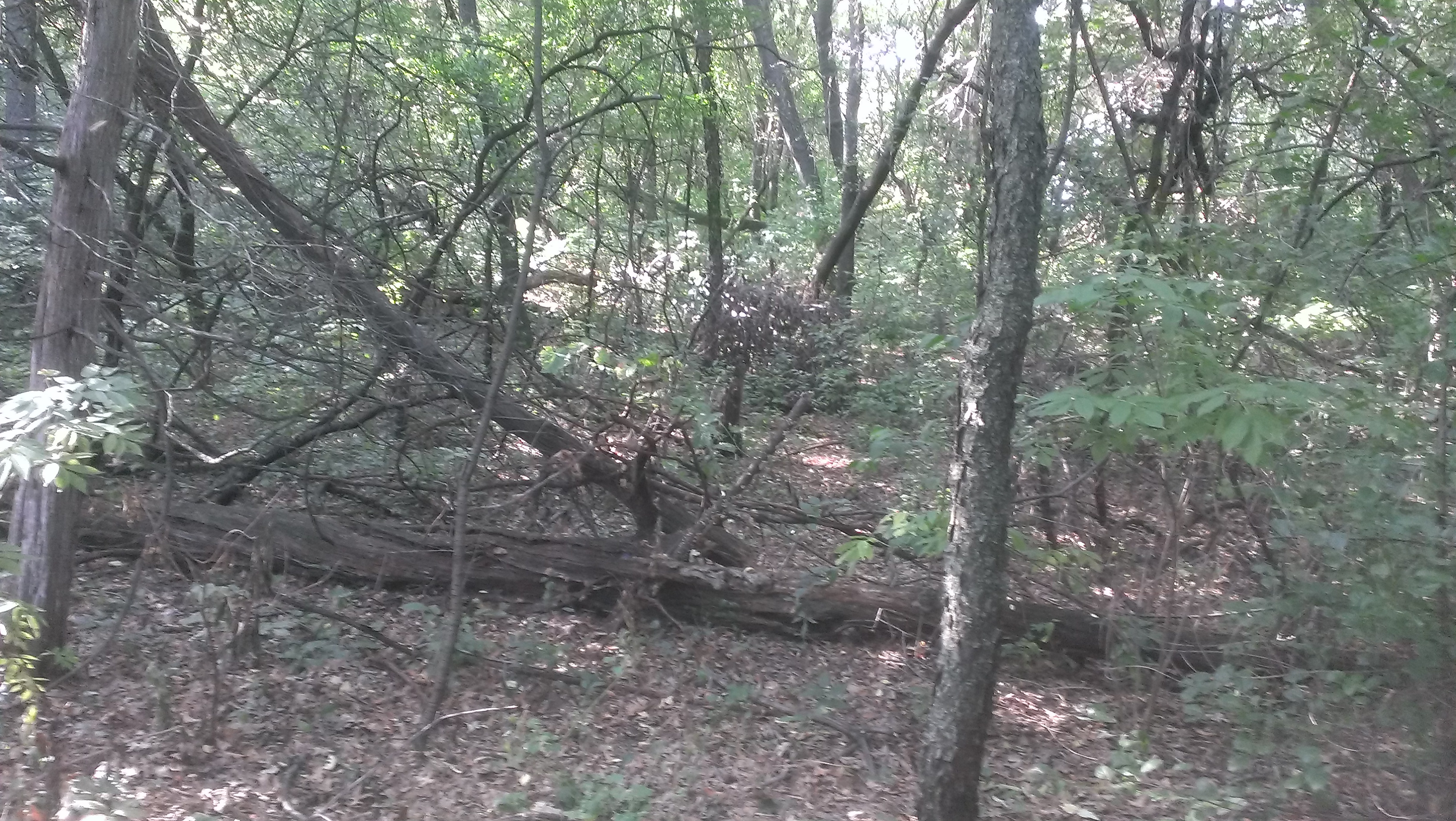
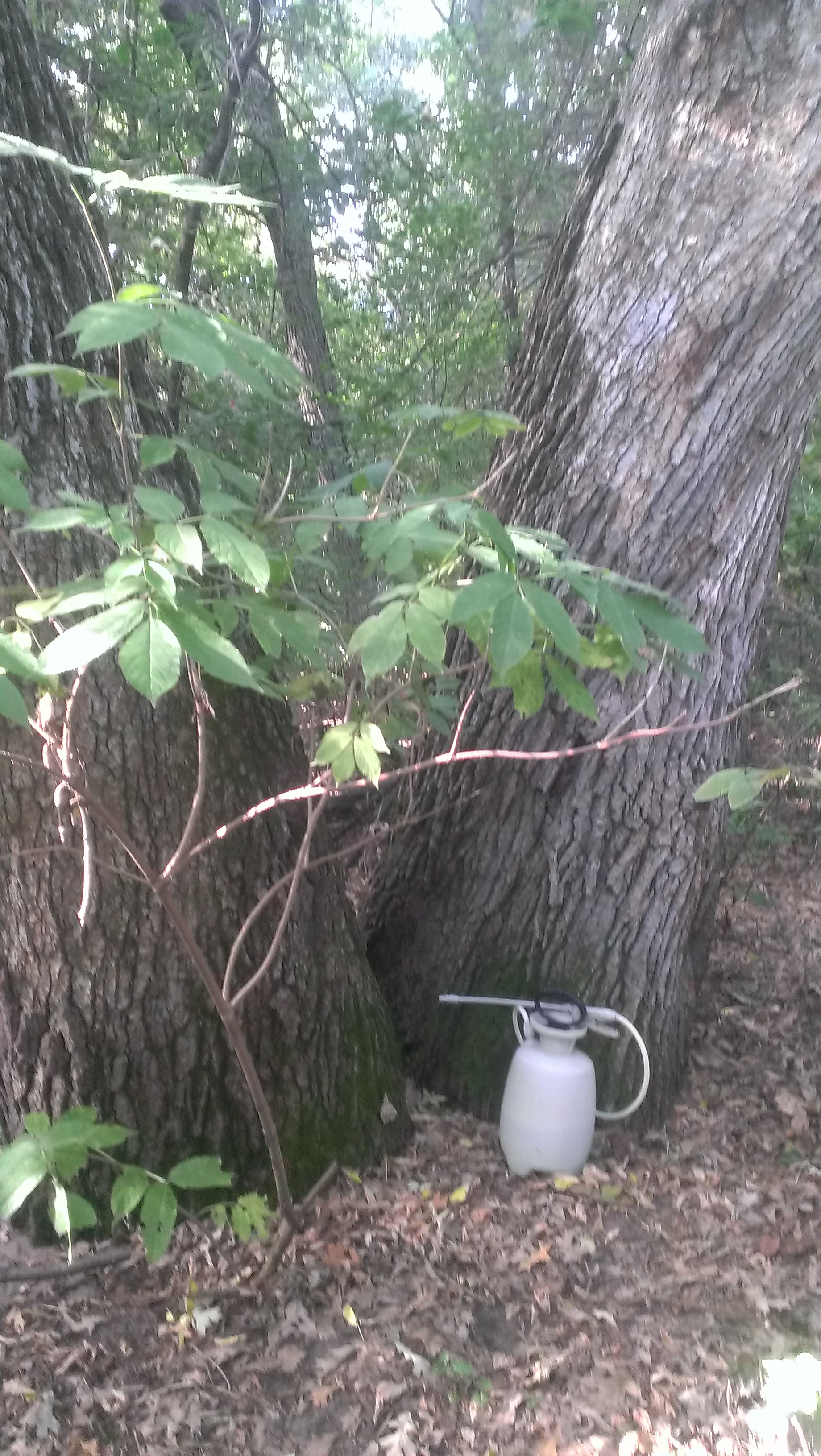
Poison ivy.   My earliest adventures with industrial strength herbicides (triclopyr) began soon after IMAG0944our purchase of this property.   Doing research I discovered Rhus radicans likes the ground around oaks.  We have lots of oaks in our woods.

My first efforts with roundup (glyphosate) had no effect.  Ha, ha.  Like rain water to me.

The first time I used triclopyr, as brush-be-gone, a dilute solution sold for ornery shrubs and could-be-tried as adult weeds, failed, too.  Back to the research.  Ah.  The best time to spray them is in the fall when the plant stores energy in its roots for the coming winter season.

(Gog and Magog)

Today (it’s fall, you may notice) I sprayed the creeping charlie because of this information.  I also went hunting poison ivy. I’ve been after it off and on for 15 years.  This year I had trouble finding any.  A good sign.  The ones I did find I coated leaves and stems.  The word on triclopyr is that it vanishes after three months in the soil.  You don’t want to use it around things you want because it’s effective.

Last I’ll use it on stumps.  The problem with stumps, especially ash and black locust is IMAG0949that the tree immediately sends up new treelets to replace the missing one.  Unless you grind the stumps, which I no longer do, you’ll have a clump of new trees instead of an eliminated old one.  I don’t cut down many trees, but when I do it means I have a specific purpose in mind:  more sun for a growing area, more space for the bees, an area for our fire pit.  New trees are not part of the plan.  Using a paint brush to coat the stumps with triclopyr, a less dilute version than brush-be-gone, solves the problem.

(in our woods near the big oaks, Gog and Magog)

In all cases I use integrated pest management to reduce and/or eliminate the need for pesticides.  I use hand removal, physical barriers like landscape cloth and careful selection of plants to reduce the need for herbicides.  I don’t like using them, but in some cases I’ve not been able to come up with other solutions.