Imbolc Hare Moon
OK. There, I did it. Missing is off to seven agents. I’ll add at least three more before I head out to Arizona. But, it’s on its way into the wide world. Good luck, baby.
Imbolc Hare Moon
OK. There, I did it. Missing is off to seven agents. I’ll add at least three more before I head out to Arizona. But, it’s on its way into the wide world. Good luck, baby.
Imbolc Hare Moon
It’s melting! It’s melting! Yes, like the wicked witch in the land of Oz the snow built up and preserved for so long has begun to melt. It runs down gutter spouts, leaves crusty holes in the various hills of snow around the house. The sun smiles and as it has grown higher in the sky its smile has increased in warmth. The Great Wheel may have been slowed a bit this winter, but it seems to have gotten better purchase.
This does not, though, for those of you far away in warmer lands, release us from the grip of winter. The ground stays frozen as long as there is snow on it and after the snow leaves it takes a while for the soil to warm up.
Outdoor gardening work won’t start for at least another month, maybe a bit longer. Some forestry tasks might get done after I get back from Arizona. The momentum has shifted and the new growing season is struggling to get born.
Imbolc Hare Moon
In that slightly down place that completing a course produces. Yes, it feels great to have stuck with it, finished. And, yes, it feels very good to have the new knowledge. But there’s now a hole where the climate change course was. This is not the same feeling I had when ModPo and the Modern/Post-Modern courses finished. That was more like exhilaration.
This one mattered to me. I’m not sure where or what I’ll do next. There are books to read, several recommended by the professors. There’s the America Votes work and the possibility of using Great Wheel as some kind of vehicle to further mitigation and adaptation in Minnesota. But right now I feel deflated, a bit overwhelmed by the magnitude of the task that lies ahead for all of us. This will pass. But it’s there.
Since I finished earlier than I imagined, I’ll be able to work on my query letters tomorrow. I am also starting a new course focused on personal change that I don’t expect to be as demanding as this course was. I let Whitman slide, did basically nothing and that’s the first one I’ve done that with, but I had overextended myself and something had to give.
Imbolc Hare Moon
A long time ago, during college, while majoring in philosophy and anthropology, I read an article about the maturation points in different academic disciplines. Mathematicians on the very young end of the scale and philosophers at the other, older end. At that time my interest was theory of the social sciences. That is, theoretical anthropology, psychology, sociology. What were the major philosophical questions that each discipline raised by the assumptions and research methodologies it employed.
This turned out to be an unfortunate focus because I got turned down at three graduate schools for fellowships because no money was on the table for people wanting to focus on theory. At the time I was not interested in changing my orientation, so I passed on graduate school. A decision I have regretted off and on ever since.
Ending up in seminary actually allowed me to continue my interest in theory since theology is just that, a philosophical and theoretical approach to the questions raised by religion. I loved it. Of course, there was that vocation on the other end, ministry, but at first I ignored that and enjoyed the work. (and the politics.)
That process funneled me (somewhat by inertia) into getting ordained, working for the church. Even then, though, I still wondered about the systems of the church, how congregations worked, how they grew and declined, how the various denominations grew and declined. My Doctor of Ministry thesis was on the decline of the Presbyterian Church from a post-modern perspective.
Anyhow, after I pulled back from that 20 year immersion in the Christian world, I revisited that earlier question about maturation. When I looked at that material during college, I’d concluded that I would mature late, probably very late since I was interested in theory, a sort of meta-perspective on politics, social science and religion.
And so, now, in my 67th year, I can report that I feel the maturation process beginning to congeal. It’s not yet finished, probably never will be, but I’m beginning to see how my odd path through the world has led me to today and how I might use that path for the good of others. In large part, I’ll do that by continuing to write, continuing to learn Latin, continuing to educate myself, continuing to grow things with Kate and continuing some level of political activity.
(Jacob Wrestling the Angel, Maurice Denis)
I do think you will see more from me over the next few years in the form of ideas and actions. It’s exciting to me to see that possibility ahead.
Imbolc Hare Moon
50 degrees yesterday. Dripping ice created a torrent in our downspouts, as if a hard rain was falling. This is still, I think, a gradual melt, so I’m ok with the temperatures. Not that I can do anything about them anyhow, of course. That rain forecast for today? Not so happy about that. Slow melt good. Fast melt bad.
Waking up to moist air, warm (over against -15) and carrying the scent of the woods and the soil, moves me forward along with the turning of the Great Wheel. My body begins to synch itself with the change, pushing me toward the outside, a part of me unfurling with the sun’s changed angle, the increased warmth.
A lot to do this week before I leave for Tucson, so I’d better get to it. Finish the climate change course. Send off my query letters. Always more Latin. A couple of putzy tech things. Call Enterprise. Get my packing organized. A two week plus trip on the road requires different packing than a weekend flight to Denver.
Imbolc Hare Moon
Sometimes, not often, but sometimes an event matches its purpose. Tonight’s anniversary dinner was such an event. We arrived at the Nicollet Island Inn at 6 pm, the same place 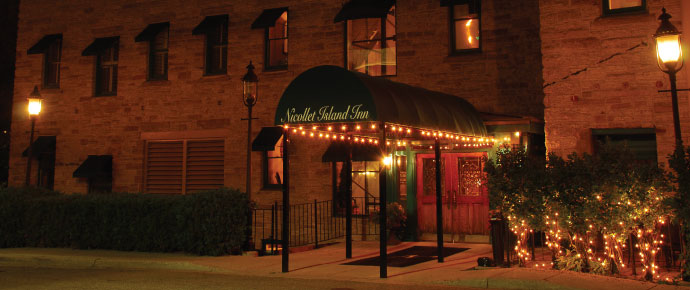 where, 24 years ago, we spent the night before boarding a PanAm (yes, PanAm, can you imagine?) flight for Rome.
The host knew it was our anniversary, took us to our table after complimenting us on our glasses and our colorful garments and pointed to the bouquet on the table. “You are loved,” he said to Kate. “24 years and still in love?” Yes, we nodded. “Wonderful. Have a great evening.” We did.
We thanked our taste in classical music, our seats at the St. Paul Chamber Orchestra for 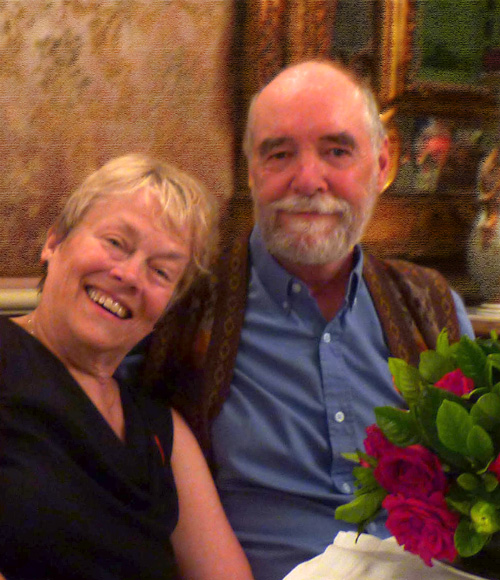 bringing us together. We looked at the things that could have gone badly like Kate earning a lot and me earning much less, then nothing. I said, “I think the thing we’ve done, all along, is nurture the best in each other. I don’t see how you can ask for more in a relationship.” Kate agreed. Somehow we have seen the highest and best in each other, staying out of each other’s way in some instances, stepping in with a helping hand at others.
(in Pizarro’s dining room, Lima, Peru)
Kate ordered the scallops; I went for the tenderloin. We both ate less than half, saving some for tomorrow. I set aside my low carb focus to have a chocolate tart for dessert. We finished smiling. Kate slid over and put her arm through mine.
Added to the bill were two Nicollet Island Inn mugs, memories of the evening of our 24th.
Next year in Hawai’i!

Imbolc Hare Moon
Nicollet Island Inn tonight for our 24th anniversary dinner.
Marriage is an interesting institution and not an obvious one. There is certainly no need  for marriage as a means of assuring reproduction. There is ample evidence that monogamy grinds against some people all of the time and most people some of the time. The notion of finding someone in your twenties with whom you will be compatible in your sixties is almost laughably difficult. Of course, that problem can be solved. First, a divorce. Second, capitulation. Third, growing along with each other.
I’ve done the first, would find the second constitutionally impossible and now, thankfully, have ample evidence that the third is an option, too. Even marrying in our forties, as Kate and I did, doesn’t necessarily augur well for life together in old age. Why not? Well, forty somethings getting married are still in their working years, burdened and shaped by the demands of occupation and vocation.
After the work life recedes, there’s no guarantee that the two will still want to see each other across the breakfast and lunch and dinner table.
Kate and I have made this transition over the last couple of years, integrating our lives in a 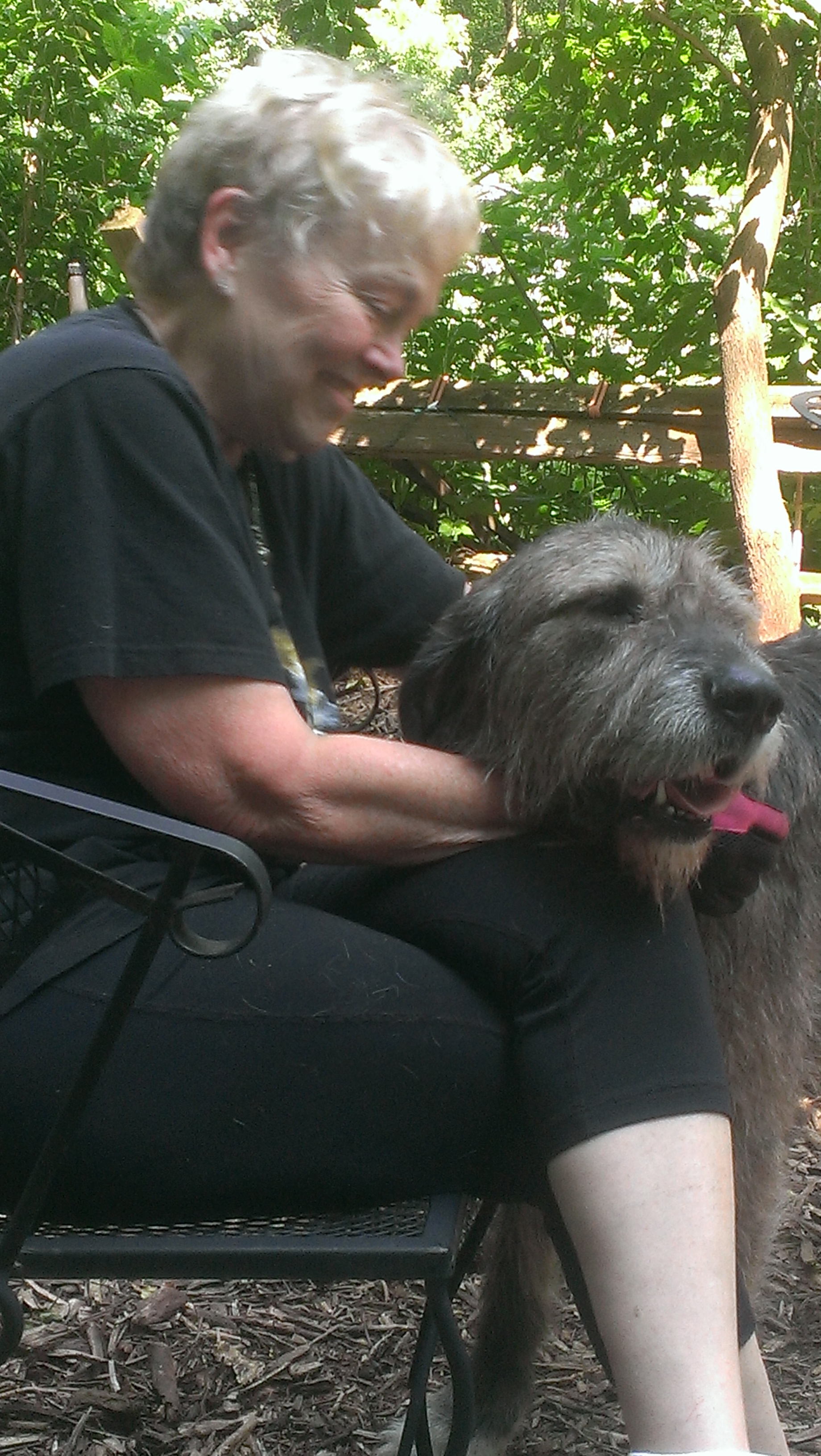 more closely choreographed dance. Now, when I work here in my study, her sewing machine whirs above me, her feet move across the floor from table to ironing board as she works on her current project. When we look at travel opportunities, we can be much more flexible in our decisions. As the growing season unfolds, so will another year of mutual garden work, growing food, caring for the bees.
We didn’t know we’d be good at this when we got married. It wasn’t on our minds. But that third option, the growing together one? It’s marked every step along the pilgrimage of our life together, a pilgrimage far from finished.
Imbolc Hare Moon
Realized the other day that I’m going to be driving to Arizona in late March. At 67 that makes me a cliche, the stereotypical white-haired escapee from the frozen lands of the north. I worked for a while at Unity-Unitarian Church in St. Paul. Roy Phillips, senior minister there for 23 years, always referred to Minnesota as the frozen tundra. His last church was in Tucson.
(Sun City Florida ad image)
In 1960 developer Del Webb opened the first homes in what would become Sun City. Sun City soon became a byword for retirement Valhalla, a place where the worthy dead-to-the-work-world could gather and each day play 18 holes. After golf they could climb in the cart and drive home to a feast celebrating having crossed work’s finish line.
Sun City was nothing more than a name and a cultural symbol to me when I married Kate. Her parents, though, had retired there, so I had more than one opportunity to see it from the resident’s perspective. The first time we visited the flat, uniform plats stood out, small single level homes interspersed with golf courses, tennis courts and services like churches, funeral homes and a recreational center. The colors were muted, desert pastels and the streets eerily quiet. The ubiquitous golf carts with their electric motors made little noise and there were few of those in sight. (Sun City Florida ad image)
The longer I was around Sun City the more aberrant it seemed to me. With a minimum age of 55 there were no children. No young families. No teenagers. This was seen as a blessing by many, maybe most who lived there, but it did something odd to the character of the place.
It meant your friends and neighbors were all old. Dinner table conversation often turned to deaths and illness, frailty. There was no future there. Only death. After that, the desert. Sun City felt hermetically sealed off from the ongoing world, a sort of vestibule for the life hereafter; when it was meant to be, I think, the life hereafter work.
A rarely mentioned but frequently experienced dilemma occasioned by this flight to Arizona was absent family. In this case it wasn’t the kids who had moved away from home, following work or a spouse, but the parents. At first, I imagine, it was exhilarating, all the time with no kids, no grandkids. No birthdays and holidays, no Thanksgiving. Free at last.
But when the inevitable decline set in, then the anguished calls would go out. And they went out to children in Minneapolis, in Boston, in New York. Sons and daughters had to do long distance elder care while Mom and Dad suffered and sometimes died alone.
Whether those more carefree years of early retirement balanced out the difficulties of the latter years differs from person to person, of course. But I know in the case of Kate’s parents, both of them, their final illnesses were difficult on all parties, a difficulty not only exacerbated by distance, but also created by it.
These early emigres to Sun City were experimenters, pioneers of the new model for healthy life after the end of work. But the lessons that could have been learned, I’m afraid were not.
Just visit the Del Webb site for proof that this kind of elder dispersal continues to this day.
Communities need their older citizens, for memory, for continuity, for child rearing, for role modeling, for what has been learned. Age graded communities deprive both the old and the young of necessary interaction. Life with children is life with a future; life without them is a sterile desert. Likewise for children life without older neighbors and grandparents is life without a living link to the past.
I feel this keenly because Kate and I are here in Minnesota with our children and grandchildren far away. To magnify that our nuclear and extended families are also far away. This is not a complaint, we’ve made our choices and they have made theirs, but the net effect is for us to be in our mini-Sun City, an aging exurban development with no children. Strange when I look at it that way, but it’s true.
Imbolc Hare Moon
The Great Wheel has been nudged forward, beginning to turn toward spring: the light in the sky today and the moisture in the air, the sudden grittiness of the once pristine snow. The temperature, even now is 36 degrees. Above freezing.
The seed orders, filled out a couple of weeks ago, went into Harris Seeds and the Seed Savers Exchange. Plant orders too. The garden map for 2014 came out and I figured the square footage for certain kinds of vegetables. This information went out to Luke Lemmers of HighBrix Gardens. He’ll send me nitrogen specific to the various beds.
Each one of these steps is gardening. Gardening is not only hoe and rake, seeds and soil. It’s planning and knowing, sourcing. This is the gardening work that can be done while the snow is still on the ground.
We did start our own seeds for a few years with a hydroponic set up, but the space it requires and the fussy of it didn’t appeal to me. So now we buy transplants. A bit more expensive, but much less hassle.
An important next step comes when the soil becomes workable and we can put in those hardy vegetables that like the cold. Then, after May 15th or so, the usual last frost date for Andover, we’ll plant the tomatoes and peppers and egg plants and kale and chard and collard greens. After that, it’s caring for the plants as they grow.
Look for our Beltane bonfire, May 1st, the official opening of the growing season.
Imbolc Hare Moon
25 years ago I left the workaday world for home based efforts, but the weekend still has a different, more relaxed feeling. As if things just aren’t quite as urgent. This is thanks to the union movements press for the 40 week combined with early Protestant and Catholic Christianity that tried to reserve Sunday for church.
In a more secular time Sunday has become, for many, a true day of rest with Saturday providing time for the domestic tasks not accomplished during the week.
The notion of a day of rest, a time to pause and consider the week behind and the one ahead, can seem like a luxury, perhaps even irresponsible. The cell phone, e-mail, broadband, and television are available around the clock. In hypercompetitive work settings there is the awful sense that someone might be catching up or that you’ve not done enough. Why not fill up this blank day with that extra effort, the push that might get you ahead.
In music there are rests, the caesura that lets a particular line or run of notes breathe, giving them definition. In winter whole species of animals hibernate and thousands of individuals are doing so right now on this property where I write. Holidays, spread throughout the year, are caesura, as are our vacations, our anniversaries and birthdays. In art, especially sculpture, we learn that negative space defines a work. Without negative space that David would still be a block of granite.
Taoism, perhaps the clearest on this idea, points out that the usefulness of a cup is not its body, but the negative space it contains. Windows. Doors. Rooms. Baskets. Silence.
The effort in our lives is like the cup, the window, the door, it is the body which contains the life, it is not the life itself. Life itself is realized in the negative spaces among our focused efforts. That’s where the laugh comes, or the gentle touch, or the smile, the encouraging word, the hug, the tear.
In my view it behooves us to grant ourselves as much negative space as we can and a day a week does not seem like too much. It is probably too little.