A wet, cool Sunday here on Shadow Mountain, the aspens dropping their yellow leaves, creating golden splashes on roads and driveways. Rain is the best fire mitigator and it comes welcome.
48 degrees and snow forecast for Wednesday, snow showers only, but hey, snow!
We went over to Evergreen for our business meeting. When we got back, the garage was calling to me. Moved things here and there, organizing, creating space for bookshelves removed from up here. They’ll hold my journals. Some of the ikea shelving from the old office will hold bankers boxes that don’t stay up in the loft. Another two hours or so of work down there.
This afternoon we bought new cabinets for the kitchen and picked out a quartz countertop, finished up design elements. Main goal, increase storage and create better lighting, update the appliances. We bought scratch and dent appliances, saving literally thousands of dollars, accepting a few dings in return for smaller cash outlay.
Our remodeler is here right now, making final, precise measurements.
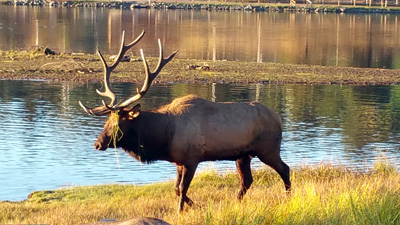
When I went into Evergreen yesterday, just after turning off Brook Forest Drive I went past a house that had a bull elk and his harem resting in their front yard, maybe 15 does. A stream runs between the highway and this house. The trees gave shade from the brutal morning sun. A domestic scene with wild animals. It came to my attention when a large bulk moving caught my peripheral vision. That’s the paleolithic helping in the here and now.
It amuses me, when I go to Evergreen, to see the number of people who gather at the lake. All these wonderful mountains and the locals come to look at the water. I imagine only a former native of a water rich state would notice the irony.
Vertical and flat. Humid and arid. Those are the big differences between our new home and our old one. Here I drive through canyons, over high passes, around stands of rock with the view often limited to a few hundred feet on either side, sometimes less than that. When we leave Conifer and go into Denver though, we immediately return to the far horizons common to the midwest. We frequently transit between the great plains and the mountain west, living as we do in the borderlands between the two.
Though we have had a wet summer and somewhat wet fall, when the rains cease, things dry out fast. We can go from low fire danger to high in a day. That’s why fire mitigation is constantly on my mind.
Black Mountain
When verticality and aridity intersect, as they do at 8,800 feet and above, a genuinely unfamiliar biosphere is the result. Unfamiliar to those from the rainy flatlands of middle America, that is. On Shadow Mountain we have two trees: lodgepole and aspen. Along streams there are more species of tree and shrub and there are microclimates that might support greater diversity, but on the bulk of the land that can grow anything, lodgepole and aspen. There are grasses, flowers, a few shrubs as understory, but just as often the rocky ground is bare. The mountains have strict limitations for plants.
The plant limits determine the fauna, too. Grass eaters like mule deer and elk do well, as do predators who eat them. There are small mammals that are prey for foxes and coyotes, but there are surprisingly few insects. That limits the birds. We have raven, crow, Canada and blue jays, the occasional robin, birds of prey that feed off food similar to that preferred by foxes and coyotes and other game birds. There are, as well, black bears. We’ve seen all of these save the bear.
Still learning about the mountains. Will not stop.
Took my new Andy Warhol print over to Evergreen this morning for framing. Smilodon fatalis and Andy are celebrations of this loft space as it moves toward a finished look.
Smilodon fatalis by Bone Clones
Stopped by Mountain Hearth and Patio to look at Primo barbecue and smoker units. Too expensive, Kate says. She’s probably right. We’ve got that solar contract and a kitchen remodel coming up.
But. We are gonna buy a quarter or a half of beef from Carmichael Cattle Company. Seems like a really great smoker/barbecuer would be just right. Ryan Carmichael has cattle off Shadow Mountain Drive, a few Herefords and one Angus. He says he has mountain lion and elk issues here, unlike his home in northwestern Missouri. The cattle make this former midwesterner glad.
New homes churn the economy, occasioning purchases of this and that. Spurs growth. All this civic duty.
Not commendable, but true. I’m finding the pink ribbons, glowing reports of breast cancer survivors and the breathless joy of pink clad marathoners and professional athletes annoying. No, I don’t begrudge a single woman their successful treatment. Far from it. I’m glad.
It’s just that my own crew, prostate cancer survivors, have their cancer, get treatment, then get back to their lives. I don’t see blue ribbons (the color for prostate cancer. which makes some gender stereotypical sense) on cars, athlete’s sneakers, bedecking runners in the prostate cancer marathon. No smiling men surrounded by their buddies cheering them on.
This year the National Cancer Institute estimates there will be 231,480 new cases of breast cancer diagnosed, 14% of all new cancer cases. Over the same period it estimates 220,800 new cases of prostate cancer, 13.3% of all new cancer cases. Breast cancer will cause the death of 40,290 women and a small number of men, 6.8% of all cancer deaths. Prostate cancer will account for 27,450 deaths, 4.7% of all cancer deaths.
The numbers, then, are very similar though breast cancer does occur somewhat more often and causes more deaths.
Still, when I saw a woman celebrating her survival of stage 1 breast cancer being feted like a celebrity, a slow wave of rancor pulsed through me. I had stage 2. This is childish, I understand that. My cancer was worse than yours and you get all the fun. Geez.
A woman I know, when I confessed this emerging feeling, said, “Well, breasts are visible, more important to a woman’s sexual identity.” More important than sperm to a man’s? I thought this, but didn’t counter. The childishness part repressed there, thank god.
Would I want to have my face with a victorious I put prostate cancer in its place expression made available to public news services? Probably not. But I’m sure there are men who would be delighted.
Not quite sure what I want from this conversation, but I needed to put it out there.
What a pragmatic, busy day. Generator installed! Yes. High fives all round. Vega groomed. She did not like having her nails cut. No big news there. Seeing the truck made her very happy. Groceries bought. Two more trees cut down. Still using the axe. Gonna get the chainsaw fueled and oiled tomorrow. I may use it. I may not.
Out late last night so we’re both knackered, to use the technical term. Oh, I forgot. The roof guys came out, too. Found a gap in the flashing around the loft’s first skylight and will repair it early next week. No more buckets under its corners.
We’re moving toward having as much work as possible done before winter, our first full winter here. That list includes a remodeled kitchen, a completed loft with walnut shelf tops installed, wire shelving up for bankers boxes, garage organized.
I will not complete the fire mitigation before winter, rather I plan on cutting down trees right through the season until I’m done.
The 50th high school reunion. Friend Tom Crane sent me an article by a historian who graduated from Hopkins High School in 1964. Tom’s sister was in that class and he was in the class of 1966 which has its 50th next year.
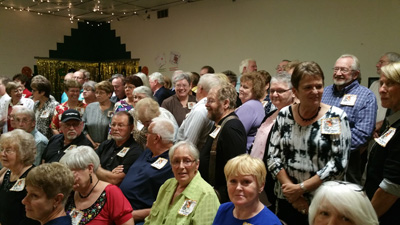
John H. Johnson, a U.S. historian who teaches a class every year at Northern Iowa University on recent American history, saw several themes of the recent past reflected in his class. Overwhelmingly white. So was mine, just look at the picture. Located in a well-to-do suburb of Minneapolis. Mine, a small town of 5,000, mostly factory workers, about 60 miles east of Indianapolis.
Like Tom and Johnson’s classes, my class of 1965 had little direct experience with the politics of the early 1960’s with the exception of the strong UAW presence in town. The latter meant that fundamental economic/political issues like fair wages, good benefits and retirement packages got attention.
Alexandria, Indiana’s class of 1965 came before the rise of Betty Friedan and Gloria Steinem feminism and unlike Johnson’s classmates its women did not go on to break glass ceilings. Most married, had children. Some worked, of course. A few, a handful, went on to college and developed careers, but they were the exceptions. Alexandria was a town where many parents had not graduated from high school; or, if they had, the high school diploma was a terminal degree. Also unlike the Hopkins experience.
There was, as Johnson described, a historical rift between male classmates who had served in Vietnam and those who fought against the war, but unlike the Hopkins instance the vast majority of military age men went into the service and most saw active duty in Vietnam. As far as I know, I was the only visible anti-Vietnam war protester in my class. We did not, as Johnson talks about happening at his reunion, discuss the war and its stateside opponents.
There was, though, the exchange of concern among myself and many of my Vietnam Vet classmates over my recent bout with prostate cancer. And, I did say at the reunion that I believed our presence there together showed the futility and stupidity of America’s currently polarized politics. We cared about each other because we knew each other from childhood, our politics did not interfere with that sense of community.
I imagine there’s a good book to be written about early baby boomer’s 50th reunions. They represent the coming together of people who were both together before the 1960’s turned U.S. history on its head and who left high school to become agents of that very change.
I now routinely take Turkey Creek Canyon Road to Deer Creek Canyon Road as a preferred route to medical services, most located in and around Littleton, a southern ‘burb of Denver. That meant I missed the road closure on Highway 470, the half ring road that defines the western boundary of the Denver metro area.
470 follows the Front Range starting at I-70, the main route into and through the Rockies going west. About 10 miles south from that point, on the way toward Colorado Springs, the old mountain range that preceded the Rockies creates an upslope that runs maybe 800 feet at a gentle slope from the highway and ends in a ridge of rock that resembles the jagged back of a stegosaurus, Colorado’s state fossil. Bowles Road intersects 470 there.
A helicopter caught my eye as I turned off Santa Fe onto 470 toward Bowles. A news helicopter?
It had a very long cable dangling beneath it with an orange looking pod suspended at the very bottom. Then, the pod opened and a brief spray of water fell toward the earth. Oh.
Okinawa Sushi, a favorite lunch stop is at the Ken Caryl exit, just one before Bowles and when pulling into the parking lot, I saw people standing, looking skyward toward the highway. More helicopters.
After lunch I saw the reason for all this. It was a grass fire that had run from the highway all the way up to the bony ridge of the first elevation. The ground was black in a 33 acre scar. 470 had only one lane open there with several fire trucks, police and other emergency vehicles parked in the other lane and up closer to the fire.
Another helicopter came chop, chop, chop over the ridge, an orange bucket again dangling below. It maneuvered into place and hung there for a bit, presumably awaiting instructions from the ground. Finally, again it released the water which fell onto a scrubby patch of land outside the burned perimeter. When the water hit, spray and smoke billowed up.
Since we moved here last December, the fire danger has been low with a few exceptions. Lots of rain, an anomaly of a year. This was my first exposure to the reality of wildfire. Good motivation for cutting down all those trees. And a reminder of the true nature of our new home.
It is so beautiful here around 5 a.m. when the sky is clear, which is most mornings. The stars leap out of the sky, reminders of the power they had when the only light pollution was an evening’s campfire. Orion stands high in the south, moving toward Black Mountain. The Big Dipper disappears behind the roof of the garage in the east, but the pointer stars are visible, showing the way to true north. Cassiopeia, that unhappy queen, extends her jagged W, a slash of stars.
Time travel has been with us since the first human looked up in wonder at the stars. What we see unaided and what we can see with telescopes comes to us from the distant, distant past. So distant that the miles come in units of time. Perhaps, in a way, our lives are like the heavens, still shining after long years, even after death, radiating out from our small sector of space-time to the far away future.
So you might go out and look at the stars and consider the bright lights in your life, still strong and beautiful, wonderful. And remember that someday, you too will shine for others. Not gone, not even absent.
Dogs, the dogs who live with us now and the others, so many, are gentle with each other. Usually. Once in awhile, like Monday when I let a peanut butter container become the object of a conflict, the not yet, probably never, domesticated dog emerges, always in a frenzy.
In this case, ironically, I was making dog biscuits from eggs, peanut butter, vegetable oil and flour. One large plastic peanut butter container was empty, so I set it on the floor while I took the red plastic container of flour and began pouring it into the mixer. Working with flour for this one-time baker soothes me, so the high-pitched yelps coming from Kate’s sewing room didn’t register right away.
Gertie
Soon enough, though. When I turned the corner around the refrigerator, I saw Gertie, our German shorthair, pinned to the floor as a determined and angry Kepler shook the folds of skin at her neck. He had her by the throat with the clear intention of ripping it, tearing. His closed jaws swung back and forth as he gripped her tighter and tighter.
A usual method for breaking up dog fights-this was far from our first-is to douse the combatants with cold water. None available. Not quick enough. Gertie appeared to me to be in mortal danger. My pulse began to race. Kate had hold of Kepler’s tail with her right hand, the one that had received the platelet injections only last Friday. Kepler didn’t respond.
When dogs go past a certain point, they are no longer the same creature who nuzzles you, leans against your leg, licks your face. I don’t know what that point is because when it is crossed things become bloody and deadly right away.
With a response I imagine similar to seeing a child in danger I leapt into the fight without thinking. Never intervene in a dog fight. A first rule of living with dogs. When struggling in this way, they don’t discriminate between friend and foe. They just bite.
There is, however, a prior and more primal rule than that first one: don’t let a dog die. I kicked Kepler. Didn’t work. He hung on, looking like a bull dog hanging on the nose of a bull. He would not quit. Gertie’s cry was pitiful and my heart sank with the possibility of her dying.
I’m not even sure now how I got Kepler off of her, but I did. Then Vega took hold. The fight fever can be contagious. I got Vega off of her. Again, I don’t recall how.
A year or so ago, Vega and Rigel had Gertie down and Rigel was the one with teeth on her throat. After I separated them and took Gertie to the vet, I told Roger Barr, the vet, that I thought they were going to kill her. He said they would have. When dogs go past that point, the instinctive warrior animal, the wilderness predator becomes dominate. Then the fight is to the death.