I’m a Lumberjack and I’m OK

Mabon                                                                   Moon of the First Snow

looking east
looking east

Fire mitigation means removing some trees. Putting solar panels on the roof means removing some trees. Turns out removing trees is something I know how to do. So, every day or so until I’m finished, I’m cutting down one tree, limbing it, cutting the trunk into firewood, stacking the firewood and putting the branches out for chipping.

A complication here that I never faced in Andover is that slash is bad. That means I can’t make brush/slash piles for the critters like I did in Minnesota. Each limb removed from the tree has to be moved into a location accessible by a chipper. That’s a lot of extra work. But it’s good work and I’m looking forward to it.

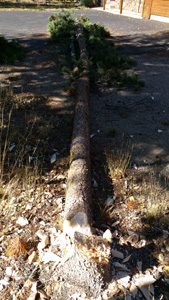
first tree cutGot started yesterday. The first lodgepole I cut down stood directly in the way of backing out of the garage. It doesn’t now. I know, this may seem callous, cutting trees down, but in actuality I’m thinning a garden bed, leaving more room and therefore more nourishment for the trees that remain.

Removing shadows from our solar panels is important, too. Shade has an outsized impact on electrical solar generation due to an unusual characteristic of silicon panels. Just a bit of shade shuts down the entire panel.

Most significant of all is fire mitigation. Lodgepoles are a pioneer species, that is, they come in after a fire, grow up, shade other species, then die back. They tend to grow close together and many get spindly, unhealthy. 30 feet from the house all trees have to have branches cut off to ten feet above the ground. This helps prevent fire from reaching the tree through ladder fuels like shrubs and tall grasses, slash. Within the 30 feet defensible space perimeter, the trees also to have adequate space between clumps to ward off crown fires.

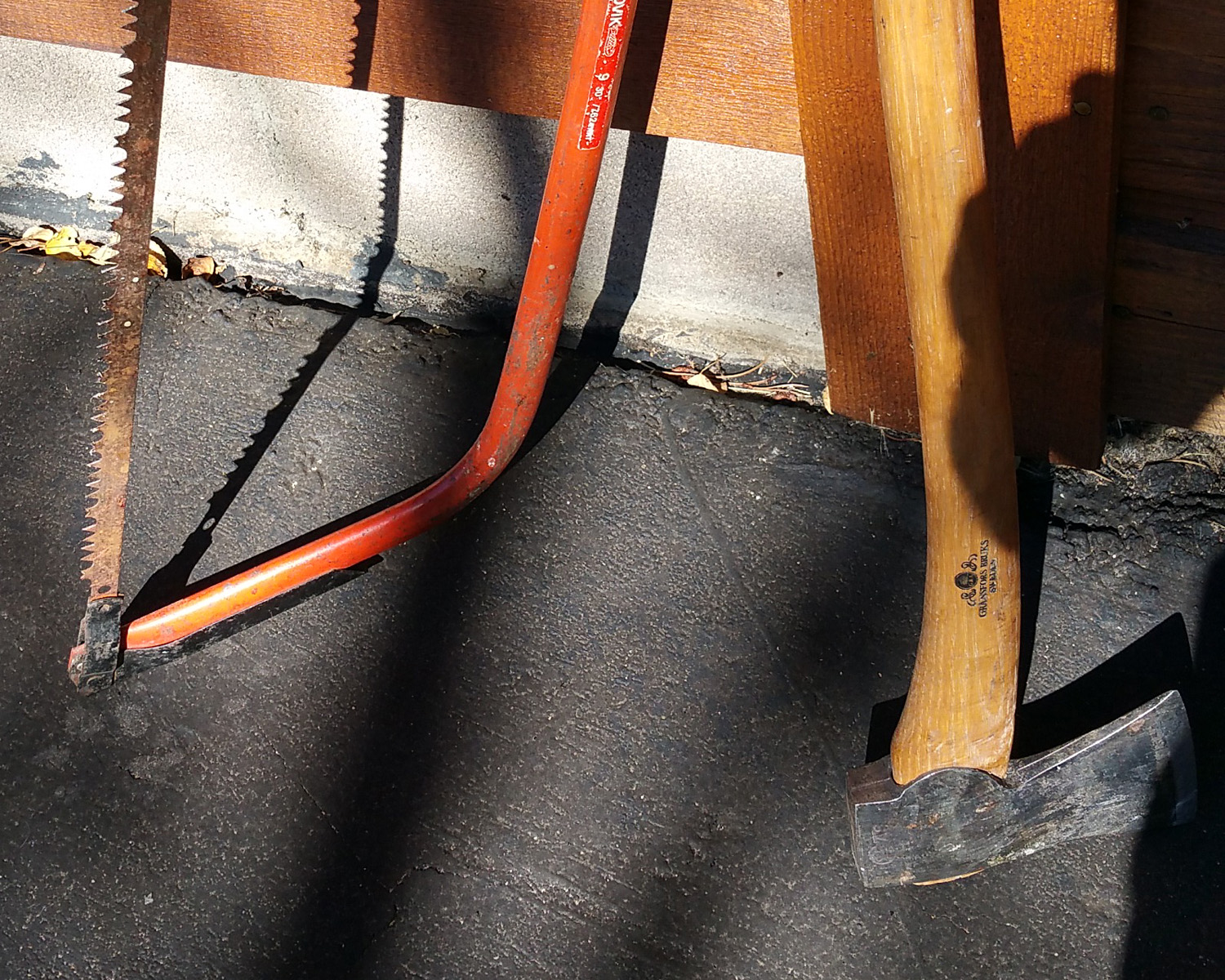
after felling tools
after felling tools. see peavey below.

The Splintered Forest guy taught me that lodgepoles need to be in clumps for their own health so the ten foot between crowns rule applies to small clusters of lodgepoles, not independent trees. Weaker lodgepoles will blow over easily due to their shallow root structure unless they have friends to break the wind.

Late fall, early winter work outside. Good aerobics. Especially when I cut the trees down with an axe like I did yesterday. With a lot of huffing and puffing. I’ll use the axe when I can because I like the handwork aspect, but the chainsaw will allow me to finish the task in a timely manner.

My limbing axe works great. With most of the branches on a lodgepole I can stand on the opposite side of the trunk and flick them off one handed. Standing on the opposite side of the trunk makes it much less likely that the axe will find its way into my leg.

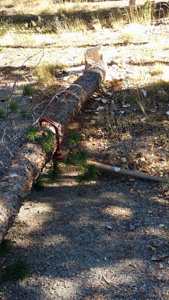
peavey
peavey

On Dying Luminously

Mabon                                                                              New Moon of the First Snow

Friend Tom Crane wrote this morning:  “Third phase (or whatever the hell it is we are in) is stereotyped as winding down, dealing with fewer issues (because they have all been dealt with already) and generally a slowing down.  Now that we are all really fully into whatever this is it seems to me there is a good bit of the opposite of that energy.  We are dealing with really significant stuff (body and health related, for instance) that never came to us when we were younger and more vital.  There is more change per square minute that we have ever seen before in spite of the stability of key relationships and situations.  And yet it is curious that we seem to be demonstrating greater capability than ever before as we navigate all this with the experience and wisdom(?) gained through decades of experimentation with who we are.”

The third phase notion is my attempt to decouple this period of life from the concept of retirement, an idea that this period of life defines itself as not-doing something. Winding down, dealing with fewer issues, slowing down featured prominently in the finish line model of retirement. We were done with the workaday world, no more 9-5. No longer the buzzing, blooming world of business with its implacable demands. Now we could kick back, put our feet up, pop a PBR and watch football without guilt. Or go fishing. Or golfing. Or quilt. Or spend more time with the grandkids.

And, when work finished up followed by four or five years of leisure, then disability or death, that model, retirement, the time of not-working, probably made sense. That is, it described life post-work for the bulk of retirees.

Lengthening lifespans have caused not-working to become inadequate for understanding life after the second phase of family building and career. In fact for some who enter the third phase they may not have given up their career, though family building is likely behind them. Still, even those still active in work often now see work as much less central, much less definitive for their identity.

If you agree to any degree with this: “I believe that the true norm of the third phase is to wander, to become like a planet to your Self, pulled by the gravitational attractions of its values and its directions. Now is the time, if you have not availed yourself of it earlier, to listen to the voices of your own heart, your own dreams, your own ancientrail.”, then, this time, call it the third phase or aging (though I’ve always found this an odd term since by definition we begin aging at birth) or old age, is qualitatively different from what has gone before.

It no longer focuses on getting somewhere, accomplishing something (though we may get somewhere and things may well be accomplished), but on the journey of your uniqueness. In this way we can arrive at the paradox, the apparent contradiction that Tom identifies: “…there is a good bit of the opposite of that energy.  We are dealing with really significant stuff (body and health related, for instance) that never came to us when we were younger and more vital…There is more change per square minute that we have ever seen before in spite of the stability of key relationships and situations.”

Once we have made or not made our family, stumbled on or victoriously walked the path of work/career, then the shift can be made to a time of self-understanding, self-expression. Perhaps the second phase could be characterized as a “we” phase and the third the “I” phase, in this sense the third phase and the first have much in common. In none of the phases do we exist solely in a we mode or solely in an I mode. I refer to a matter of emphasis, one dictated not so much by personal desire or even cultural norms, but by matters of biology.

How so? In the first phase we are young, inexperienced, naive to the world. As we grow and our bodies change, the emphasis is necessarily on personal learning: socialization, athleticism, school curriculum or skill set development. At some point in our twenties, early or late depending on the amount of schooling undertaken, the idea of family begins to take hold for most of us. This reflects a maturation of the body and an acquiescence to the species imperative for propagation. Work and/or career follows from the learning of the first phase and becomes, again for most of us, intricately entwined with family.

We are not eternal though. The body begins a decline, at first gradual, then more pronounced. At some point the children are launched, either into the workforce or into higher education then the workforce, and our own work/career reaches a peak. Sometime after we begin to contemplate a time when neither work nor family building will be central to our lives. Yes, family will still be important, probably, and even work might continue in some fashion, but neither will be at the center of our lives anymore.

What will be at the center? Individuation. The final process of personal development. Does this mean a collapse of the we and an ascendance of the I? Not at all. Your individuation may well carry you more deeply into the world. Or, it may not. It may carry you into the study, the sewing room, the world of rocks and minerals, even the development of a brand new way of human interaction. Wherever it carries you, if you are true to the defining character of the third phase, that it ends in death, you will become more of who you really are. Because, you see, it is, finally, only you that dies.

So, then, the paradox. When we are at our most authentic, are most keen to explore and liberate our gifts, the body is well into its senescence. So, the signals of mortality come fast and often: cancer, arthritis, glaucoma, weakening, imbalance at the same time the Self, the integration of body/mind, is at its most flourishing.

Though it doesn’t have to make sense, since this is a biological process and has its own timing, it does make sense to me that our most fully evolved person can be the one who faces the physical challenges of aging. By now, hopefully, we have learned of our finitude and understand biological deterioration. What a gift it is to see our frailties for what they are, accidents of our biology, and not determinative of our Self, its worth. In this way our best Self confronts the dangers and agonies that would have terrified, perhaps frozen, our younger Selves, and sees in them not the hand of a cruel fate, but the working out of a truth known since birth. We are mortal.

But, we can die as the flaming aspen does, a brilliant luminosity apparent just before the winter sets in.

Moon Rock and Baby Mountains

Mabon                                                                       First Snow Moon

Friend Tom Crane sent me a package the other day. It had the familiar Amazon prime tape across it, so I didn’t check the sender. I just opened it. The first thing I saw was a blue nalgene water bottle. Filled with water. What? I ordered water from Amazon?

It was a heavy package for its size, 10# was written on the front. In bubble wrap I found two large chunks of rock, samples Tom had collected near Carleton Peak, east of the Temperance River. It’s anorthosite, he says in the accompanying note, which also identified the water as Lake Superior water.

Knowing me well, he said I’d look up anorthosite. Here’s the first thing I found:

Anorthosite /ænˈɔrθəsaɪt/ is a phaneritic, intrusive igneous rock characterized by a predominance of plagioclase feldspar (90–100%), and a minimal mafic component (0–10%). Pyroxene, ilmenite, magnetite, and olivine are the mafic minerals most commonly present.

Who needs to go further after a description like that?

Phaneritic means it has large, identifiable matrix grains. “This texture forms by the slow cooling of magma deep underground in the plutonic environment.”  wiki

“Mafic is an adjective describing a silicate mineral or rock that is rich in magnesium and iron, and hence is a contraction of “magnesium” and “ferric”. Most mafic minerals are dark in color, and common rock-forming mafic minerals include olivine, pyroxene, amphibole, and biotite.” wiki

“The Plagioclase series is a group of related feldspar minerals that essentially have the same formula but vary in their percentage of sodium and calcium.”  www.minerals.net

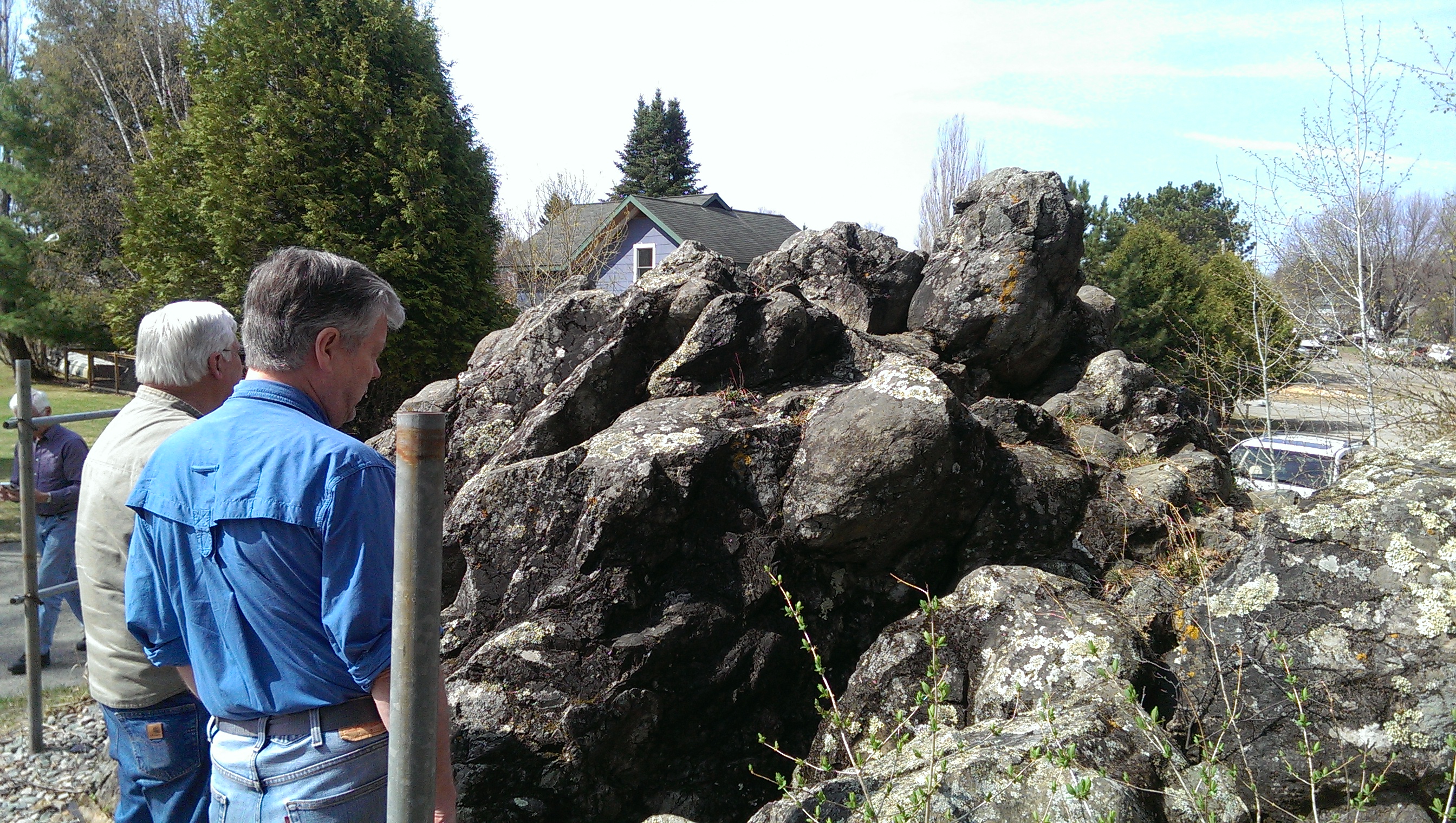
The most interesting thing I learned while looking up Anorthosite is that the highlands of the moon seem to be anorthosite, too. So the ancient Sawtooths, volcanoes of the midcontinent rift which pulled the North American landmass apart in precambrian times, created rock similar to that found on the moon.

Tom and Paul Strickland at the Ely greenstone site in Ely, Minnesota

It’s odd to consider but mountain ranges like the Sawtooths and the Appalachians, ground down by millions, even a billion, years of erosion, were once like the relatively young Rocky Mountains. So here on Shadow Mountain we are in, or rather on, a recent geological event compared to the precambrian era of the Sawtooths. In the Precambrian era life evolved and during its entire millions of years there were only animals with no hard parts.

To walk the shore of Lake Superior, in other words, is to walk on a truly ancient landform. The Canadian Shield, which exposes some of oldest rock on earth, underlies much of Minnesota, from the oldest deposits, gneiss in the Minnesota River Valley like near Morton, to the Ely greenstone found in the town of Ely.

On Shadow Mountain, by contrast, we live on evidence of the Laramide orogeny, (mountain building), only 85-55 million years ago.

Final Days. Get It While It’s Hot.

Mabon                                                                      Elk Rut Moon

house400The final days of the Elk Rut moon are gorgeous, sunny ones. The aspen trees with their leaves still on the tree, lower down from us, blaze like magic lanterns, yellow-gold against deep green. The yellow-gold has faded to a tannish yellow on Shadow Mountain where the leaves remain. Black Mountain, which had yellow gold streaks in its green hair much like grand-daughter Ruth’s pink ones,  has bald spots sprinkled here and there with darkish browns, a mountain’s equivalent of gray hair.

A certain laziness comes with the sun’s shine as it sinks lower, rising less and less each day above the ecliptic. This light seems to offer a going out of business sale for warmth. Get it while you can. Don’t waste time. Bask now or be forever chill.

Since we live on a mountain road that connects two towns and provides entry points to the Arapaho National Forest, we get different traffic on the weekend. Often it’s bicyclists, sometimes in large groups. Today it was motorcyclists, buzzing by like formula one cars, riders leaning for the curve that begins where Black Mountain Drive turns into Shadow Mountain Drive. Oddly, I find these weekend events soothing. People want to come where we live. Of course, we also get the family car with a Thule carrier on top, bicycles lashed to a carrier on back, a dog with its head out the window.

Kate’s recovering nicely so far, the pain tamped down by Vicodin and ice. I made a pot of chicken noodle soup this morning. We’re at the beginning of a long trail for her.

Joints. No, Not That Kind.

Mabon                                                                             Elk Rut Moon

As cancer season faded out in late September, so joint season took over in early October. Kate’s surgery for her painful thumb took place yesterday. Tom Crane had the same surgery last year. It’s a well practiced procedure with consistent results, after the swelling goes down and the three months of swaddling the hand is over. There are many things to learn how to do right handed: tie your shoes (not), hold a stair railing going up, take a shower without getting the bandage wet, dress yourself. And many more.

She also got a platelet injection in her right thumb, the one that has rheumatoid arthritis. This is a non-covered procedure that improves joint function in some people. The physician takes your own blood, puts in a centrifuge, separates out the platelets, then injects those platelets into the base of the thumb. My physical therapist’s mother got three years of back pain relief from platelets.

While Kate figures out how to engage life with one hand, the physical therapist has me doing an increasingly long series of exercises to exorcise (ooohh, exercises to exorcise) the referred pain from my arthritic cervical vertebrae. I like p.t. because it’s non-invasive and has worked well for me each time I’ve done it.

Here on Shadow Mountain we’re all about joints in October.

Surgery. Done Right.

Mabon                                                                        Elk Rut Moon

The waning crescent Elk Rut moon stood off in the east this morning with Jupiter just above. Beautiful.

Kate had her thumb surgery and platelet injection, left and right respectively. The surgery went well according to the surgeon Janet Leo. Kate’s resting and preparing for her first night post-op. I’m headed to the grocery store to pick up pain meds and few supplies for the weekend.

Arms Joined Hand to Elbow

Mabon                                                                     Elk Rut Moon

In my cancer season I had significant conversations with Bill Schmidt (at the International Wolf Center) and Mark Odegard (at Camp Du Nord and by e-mail) and Charlie Haislet (Camp Du Nord). Each in their own way helped me place my cancer in perspective. Mark’s own experience with prostate cancer gave me the most practical help, what to expect from the surgery and its aftermath. Bill and I talked, as we often do, about matters cosmological and philosophical, putting cancer itself in the broader context of life as a terminal disease. Charlie recounted his knowledge of patient’s husbands and fellow docs, emphasizing as he did the effectiveness of current treatments.

This is the Woolly way.  All three of these conversations occurred while we were on retreat at the YMCA’s northern Minnesota Camp Du Nord. These conversations happened on the ancientrail of friendship, the strongest bond among humans outside the bounds of family.

At this remove from cancer season, which ended for now on September 25th, I can see the web of support that carried me on its strong threads. Though we are existentially and finally alone, we are also alone together. My image of the web is of arms joined hand to elbow in a network mesh, a bouncy but tough net, warm in its embrace and durable.

This goes by way of saying thank you. More gratitude.


More Physical Therapy

Mabon                                                                        Elk Rut Moon

The waning of the golden aspen leaves has begun. The weather has become wetter and gloomier, all presaging the onset of late fall. This is the first month of the snow season here and elevations above 10,000 feet are already seeing regular snow though not a lot. Nothing in the immediate forecast for Shadow, Black and Conifer mountains, our rocky neighborhood.

Had a second physical therapy appointment today. This is a very different approach than my last round two years ago. Dana has focused on postural, neck and spine issues rather than muscle strengthening around my shoulder. She mobilized my spine, dug her fingers in at my neck and around my left scapula and gave me two more exercises. That brings me up to five right now: neck tucks, shoulder blade dips, setting my head at neutral, now looking toward my pocket after turning left and right and a modified yoga stretch while lying on my side and extending my arms, together, as far as they will go away from my body horizontally.

Oddly, Dana did not demonstrate the latter exercise, which she said she would normally do. Why? She broke a rib last Thursday during a particularly delicate adjustment on a patient. I don’t think of P.T. as a dangerous occupation.