Outside in the Rockies

20170526_095523Beltane                                                                         Moon of the Summer Solstice

Drove the fifteen or so minutes to Staunton State Park yesterday. Since we moved here I’ve wanted to include regular hiking as part of my fitness routine, but I let first one thing and then another get in the way. No longer. Bought an annual state park pass. “Sir, could I ask you if you are over 65?” Saved me ten bucks. Sure. Ask away.

Debbie, the personal trainer who put together my new workout plan has suggested I alternate cardio days with resistance work. Since I’m paying her for her expertise, I’m going to go follow her suggestion. She also said hiking would be good for abductor/adductor strengthening, uneven terrain. “The Davis Pond trail at Staunton would be a place to start.”

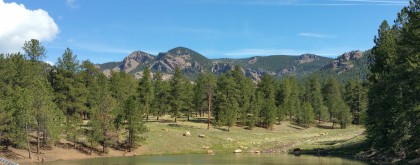
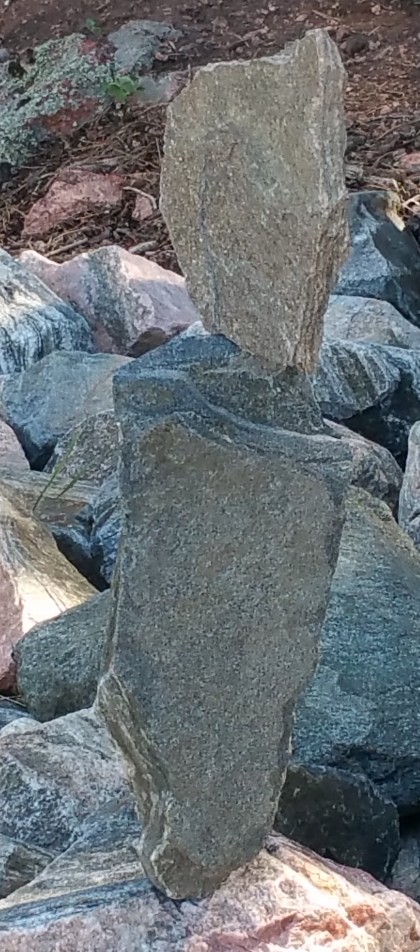
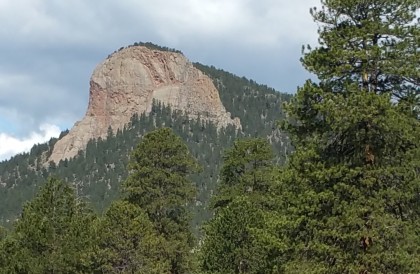
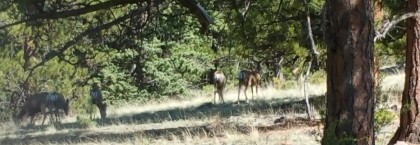
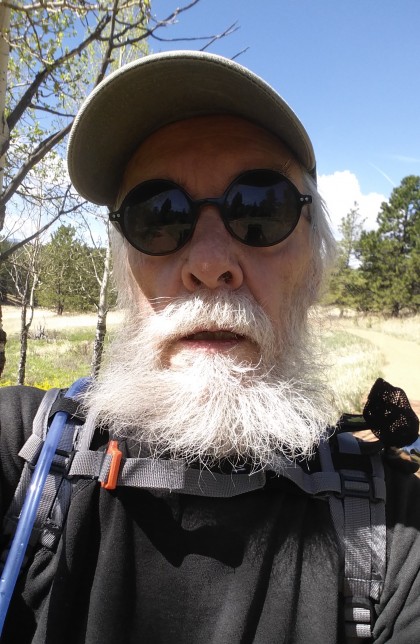
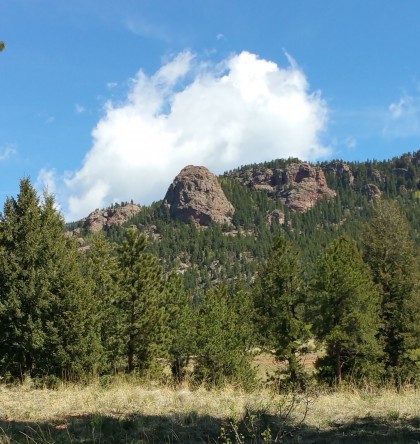
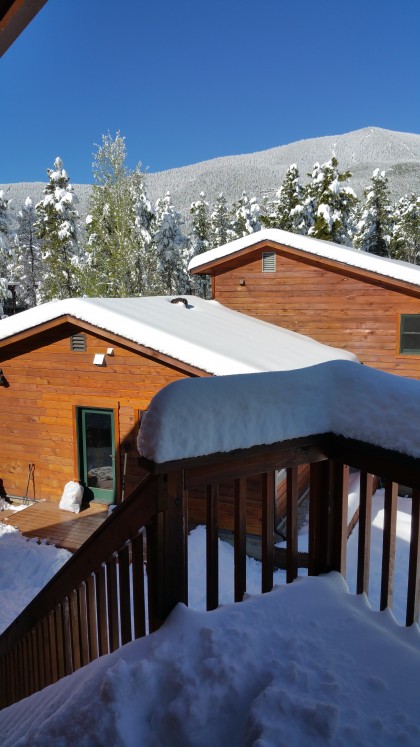
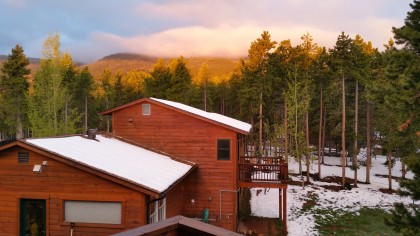
Here are a few pictures from that very trail. I used to exercise outside a lot: Crosby Park in St. Paul, Lake George Regional Park and Rum River Regional Park in Anoka County, but the ease of the treadmill and inertia moved me away from it. Glad to be getting back. And the scenery here is amazing.

20170526_09535620170526_09541120170526_10061320170526_10161620170526_10275220170526_102326

Either Holy or Not-Yet-Holy

Beltane                                                                                     New Moon (Summer Solstice)

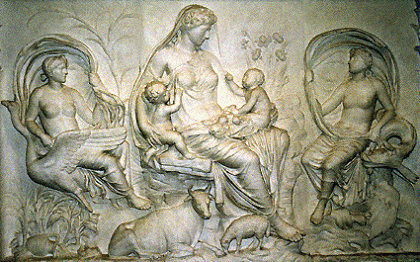
Gaia
Gaia

Yesterday was my first religious work since moving to Colorado. I felt a bit awkward, mildly anxious. The awkwardness and the anxiety came largely from the Jewish portion of the session since I don’t read Hebrew and have a very limited feel for the deep background. This primarily involved understanding words like hasidut, which I had mistakenly translated as loving deeds when it actually refers to a person engaging in them. Chesed, which is familiar to me from seminary as loving-kindness, was less problematic. Ma’asim, which I took as deeds of daily life, seemed to mean close to that.

chesed2This was important because the material I had prepared focused on deeds of loving kindness toward grandmother earth. Bonnie and Tara, both fluent in biblical Hebrew, gently put me back on course when I made a mistake. Their helpfulness made me realize, just now as I’m writing this, that there is a different way of being a presenter, one that relies on others as well as on preparation. I know, obvious right? Not to me because in the Christian religious culture and even in the UU culture the clergy presents and others react. The process can be dialogical, yes, but usually involves only reactions to the ideas of the presenter.

We did have a wonderful discussion about anthropocentrism and various religions’ implication in its effect on the environment. Mostly though we discussed ideas generated by several quotes I gathered. They ranged from a segment of Emerson’s introduction to his essay, Nature, to Henry Beston from the Outermost House, and also included several thoughts on the nature of holiness by Jewish theologians.

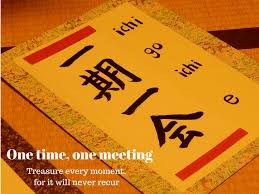
ichigo ichie2Here are a few of the latter that I found especially moving:

Martin Buber: Holiness is not found in rising above one’s neighbors but in relationships, in human beings recognizing the latent divinity of other people, even as God recognizes the divinity in each of us. The commentary adds, “As human beings we can be Godlike by exercising our powers to sanctify moments and objects in our lives.”*

“The modern distinction between “religious” and “secular” is unknown to the Torah. Everything we do has the potential of being holy.”*

ichigo ichieAgain, from Buber, “Judaism does not divide life into the holy and the profane, but into the holy and the not-yet holy.” Another scholar, a man named Finklestein, adds, “Judaism is a way of life that endeavors to transform virtually every human action into a means of communion with God.”*

This, too, is in the commentary: “…(find) ways of sanctifying every moment of your life. We can be as holy as we allow ourselves to be.”*


Depth

Beltane                                                                    New Moon (Summer Solstice)

everbean_colorado

Lunch with Bonnie at the Everbean, a coffee shop overlooking Lake Evergreen. Bonnie is in a mentored adult education style path to becoming a rabbi in the Renewal Movement. I wanted to discuss my material for today’s mussar session. She was the mussar point person as Beth Evergreen managed a two-year grant awarded to them. The program focused on how to integrate mussar into synagogue institutional life. 22 congregations received a grant and coordinated their work with each other. (If you don’t recall what mussar is, here’s a reminder website.)

Bonnie encouraged me that my approach, focusing on the application of the ideas of hasidut (a person of loving deeds) and chesed (loving-kindness) toward grandmother earth was in bounds for a mussar dialogue. We’ll see how that works out later today. I’m excited.

In the evening Kate and I went to a havurah, a fellowship gathered for a specific purpose. This havurah is a once a month mussar session that features food and wine before exploration of a middot of the month. The Thursday afternoon mussar group studies a text and meets weekly.

Bonnie led a session on tikvah, hope. She took us into the idea by using the Israeli national anthem, Hatikvah.

I found the melody haunting and the poem, written in 1877 or 1878, used for the lyrics, a profound expression of the yearning for a place to call home. Bonnie led us in a close reading of the poem’s stanzas used in the anthem, only two.

The lines that struck me most were these:  “Our hope is not yet lost,
The hope of two thousand years…” The two thousand years here references the destruction of the second temple in 70 a.d. It still amazes me to be in the midst of this group of Jews, members of the tribe, whose time horizon extends far back. This two-thousand year old hope marks a rebellion by the Jews against the Roman empire, a failed rebellion since it ended in the destruction of the temple built to replace the first constructed by King Solomon.

Rabbi Edgar F. Magnin, 1929-1930: "The Jews march captive out of Jerusalem bearing a golden Menorah or candlestick of the Temple."
Rabbi Edgar F. Magnin, 1929-1930: “The Jews march captive out of Jerusalem bearing a golden Menorah or candlestick of the Temple.”

What amazes me is the historical reach while genetic and genealogical descendants of that same history sit around the table as we discuss these things. My viewpoint toward religious matters is radical and skeptical, but I also have a conservative side that relishes history and personal connections to history. Judaism, like the Chinese civilization of the Han and Japanese civilization, all cultivated over several thousand years, appeals to me in part for this reason. These older, truly ancient trails offer a correction to the almost ahistorical sensibilities of American culture.


Elliptical Reasoning

Beltane                                                                         Rushing Waters Moon

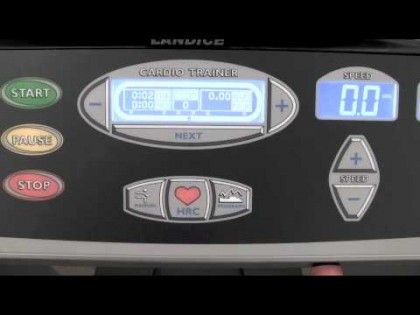
landiceI put myself in a corner with my workouts. In an effort to get to 10,000 steps a day I began to place more and more emphasis on cardio, increasing my time on the treadmill and on the elliptical for high intensity. Problem. I got too tired to do my resistance work. I prioritize cardio since a heart attack or stroke is a real risk for a white male in his 70’s and cardio can help lower the risk. Even so, balance and a certain amount of functional muscle strength is important to daily life so I don’t want to ignore those either.

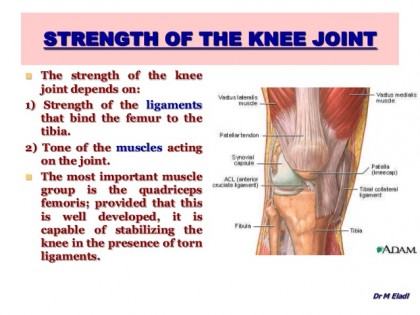
Full recovery from the total knee replacement also requires resistance work, strengthening muscles that support the knee as it works. The good news is that the increased cardio does strengthen the quads, very important for the knee, but moving always in that straight line way does little for the abductors and adductors which stabilize the knee. What to do?

anatomy-of-the-knee-joint-33-638Hire a personal trainer. I went to a small fitness center situated next to Select Physical Therapy where I did my post-op p.t. Both are in store front settings in a small mall with a raised boardwalk and other businesses like a hairdresser and Altitude Martial Arts.

I met with Debbie yesterday for about an hour and a half. She’s good. She listened to what I’ve done in the past, what I’m doing now. She took my blood pressure and reviewed my medical history. After that we did some warm up and a few exercises, some new to me, some the ones I’ve carried over from the end of physical therapy.

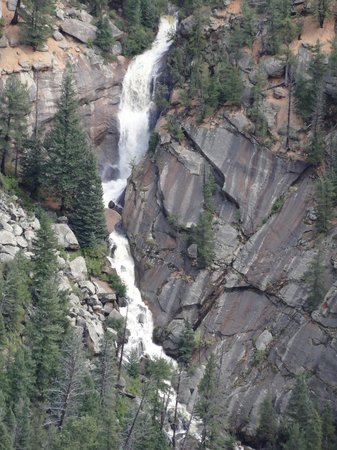
staunton state park: elk falls

Though she’s developing a complete body workout for me that I’ll learn on Thursday, she made two suggestions yesterday that I think will prove important over time. First, she noted that I had little in my routine to work the abductors and adductors. Exercising them will require working in different planes of motion than straight ahead. Second, hike outside. This one, while obvious to someone in the mountains, was important to me because I’ve allowed inertia to keep me at home. I needed a push to get out, to hike regularly and she gave it to me. Already worth the price of admission.


The Longest Day

Beltane                                                                             Rushing Waters Moon

These are the last two days of the Rushing Waters Moon but its namesake creeks will continue rushing for another week or two. Last week’s substantial snow has been followed by some rain and last night another inch or so of snow. More precipitation to come, too.

The Moon of the Summer Solstice is new on the 25th. If I had the cash, I’d go to Sweden.


Everydayness. Monday.

Beltane                                                                           Rushing Waters Moon

Some days are quotidian. 9am. Glaucoma pressure check and scheduling of testing for cataract surgery. Noon. Septic system pumped out by Shirley Septic. Nap. Ordered hearing aid batteries and skin softener. Went to fitness center to sign up for personal training. Want to ramp up my post surgery exercise. Getting important, but very ordinary, stuff done.

What oh what will tomorrow bring?

We are a diverse species

Beltane                                                                   Rushing Waters Moon

Actual complaints received by the British travel agency, Thomas Cook Holidays:

1. “On my holiday to Goa in India, I was disgusted to find that almost every restaurant served curry. I don’t like spicy food.”

2. “They should not allow topless sunbathing on the beach. It was very distracting for my husband who just wanted to relax.”

3. “We went on holiday to Spain and had a problem with the taxi drivers as they were all Spanish.”

4. “We booked an excursion to a water park but no-one told us we had to bring our own swimsuits and towels. We assumed it would be included in the price.”

5. “The beach was too sandy. We had to clean everything when we returned to our room.”

6. “We found the sand was not like the sand in the brochure. Your brochure shows the sand as white but it was more yellow.”

7. “It’s lazy of the local shopkeepers in Puerto Vallartato close in the afternoons. I often needed to buy things during ‘siesta’ time — this should be banned.”

8. “No-one told us there would be fish in the water. The children were scared.”

9. “Although the brochure said that there was a fully equipped kitchen, there was no egg-slicer in the drawers.”

10. “I think it should be explained in the brochure that the local convenience store does not sell proper biscuits like custard creams or ginger nuts.”

11. “The roads were uneven and bumpy, so we could not read the local guide book during the bus ride to the resort. Because of this, we were unaware of many things that would have made our holiday more fun.”

12. “It took us nine hours to fly home from Jamaica to England. It took the Americans only three hours to get home. This seems unfair.”

13. “I compared the size of our one-bedroom suite to our friends’ three-bedroom and ours was significantly smaller.”

14. “The brochure stated: ‘No hairdressers at the resort.’ We’re trainee hairdressers and we think they knew and made us wait longer for service.”

15. “When we were in Spain, there were too many Spanish people there. The receptionist spoke Spanish, the food was Spanish. No one told us that there would be so many foreigners.”

16. “We had to line up outside to catch the boat and there was no air-conditioning.”

17. “It is your duty as a tour operator to advise us of noisy or unruly guests before we travel.”

18. “I was bitten by a mosquito. The brochure did not mention mosquitoes.”

19. “My fiancée and I requested twin-beds when we booked, but instead we were placed in a room with a king bed. We now hold you responsible and want to be re-reimbursed for the fact that I became pregnant. This would not have happened if you had put us in the room that we booked.”

BE AWARE …

My Process

Beltane                                                                   Rushing Waters Moon

MUSSAR-PATH-OF-W-LOGO1Still working on how I will lead our mussar class next week. It’s been hard for me, mildly anxiety producing. First, I don’t have the depth, any really, in Jewish thought. The Mesillat Yesharim, Path of the Upright, is a complex, subtle and often difficult to parse text. With a guide like Rabbi Jamie Arnold its complexity and subtlety becomes an advantage, encouraging a range of views, sparking discussion. But with me, lacking sufficient knowledge, it could become a bramble thicket instead.
Secondly, I do have some depth in other fields, especially those related to the environment, and I find myself drawn to them with the content of chapters 18 and 19 in this central mussar text. Those two chapters recount movement toward hasidut or piety and chesed or loving kindness. Since these are action outward categories-hasidut can also be translated as loving deeds-ecological thinking fits well with them. But. I realize if I go in this direction I risk making my own agenda the centerpiece rather than learning about these middah.

Kabbalistic_creatorThirdly, the whole Jewish immersion experience I’m having at Beth Evergreen is like learning a new language. I have some words and a very limited amount of grammar. I don’t want my naivete getting in the way of other’s learning.

Last. As is usual for me, I have way more information than can possibly fit. At this stage, roughly a week away, that’s not a problem. Except it is. I don’t know how to edit the material because I’m not really sure what my focus is. Is it hasidut, chesed, kedusha (holiness) or is it the manifestation of those ideas in the world? In this case it’s a question of am I moving too quickly beyond the new concepts to their application?

I’ve enlisted the help of a rabbi in training, Bonnie Houghton, to help me sort out what will be useful and what won’t. Mussar and Torah study both emphasize the value of a study partner. A sound idea.

Oh. And. I’m not a Jew.