The sound of radio waves from Cassini as it crosses Saturn’s rings and the gap between them and the planet itself. Dust particle hits make most of the noise in the second clip. I found hearing these sounds an eery, literally other worldly experience. An extension of our human senses is actually out there, between Saturn and its rings. That’s what this sound said to me and said it in a way multiple photographs for some reason cannot.
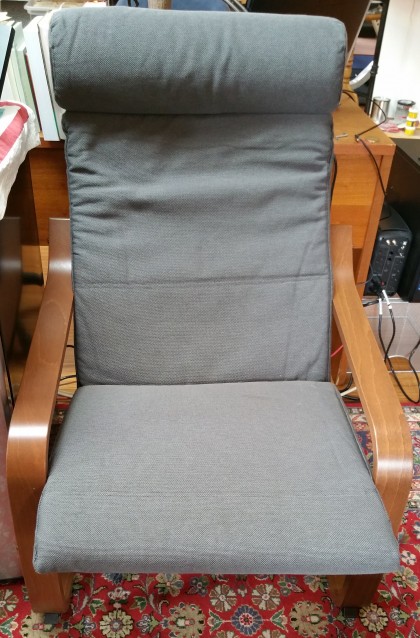
Finished assembling Ruth’s reading chair here in the loft. Two footstools to go, one for her chair and one for mine. I want her to have a safe place, a quiet place where she can read, just hang out.
Ruth struggles with some unidentified emotional quirk, one held at bay right now by Risperidone, an anti-psychotic. This drug is worrisome to both me and Kate, so we’re pressing for her to have a formal evaluation. Use of such a powerful drug, it blocks or dampens dopamines and regulates serotonins, needs to have a sound medical reason for its prescription, a specific diagnosis. She doesn’t have one right now.
When we moved to Colorado, it was with two primary intentions: be a part of our grandchildren’s lives (and Jon and Jen’s) and live in the mountains. In both cases we’ve exceeded our own expectations.
Being nearby grandparents presented challenges from the start. Jen was never happy with our move to the mountains. “Too far away.” We said we were 900 miles closer. No joy there. Now of course we know that the marriage between Jon and Jen was in its final months, creating various layers of conflict, most of which we were ignorant. No more.
The onset of the divorce has, of course, had outsized effects on the kids. Uncertainty and instability are poison to young kids. Where will we live? Will mom and dad ever like each other again? Who will take care of us? Were we responsible? Attach this world altering anxiety to two already troubled kids and the difficulties multiply.
Being a grandparent in this situation has sometimes been an exquisite torture. We can see what’s happening, empathize, support, but we have no direct impact since Ruth and Gabe are not our kids. In our culture this is as it should be, I’m not contesting that, but being so close to the problem and being unable to act requires a level of zen I don’t always reach.
Gabe has his own struggles. He’s too often by himself at school, sometimes bullied. At home he sways from sweet to angry, petulant and destructive. In his case we often encounter behavioral issues that we can deal with directly because he exhibits them toward us.
He tells the dogs he loves them, pets them, while occasionally pinching them or twisting their ears. We immediately put limits and consequences on these behaviors, but they slip back in from time to time anyhow.
We had not expected to have this kind of experience, definitely not, though we have been and continue to be glad that we’re here. We’ve been able to shelter Jon and the grandkids over a difficult year, to provide a place for them to regroup. That doesn’t mean it’s been easy for us, it hasn’t, but family is about family, not ease.
Fog this morning over Black Mountain. It comes in and out of view as the mist moves toward us. Now it’s gone altogether. There’s a thin scrim of icy snow on the solar panels. Colder last night.
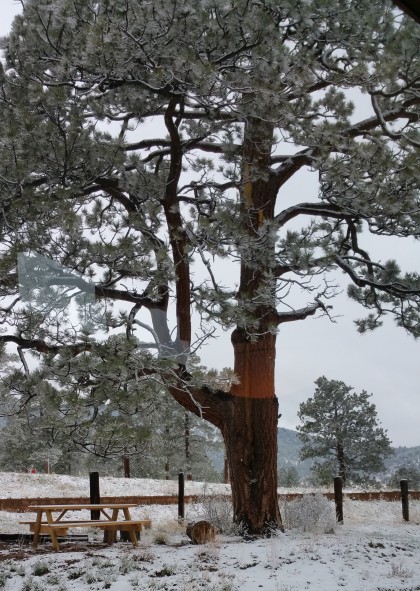
My Japanese informed aesthetic often finds resonance here in the mountains. The ponderosa pines that surround Beth Evergreen’s synagogue present heavily crenulated bark, twisted branches and a sturdy calm. From the sanctuary, looking south and east, one window pane has an especially crooked branch that reaches up like a hand. When the snow comes, it looks like a portion of a Kano school gold screen. Ravens and crows land on these branches, too, also emulating the scenery that inspired so many Japanese painters and printers.
Moon watching, a Japanese pastime, has its analogue here as well. The moon rising and setting among the mountain peaks, clouds placing a thin gauze in front of it, the stars as its context, emphasize the moon’s romance. I can stand on my deck here off the loft and watch clouds cross the moon’s face. Its silvered light makes beautiful shadows of the lodgepole pine.
Hokusai (1760-1849), Boats and Moon, an ukiyo-e print
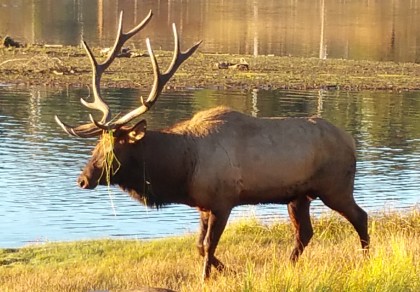
Big eared mule deer and thick, tall elk come down to Maxwell and Cub creeks, lapping up the cold fresh melted snow. Mountain lions slip noiselessly through the undergrowth, lie prone on rock cliffs waiting for them to pass nearby. Bears root up tubers. Minx, bobcats, pine martens, smaller predators, hunt for prey. Rabbits and squirrels and mice feed, look over their shoulder. The web of life is vibrant.
Bull Elk, Evergreen, 2015
Ichi-go ichi-eis a Japanese phrase often associated with the tea ceremony. The tea master arranges art in the tokinama, chooses teas and sweets, decides which tea bowls and tea pots and tea utensils to use, then greets their guests as they arrive, often no more than one or two. He does this to create an ichi-go ichi-e, a once in a lifetime moment or for this moment only. It connotes the treasure of each meeting between or among people.
Each moment of the day Black Mountain offers ichi-go ichi-e to those of us who live near it, if only we stop and look. To appreciate ichi-go ichi-e though we need to pause, or as mussar teaches us, put a space between the match and the flame. If we slow down our glance, our gaze, let it come to rest, if we take a breath and consider what is right there in front of us, then we find once in a lifetime moments happening throughout our day.
Ponderosa Pine, Beth Evergreen, April, 2017
These do not, as you might think, cheapen or dilute over time, rather they enhance our experience of the world. We recognize the fleeting nature of life, of this moment and that moment, of the unique and precious and irreplaceable flavor to each encounter. Nothing is old, all is new, always.
In fact, to the extent that we can gain an appreciation of ichi-go ichi-e, then we never age.
April was fraught. Physicals and other medical matters created, if not anxiety, then very close attention. Kate’s shortness of breath and fatigue triggered imaging, a chest x-ray and an echocardiogram. There’s a physician’s nostrum that goes: if you look, you’ll find something. And so it was. Some scarring on her lungs, a short list of heart issues that “do not require surgery at this time.” For us anyhow, knowing is better than not knowing and the increased clarity eased concerns about her overall health. At least right now.
Ruth and Gabe turned 11 and 9. With the divorce birthdays have become contentious. Jen planned a birthday party for Ruth that didn’t include Jon. Ouch. Still in its first months after final orders the divorce means Jon and Jen have to establish new norms about how to deal with such things. Not easy when the breakup itself created more conflict.
Jon also needs to buy a home, get back into the city so his commute won’t be so long. Once he has a new place the custody arrangement will become more equal and parenting should be easier for him. The spring housing market is the right time, lots of houses on the market, though the still heated Denver housing market, one of the hottest in the country, affects affordability.
He’s been here almost a year and our garage plus outside it has overflow from his storage unit, enough to make our capacious garage (space for four cars) feel cramped. We’re ready to get back to our quieter, septuagenarian lifestyle, too.
April included several events at Beth Evergreen. A passover cooking class, a community seder, and the three day presence of Rabbi David Jaffe. Kate and I took the cooking class and helped set it up. We also did several different things for the Rabbi Jaffe events.
We spent a night and a day at a hotel in Lone Tree learning about hemophilia.
April, Eliot said, is the cruelest month. Maybe not exactly cruel this year, but stressful? Yep.
Cue the couples out in the fields doing their sympathetic magic for the fertility of the crops. Light the bonfires for leaping over and the bonfires for driving the cattle between. Gather the naked Scots outside of Edinburgh for the great fire festival. Dance in the streets because the growing season has finally come round again, the Great Wheel has turned and food will begin to appear from mother earth.
The greenman is dead, long live the greenman. Let the lady and the god Cernunnos mate again and again and again. Watch as the seeds break open and pierce the soil, spreading leaves, gathering in sunlight and drinking in rain. See the birds, gone for the season, return to sing and fly and swoop and delight us.
As winter has made us fold our arms and shiver, put on coats and boots, Beltane says, open them, embrace the sky, kick off the boots, shed the coat. Go out into the forest and walk, slowly. Listen to the streams falling down the mountainside. Feel the wind come over the continental divide, still cool from the snow covered peaks beyond it.
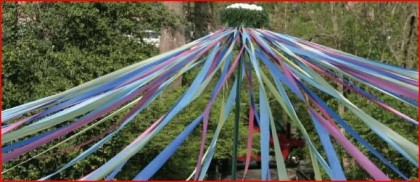
This is Beltane. Mayday. Collect women and men, girls and boys, give them streamers and ribbons, connect them to the tall pole and have everyone swirl, under and in and out and back again. Pick flowers for the table, for a basket, for your lover.
May the power in each plant, in each rock, in each deer and fox and moose and elk and badger, in every person you meet, each bit of food you eat illuminate your heart and may your heart illuminate theirs. This is a time for coming out. Hug. Kiss. Smile. Appreciate.
Show gratitude for the snows of winter, the transition of spring, and the promise of nourishment spreading among us now. We have come again to the season of plant growth. The time when animal babies slowly mature. Celebrate, celebrate, dance to the music of the earth herself and her consort the sun.
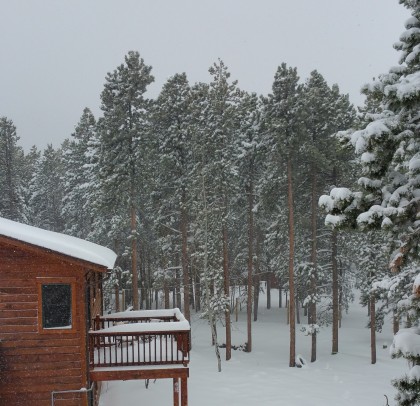
The last day of spring. Solar panels covered. Roof covered. Driveway plowed. 16-24 inches of new snow Friday night through yesterday. Delightful, but hardly springlike. In our spring fantasies, that is. The ones that have tulips and iris and crocus and lilacs and wisteria in them. For a mountain spring though, welcome and not unexpected.
Kate and I are still recovering from our three days of cooking and helping out at Beth Evergreen. Geez. Still, we have the time and the dogs have the patience. This pack anyhow. Vega would not have let us sleep in like Kep, Gertie and Rigel do. She had very clear ideas about when to go to sleep and when to wake up.
We spent most of yesterday admiring the falling snow. A snow globe day, refreshing and beautiful.
9 days ago
Still learning the mountains, how they change. Snow. Light. Rain. Fall. Flowers. Rapidly flowing streams. Clouds. Freeze and thaw. Fire. The animals they nurture move in and around and on them. Night and day. The stars and the moon. The sun as it arcs across the sky. All wonderful, all different.
In one of the sessions with Rabbi Jaffe a member of the board referred to the Beth Evergreen folk as mountain Jews. I liked that. I’m a mountain pagan, a mountain docent, an old man of the mountain. And a fellow traveler with the mountain Jews. Welcome to the journey.
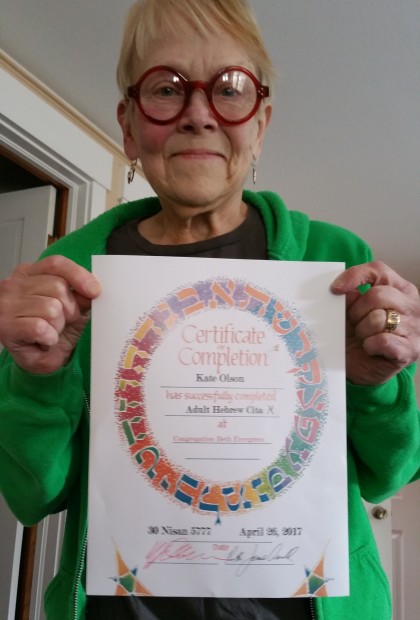
Kate with her graduation certificate for adult Hebrew
Missed yesterday. A very busy two days for both Kate and me. A visiting scholar at Beth Evergreen, Rabbi David Jaffe, came into town on Thursday morning. His first event was a potluck, then a mussar (Jewish ethics) session. Kate and I went early to set up.
Then, that evening Rabbi Jaffe walked the board and other leaders of the synagogue through what he called a soul curriculum for the organization as a whole. I resonated most with this presentation. Kate and I were there because I’m a member of the Adult Education committee. Both of us contributed soups to the soup and salad meal. I made chicken noodle soup and Kate made Vietnamese Pho.
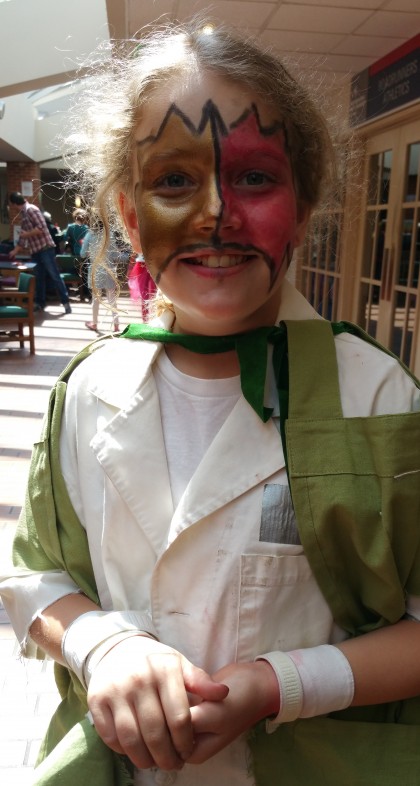
After getting home around 9:30 (our bedtime is 8pm) we got up the next morning and drove into the Denver Performing Arts Center to see grandson Gabe perform in the Denver Public Schools Shakespeare Festival. This ended up taking longer than intended, but we got home in time for a nap before returning to Beth Evergreen yesterday at 4:30. This time we helped set up for Rabbi Jaffe’s lecture, preceded by a congregational meal.
After helping set up tables, arrange flowers, distribute utensils to each place, we attended the James Taylor shabbat. Rabbi Jamie Arnold, Beth Evergreen’s rabbi, is a talented musician who does covers and writes his own music. He often modifies familiar songs with Jewish prayer book language and writes Hebrew verses for them, too.
The meal, catered by Ali Baba, a Golden Lebanese restaurant, and paid for by a generous congregant, fed about 80 people. The tables filled the social hall plus a table set up in the entry way. It was exciting to have that many people together, eating and sharing stories.
Afterward Rabbi Jaffe gave a lecture on mussar. It was more sparsely attended than it might have been due to the heavily falling snow and the predictions-now fulfilled-of around a foot of accumulation.
We again got home around 9:30pm. Late to bed twice in a row. Harder and harder these days.
Today was the People’s Climate March in Denver, which I intended to attend, but the roads going down the hill are icy and snow covered. Climate change is, as I said in an earlier post, once again the focus of my political energy so I’ll only miss the gathering, not the action.
This late spring snow challenged our Rav4 on the way home last night. Hwy. 78, aka Brook Forest Drive/Black Mountain Drive/Shadow Mountain Drive winds up the mountains from Evergreen. It was snowing hard, the roads were not plowed and the shoulders are narrow. No sudden plummets, but sufficient curves and changing elevations to make the drive interesting. Plus, I was ready to be asleep an hour before we left Beth Evergreen.
Today, though, and the next week, too, we have a quieter time. No grandkids this weekend and only one scheduled event in the next week.
The mountain streams we see regularly: Shadow Brook, Maxwell Creek, Bear Creek, Cub Creek have begun, a bit early, I think, their post-ice plummet toward sea level. In May these streams are often boiling, filled with snow melt and pushing the limits of their banks. On any given day driving past them as they speed downhill, down the mountain, they look interesting, worth watching for the tumult; but, in fact, these racing streams are much more than merely interesting.
They are the levelers of mother earth. They take the mighty and strip them down to size, pebble by pebble, rock by rock, chunks of soil by chunks of soil. A defining characteristic of a mountain is its imposing size, its thereness. Mountains dominate their landscape, putting up barriers to human passage that often forced the pioneers of nineteenth century America to go around them rather than over them. They seem, in the moment, eternal.
When living in or visiting a relatively young mountain range like the Rockies, no reasonable person would ever expect them to look any different than they do right now. Colorado is proud of its fourteeners, those summits exceeding 14,000 feet. Mt. Evans, for example has a summit of 14,265 feet. That’s precise. And, would you add it to a website or book or road sign if you expected it to change? No.
Near Bailey, 2015
But it will. One only has to drive east toward the Atlantic to see what’s in store for even Mt. Evans. Look at the Appalachians. Their mountain building episode (orogeny) happened around 480 million years ago. When it was done, the Appalachians stood as tall as the contemporary Rockies. The Rocky Mountain orogeny was a quite recent, geologically speaking, 80 million years ago. They too will wear down.
In the spring we see this process at its most obvious as mountain streams from every summit in every range of the Rocky Mountains, including here in the Front Range, obey gravity and try to find the lowest points available to them. Of course, the streams are not the only process at work. Drive on Highway 285 out of Conifer, as we do often going down or returning from Denver, and you will see large steel mesh hanging over some cliffs. In other places there are bolts driven into the side of rock faces, giving them a slightly Frankensteinian look. In other spots massive retaining walls of concrete encase an especially troublesome chunk of mountain.
These CDOT efforts are not always successful, witness the many Watch for Falling Rocks signs sprinkled throughout Colorado. Freezing and thawing splits the rock faces and they come tumbling down, creating talus or road obstructions. Just this last year, near Glenwood Springs, a large boulder broke loose from its millions of years long position and crashed down on an SUV on I-70, killing the driver. Winds, too, often reaching high double digit speeds, also wear away the rock.
These forces are slow, miniscule in appearance, but massive in their results over long periods of time. When driving by a mountain stream in full force, remember the Appalachians. They’re coming, but not soon, to a Rocky Mountain range near me.
Today I’m making chicken noodle soup and Kate’s making Vietnamese pho. We’ll serve this at a Beth Evergreen leadership dinner for Rabbi David Jaffe, author of Changing the World from the Inside Out, a Jewish Approach to Social Change. Along with our friend Marilyn Saltzman, chair of the adult education committee, who is making a vegetarian squash soup, we’ll provide the soups for a soup and salad meal. I really like this low key involvement. It feels manageable.
Although. I am hoping that Rabbi Jaffe’s time here at Beth Evergreen, tomorrow through Saturday as a visiting scholar, will spur the creation of an activist group focused on some form of response to the Trump/oligarch era. In that instance I’m willing to move into a more upfront role, though I would prefer to remain a follower.
Then, there’s the Sierra Club. I wrote here about my excitement with Organizing for Action, Conifer. That was back in January, I think. Lots of people, lots of energy. Good analysis. I thought, wow. Here’s my group. Then, I never heard from them again, my e-mails went unanswered. Weird, but true. Weird and disqualifying for a group that’s organizing political work.
So I renewed my effort to connect with the Mt. Evans’ local group of the Rocky Mountain Chapter of the Sierra Club. Colorado seems to work more through these regional clusters than as a whole. There are nine of them, covering the entire state. The Mt. Evans’ group includes our part of Jefferson County, Clear Creek County and a northern portion of Park County. It’s titular feature, Mt. Evans, is a fourteener (over fourteen thousand feet high) which has the highest paved road in North America leading to its summit. According to locals here it’s also the weathermaker for our part of Conifer.
I finally made it to a meeting a couple of weeks ago. When I came back, Kate said, “You seem energized.” I did. And, I hadn’t noticed. Something about that small group plugged me back into my reigning political passion of the last six or seven years: climate change. Oh, yeah. With OFA I’d tried to head back toward economic justice, my long standing motivation for political work, dating back to the UAW influences I picked up as a teenager in Alexandria. Guess the universe understood me better than I understood myself. Not much of a surprise there.
My mind began ticking over, running through organizing scenarios, figuring out how we could (note the we) raise the visibility of the Mt. Evans group, gain more members, influence local policy. This is my brain on politics. I might be willing to play a more upfront role here, too, though I want to explore other ways of being helpful first.
Anyhow, between these two, I’m sure I’ll get my political mojo working in some way. And that feels good. Want some soup?

 Finished assembling Ruth’s reading chair here in the loft. Two footstools to go, one for her chair and one for mine. I want her to have a safe place, a quiet place where she can read, just hang out.
 The onset of the divorce has, of course, had outsized effects on the kids. Uncertainty and instability are poison to young kids. Where will we live? Will mom and dad ever like each other again? Who will take care of us? Were we responsible? Attach this world altering anxiety to two already troubled kids and the difficulties multiply.
 He tells the dogs he loves them, pets them, while occasionally pinching them or twisting their ears. We immediately put limits and consequences on these behaviors, but they slip back in from time to time anyhow.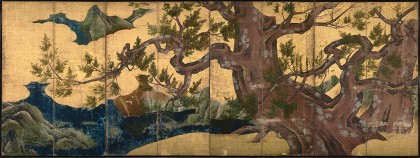


 Ruth and Gabe turned 11 and 9. With the divorce birthdays have become contentious. Jen planned a birthday party for Ruth that didn’t include Jon. Ouch. Still in its first months after final orders the divorce means Jon and Jen have to establish new norms about how to deal with such things. Not easy when the breakup itself created more conflict.
 Cue the couples out in the fields doing their sympathetic magic for the fertility of the crops. Light the bonfires for leaping over and the bonfires for driving the cattle between. Gather the naked Scots outside of Edinburgh for the great fire festival. Dance in the streets because the growing season has finally come round again, the Great Wheel has turned and food will begin to appear from mother earth.
 This is Beltane. Mayday. Collect women and men, girls and boys, give them streamers and ribbons, connect them to the tall pole and have everyone swirl, under and in and out and back again. Pick flowers for the table, for a basket, for your lover.
 The last day of spring. Solar panels covered. Roof covered. Driveway plowed. 16-24 inches of new snow Friday night through yesterday. Delightful, but hardly springlike. In our spring fantasies, that is. The ones that have tulips and iris and crocus and lilacs and wisteria in them. For a mountain spring though, welcome and not unexpected.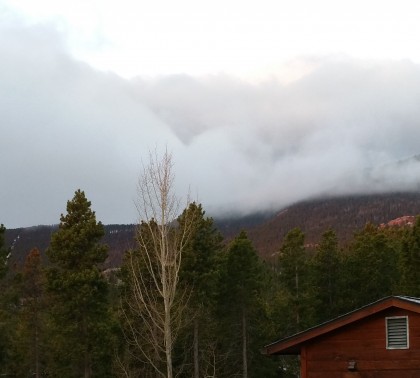
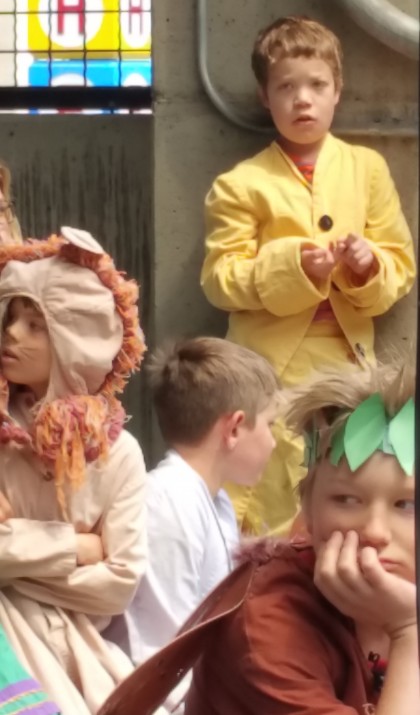 After getting home around 9:30 (our bedtime is 8pm) we got up the next morning and drove into the Denver Performing Arts Center to see grandson Gabe perform in the Denver Public Schools Shakespeare Festival. This ended up taking longer than intended, but we got home in time for a nap before returning to Beth Evergreen yesterday at 4:30. This time we helped set up for Rabbi Jaffe’s lecture, preceded by a congregational meal.
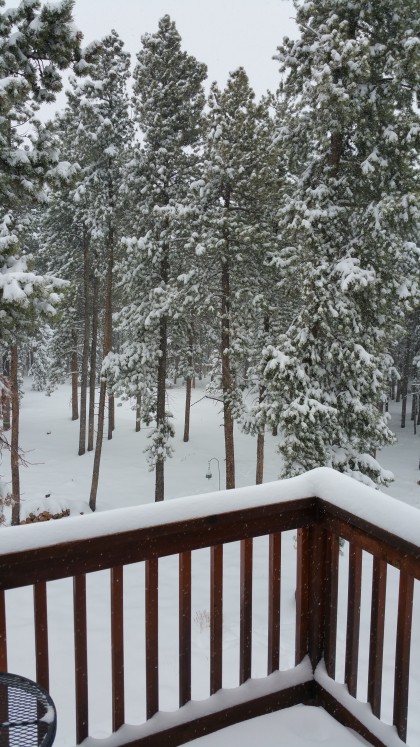 Today was the People’s Climate March in Denver, which I intended to attend, but the roads going down the hill are icy and snow covered. Climate change is, as I said in an earlier post, once again the focus of my political energy so I’ll only miss the gathering, not the action.

 Today I’m making chicken noodle soup and Kate’s making Vietnamese pho. We’ll serve this at a Beth Evergreen leadership dinner for
 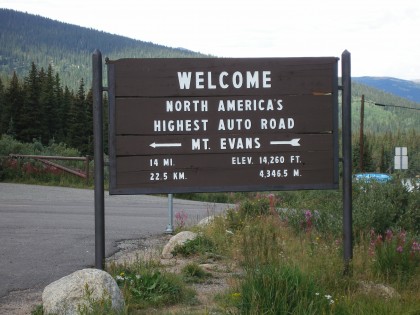 So I renewed my effort to connect with the Mt. Evans’ local group of the Rocky Mountain Chapter of the Sierra Club. Colorado seems to work more through these regional clusters than as a whole. There are nine of them, covering the entire state. The Mt. Evans’ group includes our part of Jefferson County, Clear Creek County and a northern portion of Park County. It’s titular feature, Mt. Evans, is a fourteener (over fourteen thousand feet high) which has the highest paved road in North America leading to its summit. According to locals here it’s also the weathermaker for our part of Conifer.