Kate finished the first draft of Superior Wolf. In one day. She made a very helpful suggestion which will require considerable revision, but the book will be stronger for it. A quote by Terry Pratchett, a British fantasy author: “The first draft is telling yourself the story.” Yes. Now I know, for instance, that the lead character is really Lycaon, not the initial main character I imagined. Those two things alone point the way toward a good revision.
The new schedule has taken shape, solidified. I write ancientrails first thing, like I’m doing right now. Then, I move onto Jennie’s Dead, which has begun to live and breathe, I’m excited to say. My goal each morning is to finish a post here and write 750 words in Jennie. I get breakfast either during or after I get those two things done. If I have the time, I’ll spend 30 minutes filing posts from ancientrails for Reimagining. Workout, which ends before lunch. Lunch. Nap.
Many monasteries had Scriptoria, otherwise known as writing rooms
The after nap part is not so solid yet. I do read then, Arthur Green’s introduction to the Zohar, for example. I have not started translating again and, since I start Hebrew this week, I think, it might absorb that energy. By 4 p.m. or so, I’m moving toward the evening and happily so.
My life is best when I have large blocks of time I can manage and, when I’ve figured out a rhythm for the work I have underway. That’s happening. I’m grateful to Kate for supporting me in this and, for finding this amazing space. I want to have a library dedication sometime in October, in the main to thank her.
We’re still under the Eclipse moon that brought us totality across the U.S. That same moon has now shone on Harvey, as he devastated the western Caribbean, then Texas, and Irma, as she moves through the eastern Caribbean on her way to landfall in Florida. Meanwhile, Jose, another Category 4 storm is following Irma’s path for now and Katia, a Category 2, is going ashore in the Mexican state of Veracruz. An earthquake 8.1 on the Richter scale struck southern Mexico on the Pacific side shaking much of the nation.
Lost in the darkness of totality, the shaking of Mexico and the powerful winds, rains and storm surge of the hurricanes, at least on national news, are the wildfires rushing through the forests of the West. According to the National Interagency Fire Center, 8,081,369 acres had burned in the U.S. from Jan. 1 through Sept. 9. This well exceeds the average from the last ten years for the same time period: 5,558,384 acres. Worryingly, the average number of fires per year over the same Jan thru Sept period is 50,857. The number of fires in 2017 so far is 47,854. Fewer fires and more acreage burned means larger fires with more destructive potential. These are the megafires Michael Kodas has written about in his book of that name, published last week.
Warning for Irma
The Eclipse Moon of 2017, its lunar month, might well change its name to disaster moon. My mind often feels overwhelmed by the magnitude of the catastrophes during the month of the Eclipse Moon. I’m able to notice them as they present themselves, but unable to hold my attention on any but the most recent, most horrific news.
This is a problem because each of these disasters: hurricane, earthquake, wildfire brings devastation to wide swaths of land, over multiple populations, concentrated and rural. The news predicts their coming, at least in the case of wildfires and hurricanes, then sends out pictures and text of their immediate, painful encounter with whatever is in their path. But this season, the wildfire this time has been followed by the hurricane now and the earthquake, then more hurricanes. And the critical phase, the recovery and rebuilding phase, does not begin until the event has finished.
This means that across North America, in Mexico, the U.S., the Caribbean and Canada we have centers of destruction that have not even begun to pick up the debris and sort through wreckage before the next catastrophe has hit. Millions of people, millions of acres of land, buildings, millions of wild animals are suffering and will continue to suffer. Right now. Which one has priority? How do we marshal our collective resources across so wide a swath of pain?
Perhaps an even better question is, how do hold in our hearts and minds all of these, the burned forests, lost homes and devastated wildlife? The buildings and lives inundated by waters from the Atlantic and Caribbean displaced by wind and rain. The cities and towns and villages gripped by a moving earth. Will we go forward from the month of the disaster moon, watch football, go back to school, prepare our homes for winter and forget about them?
Down the hill at 8 a.m. yesterday to deliver the Rav4 for detailing and air conditioner help. They pay for a rental from Enterprise so I took the shuttle over there. “Is a Challenger, o.k.? Looks like you lucked out.” Yep. Got an all white chunk of Detroit iron, a real muscle car. First time I’ve driven something with a V-8 in a very long time.
It ignited my inner teen ager. I called Kate and asked her if she could find her poodle skirt, “I’ll take you over to Sonic and we’ll cruise the drive-in.” Poodle skirt’s apparently long gone, so I came home and had breakfast.
Pushing the Challenger around the curves on Brook Forest Drive seemed apposite to what it wanted to do. This car begged to have the hammer down on a quarter mile stretch of back country asphalt, a hair band wearing girl jumping up and dropping a handkerchief. It was a clumsy car, typical of what I remember from my dad’s Fords I drove as a kid. Even so, that responsive power, available with a flick of the foot, sure brought back memories.
Kate went in with me to pick up the Rav4. She looked tiny in the Challenger’s passenger seat. A movie and dinner after picking up a cleaned up, cool vehicle.
We saw Tulip Fever, a costume drama, and a reasonably bad one. Alicia Vikander and Christoph Waltz were excellent, but the overall flow of plot was alternately too fast and too slow. Too, I made a disappointing discovery. I couldn’t hear about a quarter or more of the dialogue. That was no fun. I need to watch movies, especially ones with dialects, tv as well, for that matter, with closed captions. Otherwise I miss a good deal.
Today the rhythm returns to normal. Write, exercise, mussar. Late nights, or my version of late nights these days, Tuesday 9:30 p.m, last night 8:45 p.m., plus days too busy for exercise or writing drain me. No chance to recharge.
OK. Cataracts. The good news. Stable and not too bad. Bad news. The same. Sigh.
Had a nightmare last night. Not often I have those. This one involved a gradual decompensation from ordinary life to forgetfulness to a social worker coming to help me as a vagrant, finding me in a dilapidated house with some others, also disoriented. Frightening. Might have been instigated by a pun game I played last night at Beth Evergreen. I wasn’t very quick, sometimes had nothing. I felt a bit embarrassed, slightly intimidated. It had been a long day, I was tired and the games went on past my bedtime, so it wasn’t the best circumstances for me. Still.
This morning I’m off to Stevinson Toyota to see if I can get the air conditioning revved up again. Ironic because it was 40 degrees when I got up this morning. Down the hill is hot, record breaking hot over the last week with DIA hitting 96 two days ago, and we’re going in more often with Jon’s move to Aurora still underway. So. Fix the air con.
Electrical problem fixed. A wonky main circuit breaker. Fortunately Brian of Altitude Electric was nearby and had time in the early afternoon.
Kate had problems with hypoxia yesterday. The wildfires further west have filled our skies with particulates and ozone, making air quality tough on those with respiratory issues. Once she hooked up with her O2 concentrator, she improved quickly.
So. Life’s sine curves oscillate through our days. Yesterday had more trough than peak.
Labor day. The Rubicon of summer for Americans. Once in the past, much like August in Europe, the vacation month, the world turns serious. Schools begin. (though here in Colorado they’ve already begun. which still seems wrong to me.) The pace of the harvest picks up as wheat and corn and soybeans mature. The Federal budget year ends in September, so bluster and shimmying rocks out from D.C. across the land.
As I wrote earlier, I get a distinct boost as fall asserts itself. It’s 46 here this morning and the gas stove in the loft kicked on. My mind, like a trained puppy, sits up and begs to be fed, wants to do tricks like write, do Latin, read. I love this transition, partly because it means the heat of summer is fading, but mostly because parts of me that I cherish come fully alive.
Eduardo and Holly invited us and our immediate neighbors: Jude, Roberta and Jim, Alexis and Troy over yesterday for a Labor Day cookout. Eduardo is an excellent cook, offering black beans, seasoned rice and carne asada from his grill. We brought deviled eggs, Jim and Roberto a spicy shrimp salad, Alexis and Troy homemade hummus. Eduardo and Holly’s house has multiple levels in the back and we ate on the lowest level, a cool breeze gradually replacing the heat of the day.
While writing this, I got an intercom call from Kate. Power’s out, can you fix it? Well… I can go out to the main, check the circuit breakers. I did. There were several breakers thrown, maybe seven altogether. So, I returned them to their on positions and voila! Nothing changed. ? So went back out and did the same thing all over again, essentially rebooting. Hey, it works on computers and modems. Nope. Doesn’t make sense to me, and I don’t like electrical things that don’t make sense.
Sigh. It means I have to start the difficult process of trying to get an electrician out here. I’ve contacted Altitude Electric, hoping that the modest relationship we built during the oh, so drawn out generator installation process will encourage them to come. The mountain way means certain trades are just not reliable up here.
In other news I go to the ophthalmologist today. Hoping, in the strange way of medical care in our time, that my cataracts have worsened to the point that Medicare will pay for their replacement. Improving my vision through cataract removal is, of course, desirable, but mostly I want to see if they can permanently improve my reading correction. I read a lot, in lots of different places and cheaters don’t work since I have an astigmatism. That means I often have to rely on arms out, head back mode.
That was the idea I was reaching for in the post below about the West. Wildfire. Precious Water. Mountains and high plains. Blue sky and fancy clouds. Of course versions of these are everywhere, yes, but here they’re in your face, unavoidable and unmissable companions of daily, even hourly life. Not the wildfire, you say? Live in tornado alley? On a hurricane prone coast? In an earthquake zone? You’re always aware.
Earth, air, fire and water. Not a 70s disco band, but the notes of a changing composition of seasonal change. Right now we’re in the transitional movement between the allegro of the growing season to the andante of harvest, the celebration of senescence. Human activity does become more frenetic during the harvest, a sort of false allegro, but only because the plant world knows winter is coming. You can hear those bass notes as seeds form and disperse, plant stalks brown and wither, green fields become tan or golden.
Up here in the mountains the occasional aspen has begun to turn. The grasses in the mountain meadows have lost their intense green. The angle of the sun has already lessened, casting deeper shadows. Orion is visible in the dark, clear night sky. Moose, elk and deer bucks have begun to drop the velvet on their antlers, preparing for the quickening of the rut. The bears become more brazen as their need for calories, more calories, before hibernation makes them feel an urgency.
Somewhere around us in the Arapaho National Forest, up in the Mt. Evans Wilderness Area, over in Staunton State Park, the fox and the marmot and the fisher and the pika, the Abert squirrel and the red squirrel can feel their coats beginning to thicken. The mountain lions know the seasonal changes in their prey and change their hunting patterns.
The orchestra of life plays this symphony all year as it responds to the conductors spring, summer, fall and winter, each with their own favorite tempo. The elemental nature of the West makes the composition here often raw, sometimes going as far as dissonance during the chinooks, or a dry summer month, during a blizzard, yet it is usually majestic with soaring blue notes and the babbling background music of mountain streams and bugling elk.
summit lake park, the highest city park in North America
In fact, the highest paved road in North America. Which happens to be only 46 miles from our front door, the Mt. Evans Road. It’s a joint project of the Denver Parks System and the National Park Service with the NPS controlling admission to the road leading to the summit and DPS controlling access to three fee areas: Mt. Goliath (bristlecone pines at the krummholz level), Summit Lake, which is a clear mountain lake with a small glacier poised high above it on Mt. Evans, and the summit itself.
Last year Ruth and I drove up, but were too late to get any further than Summit Lake, the road continuing on past there closed for the season. This year, today, Ruth and I went again. This time we made it all the way to the top. But. The Mt. Evans Road closes every year the day after Labor Day and the summit had a huge number of people with the same idea we had. I knew it would be that way, but it was an incremental improvement over last year.
mt. goliath natural area
Next year, during the week, early in the morning in June, July or August. It opens on Memorial Day, if, that is, it has no snow.
The road itself, especially the segment after Summit Lake is narrow and, as the orange sign said, Damaged. That makes crawling up and down it with others entertaining. The downhill side of the road, which shifts as it snakes its way up and down the mountain, has no barrier and for much of the road virtually no shoulder.
Since Colorado has many bikers, both bicyclists and motorcyclists, sharing the road with a car in the other lane and a bicycle or two can be challenging. Not to mention the road damage which can include, and in fact often did today, chunks of road missing, eroded away. This phenomenon almost always presented itself on the downhill side of the road. So there’s that big SUV pushing its way up, you’re on the way down, a good long drop with plenty of over and over and over and over again potential if you make the wrong move, and a bicyclist or two, bless their VO2 maxed out hearts, struggling up or down. Yowza.
In visiting it next year I plan to visit it as a mountain deity, one which took my breath away today, even sitting in my internal combustion powered chair. Mt. Evans is our weather god, altering the flow and intensity of weather patterns as they come from the west and cross the continental divide not far away. The result, in our little Evansonian microclimate, is increased precipitation both winter and summer, but more in the winter. Remember that 200 inches plus we had the second winter we were here? Mt. Evans for the assist.
Mt Evans Summit
There was one mountain goat visible to me today. Improbably it was standing among a bunch of hikers above the Meyer-Womble Observatory, which, until an Indian Observatory opened in 2001 was the highest operating telescope in the world. Apparently the mountain goats lick the soil on the summit to obtain needed salts.
If you ever visit during the summer, let’s go. I’m always up for a visit to the mountain top.
Vast, blue sky with puffy white clouds. Jagged mountains and flat plains, forests and wildlife. Wildfire. Snow, rivers, a few lakes. Air, earth, fire and water. The West is so elemental. It’s no wonder that it has enlivened the imagination of those who visit it or read about it, yet is so difficult a place to live. Here the natural world apart from the built world (also natural in its way) dominates. The cities like Denver and Salt Lake City, Cheyenne and Boise, Vegas, Tucson, Phoenix are islands, admittedly big islands, but islands nonetheless, of concentrated human habitat. They disappear around the bend of a mountain pass, or are obscured by arid land with few towns.
It is obvious that we humans are here on sufferance, ravaged by fire, made thirsty by drought in an already arid land, moving slowly even in our cars and trucks across mountain reaches, unable to grow enough to eat. It is, I think, this stark contrast between the wealth and power of human civilization humbled by the land and the sky that makes the west mythic, much like northern Minnesota and Michigan.
The west has begun to seep into my bones, become my home. I live here and have begun to feel it, the place. Still learning, though.
Arthur Szyk (1894-1951). The Holiday Series, Rosh Hashanah (1948), New Canaan, CT
Judaism as a civilization, a culture, appeals to me on several levels. As practiced at Beth Evergreen it focuses on ethical living through character development, mussar, offers solace to mourners through kaddish at regular services, nourishes a vibrant community where folks actually care for each other and their daily lives, and punctuates the year with the celebration of meaningful holidays. There are also multiple opportunities for learning. This fall I will participate in the adult education series Words, Words, Words, take Hebrew and later the second kabbalah class.
Mussar yesterday focused on forgiveness. It was timely. Forgiveness couples with the energy of a new year during the high holidays, Rosh Hashanah and Yom Kippur. Giving and seeking forgiveness for wrongs committed in the past year is on the hearts of everyone in Jewish communities around the world. There are of course more involved theological reasons for both holidays, but at its humanist level Yom Kippur, the day of atonement, underscores the impulse to punish others in ways great and small for their actions that hurt us. And reminds us forcefully to resist it by forgiving those actions in others and seeking forgiveness for the wrongs we have done to them. In a small community where relationships really matter, like Beth Evergreen, like your extended family, forgiveness makes ongoing community life possible, reducing rancor and hostility while opening relationships up for movement into the next, new year.


 This means that across North America, in Mexico, the U.S., the Caribbean and Canada we have centers of destruction that have not even begun to pick up the debris and sort through wreckage before the next catastrophe has hit. Millions of people, millions of acres of land, buildings, millions of wild animals are suffering and will continue to suffer. Right now. Which one has priority? How do we marshal our collective resources across so wide a swath of pain?
 Down the hill at 8 a.m. yesterday to deliver the Rav4 for detailing and air conditioner help. They pay for a rental from Enterprise so I took the shuttle over there. “Is a Challenger, o.k.? Looks like you lucked out.” Yep. Got an all white chunk of Detroit iron, a real muscle car. First time I’ve driven something with a V-8 in a very long time.
 Kate went in with me to pick up the Rav4. She looked tiny in the Challenger’s passenger seat. A movie and dinner after picking up a cleaned up, cool vehicle.
 Had a nightmare last night. Not often I have those. This one involved a gradual decompensation from ordinary life to forgetfulness to a social worker coming to help me as a vagrant, finding me in a dilapidated house with some others, also disoriented. Frightening. Might have been instigated by a pun game I played last night at Beth Evergreen. I wasn’t very quick, sometimes had nothing. I felt a bit embarrassed, slightly intimidated. It had been a long day, I was tired and the games went on past my bedtime, so it wasn’t the best circumstances for me. Still.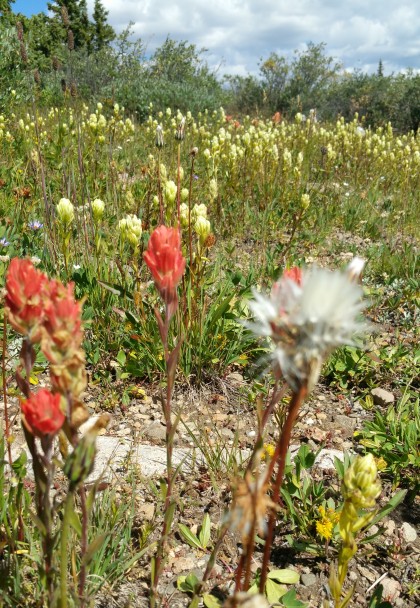
 Up here in the mountains the occasional aspen has begun to turn. The grasses in the mountain meadows have lost their intense green. The angle of the sun has already lessened, casting deeper shadows. Orion is visible in the dark, clear night sky. Moose, elk and deer bucks have begun to drop the velvet on their antlers, preparing for the quickening of the rut. The bears become more brazen as their need for calories, more calories, before hibernation makes them feel an urgency.
 The orchestra of life plays this symphony all year as it responds to the conductors spring, summer, fall and winter, each with their own favorite tempo. The elemental nature of the West makes the composition here often raw, sometimes going as far as dissonance during the chinooks, or a dry summer month, during a blizzard, yet it is usually majestic with soaring blue notes and the babbling background music of mountain streams and bugling elk.


 Vast, blue sky with puffy white clouds. Jagged mountains and flat plains, forests and wildlife. Wildfire. Snow, rivers, a few lakes. Air, earth, fire and water. The West is so elemental. It’s no wonder that it has enlivened the imagination of those who visit it or read about it, yet is so difficult a place to live. Here the natural world apart from the built world (also natural in its way) dominates. The cities like Denver and Salt Lake City, Cheyenne and Boise, Vegas, Tucson, Phoenix are islands, admittedly big islands, but islands nonetheless, of concentrated human habitat. They disappear around the bend of a mountain pass, or are obscured by arid land with few towns.