Gabe yesterday hunting for bones on Black Mountain
Gabe came in yesterday afternoon (He’s with us due to no school on Friday.) and said, “Grandpop, there’s birds in the sewing room.” Huh? Kate’s sewing room, the old garage remodeled by the last owner, opens to the outside and due to the bug free environment here–at least relative to Minnesota–we often keep the door open so the dogs can go in and out. Easier on all of us.
Sure enough, there were two small sparrow sized birds in the sewing room, fluttering and searching for places where they could see light, unfortunately mostly through windows. I opened windows, left the door open and began to talk to them gently, encouraging them to find their way outside. Gabe, unbeknownst to me at the time, had named them Jerry and Billy.
Jerry and Billy somehow found the window above Kate’s sewing machine a possible escape portal. Nope. Closed. Billy fluttered up by the top of the moveable bottom half of the window; Jerry chose the window sill, trying to push through the unexpected and unseen barrier with no luck.
Then. Rigel, who had come in the open door, looked over, saw the poor fluttering bird, ran over there and grabbed Jerry in her mouth.
Gabe, “Oh, no.”
Jerry seemed lifeless after Rigel took him in her mouth, not gently at all, and bit down. She took Jerry outside, finished him, then ate him, most of him. Gabe later buried the one wing and mostly empty body cavity in the front yard. He said, “I had fun burying Jerry.”
Hobbes said, “Life is mean, nasty, brutish and short.” I’m sure Jerry would agree.
A couple of months ago I joined a new group at Beth Evergreen, one designed to provide leadership for continuing to integrate mussar (Jewish ethics and an approach to spirituality) into synagogue life. The group’s work involves deepening our own practice of mussar and through that enhancing the practice of others.
In the first month we focused on-hmmm, I don’t recall, which is telling. I felt embarrassed when we got together to discuss our practice because mine had not gone well. The next month, I resolved, would go better. That month, the month of Elul, ended on September 20th, the day before erev Rosh Hashanah, New Year’s eve, or the first of Tishrei. We meet again next next Wednesday.
Mussar identifies soul traits that come from within the Jewish tradition, but have universal application. That is, though mussar is a particularly Jewish approach to ethics, it can have application for anyone. According to Mesillat Yesharim, the medieval text we’ve been studying for the past year plus, these traits develop in a particular seder, or order.
The first trait, according to this book, is watchfulness. The subtle permutations of each soul or character trait get a good deal of attention in Mesillat Yesharim (The way of the righteous) but the first task is to get a grasp of the trait. Watchfulness correlates to mindfulness, to self-awareness, and I relate it most to the Greek know thyself.
Awe, or hitlamdut* in Hebrew, being a learner, being in a constant state of curiosity/awe, was the middah (soul trait) for last month, Elul. This month, Tishrei begins with Rosh Hashanah, and its tenth day is Yom Kippur, the day of atonement. The period from Rosh Hashanah are collectively the Days of Awe, the High Holy Days in the Jewish liturgical year. Awe is central to the experience of the most sacred days of the Jewish year.
In my mussar practice for the month of Elul, I committed, once again, to journaling and to using a focus phrase. Mine was, Say Awe, a yellow post-it note is on my computer tower. Over the month I have noted moments of awe using Keep, a note-taking app on my smartphone.
The first morning of this new practice I got up at 4:45, fed the dogs as usual, then went outside to walk up the stairs to the loft. On clear nights, most nights here on Shadow Mountain, the starry sky is a wonder all on its own. This night though had something special to kick off my days of awe: Orion had risen. Readers of this blog may recall my special relationship with Orion, one begun on lonely nights in the guard shack where I worked during my senior year of college.
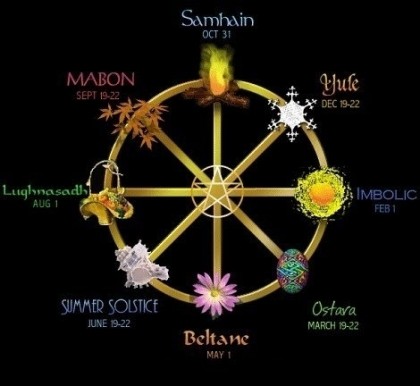
Orion returns as the Great Wheel turns into fall, the beginning of my favorite half of the year, reaching its high point (low point?) on the Winter Solstice. Each year since 1968 Orion has returned as a friend, a companion during lonely, dark nights. It gladdens my heart to see him since he only visits during this time. His return on this particular night was awe-some. Orion got me started on a month of awe.
As the month has progressed, I have encountered many moments of awe: realizing the heat on my face had traveled 93 million miles through empty space, being aware that each night I go unconscious, taking myself out of the much more familiar waking world, Black Mountain appearing in the morning as the sun burned off its misty shroud, experiencing sonder-the realization that each person you pass has a rich, full life and that you will never know it. At the dentist’s office for a teeth cleaning, alone in the chair and waiting for the hygienist I went into a revery about light, light bulbs, electricity, the wonder of human invention, the evolution of teeth, the astounding reality that each of us are the current instances of an unbroken line of successful procreation, a line of procreation that began with the very first one-celled organism.
As I followed this practice, this mussar practice, deeper into awe, I discovered I could summon an experience of awe at will. And, that I’d been doing something like this for a long time.
Here’s an example. Kate and I enjoy eating at the New York Deli, an authentic Jewish deli that happens to be on our route into Jon’s house. We went there a couple of weeks ago and I ordered a white fish platter. It was huge. There was white fish, dollops of cream cheese, capers, tomatoes, onions, lettuce. On the side were two bagels, sesame seed as I had requested. Awe was on my mind so I looked at the platter. This meat came from a white fish that swam in some lake, it’s a freshwater fish, not too long ago. It had to be caught, selected, preserved (probably through refrigeration), processed, packed, stored and shipped. Then it had to be opened, divided and placed on my plate. Imagine all the individual people involved, all the different modes of transportation: boat, truck, maybe rail, maybe airplane. The cream cheese: specific cows were milked, the milk pasteurized (Louis Pasteur), chilled, then sent to a dairy somewhere and used to create the cheese which likewise had to be transported here to end up on the plate. You can see how this goes. The wheat in the bagel: sowen somewhere, cultivated over a growing season, combines in formation harvesting it, more transportation, milling, mixing the flour with eggs and yeast, baking. Growing the sesame seeds. The tomatoes. The onions. The lettuce. Do you see what an amazing, awe-some thing that white fish platter was?
My conclusion, right now anyhow, is that awe, far from being an irregular, occasional moment of OMG, is a matter of the perspective we bring to each life moment. If we choose to probe deeper, we can find the awe in the awedinary.
So, as I learned at the dentist’s, say awe.
*Hitlamdut
Hitlamdut/התלמדות – being a learner. Hitlamdut is central to R. Shlomo Wolbe’s mussar. Practicing Hitlamdut means adopting the perspective of being a constant learner. We are always just practicing and we never actually reach perfection in this life. A perspective of hitlamdut protects against arrogance and destructive self-criticism. With the perspective of hitlamdut, we try to see every experience from the 30,000-foot view. Rather than just being in the experience, or responding to it in negative ways, we recognize that we can learn from it.
A peculiar sequelae of my new schedule, afternoons remain inchoate. After the nap and before supper. Not sure yet what to do with that. Might be good for games and puzzles? I want to read then, too, and do Latin (or, Hebrew). Perhaps once kabbalah and Hebrew classes get cooking I’ll find this the natural time for that work. The issue is peculiar because once I’ve fed the dogs, gotten my writing done, finished items off my to do list and completed my workout, I’ve already had 7 plus active hours.
So after the nap there’s this, ok, you’ve done enough, kick back, relax feeling, yet it feels off since it’s still the middle of the day. Weird. These matters do have a way of resolving themselves over time, so we’ll see.
Kate was in fine fettle yesterday. [fettle, what is that? state or condition of health says the online dictionary. Makes sense. Also, oddly, as a verb: trim or clean the rough edges of (a metal casting or a piece of pottery) before firing]. Anyhow she felt good and I felt good seeing her feel good. She’s done a great job of adjusting to Sjogren’s, not easy at all, and days like yesterday are the reward. May she string many of them together.
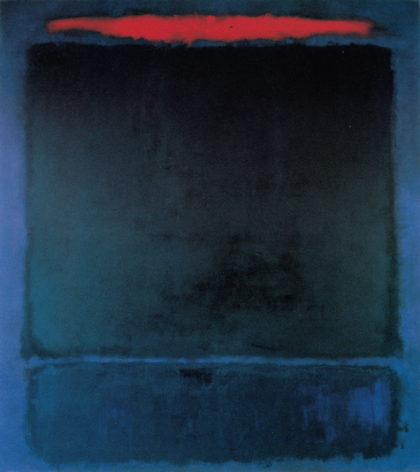
Been thinking about a new analogy for reimagining/reconstructing faith: the transition from representational to abstract art. I like the analogy because it reaches deep into prehistory to the cave art of Lascaux and Chauvet of 40,000 years ago. This tradition developed so powerfully that its underlying assumptions were simply not questioned. What would art be about but the reproduction of the human world in two-dimensions? Then, in 3, but still a man, or a god, or an animal. The introduction of perspective reinforced the representational, but did, I imagine, to the sensitive eye, give an inkling of the manipulation of space and color that really underlay art making.
No. 118 1961 by Mark Rothko
So called modern art was a radical break with this tradition. It happened as artists in many places looked at painting and sculpture with fresh eyes. They asked about the purpose of art, the purpose of paint on canvas, the purpose of reshaping wood and stone. What are the primary elements of the work? Color. Paint. Form. Space. Negative space. And perspective, did it have to be mathematical? Was there a perspective that developed simply through the use of color? (Cezanne) Did perspective have to be singular? (Picasso) Could a painting be nothing but color? (Morris Louis, Rothko, Kandinsky) What about painting or sculpting things that could not exist? (Man Ray, Dali, DuChamp)
mao trach dong
As artists began to consider the fundamentals, the unexamined assumptions of making art that had shaped its global expression since humans began making marks, though, that other tradition, the old representational one, did not die out. There were still portraits, still landscapes, still still lifes, sculpted men and women and animals and mythical beings of all sorts. This reimagining, reconstructing of art itself seemed to displace the older way, but only because museums became so dominant. There were modern art museums like the Walker and the Guggenheim and the Modern and the Tate which seemed to position the older, encyclopedic museums like the MIA, the Metropolitan, the Kunsthistorisches, the Louvre as showplaces of what used to be. Even the development of ateliers, who imagine themselves as the heirs to the older tradition, seemed to be an admission that the reimaginers had swept the field.
So what I’m proposing is not another religion with a different origin story, a different set of scriptures, different roots from, say, Hinduism, Zoroastrianism, Christianity, Islam. And what I’m definitely not proposing is a reductionistic attempt to find out what all religions have in common, nor am I proposing a sort of tolerance for all faiths, an attempt to learn from each of them (though this is a good thing to do) and out of that shape a new faith.
No, I want to play with the fundamentals of religion, those things that underlay the tradition of religious thought and practice. I say play advisedly because I think it was the playful aspect of the artists who questioned their tradition that made their work bearable. And, in making it bearable, made it accessible enough to thrive.
So, what are some of those fundamentals? Prayer, worship, gods, ritual, art, revelation, congregations, sacred space, the notion of sacred, divinity, after life, morality and ethics. How might a radical approach take the long history of prayer, for example, and reshape it, reconfigure it, reuse it for the person who chooses to stand outside particular traditions, but still wants to paint? Or, what about gods? How does the notion of powerful, unseen entities with various agendas fit into the life of persons no longer monotheists, no longer willing or able to see many gods?
I don’t even want to do what Emerson proposed. That is, have a religion of revelation to us rather than the dry bones of theirs. I want to examine revelation itself. What is revealed? Why is hiddenness so important to religion? What is revelation in a quantum mechanical world? Where is revelation? How are things revealed? How have things been revealed all along, but we didn’t notice? And why do we care about a world beyond the one we experience effortlessly?
Weather forecast says snow beginning at 5:30 a.m. It’s 5:10 right now. The first snowfall is still magical to me, after all these years. Snow is gentle, quiet, transformative. Its return ushers in the fallow season, the time of holidays, of holiseason. The forests become different places, too. Streams will run under ice. Tree branches will have loads of snow ready to drop on unwary hikers. Snowshoeing and skiing. Then there’s the feeling of sitting in a warm house, watching snow accumulate, not having to be anywhere-thank you, retirement-maybe some hot chocolate and a good book, a movie.
We had a soaking, all day rain yesterday. Very humid east, not so much arid west. Temperatures were cool during the day and down to 35 degrees last night. After a busy week, having Saturday as a quiet day was good.
The now not as new work schedule has taken hold, at least the before lunch part: Ancientrails, Jennie’s Dead, breakfast, news and e-mails, workout, lunch, nap. The after nap portion, which was to be Latin and reading until 5:00 or so, has still not solidified.
Any schedule has its rhythm broken by errands, medical appointments, maintenance matters like oil changes for the Rav4, scheduling folks to handle things like boiler inspections, circuit breaker fixes, but over time I’ve learned that simply returning to the pattern usually keeps me moving me forward.
That’s especially important for workouts, which are easy to forego. On Mondays, Wednesdays and Fridays, I do 20 minutes of cardio, then resistance work, then 20 more minutes of cardio. On Tuesdays, Thursdays and Saturdays, I do the high intensity cardio plus 50 minutes or so slower cardio. If I miss a Monday, I go on to the high intensity, slow cardio day. If I miss a Monday and a Tuesday, I still go to the 40 minutes of cardio, resistance work day. For me, keeping the same workouts on the same days of the week keeps me from feeling guilty (I’ve missed so many workouts, it doesn’t make sense to even try and get back to my schedule.) and guilt stops the process altogether.
Of course, there is the question of why keep at it? At 70 it would be possible to argue that the pace of life should slow down. Why keep pushing, especially if self-esteem doesn’t demand it. And mine doesn’t.
The third phase is new. It used to be that 65 or so meant the end of a working life, retirement happened, then death, often before 70. Those that made it into their seventies were often burdened with serious medical problems that drained energy and created obstacles to doing much else.
In 1960, when I was 13, U.S. life expectancy was 69.7 years. In 2015 it was 79 years. Our perception of age is not shaped so much by our experience of age itself, but by our attitude towards age created when we were not aware they were forming. In the working class community where I grew up until age 17 65 was retirement and death, at least for men, who were the primary workers then, followed 18 months or so later.
In other words, when I learned what being old meant, it was basically work, stop work, die, and the ages around which those latter punctuations occurred were before seventy. Life after seventy had no shape, no coherence, except frailty, nursing homes, dotage. (for, as Kim Jong Un says, dotards.) Though is no longer true, and has not been for some time, by 1990 the average life expectancy had risen to 75 years, my inner image of aging was shaped in the 1960’s world of Alexandria, Indiana.
We try to adjust to changes like these, but the patterns of our childhood often shape our beliefs about what’s possible. If work stops at 65, what comes after that? No work? No ability to work? Or, relief that work is over, so the 1950’s model of an ideal retirement, gold or canasta or bingo or photography. Life after 65 meant hobbies, doing things you’d put off doing, then dying. But in fact life after 65 was so short for most people that getting traction for some new phase of life, a phase with no work and the responsibilities of in-home child rearing completed, didn’t seem to make much sense.
70 is not the new sixty. It’s the new 70. What 70 is the new sixty really means is that for those raised in the 50’s, 70 now appears like age 60 did when we were kids. Big difference though…we’re in that sixties range of health, but we’re 70 and work has fallen away, the kids are gone. What do we do?
So far my response has been to do what keeps me physically, intellectually, emotionally and spiritually engaged. Why? Because the alternative is the Barcalounger, favorite tv programs, the occasional extended family meal, then the funeral home. The old model of retirement, what our financial consultant Ruth Hayden called the finish line model of retirement, was sort of like forever recess, a surcease from the demands of the boss and the day-to-day demanded non-work like activity, otherwise what was the point of retirement?
Now, though, retirement really means (for those of us financially secure anyhow) a change in who determines how we spend our time during the day. We do, not the workplace. If we take on that responsibility with the image of the 1960’s in mind, we take a breath and try to imagine what we always wanted to do when weren’t working. The more pertinent question, it seems to me, is really who do I want to be?
Yes, retirement and the life following it, the third phase as I call it, is just that, a new and different time of life, one in which the question of how do I live can have a radically different answer than in the first two phases. Who are you? Who do you want to be? If you want to be a person whose constant focus is recreation, who gets up in the morning for another day of adult recess, you can. If you want to be a dress designer after years as a forensic engineer, you can. Or, as in my case, the work before retirement age was satisfying, self-directed, so there’s little reason to change just because some age-related cultural turning point has been reached.
What this means for me is that as long as I am able, I’ll continue to write, to read, to research, to stay engaged in current happenings. I’ll keep at my spiritual growth, stay connected to friends and family. I’ll work out and do what I can around the house. When I can no longer do these things, if that time comes, I’ll reassess. Death is always ready to greet us, we don’t have to accelerate the process.
A couple of weeks ago I went in for cataract and glaucoma exams. Then, Wednesday, my hearing aid stopped working. I’ve also been a little short of breath, not unusual up here at 8,800 feet and my oxygen saturation is ok. The good news is that neither my cataracts nor my glaucoma have worsened and my hearing aid got unblocked by the folks at Hearing Rehab. And the shortness of breath does seem to be a response to altitude and not a failing heart.
These are what I call mortality signals. None of them, in themselves, are fatal; but, like my sudden hearing loss at 38 in my left ear, they are blinking yellow lights, caution, fatal error ahead. Birth is a mortality signal, too, of course.
Instead of pushing these signals into the background of my mind I like to embrace them, take the hint of life’s progress towards its entropic end. Nope, not gloomy or depressive, in fact, the opposite. Energizing, gratitude producing. I’m still here and functioning. Happy to have awakened this morning, happy to have a day ahead with Kate and the dogs, happy to have my loft, happy to be in the mountains. Joyful, even.
There’s a message about prayer here though I’m not clear yet on what it is. In response to Rabbi Jamie’s focus on prayer for the High Holy Days, I’m trying to reimagine prayer from a spot outside the Jewish tradition, reconstruct the concept of prayer without the Talmud, the Torah, the long history of Jewish prayer books.
Here’s where I am so far. Prayer is, at its most basic, communication. Important communication, significant to the prayer on the most critical matters in the life of the spirit. Prayer is also, at its most basic, the creation and sustaining of a relationship.
There are many sorts of prayer: supplication, petition, praise, anguished, thankful, angry, loving, contemplative, meditative, even constant. There are also communal and intercessory prayers, prayers of commitment and prayers of repentance.
So the question is prayer from whom to whom? Or, from whom to what? What is the relationship that prayer nurtures, why do I want to sustain it? Why is that relationship important? How is prayer different from other forms of communication, of other ways of creating and sustaining relationships? Or, is it different?
Friend Bill Schmidt, cyber mage, sent me a link to this New Yorker the article, The Nazi Sites of Los Angeles, and wondered about my reaction. Here’s what I wrote to him:
“Well. There are two responses, both right, in my mind, but somewhat contradictory.
The first is that there has been a rise in anti-semitism in schools here in Jefferson County. Beth Evergreen and the anti-defamation league have been in conversation with the various school’s leadership and promoted responses that you might expect: curriculum about the Holocaust, anti-discrimination, anti-bigotry workshops for students and teachers, that sort of thing. This increasing anti-semitism seems, at least to me, given license by our bigot-in-chief. His rhetoric, whether explicitly anti-semitic or not, encourages those who fear the other-any other not white or evangelical. And yes, Never again, does come to mind.
The second response, made by a woman from Beth Evergreen whom I know, appeared just this week in the Canyon Courier as a letter to the editor. She said that the kids were not the problem and that convocations on discrimination, curriculum additions would not solve the problem, which she identifies as rooted in the home. This backs up something another woman, Tara, said when she dismissed much of the school brouhaha by saying it was kids trying out various attitudes. Both Tara and Lisa, the letter writer, see the uptick in anti-semitism as only to be expected in an environment where hatred is a family value, one passed down through the generations.
It’s a little strange for me, being in but not of the tribe, a privileged fellow traveler, to notice that I experience these attacks more personally now. These are acts against people I know, whom I care about, some of whom I’ve come to love over the past year. Rabbi Jamie, in his sermon Wednesday night for Rosh Hashanah, referred to Beth Evergreen as a family. Now, that can be a canard, a something religious leaders like to imagine is the case, but I have to say I experience Beth Evergreen that way. It has become a real community, a family, for me, much in the same that the Woolly’s did-except here I have sisters as well as brothers. From within that sort of embeddedness I feel things as a part of this particular family of Jews, this Beth Evergreen congregation. I’m not of the tribe, but I am of Beth Evergreen.”
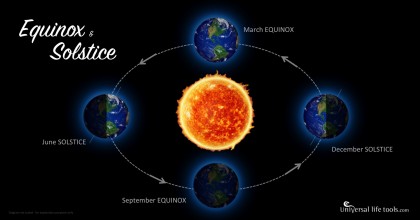
Today is the autumnal equinox. As the great wheel rolls on through the year, this is a day/night of balance, of night and day roughly equivalent. Here in the Rockies, on Mountain Time, the earth and sun are not, at the equator, tilted away or toward each other. The moment when this is true occurs at 2:02 p.m, MST. The day itself will be 12 hours and 9 minutes long. The 12 hours and 1 minute day doesn’t come until September 25th this year.
The notion of equinox though, equal day and night, reminds us that this astronomical event, sun and earth’s midpoint lining up, does mark a significant change. The light gradually increased from the vernal equinox to a maximum day on the summer solstice. Darkness gradually increases from September 25th to its maximum at the Winter Solstice, the longest night of the year.
For reasons I don’t fully understand, I prefer the six months of the year when darkness dominates. This period between autumnal and vernal equinoxes is my favorite half of the year. Here in the temperate latitudes-we’re 4 degrees north of the 35th latitude here in Conifer and temperate equals 35 – 55 degrees of latitude-this six months goes from the tail end of the growing season’s warmth to the slow release from winter’s cold that usually happens in late March.
Here in the mountains the streams have long ago drained off last winter’s snowfall; the aspen have turned golden. The cervids have begun their annual procreational dance. Sex is in the air. We have snow in the forecast for Monday and night time temperatures are in the good sleeping weather range for Kate and me. In Minnesota we could hear the Andover marching band practicing and here the high school football season is already well underway. Coats become an item of consideration when leaving the house.
It’s a time to consider the balances in your life. Has anything gotten out of whack that needs adjustment? Working too much? Seeing too little of family and friends? Or, too much? How about the diet of your choosing? Too much or too little exercise? Television? Social media? What other dialectics in your life might you examine?
Consider taking a cup of coffee (beverage of your choice) on one of these days with a just right temperature and going somewhere quiet. Investigate your life, probing for parts of it that may not be nurturing you right now. What are they? How can you make gradual, not sudden, changes that will help you become the person you already are? It may be that some of that work involves cutting something back or increasing something else, just like the temperate latitudes do with their light menu.
We can learn from the rhythm of day and night over the course of a year that each one, light and dark, nurtures different things, sometimes drastically different. Summer grows our food while Michaelmas, September 29th, is known by some as the springtime of the soul.


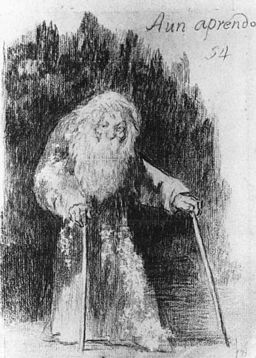
 Awe, or hitlamdut* in Hebrew, being a learner, being in a constant state of curiosity/awe, was the middah (soul trait) for last month, Elul. This month, Tishrei begins with Rosh Hashanah, and its tenth day is Yom Kippur, the day of atonement. The period from Rosh Hashanah are collectively the Days of Awe, the High Holy Days in the Jewish liturgical year. Awe is central to the experience of the most sacred days of the Jewish year.
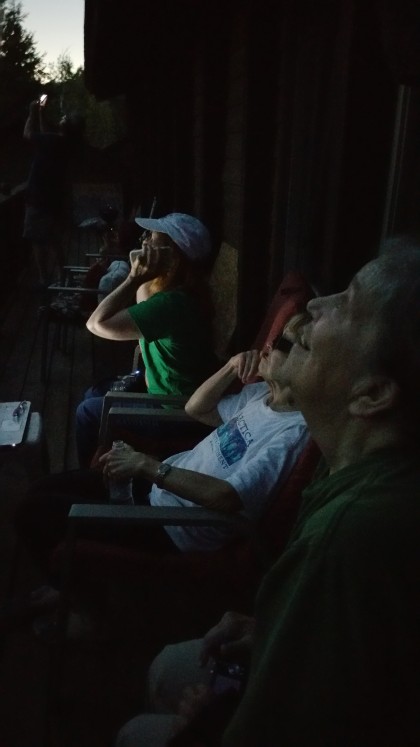 Orion returns as the Great Wheel turns into fall, the beginning of my favorite half of the year, reaching its high point (low point?) on the Winter Solstice. Each year since 1968 Orion has returned as a friend, a companion during lonely, dark nights. It gladdens my heart to see him since he only visits during this time. His return on this particular night was awe-some. Orion got me started on a month of awe.
 Here’s an example. Kate and I enjoy eating at the New York Deli, an authentic Jewish deli that happens to be on our route into Jon’s house. We went there a couple of weeks ago and I ordered a white fish platter. It was huge. There was white fish, dollops of cream cheese, capers, tomatoes, onions, lettuce. On the side were two bagels, sesame seed as I had requested. Awe was on my mind so I looked at the platter. This meat came from a white fish that swam in some lake, it’s a freshwater fish, not too long ago. It had to be caught, selected, preserved (probably through refrigeration), processed, packed, stored and shipped. Then it had to be opened, divided and placed on my plate. Imagine all the individual people involved, all the different modes of transportation: boat, truck, maybe rail, maybe airplane. The cream cheese: specific cows were milked, the milk pasteurized (Louis Pasteur), chilled, then sent to a dairy somewhere and used to create the cheese which likewise had to be transported here to end up on the plate. You can see how this goes. The wheat in the bagel: sowen somewhere, cultivated over a growing season, combines in formation harvesting it, more transportation, milling, mixing the flour with eggs and yeast, baking. Growing the sesame seeds. The tomatoes. The onions. The lettuce. Do you see what an amazing, awe-some thing that white fish platter was?
 A peculiar sequelae of my new schedule, afternoons remain inchoate. After the nap and before supper. Not sure yet what to do with that. Might be good for games and puzzles? I want to read then, too, and do Latin (or, Hebrew). Perhaps once kabbalah and Hebrew classes get cooking I’ll find this the natural time for that work. The issue is peculiar because once I’ve fed the dogs, gotten my writing done, finished items off my to do list and completed my workout, I’ve already had 7 plus active hours.


 So what I’m proposing is not another religion with a different origin story, a different set of scriptures, different roots from, say, Hinduism, Zoroastrianism, Christianity, Islam. And what I’m definitely not proposing is a reductionistic attempt to find out what all religions have in common, nor am I proposing a sort of tolerance for all faiths, an attempt to learn from each of them (though this is a good thing to do) and out of that shape a new faith.
 So, what are some of those fundamentals? Prayer, worship, gods, ritual, art, revelation, congregations, sacred space, the notion of sacred, divinity, after life, morality and ethics. How might a radical approach take the long history of prayer, for example, and reshape it, reconfigure it, reuse it for the person who chooses to stand outside particular traditions, but still wants to paint? Or, what about gods? How does the notion of powerful, unseen entities with various agendas fit into the life of persons no longer monotheists, no longer willing or able to see many gods?
 That’s especially important for workouts, which are easy to forego. On Mondays, Wednesdays and Fridays, I do 20 minutes of cardio, then resistance work, then 20 more minutes of cardio. On Tuesdays, Thursdays and Saturdays, I do the high intensity cardio plus 50 minutes or so slower cardio. If I miss a Monday, I go on to the high intensity, slow cardio day. If I miss a Monday and a Tuesday, I still go to the 40 minutes of cardio, resistance work day. For me, keeping the same workouts on the same days of the week keeps me from feeling guilty (I’ve missed so many workouts, it doesn’t make sense to even try and get back to my schedule.) and guilt stops the process altogether.
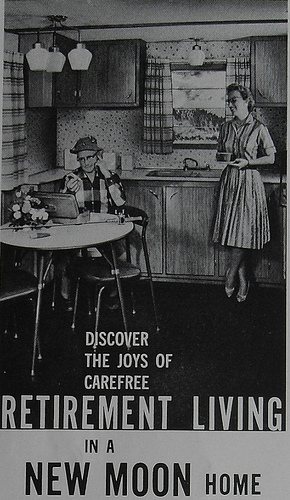 The third phase is new. It used to be that 65 or so meant the end of a working life, retirement happened, then death, often before 70. Those that made it into their seventies were often burdened with serious medical problems that drained energy and created obstacles to doing much else.
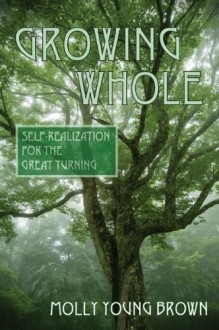 70 is not the new sixty. It’s the new 70. What 70 is the new sixty really means is that for those raised in the 50’s, 70 now appears like age 60 did when we were kids. Big difference though…we’re in that sixties range of health, but we’re 70 and work has fallen away, the kids are gone. What do we do?
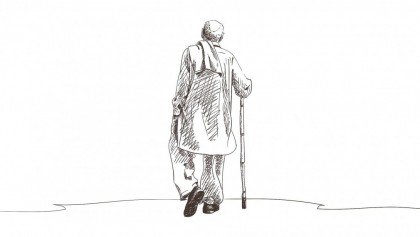 Yes, retirement and the life following it, the third phase as I call it, is just that, a new and different time of life, one in which the question of how do I live can have a radically different answer than in the first two phases. Who are you? Who do you want to be? If you want to be a person whose constant focus is recreation, who gets up in the morning for another day of adult recess, you can. If you want to be a dress designer after years as a forensic engineer, you can. Or, as in my case, the work before retirement age was satisfying, self-directed, so there’s little reason to change just because some age-related cultural turning point has been reached.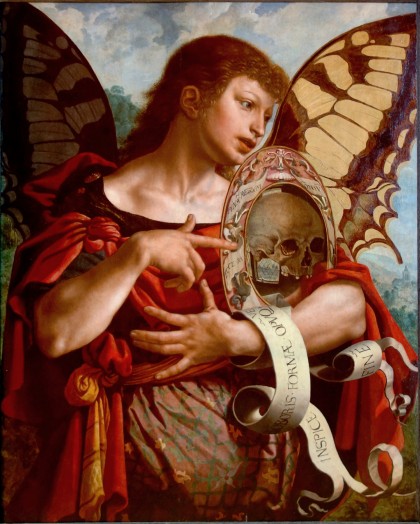
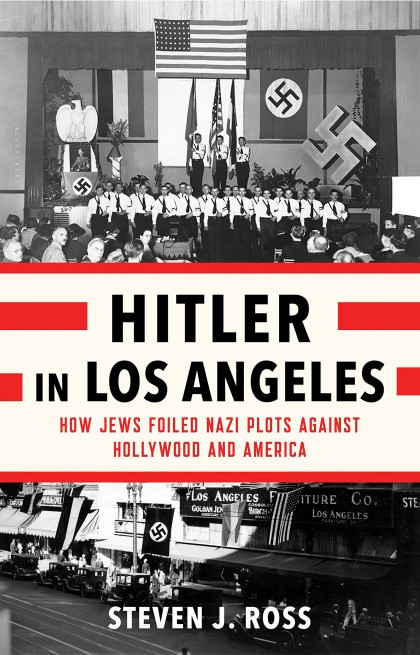 Sites of Los Angeles
 Here in the mountains the streams have long ago drained off last winter’s snowfall; the aspen have turned golden. The cervids have begun their annual procreational dance. Sex is in the air. We have snow in the forecast for Monday and night time temperatures are in the good sleeping weather range for Kate and me. In Minnesota we could hear the Andover marching band practicing and here the high school football season is already well underway. Coats become an item of consideration when leaving the house.