
Garden Theme for 2010: Consolidation

Imbolc                                       Waxing Wild Moon

At this time of year gardeners begin to develop x-ray vision, seeing through the snow, ice and frozen  soil and imaging the greening.  Those of us who rely on memory more than paper try to envision what we’ve got in the ground, sort of the botanical base line.  Perennial flowers and plants, which make up the bulk of our terraced gardens, have an established presence.  We add in some annuals as the spirit moves, sometimes we divide existing plants like hosta, hemerocallis, iris, Siberian iris, liguria, bug bane, dicentra, aster.  Once in a while we plant new bulbs.  None last fall, for example, but that gardensenscence09probably means some this fall.
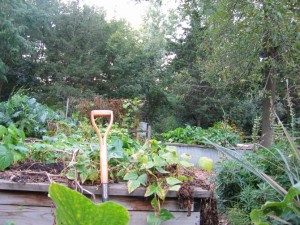
(pic:  where we left off last fall)

This part of the garden requires work, but not as much as the vegetables and the orchard.  I count it is a known quantity.

The permaculture additions, of which we have made several over the last three years, are still new to us, requiring attention and learning.  This year, I’ve decided, will be a consolidation year.  Nothing new, making what we have work as well as we can.  That means planting vegetables in two categories:  kitchen garden for eating throughout the summer and early fall and vegetables for storage over the winter:  potatoes, garlic, parsnip, carrots, greens, squash  those kind of things.

There is a good bit of work to be done repairing Rigel and Vega’s late fall destruction.  That won’t be repeated because we have a small fortune in fencing around the vegetables and the orchard, but I lost heart last fall and didn’t get the netaphim repaired and earth moved back into place.  That awaits in the spring.

In mid-March I have the bee-keeping class and this year I have the same consolidation idea for the bees.  Establishing the hives as permanent parts of our property.

We do have a couple of smaller non-garden projects that need to get done.  I dug the fire-pit two years ago, but with all the fun of the puppy’s last summer never got back around to it.  It needs finishing.  I also want to turn the former machine shed into a honey house, a place to store bee stuff and to process the honey.  Of course, we actually have to produce some first.

An Andover Olypmics?

Imbolc                                      Waxing Wild Moon

The winter olympics could have been held in Andover this year.  If we had any mountains.  We’ve had snow and cold, the key ingredients.  Also, Lindsey Vonn and her husband could have stayed in Burnsville instead of Olympic Village, maybe gotten a few runs in at her home hill, Buck Hill.

Well, it’s the olympic world’s loss.

(Yayoi Kusama
Untitled, 1967
Barbara Mathes Gallery, New York)

Kate made my/our favorite cookies today.  She also made chicken schnitzel and a warm potato salad with sweet onions last night.  Boy was that good.  All that and she cooks, too.

Chapter 6 of Wheelock is under my belt and Kate’s working on it right now.  We’re skipping this week so she can catch up.

I don’t have a tour this Friday, but I do have a Legcom meeting on Wednesday and the docent discussion group tomorrow, focusing on how to discuss contemporary art.  This conversation will be led by an educator from the Walker, a connection made by Allison.  Should be a big help for the contemporary art exhibition:  Up Until Now, coming later this spring.

Whee!

Imbolc                                    Waxing Wild Moon

Here’s a revelation it’s strange to have this late in life:  I enjoy learning for its own sake.  Now I knew that at one level or another before, it’s true, but here’s what I’ve just learned.  After I finished my workout this evening, I went back to working on Latin translation.  At first I approached the Latin like school, do the work, get it right, then do more work, get it right.  So on.

But tonight as I sat there puzzling out the meaning of the sentences and the word endings, I realized I was having fun.  This was no longer a goal oriented, hoop-jumping exercise, but something I simply enjoyed.  Like, I don’t know, playing checkers or basketball or chess or dancing.  Strange, huh?

Maybe it’s always been this way for me, I don’t know.  It feels like a secret, something I shouldn’t tell, but there it is anyhow.  At 63.  There’s always something new around the corner.

Kate and I had an African evening.  We finished the first season of the HBO series, The First Ladies Detective Agency.  We read all these quite a while ago.  The casting for the series is spot on and seeing the Botswana setting makes the stories come alive even more strongly than in the books themselves.  After we finished the last episode, we watched Duma, a story of a South African boy and a cheetah he raises from a cub.  It has the usual boy reluctantly returns animal to the wild, the animal comes back for one last hug sort of plot line, but with some unusual depth added by his long journey from Capetown back into the bush with Duma, the cheetah and a man he meets in the bush.  Both of them are well worth  watching.  Not my usual dark fare, but good anyhow.

What Good Is Philosophy?

Imbolc                            Waxing Wild Moon

“Science is what you know, philosophy is what you don’t know.” – Bertrand Russell

In spite of what I said yesterday I have listened to the opening lectures on of a history of philosophy course.  In the first lecture the professor teased out three notions of what philosophy is:  1.  A search for answers to the perennial questions, 2. A love of wisdom and 3. A quest aimed toward the unknown.

Each of these makes sense to me in their own way, but it is the 3rd idea I want to explore.  Russell’s quote nails it so well.  In this understanding of philosophy the discipline performs the early thought experiments, theorizing and critique out of which grow many others.  Science and the scientific method grew out of early philosophical speculations about the nature of reality, such speculation goes back to the very beginning of Western philosophy in the pre-Socratic philosophers of ancient Greece.  Once regular methodology and empirical data begin to define a new discipline it pulls away from philosophical thought into its own domain.  Psychology is another example.  Theology put philosophical rigor in service to Christian faith.

The ongoing rhythm of philosophical investigation leads to many answers to the same problem.  This in turn leads to skeptical thinking which observes that many answers to the same question does not make sense.  Then a consolidation occurs which often develops into a cohesive new line of thought.

A good example of this process going on right now involves the philosophy of mind.  At issue is the nature of consciousness, the existence or non-existence of free will and the nature of the self or the individual.  Pretty fundamental matters, especially when we consider what it means to be human.  The back and forth of philosophical speculation in these areas courses past the limited tools we have for empirical investigation into the brain.  Some people say we will never solve the problem of consciousness because the investigation requires consciousness  itself.  I’m in this latter camp.

All I wanted to observe here is the interesting result of philosophical speculation:  disciplines develop and move away from home, leaving philosophers once again wrestling with the unknown.

An Arty Day

Imbolc                                        Waxing Wild Moon]

The museum had lots of visitors today.  Many, the ones I toured among them, were there on a school outing.  Others, a surprisingly large number, came for the foot in the door show.  Foot in the door is an installation done by the museum every 10 years.  Any one in the state can enter an object so long as it fits in a one foot by one foot by one foot cube.  If you work meets that test, you’re in the show.

That makes for a scene like one I witnessed at the ticket counter.  An older man and his wife came up to the counter.  He said, “I’ve never been here before, but my son has a piece in the museum.  I want to go see it.”  He said that with a feeling of pride.  A lot of the people going through this show looked to me like first time museum goers.  I overheard a woman say in the gallery, “A person that knew about art could tell.  Some of these people have real talent.”  She was right.

Foot-in-the-door fully occupies two large galleries, a smaller one and still spills out over into the halls.  There is so much to see that three or four visits would only give you a first pass.  A treat.

The kids I toured today from St. Francis were a Spanish class and wanted to see Spanish art.  On both tours, though, I took them to foot-in-the-door, too.  These are living, working Minnesota artists, many young folks.  I told them if they wanted, at the next show, they could have a piece in the show.  They loved the crazy variety.  The boys were taken by the fact that there was .45 revolver entered.  They took pictures of it with their cell-phones.  Another kid liked the alarm clock.  Still another liked, as I did, a cubic foot of broken eggs glued back together.

These kids really took to cubism and surrealism, grasping quickly the rather tricky shift in artistic purpose that these two art movements put into the world.  It surprised me some, but they really enjoyed the quirky nature of synthetic cubism and the irrational nature of surrealism.  Both fit the teenage moment.

Back Into the World of Art

Imbolc                                   Waxing Wild Moon

Kate and I didn’t get a chance to check our work before getting on line with Greg, the Latin tutor.  It showed.  Turns out doing this together has a great learning benefit for both of us.  Makes me think retirement with this gal’s gonna be fun.

The continuing ed at the MIA has left something to be desired lately.  It used to feature art historians, visiting curators, folks like that, now it’s often education staff or something related to process not content.  There’s nothing wrong with the education staff, but they did the docent training.  At the continuing ed events I like to hear outside perspectives, other modes of scholarship, punchy ideas.

Matthew Welch, the Japanese curator and the head of a curators at the museum, has those scholarly credentials and he takes great care to make his material useful for docents.  He was to give a lecture today on a piece of Japanese armor the museum purchased.  I drove in to hear him because I respect his work.  A lot.  Problem is, they canceled the event by e-mail at 10:45.  I used that time to prep for my tours tomorrow, got on the phone with Greg, then took off for the museum.

No lecture.  Turns out they had some leakage in the admin wing.  Not such a big deal in some ways, but the leaked happened onto Matthew’s computer.  He’s such a meticulous speaker and uses so many good slides that it wasn’t possible to do the lecture.  A shame.  We’ll pick it up some other time.

Spent three hours getting ready for my first tours since mid-December.  A group from St. Francis high school, just up Round Lake Boulevard about 7 or 8 miles from home.  They want Spanish art.  As it happens, I got assigned to start on the third floor on the east side of the building which means our Goya is the first painting I can use.  That means I move from Goya to the cubists and from the cubists to the surrealists, then onto the mannerists and, if I get that far, end in the baroque.

(El Greco’s Burial of Lord Orgaz)

Going that direction I discovered (for me) an interesting relationship between cubism and surrealism, major art movements at the turn of the 19th century into the 20th, and the mannerists, a style situated between the high renaissance and the baroque.  The two more modern movements used Cezanne and African masks to jump away from illusionistic realism, that is, realism with perspective that attempts to fool the eye into thinking a 2-d image is 3-d.  Cubists took reality apart and put it back together from different perspectives, often using geometric shapes.  Surrealists wanted to peak inside the unconscious and  splay it out on the canvas.  Turns out the mannerists pushed off against the high polish and perspective of the High Renaissance, such masters as Raphael, Michelangelo and Da Vinci.  They turned away from vanishing point perspective, went for spiritual intensity (the unconscious?) and used elongated figures and asymmetrical composition to distinguish their work from the preceding period.

Someone else noticed this a long time ago, I’m sure, but it was fun to put it together.

Guts and Points

Imbolc                                    Waxing Wild Moon

Lindsay Vonn under the wild moon in Vancouver.  What a performance.  I referred a few weeks back to Michael Jordan’s game against Utah in the NBA finals.  He had the flu, was obviously sick, but put up a triple double and da Bulls won the game.  This was better.

Vonn, skiing with a deeply bruised shin, plummeted down the 1.8 mile long, rock hard ice of the Olympic downhill course, favoring her right leg, favoring it so that she took the weight on her inside leg in turns and even skied the last several yards to the finish line on one ski.  Imagine the physics of that.  And won the gold.

I don’t know if anything in sport is actually heroic, but this run was a monster testament to the human spirit, the will to win and the ability to block out pain when in pursuit of a goal.  Her reaction at the bottom matched her run.  She jumped, squeaked, pounded her fists in the air, lay down, cried, ran to her husband to cry some more, smiled and made others smile and cry along with her.  And to think she learned to ski at Buck Hill.  Go Minnesota.

The flying tomato deserves a nod, too.  I don’t know whether snowboard half-pipe is a sport, but it’s certainly athletic and Shaun White, he of the long red hair and the dazzling smile, showed the heart of a champion.  He won the competition on his first run with a 45+ score out of 50 without laying down his public secret trick, a 1280 Double McTwist.  On his second run, when he could have coasted, instead he took his last run up the pipe to launch, execute and land this trick.  I saw it and I don’t get it, but the crowd and the judges did.  He got a 48.4 on his final run.  In other words, he increased his score after he had already won the gold.  An entertainer.

A Bit On Science

Imbolc                                      Waxing Wild Moon

As the Great Wheel turns, as the earth flies in its unimaginably long ellipse around the sun, we go on pretending in a terra-centric universe.  The sun rises?  The constellations rotate through the sky?  The moon rises and sets?

It’s no wonder the Catholic church was so reluctant to buy it.  I mean, who was this guy Galileo and this other guy Copernicus compared to the Church Fathers?

Woolly Buddy Tom Crane surprised me at our recent retreat on a matter related to this.  I’d read a New Yorker article about the execution of a man in Texas convicted of arson in the death of his children.  The point of the article was to demonstrate that an innocent man had died as a result of our use of capital punishment.  It did this by using a renowned arson investigator who critiqued the arson investigators who sealed the man’s fate.  (I just did a quick look and I can’t find the article right now.  If I find it, I’ll post a link here.)

Anyhow, I mentioned it to Tom, a forensic engineer, and he said, “Oh, yeah.  Evidence-based science.  That’s we talk about all the time.”  He went on to say that it was a great tragedy.

What struck me though was this notion of evidence-based science.  My first reaction was, is there any other kind?  Then, I realized:  intelligent design, climate change deniers, any time ideology substitutes conviction for evidence, we risk non-evidence based science.

It was Francis Bacon in his Novum Organum who made the wonderful analogy about method.  If, he said, your method chose the wrong path for you on which to run, running faster would only take you further from your goal.  He proposed that method was all and that the empirical method was the right one for science.  This idea did not catch on overnight and there are still realms it has not penetrated, most notably of late of course, the GW Bush Whitehouse.

The Week So Far

Imbolc                                       Waxing Wild Moon

Another day in the world of ancient Rome.  Translation continues to be fairly easy for me, though there are certain cases that give some trouble.  So far my learning has kept pace with the chapters.  I hope that continues.

Kate got pretty weary at work on Monday.  She saw too many patients.  She’s rebounded today, though and I think that’s a good sign for the future.

Kona, our largest whippet, has a fancy yellow bandage on her right rear leg after having what we believe is a benign growth removed yesterday.   She also has a water resistant sleeve over it, the Medi-Paw, that allows her to go outside.  A good thing.  Like most dogs I’ve known she simply ignores whatever discomfort she’s experiencing and does most of what she did before.  I was laid up for two months plus after my achilles surgery.

Now a bit on the novel.  Decided I had to start writing again, even though I’m revising, too.  I feel too disconnected from its flow.  Revising is important, but it doesn’t feel like an organic part of the process for me, at least not yet.

Don’t like the weather? Tough.

Imbolc                               New Moon (Wild)

We have more snow.  Not a lot, maybe a couple of inches.  It makes the whiteness fresh.

Some folks have begun to complain that this winter has gone on too long and that this snow insults us.  The weather is.  It neither goes on too long, nor stops too soon.  Our food may run out before the winter ends, but that’s our dilemma, not the weather’s.  Our patience may wear out with weather too cold or too snowy or too icy, but the weather comes and it goes, our attitude toward it is what needs to change, not the weather.  The weather may wreck our garden, ruin our crops, or give us bounty.  Again, the weather causes rain, heat, drought, cool days and hot nights, what use we can make of them or what harm they may create for our horticulture or agriculture reflects our needs, not those of the planet’s air and water circulation systems.

Better for us to adapt ourselves to the changes, to find in our lives the place for adjustment.  As Taoism teaches, we need to align ourselves with the movements of heaven.  This is even true of our political work.  We need to act politically in a way that utilizes the forces and realities of the moment rather than railing against their injustice or patting ourselves on the back for their justice.  This too is aligning ourselves with the movements of heaven.