All posts by Charles

Northern Spark

Beltane                                                                       Waxing Garlic Moon

1:03 AM with a sickle moon, stars and a warmish night fallen over the Twin Cities.  Just back from Minneapolis and the Northern Spark Festival.

There were lots of people, mostly in their twenties and early thirties, but not all.  I was there, for one.  As the organizer said, folks from other parts of the country can’t believe we roll up the sidewalks at 9:00 PM.  This event, which spread folks over several venues, made each place but one feel safe and accessible.  The feeling of people out, just out to be out, made me feel glad, joyful.  Walking along the River Road behind the Guthrie and the Mill City Museum reminded me of an evening I spent in Savannah a couple of years ago.

With one exception.  We have no small shops, restaurants and candy makers along the river.  We preserve our riverfront in a solemn, Scandinavian manner.  The upside is that it has not given way to tourist kitsch as parts of the Savannah area has; the downside is that it has no color, no life, only ruins and water.  Except for tonight.

I went to three venues after I realized the free bus ride would take two hours to get me back to my car.  I drove first to the MIA, walked to MCAD, then drove to the Walker and finally the area around the stone arch bridge.

The night itself was perfection.  I can’t imagine a more perfect combination of humidity and temperature and clear skies.  Not to mention the moon.

I began at the MIA because the Battle of Everyouth was a 10:00 to midnight affair and I wanted to be sure to see it.  Unfortunately, the only venue where it did not feel totally safe was this one.  The Battle of Everyouth, though it projected large, interesting images on the Museum’s north facing facade, did not have a very big footprint in the park, so the bulk of the park was dark.  This project, which I visited with some eagerness, was a bit underwhelming.  Part of that came from the darkness of the setup in a dark park.  It got swallowed up as a big event by the bigger park.  It’s primary impact may well have been the prep work with the kids from Washington High.

MCAD had three different venues that I saw and a couple I didn’t.  I’ll talk more about those tomorrow, but one, projected on a white wall just to the right of main entrance of the class wall featured a machine programmed by an artist with an algorithm that draws flowing shapes.  It got me attention.

At the Walker I revisited the show about Voyeurism and Surveillance and the It Broke From Within show again, too.  I wandered around outside, watching folks make small art projects and sat on the terraced wall and looked at down town.

The Stone Arch bridge had lots of people, the most of the three places I visited.  An excellent projection lit up the four grain elevators silos next to the Mill City Museum.  On the bridge there was the sperm and egg ride, a moving illustration of the classic of mountains and seas and a laser set up that baffled me as to its intent and its result.  but no horse on the barge.  I don’t know whether the floating white horse was elsewhere, but it was one I wanted to see and that I missed.

It was a fun evening, giving me a sensation I enjoy, that of being a tourist in my environs.  I hope it happens again next year and becomes bigger.  Maybe I’ll take a room in downtown for the event.
Bees and Dogs

Beltane                                                        Waxing Garlic Moon

Bee check this morning.  Colony 1 is about a week ahead of 2 and 3 due to my late release of the queens in those two colonies.  None of them have brood in the top box, though there is 400_honey-extraction_0225new pollen stores and honey.  They’ve only had the top box on for a week, so I’m not expecting much until the next hive inspection.  If I don’t see brood then, well, I don’t know what.

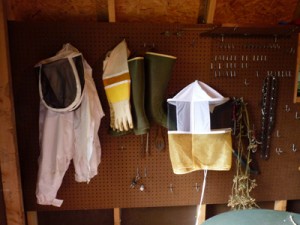
All three colonies look healthy, plenty of bees and plenty of room.  These bees, too, are so gentle.  I can inspect the hives with just a veil, a long sleeved t-shirt and gardening gloves.  So much better for the heat.

Each colony still has stored honey in the frames I put into the top boxes, the first one less than the rest, but they still have some.  I may need to get some feeder pails and some syrup, just to be sure.

I feel more confident this year, more sure of what I’m doing and what I’m looking for when I do a hive inspection, but I’m still a long way from a  knowledgeable bee keeper.

Mark has started a second round of work on the fire pit, a project stalled three years ago by lagging energy on my part.  He squared off the walls, has cut landscape cloth to put behind the granite paving stones I bought from the guy on Round Lake Boulevard and also put landscape cloth on the botton of the fire pit and covered it with sand.

Gertie went outside this morning and wandered around the front yard.  She moved slowly, feeling the trauma today probably more so than yesterday as the vet’s pain killer subsided.  She’s still on two pain meds though, tramadol and rimadyl.  I think she’s gonna be fine.  We’ve seen battle wounds before.

As I went to sleep last night, I said to Kate, “Just like an episode of Combat Hospital.”

Ripped Apart

Beltane                                                                    Waxing Garlic Moon

Pentheus gets ripped apart by his mother and her fellow Bacchantes.  The Guthrie’s production of The Bacchantes by Euripides several years ago gave the story a telling I’ve never forgotten.  It gave me a jolt.  I’ve moved on from Diana and Actaeon in Ovid to Pentheus.  His story begins about 250 verses further on in Book III of the Metamorphosis.  I’m not far into it, only about 12 verses, but already Pentheus’ fate has been foreshadowed by the great seer, Teresias.

My tutor says I’ve learned to spot and translate the verbs, a key first move, but I still have trouble picking out the subjects of the sentences. That’s what I have to work on for next week.

(Pentheus and his mom.  Pompeii. Romersk ca. 70 e. Kr. (Royal Cast Collection, Copenhagen)

Speaking of getting ripped apart, I came home from a lunch with Justin Fay, the Sierra Club’s lobbyist, to find Kate gone.  She had taken Gertie, our son and his wife’s dog, to the vet.  Yet another scrap broke out and this time Gertie ended up with seven spots that needed stitches.  The end result of this was, of course, a hefty vet bill and a hurried consultation between Denver and Andover over Gertie’s fate.

We resolved it this way.  Gertie has become a liability at Jon and Jen’s, growling at Gabe, 3 years old, nipping four neighbors and going after the postman, not to mention climbing the fence to get out.  So.  What to do?  I really like Gertie; she has a big personality, a bouncy vital way, but she is a mischief maker, a trickster.  Gertie will stay here with us and we’ll figure out how to manage our pack without any one getting hurt.  We’ve had to do it before when one of our Irish Wolfhound’s, Tully, decided that our Whippets were prey.

First step is to get Sollie back to Denver so we can reduce the number of dogs.  After that we’ll probably try letting Gertie and the big girls out again, hoping that the changed dynamics will have resolved.  If we have another spat, we’ll have to go to some management strategy, maybe a dog run outside, or having Gertie and one big dog at a time out.

We have Mark here now and Gertie will stay.  We’ve become a hostel.

Second Life

Beltane                                                                      New Garlic Moon

Rigel has spent the morning with a very worried look.  She doesn’t like thunder and barks at it to tell it to go away.  That doesn’t work well.

She’s not nearly as reactive as Tira, one of our Irish Wolfhounds, who somehow had it in her head that she was safest inside a vehicle.  That meant if a window in either the truck or the Celica had been left open, she’d jump inside.  My Celica still has her clawmarks in the upholstery.

In the wee hours of one morning I found her hanging worn out over the top of a chain link gate we used to keep the big dogs out of the garage.  She’d jumped it, but gotten stuck.  In her frenzy she ripped the truck license plate, which was within reach, to shreds and scratched up the truck hood.  The license plate cut her lip and there was blood everywhere.  I thought she was dead.

Running over to her, I lifted her off the gate–not easy, since even the smallest Wolfhound bitch weighs in at 150 pounds–with sheer adrenalin.  She struggled to her feet and looked very happy to see me.

Stayed up a bit late last night working on my avatar in Second Life.  Inspired by the presentation yesterday I decided to check out a virtual world.  There’s a learning curve to it.  So far my avatar, Quam, a Latin word for why, has ash blond hair and is wearing a get up cobbled together from an array of clothing options, none of which really suit me.  In this regard a typical male, however, Quam does not want to spend all his time figuring out how to be a clothes horse so his current outfit is good enough for now.

Quam learned how to walk, fly, push things, see up close, how to chat, how to change his clothes, but his meat package real world avatar got sleepy and had to go to bed.  Not sure I’ll stick with Quam, but if I figure out how to do it, I’ll get a snapshot of him and post it here.

Here’s the weird part.  I had dreams of flying and of going to the tops of buildings to scout the terrain.  I did both of these things in Second Life.  Hmmm….

Art Immersion

Beltane                                                                              New Garlic Moon

One of those days.  Into the museum, leaving at 10:30 am and just got back now, 6:00 pm.  Had a Japan Art Cart, oh boy, with very few visitors.  A group of autistic kids and a classical musician and his daughters stopped by and that was about it.  The art cart business is just too passive on the one hand and too intrusive on the other, i.e. we have to encourage people to stop.  On the other hand, I do love talking about the Japanese tea ceremony, a great gift to world civilization.

After that, and I mean right after that, the art cart closed up at 1:30 and the continuing ed for the day started at 1:30.  Celia Peterson gave a very interesting presentation on games and art, both physical and virtual games, as possible adjuncts to museum experiences and as art objects themselves.   It really cranked up my thinking about the possible, the nearly possible and oh boy I can’t wait until it is possible.

(screenshot from acmipark, a virtual version of an Australian museum)

Example.  How about a museum that displays its objects inside a virtual world like second life?  Or, a virtual museum where interaction with objects could bring up art historical, geographical, biographical information, for example, about an object that interested you.  This kind of stuff turns me on, makes me want to get involved.

After that a meeting on my direct action idea, a rolling, international projection of the artist’s image on museum walls from eastern Europe to California on June 30th, the night before the 90th celebration of Chinese Communism.  A docent has agreed to take the idea to our museum president.  She’s also president of an international association of museums that would probably make this pretty easy.  It’s a big, yet simple idea, and it would have plenty of media punch.  Hope it happens.

Books

Beltane                                                                              New Garlic Moon

When I get interested in something, I buy books.  Not just one book, but many books.  Book buying has always been an important of my life and continues to be.

Latin is a for instance.  When I first got interested, I bought Wheelock, an iconic text for autodidacts wanting to tackle the language.  At another point I bought a dictionary and a book, library2011-05-06_0874501 Latin verbs fully conjugated.  Once I begin to learn Latin and could see more learning ahead, I purchased the OLD, the Oxford Latin Dictionary, which is the gold standard of Latin-English works.  Thanks to Amazon I got one for a very good price.
At the same time I began to focus on Ovid.  I needed a Latin text without English, but with a commentary.  I found William Anderson’s.  It’s not bad, but it’s not as helpful to a real tyro like me as it could be.  I just bought a translation with commentary by D.E. Hill.  Again, the commentary leaves a lot to be desired from my amateur perspective.  I also bought a wholly Latin text by Richard Tarrant, a contemporary Ovidian scholar who has done careful research into the oldest texts available, all from the middle ages, 1100-1200.  I bought this last one because while learning Biblical interpretation I got stamped with the important of textual criticism.  Words matter and having the best text matters.

At this point, if I can’t find something on Perseus, the go to place for classics scholars, I have, so far, always found it in one of my books. I also have several books on Ovid and Roman poetry.  Each has helped me at some point.

I have similar collections of books for other areas:  Lake Superior, Biblical interpretation, theology, liberal thought, liberal religion, the enlightenment, the Renaissance, depth psychology, travel, China, Japan, Angkor, Ralph Waldo Emerson, neuroscience, Hawai’i, Minnesota and various other states, the Celts, Meso and Latin America, art, a nature/space/geography/history collection, poetry, philosophy, fairy tales, mythology, literature and graphic novels.  I rarely use certain collections until I find I need them, then I go deep.  That’s why I need to have them.  When I decide to get active on a topic, I don’t have time to go scouring for resources.  I like to have them at hand.

In the Garden

Beltane                                                                           New  Garlic Moon

One of those nights last night, unable to get to sleep, still rolling around awake at 1:00 a.m.  Up a little bleary.  Wrote  few e-mails, then out in the orchard, first.  I’ve had tent caterpillars on two trees.  Each time I have removed the tent and stepped on it or crushed the worms.  This is non-chemical pest control, a route I prefer and, as long as I’m not running a commercial operation, one I can pursue.

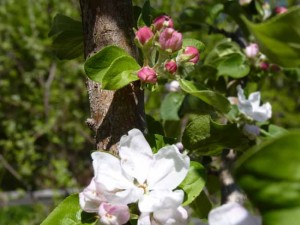
Now I wander in the orchard, looking at seed pods (fruit) beginning to develop from the last of the blossoms which dropped this week.  I’ll try to find worms and moths before they do 2011-05-17_0805early-spring-2011damage and as long as I can I’ll follow pinch and destroy.  After that, I think, right now anyway, that I’ll go with Gary Reuter, the bee rangler for Marla Spivak.  I’ll just put up with wormy apples.  This is partly out of regard for the bees who have enough pressure of them and they don’t need an added pesticide load from our orchard, but it’s more out of a commitment to no pesticides, grow strong plants and let them fend for themselves.  It’s worked reasonably well for me so far.
(before the fall)

After the orchard the potatoes were next.  Now that the soil has warmed up the potatoes have begun to grow, their dark lobe shaped leaves appearing atop a fragile looking stalk.  At this point the basics of potato culture involves mounding earth over the stalk as it grows.  That’s what I did today.  In the long raised bed where I have most of the potatoes this year, I also have a bumper crop of asiatic lilies and tulips.

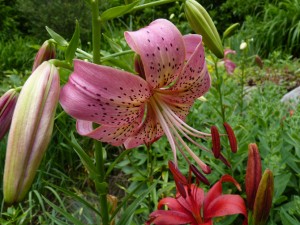
I planted this bed originally as a cutting garden, years ago.  The same fall the bed was built I went out to the Arboretum to a lily growers sale and bought Minnesota hardy bulbs.  They’ve been in that bed ever since, maybe 10 years.  Boy, have they enjoyed that bed.  They’ve started lilies all over the place.  That means that as I mound the potatoes I have to move around the lily bulbs that have generated.  I hate to just throw them away because they’re so hardy and have been with me so long.  I’m trying right now to raise vegetables and flowers in the same bed.  That’s also worked reasonably well for me.06-28-10_earlylilies

I also mounded the leeks as my last action in the garden this morning.  In the case of leeks the mounding blanches the stalk, keeps it white underground and increases the usable part of the leek.

That done, I’ve come inside to work on my Latin.  Pentheus, now, Book III:509-to the end.

Blue Collar Plants

Beltane                                                                          Waning Last Frost Moon

The last day of May.  Where do the good times roll?

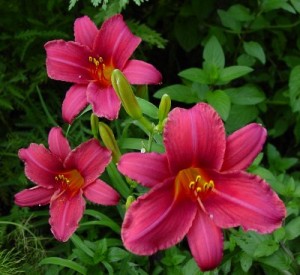
This morning Mark and I worked on digging holes in a front bed (Mark) and digging, weeding and dividing hemerocallis, then transplanting them (me) into the holes dug in the front hemerocallis_just_sobed.  Hemerocallis (day lilies) are the blue collar workers of the perennial beds.  They work hard, are hardy and bloom like crazy in August.  They also have grow out, expanding their territories.  And they never die.  Hemerocallis are forever.

I’ve gone through several different attitudes toward them.  At first I loved their variety and bought several different kinds, putting them in places where I wanted foliage most of the season and blooms during the particular periods when the variety bloomed.  That was good.  Then, they began to spread out, multiply, take up space, crowd out other plants.  That was bad.  So, I began to divide and transplant them, much as I did this morning, but with less thought.  Eventually this meant that I had not solved the problem, but spread it to different areas of the garden.  Duh.  So.  I stopped buying hemerocallis.  That was good.  I have given away dozens of clumps of various varieties and yet I have still more.  You can see  how a nursery person could learn to love hemerocallis.

Now I have what I like to think is a mature attitude toward these sturdy plants.  When I need to crowd out weeds and have a bed that will no longer require attention, I reach into my ample supply of hemerocallis and dig, divide, transplant.  We now have a good working relationship because we understand each other.

Monkey. Still. But, Making Progress.

Beltane                                                                     Waning Last Frost Moon

Whoa.  84.  Sometimes I think of the seasons as if we were on a moveable patch of earth.  On a day like today our patch got shifted on the seasonal moving belt to about Georgia.  Last week we were parked above the Canadian border for a while.  Who knows where we’ll go next.

I have passed the 50% mark in reading Monkey:  Journey to the West.   That means I’m somewhere around 1,000+ pages in.  Hard to tell on the Kindle, though I know precisely how far I am in percentages.  This book is funny, wise, rollicking, supernatural and just a bit cynical.  Well, maybe a lot.  Yesterday I bought a book that features English works on the Chinese classics.  It has a lot to say about these favorites, but I’ve still found no commentary that helps me get, say, the wood, water, earth, fire, metal sequence or the names of some characters or the works referenced as if everyone knew them.  Next up, probably next year, is The Dream of the Red Chamber, the best of the six, in the opinion of several writers.

While hunting for a picture to go with this post, I discovered that Neil Gaiman, author of the Sandman graphic novels and several fantasy novels started, back in March, on a screenplay for a trilogy based on Monkey.  Should be interesting.

If you feel like you have the time, both Monkey and the Romance of the Three Kingdoms will more than repay the effort.  There’s a different culture at work here, sometimes a radically different one, but, at other times, radically similar.  That’s the power of reading works from other cultures, insights you can’t get any other way.

A slow day.  Business meeting in the morning.  We scheduled a couple of days in July, post Kate’s second hip surgery, to go over our expenditures in the first six months of retirement, check them against our budget, see where we need to adjust.  Big fun.

An Unforgivable Sin?

Beltane                                                                    Waning Last Frost Moon

“Man is the only creature who refuses to be what he is.” – Albert Camus

Dogs behave like dogs.  Ticks like ticks.  Ravens steal.  Osprey fish.  Shark keep moving.  Even the heart beats, the liver and the kidney detoxify, the stomach and the gut digest and eliminate.  The nose smells.  The ear hears.

We are the only creatures who, at a super-organism level, can refuse to be what we are.  It is both our glory and our damnation.  When we resist the impulse to violence, the credo of self first and the will to domination we become creatures of wonder, covered with grace and filled with light.  When, though, we take more than we can eat, steal more than we need from mother earth, use our evolved brain to imprison other creatures when we do not need them for food, then we walk to the mouth of the River Styx and throw ourselves in Charon’s boat.

Here is the first and greatest sin, perhaps the unforgivable sin.  We imagine ourselves apart from nature, as unique and special beings, exempt from evolutionary history and immune to natural consequences.  While it is true that our great technical and scientific skill seems to partition us off in our own special province, it is not so.  Why not?  Read an article about peak oil.  Consider the consequences of peak water.  Look at the struggle to find precious and rare metals, needed for sophisticated electronic devices.  It leads the Polymet Corporation to the conclusion that not only could they find them in our wonderful northeastern Minnesota, they must mine them.  Must.  Or else.  What?  No more cell phones, laptops, tablets?

Consider the moment of peak rare earths and metals.  What then.  Mother earth only has a certain cache of elements and their combinations, a cache configured in the fires of solar fusion and flung out in the processes that created our solar system and our world.  We do not, can not, make more copper, barium, lithium, nickel.  What gives corporations the arrogant assumption that they can use this store of minerals for their own private purpose?  What gives humanity the temerity to arrogate to our uses all the fossil fuels, all the stored carbon, all the metals gathered in mother earth’s body?  If this question seems naive, then ask how extinction might feel, extinction because we refuse to recognize our limits and our real location in the community of creatures and the world of things?

So, I invite you to go outside this memorial day weekend and find a flower, a tree, a bird, a dog.  Sit with them for a while.  Notice if they try to take more than the universe has allocated for their use?  Notice how they appreciate the water, the sun, the sky, a friend.  Then watch one of us.