Category Archives: Bees

Bee Diary: Memorial Day Weekend

Beltane                                                                     Waning Last Frost Moon

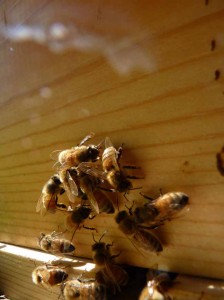
The bees.  Today the second hive boxes went on each colony.  This means that 70-80% of the frames in the bottom boxes have brood and pollen, requiring more space now for expansion of the growing number of bees.

Without a second hive box the chance of swarming, increased by overcrowding, would become probable.  In the ideal bee keeper world, adding the second hive box, with moving a 500honey-extraction_0231frame from the box below to the new one to entice the bees up, eliminates swarming.  No bee keeper wants a swarm because about half the bees and the young queen leave and the remaining, now queenless workers and nurse bees have to create an emergency queen.  Since half of the workers are gone and emergency queens are not as productive as the new, young queen the beekeeper gets little if any surplus honey.
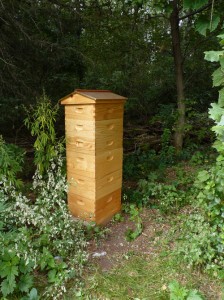
(this is where we’re headed.  this colony has three deeps and three honey supers.  last august)

On two of the colonies I added regular hive boxes, or deeps, that is a box able to hold the 9 5/8″ frames.  This is the standard UofM beekeeping in northern climates method and it aims toward overwintering of the colonies and using them to both create a new, child colony next spring and a maximum honey producing colony, the parent.  On the third colony, however, I added two honey supers instead of a deep.  This is the same amount of space as a deep, but the honey supers are lighter since they’re only half the size of a deep.

This last colony I plan to manage solely for this year, attempting to get maximum honey production from it.  I’ll accomplish that by extracting all the honey this colony makes.  I estimate I would have had another 150 pounds of honey last year had I practiced this method.  The downside of this method is that the colony will die in the fall because it will have no honey stores to live on through the winter.  It also doesn’t create a parent colony for the UofM method.

This may sound cruel, but if it’s effective, it will only reflect the reality I experienced last winter.  All three of my colonies died.  I had to start with new bees this year.  The honey those colonies made to overwinter filled a deep and a half, the equivalent of 36 full honey supers.  Since we only extracted from 2 full and several partial supers last fall, that would have meant a good deal more honey.

An experiment.  We’ll see how it goes.

It continues to amaze me that these bees are calm, giving me no problem when I do colony inspections.  With smoke they go about their business while I go about mine, the work gets finished and I move on.  Don’t know what the difference is, whether I’m calmer or these are more docile bees.  Maybe a bit of both.
Anco Impari (I’m Still Learning. Goya)

Beltane                                                                 Waning Last Frost Moon

We continue sliding toward summer, a cool, moist descent, not at all like the sudden, blazing ascension we often see, usually full on in place by now, with sun screen and hats and pitchers of lemonade set out on patios.  At some point it will warm up, at least I think it will.  There have been years without summer, years when the weather remains much like what we have now, days cool in the morning, warming in the afternoon and falling off to cool nights.  Could be this will be one of those summers.

I’ve worked this morning on Pentheus, the first few verses proving difficult for me, almost as if I’d entered a different text altogether though it’s only 300 verses away from Diana and Actaeon and in the same Book, III of XV.

Something captivates me as I get into the Latin flow, the world tunes out; the text and I begin this tug of war, me digging, using dictionaries and online aids, the text resisting, remaining stubborn, not allowing its meaning to emerge without a struggle.  The tension between the text and me lies in the language of an ancient people and my learning, a tension requiring both, learning and the language.  Without some knowledge, there would be no tension.  If I had no learning, the words in Latin would sit immutable as stone, as strong a barrier to me.  If my learning were to the level of fluency, the text would not be a barrier at all, I would read as I do in English.  Instead, I’m in a middle place, knowing and learning at the same time, so the text became enticing, pulling me further into the journey, not only of Ovid’s texts, but of the others:  Cicero, Caesar, Livy, Martial, Tacitus, Horace, Seneca.

The feeling reminds me of how I reacted to serious study of art history.  At first there was so much information, so many different aspects that I felt overwhelmed, as if I could never get my head above the surface of this great ocean of learning.  As time passed, as I walked the halls of the museum, read texts and looked at more and more art, a shaky gestalt began to form.  There was a rough chronology, even a global chronology.  There were styles and forms and methods and instances of all three.  At some point the Song Dynasty became separate from the Tang and the Han, just as the early Buddha images became distinct from the later ones of Tibet, Thailand, China.  Neoclassicism and impressionism began to tease themselves apart and appear as separate, thought related movements.  Beckman and Kandinsky and Monet and Barye and Poussin and Church and the master of the embroidered foliage sorted out into times and influences and basic tenets.

(of course, like most of us, I’m a combination of autodidact and schooling, but since college, the autodidact part has definitely taken precedence.)

Now I have a scaffolding on which I can hang new learning, it fits in a large gestalt, which, while far from comprehensive, at least describes the outlines, the places where there are gaps and the places where some new learning easily fits.

Right now Ovid and his Metamorphoses are my teachers, aided by my tutor Greg Mambres and my own reading, learning.  My scaffolding is up, but it’s very shaky.  I have verb forms, conjugations, nouns, declensions, adverbs, participles, clauses, imperatives, word meanings, poetic forms but often I revisit and revisit the same learning, still not seeing with clarity where on the scaffold something belongs.

It was the same with the garden, first flowers and then vegetables and is still now with the bees.  Large tracts of unknowing papered over by fragments of knowledge.  In bee-keeping for example I look at cells.  Hmmm. Those look like drone cells but maybe they’re queen cells.  Or maybe not.  Is it time to put on the second hive box?  Or, is it too early?  Should I use full-sized hive boxes or should I switch to honey supers to keep things lighter?  In gardening.  Just try planting garlic in the spring some year.  Won’t work.  It needs to over winter for a late June harvest.  Want a colorful spring and early summer?  Plant in the fall.  In the orchard I’m practicing IPM, integrated pest management, which means at this point, killing bugs by hand.

What I’ve learned is that knowledge accumulates.  New knowledge needs a scaffolding, a chest of drawers, a memory palace so that it can become integrated.


Horticulture

Beltane                                                              Waxing Last Frost Moon

Gardening commends itself in several ways, but two are most important to me.   Having life tuned to the seasonal and daily rhythms of heat, light, rain, snow, even frost like we have predicted for tonight, grounds me.  If the frost comes and I have nothing outside to protect, it is a passing phenomenon of little interest.  With delicate plants to protect I know what it means, cold enough to cause ice crystals inside plant cells to burst.  Likewise drought is of no notice to me if I live in a condominium or on a city lot where my grass and a tree or two are my only contact with the plant world.  With a vegetable garden, though, the plants dry up, don’t produce.  I have to consider the drought, see that my plants get adequate water.

When the rains come, followed by warming days and the seeds leap up through the soil, when the potato eyes push a stalk and early leaves through to the surface, when those leeks nurtured since early April stand up and begin to fatten, it matters to me.  Their work, much like the bees, comes from their essence, not from anything I do, but, also like the bees, I have a role, to protect them, to see they have what they need.  We work together, the vegetables, the fruit trees, the currant and gooseberries bushes and the bee colonies.

The food that comes from our garden does not see us through the winter, though some of our crops, like potatoes and garlic for example last that long, but eating close to the land, lower down the food chain, happens more naturally when some substantial part of the diet comes from home.  So, the food alone serves as a final link to the growing process, but as a present symbol of the food available in the vegetable world, it paints into our world color that needs to be at our table all year round.

This, then, has come to pass as my new faith, a link with the earth and its fruits, a role in caring for them and the constant reminder of our dependency, our interdependency on it all.  When I began to work with the Sierra Club three plus years ago, I did it to put my political experience to work on behalf of the living world, in part at least as a thank offering for the sustenance I have received from it all these many years.

Bee Diary: May 15

Beltane                                                              Waxing Last Frost Moon

Checked the bees just now.  Each colony queen right, lots of bees and brood.  Still honey in the frames I put in when they arrived, but I did pollen patties today.  These bees are calm, allowing me to check the frames after just a bit of smoke, no attacks so far.  So, the bee season has a good start.  Still planning to try both the old method, take all the honey the colonies produce, and the Furgalas three deep overwintering method.  Not sure which way I’ll way go, 2 old, 1 Furgalas or the other, but I have to decide before I put the third hive box on them.  I’m still thinking whether to use honey supers after the first box, primarily to make each box a bit lighter weight, easier for this old back to handle.

Button down below says frost advisory.  Yike!  Well, it just shows that the averages are what they are for a reason.  I took a chance and I knew it.  Now we have to protect the tomatoes, the herbs, the coleus, maybe some others.

Bee Diary: May 9, 2011 Wax Moths

Beltane                                                                       Waxing Last Frost Moon

Minnesota Hobby Bee Keepers last night.  There’s always something at these events.  Last night Gary Reuters, Marla Spivak’s associate and bee wrangler, took general questions on hive management.  He does this every meeting, but he took more time last night.  I learned about wax moths.  Wax moths, which come on the winds of mid-summer, infest hives and ruin the comb.  If all the hive box frames are on colonies by July, this is not a problem because the bees fend them off.  Then, when the season is over, any frames left out of a hive box go into the cold shed and the moth larvae die over the winter.

Here’s the interesting part.  The function of the wax moth is to invade vacated bee colonies and reduce the comb and other residue, like propolis, to a substance more usable by the rest of nature.  In other words the wax moth is another aspect of the intricate dance in which the bees participate, a natural part.  The number of things bees can teach us seems, at this stage in my learning, as numerous as the pollinators themselves.

And Yet More Planting

Beltane                                                           Waxing Last Frost Moon

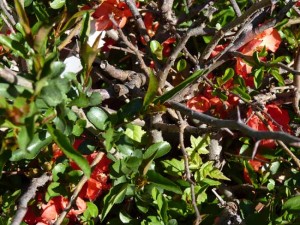
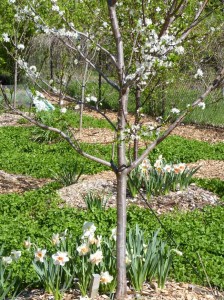
Cherokee Trail of Tears.  Hutterite.  Soup beans and green beans.  Vidalia onions from sets grown in Georgia.  Purple passion and white asparagus.  Three varieties of tomatoes.  Golden beets.  Pretty much the last of this year’s non-succession planting.  Mark’s been a big help, letting Kate and I focus on the things we do best.  One or two things remain: cucumber, gourds, but they’re delayed right now.  So Artemis Hives and Gardens has all the bees in their colonies, early and post-frost vegetables plants in the ground and daffodils and tulips and our magnolia providing color.  The fruit tree’s buds have swollen; the currants have fully leafed out; the quince has its bright red flowers; the gooseberry plants are in a new home with more sun and Kate has planted shade lovers in the spots where the gooseberries were.

Left to figure out.  What crop(s) to grow in the hydroponics during the summer.  How to take good care of the fruit trees and their produce.  Succession dates for the rest of the growing season.  Mulching and pruning.  Weeding.

My object list for my Thursday early evening Love, Sex and Scandal tour:  Venus figurine, The Singer Su Hsia0-Hsia0, Theseus Killing the Centaur, Bacchante and Satyr,  Mlle. Lange as Danae, Lucretia, The Little Girl, The Living Room.  This group wanted edgy.  This tour will qualify.

Late to bed last night, a great day today so I planted in the am, but I still need to do Latin.  Not so easy with a fuzzy head.  Probably nap time.

A Garden, Some Latin, Ai Weiwei

Beltane                                                     New Last Frost Moon

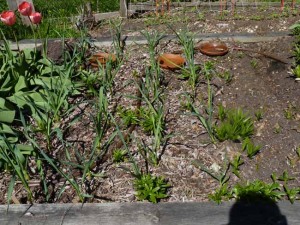
The potatoes are in the ground.  The lettuce has two leaves, as does the spinach, a few beets have emerged.  The leeks look a bit droopy, but they’ll pick up.  The garlic is well over 6 inches now as it makes the final push for harvest in late June, early July.  None of the carrots have germinated yet and most of the beets have not either. The onion sets we planted havecropped-free-ai-weiwei mostly begun to show green.  The bees show up now around the property, working as we do, tending the plants in their own, intimate way.  The gooseberries we transplanted look very healthy.  The daffodils are a carpet of yellow and white.  A few scylla out front brighten up the walk with their blue.
Most of today went into Diana and Actaeon.  I’m down to verse 227, the finish line is 250.  I’m close and moving faster now than I was.  One of the things I’ve learned is that doing this at a pace which would allow you to complete a project in a reasonable time frame would require real skill.  I’m a hobby Ovidist, to be a Latin scholar would take decades.  Who knows though?  I might make it.  When I finish this first tale in the Metamorphosis, I’m going to have some kind of celebration.

Buddy Mark Odegard has come up with three remarkable designs for a Free Ai Weiwei t-shirt.   Here’s an example and the one most seem to prefer:

Uh-Oh

Beltane                                                           Sliver Bee Hiving Moon

Bees check this morning.  Colony 1 is queenright.  Colonies 2 and 3 were not queenright because I had improperly handled the indirect release.  The queens were in the cage still, being tended to by the colony so I direct released both of them.  At the next hive inspection, I imagine they will be queenright, too.  Pollen patties were not depleted, nor even used for that matter.  There was still honey in the frames from last year’s hives, so all looks good right now.   The bees were calm.

Had a last hurrah with the Titian show, docent colleagues who’d toured it showed up.  We discussed how we’d handled certain paintings, noticed things we hadn’t seen before, fun to rehash.  Afterward we went over to Rinata’s and had their $20 Sunday evening meal.  Tasty.

After that, tai chi, just down Hennepin five blocks.  Was I not ready for what happened tonight.  I positioned myself on the end of the line and, being alone, totally lost my place, forgot moves I knew well.  I’d practiced and practiced this week.

Dropping the moves out of my consciousness created a sense of panic, one I know well.  My brain tells me:  leave, leave, leave.  It’s a sort of red klaxon at work.  A tight chest.  I don’t like to fail.  At anything.  And this is for stress relief?  Well, not for me.  Not tonight.  I calmed myself down, changed positions and tried to keep my head in the class.  It was hard.

Afterward I talked with teacher.  She reassured me.  Told me chaos often proceeds a break through.  Told me that she was totally confused in her first ten weeks.  That she’d get me confident.  I felt flushed and embarrassed when she told me I had to concentrate on keeping my hips together.  I though I had been.  Again, I don’t like to be doing something poorly.  There is of course motivation here, yes, but there’s also fear and avoidance.

On the drive back I just drove, listening to Wolf Hall, a very good novel about Henry the VIII, Cardinal Wolsey and Thomas Cromwell.

Gooseberries and Bees

Spring                                                                                 Waning Bee Hiving Moon

Yet more work on Missing this morning.  Still at play in the Winter Forest, up in the Dark Range, around the shores of Lake Arcas and on the waters of the Winter Sea.  It is so difficult 640cranes-photographto know what the quality is of your own work.  Very difficult.  Some say impossible.  May well be.  This one feels, however, like the best work I’ve done to date.  But, hey, that’s just the author speaking.  What does he know anyhow?

(photograph by Tom Crane)

This afternoon Mark and I transplanted four gooseberry from their shade sheltered residence along the west facing side of our hour to an east and south facing slope in the third tier of our perennial beds.  As we worked digging the holes to receive the shrubs, then digging the gooseberry plants prior to placing them in their new homes, bees buzzed around the deck, drawn, I imagine, by the residue of last year’s honey extraction.  Now long over as far as we know, last August, fall rains have pounded the deck.  Snow has piled up it over two feet high and that has washed away with spring rains, yet the delicate sensory apparatus of the honeybee knows that something was done here, something relating to honey.  Perhaps bees have their own CSI crews.