Category Archives: Our Land and Home

We Inch, Slowly, Toward Spring

Spring                                                                 Waxing Bee Hiving Moon

Kate comes home tonight.  Yeah!  I miss her when she’s gone. I’ll follow our usual procedure and pick her up at the Loon Cafe, conveniently located at the end of the light rail service 650-herb-spiralfrom the airport.  Makes the drive much shorter and I get a good meal in the bargain.

After the biting and the barking and the adrenaline I figured out a somewhat complicated solution to the Rigel/Sollie problem.  It involves making sure that one set of dogs is in their crate before admitting the others to the house.  This way nobody trespasses on anybody else’s territory.

It demands a careful watching of when Rigel and Vega are away hunting so I can let Sollie, Gertie and Kona inside.  Or, alternatively, when Rigel and Vega are on the deck and the others are out hunting.  A bit baroque I know but I have no more indentations in the leg.

(pics from April of last year)

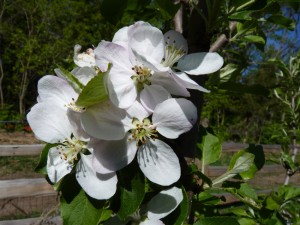
As the Bee Hiving moon goes from New to Full, our yard will lose its snow and we will have several species of flowers in bloom, a few vegetables in the ground and as it begins to wane we should have our new bees hived and happy in their new homes.  There are things that need to happen before this last, not the least moving the hives to the orchard, cleaning all the frames of propolis and burning the old hive boxes and frames I got from Mark, the bee mentor.650-apple-blossoms

Seeing the bulbs planted in the fall begin to emerge always heartens me because it reminds me of hours of labor spent in the cool air of late October or early November.  We won’t be here for that time next year, so probably no new bulbs this year.

In fact, I’m declaring finished to our orchard, garden, vegetable, bee expansions.  We’ll stick with no more than three hives, the raised beds and other beds we have in the vegetable garden, the trees and bushes we have in the orchard and the flower beds we have in place now.

We’ll always have to replace dead plants and put in new ones in their place.  We have to care for the fruit trees and bushes, plant vegetables and maintain the bee colonies so we’ll have to plenty to keep us occupied.  I just want to get good at the stuff we have and begin to slowly limit the work we do over the course of the year.

Breakthrough!

Spring Waxing Bee Hiving Moon

I have made several entries private and will explain that decision on Sunday. Stay tuned.

The snow has only a few strongholds left in our front yard though the back and the woods still has plenty. The garden behind our patio has daffodil stems through the 06-27-10_marigoldeyeviewearth, a bit yellow at the top, then light green, then a darker green. Soon there should be other bulbs breaking through including some I’d forgotten I planted in the orchard.

This is the transition week for our place, when the snow disappears and the greening begins. I’m excited to see the garden come to life. When the bees come, some time after April 23rd, it will feel like the whole gangs back together. I’m hopeful that the orchard will start producing this growing season. We’ll see.

I want to get some more woodchips down right away in the orchard, perhaps in the vegetable garden, too. 670_0300

It’s also time for serious clean up work in the back. I got distracted last fall and didn’t keep up with the maintenance as well as I could. Then, there’s all those tree branches split by the heavy first snowfall last November. So, plenty of outside work.

We ate the last of our potatoes just two weeks ago and still have garlic, yellow onions, honey, and canned vegetables from several years.  We couldn’t make it as pioneers but we’re doing well at supplementing our diet.  More.  We tune our lives to natural rhythms, especially in the growing season.

That original revelation to us that Emerson talks about is coming along out here in Andover.

In Spring A Man’s Heart Turns to…Yard Work

Spring                                                             Waxing Bee Hive Moon

The weather has turned gray, inclement, wet.  The snow continues to melt, but not wholly disappear, as if it has gotten used to the yard and wants to stay as long as possible.  Where the snow has melted, there is mud.  Mud that tracks it on little dog’s feet.  And big one’s, too.  The spring cleaning season has begun.

This morning I look outside and see only work:  the trees to repair, various objects that need to get picked up and burned or trashed, the bee hives I need to move, old plastic that has to come so we can plant underneath it.  This last is a method for killing weeds without herbicides.  Leave the plastic in place for a couple of years and seeds germinate but die for lack of sun.  Works pretty well.

Of course, there’s the garden that will need planting, too.  Perennials left in for winter interest must come out now to make for their 2011 versions.

Tomorrow I plan to have a meal of greens from the hydroponics and next Monday I’ll use the basil grown there for a caprese salad for an afternoon meal with my docent friends.

Mark, my brother, e-mailed me and says his flight comes in on Saturday at 1 pm.  I’ll be there.

Have to practice my Tai Chi.

Our Own, Original Relation to the Earth

Spring                                                            Waning Bloodroot Moon

I’ve discovered an analogy between translation and science.  Coming to a premature conclusion about the meaning of a passage causes chopping and cramping to fit meanings, declensions and conjugations into the preconceived notion.  The better way lies in suspending judgment, collecting all the possibilities, then, sorting them out in context, both with the larger work and among themselves, to find the probable meaning the original author had.  In science, the old method, the deductive method, began with a premature conclusion about the nature of reality, say, the earth is the center of the solar system and then made observational data fit the conclusion.  Francis Bacon summed it up well.  If method were a foot race, then the wrong method would take you further and further from your goal, no matter how fast you ran; the right method (the experimental method) carries you toward your goal, again no matter how fast you run.

Biblical translation often suffers from this very problem.  Predetermined theological or dogmatic conclusions force particular choices in translation, choices that support or reject a sanctioned premise.

It is, too, unfortunately, a trap fallen into by many folks I know.  Using second or third removed “sources” for so-called teachings is not new, but it’s phony baloney and muddies even the best minds.  Let me give you an example.  Many of the Wiccan or neo-pagan folk refer with confidence and certainty to certain Celtic religious practices.  Here’s the rub.  All we know about the ancient Celts in other than an archaeological sense, comes from three exceedingly suspect sources:  Roman writers like Julius Caesar and Tacitus, Roman Catholic monks who wrote down some material about the Celtic folk religion and a romanticized version of Celtic lore that surfaced in 18th century England.  The Romans conquered and subdued the Celts militarily; the Catholics oppressed them spiritually; and  the English treated the Celts as second and third class subjects.  Yet it is the literature of these three sources that contain the deposit of information about early Celtic religious practices and beliefs.

Now, even this data, through careful scholarship and skilled literary criticism, can yield solid or at least strongly suggestive information.   We learn some things about the Triple Goddess Brigit, for example, through material written about the Catholic saint who co-opted her place in Celtic lives, St. Bridgit.

It’s an odd field, these contemporary attempts to recapture a relationship in the present with the attitudes toward the earth held in our deep past.  I count myself as part of it, though with a twist, rather than retrieving the thought world and ceremonies of our ancestors, I’m following Emerson.  We need an original relationship to the earth, one based on our experience, not theirs, a religion of our own “revelations” gleaned from the earth as she is now, not the record of theirs.

As one way of getting at it, I take a cue from an Iroquois shaman I met long ago who prayed for the winged ones, the four legged, the ones who swim in the rivers, lakes and oceans, the flying ones and the ones who crawl.  When I asked him why he didn’t he pray for the two-leggeds, the answered, “Because we’re so fragile we depend on the health of all the others.”

We don’t need to become faux Iroquois to grasp and incorporate this sensibility.  All we need do is realize the onrush of climate change and the danger it poses to our species.  In that one move we can shift over to a deep respect for mother earth and all her parts, the living and the inanimate.

That is the fear based way and I’m perfectly ok with it if that’s what it takes to move you because not all fear is baseless.

Another way is to step up your own intimacy with the living world by growing vegetables, keeping bees, growing flowers, participating in the local foods movement, shopping at food co-0ps,  This web of activities coupled with mindfulness about where you are and what you eat can increase your sensitivity to the thrumming, vital interdependence of which we are a real and intextrictable part.

Many use camping, hiking, bird-watching, weather forecasting, fishing and hunting to put themselves into this I-thou relationship with the earth.

There’s so much more here, but I want to plead for direct experience, not the cadging of other cultures, not the assumption that by associating ourselves with indigenous persons we become somehow more in tune with the earth.  No, the one you need to be associating with is yourself and your daily, lived experience.  Can we learn from others?   Of course.  Can we become them in any authentic way?  No.  Absolutely not.
An Expansiveness That Opens The Heart

Imbolc                                                New (Bloodroot) Moon

Immersed again in the history of ancient Rome, that interesting period when the Republic gives way to the reign of emperors, night has fallen, a clear night.  I’ve wanted a clear night because I want to see the stars here on the prairie, away from city lights.  That’s next.

Brother Dusty (James) Johnson has lived out here under the big sky of South Dakota for several years now and fell in love with it.  I can see why.  There’s an expansiveness that opens the heart, yet somehow too points back to the very spot where  you stand, a sort of universal and a particular in one moment.

In Andover due to tree cover our focus is resolute and local.  We see our yard, our neighbors, our woods, our gardens, our bees.  Out here you can see  your neighbor’s pasture, your neighbor’s cattle and their neighbors.  The weather doesn’t sneak up on you here, as it can in Andover, coming up over the woods to our west, it announces itself far in advance, scudding clouds, lightning, wind.  All out there.  There’s a frankness and an honesty in that.

I only have two more writing days left, Sunday and Monday, but I’m very pleased with the amount of work I’ve gotten done.  In fact, as I hoped, this intense focus on Missing has let me see what I’ve been missing, this anchor to my day, the writing anchor.  I’ve let the ship slip its moorings and float away on the winds of Latin, art, politics, bees and gardening.  I need to bring this ship of daily writing back into harbor, keep it where its protected.

It means, I know, a change in my schedule, an earlier rising and an earlier bedtime, but to be honest with who I am, I need to make the change.

This has to be done while not losing the gains I’ve made in those other areas, that will be the trick.

Chainsaw and Snowblower. Watch out.

Samhain                                                  Waxing Moon of the Winter Solstice

An inside day today.  Tomorrow outside.  A little bit of chainsaw action on trees broken by the early wet snow in November.  Some snowblower work on the sidewalk, clearing a wider path to the front door.

I also have some mulch to lay down.  A bit late, not for mulching, but for the mulch which is in garden bags on our patio.  Frozen I imagine.  I might have to take a sledge hammer to it.

Maybe some soup making if I have any energy left in the afternoon.

The oldest cousin on my mother’s side, Ikey, has entered a nursing home for what sounds like hospice care.  He was the oldest son of Uncle Ike and Aunt Marjorie, my mom’s oldest sister.  When the sickle begins to bite into the generation of my family to which I belong, it has a frisson not there when my mother’s generation died off and eventually out.  I was never close to Ikey, but to most of the rest of my cousins I have relationships nurtured by at least every two year visits.  They’re mostly in Indiana, where I was raised.  A note for Ike, for peace and calm.

Going to the Mailbox

Samhain                                                          Waxing Moon of the Winter Solstice

The storm seems to have slowed down a bit, winds have decreased as has the snow.  It looks we got around a foot, but I can tell you that many of the drifts exceed that.

First, my insulating vest over my sweatshirt.  Then the wind pants over my sweats.  Down coat.  Mad bomber hat with rabbit fur flaps secured under my chin.  Scarf around exposed neck.  Insulated socks pressed into Sorels.  I was ready to get the mail and the newspaper.  Successful.   Minnesota, a state where getting to the mailbox from the house can be a challenge worth dressing up for.

After that adventure, I strapped on my snow shoes and headed out to Ruth and Gabe’s playhouse to retrieve the little giant ladder system still standing out there.  I waited until a historic snow storm to grab it just to test my true mettle. I’d say it was thin aluminum.

The damn ladder system is heavy and clumsy.  Walking in snow shoes is not an elegant dance in the best of situations, but navigating around small shrubs without snagging and trying to thread my way between an electric fence and a snow-drift narrowed passage up onto our deck, all the while dragging a ladder–priceless.

The ladder went in the garage to melt off its snow and be ready for Adam Lindquist, the improbably named Chinese lighting specialist from Lights on Broadway, who is coming out on Wednesday to install our new fixtures.  Huffing and puffing I sat down to drink some hot chocolate Kate made.  Decided to give myself 20 minutes of aerobic workout since I also shoveled the deck some.

Just finished my other 30 minutes on the treadmill.  Now I can settle down and enjoy the storm.  Tomorrow, more Latin.

Emergence

Samhain                                       Waning Thanksgiving Moon

One of those days.  Snow brought our first drive way clearing by John Sutton, but not until both Kate and I had left.  I did the sidewalk.

The drive into the Sierra Club took about 15 minutes longer than usual, but I made it to the first interview on time.  I spent the next 3 hours with Michelle and Margaret as I will tomorrow, interviewing candidates for the Sierra Club policy position.  One candidate referred to us as the big boys at the State Capitol.  Hitch up those britches and let’s get to work.

On the way in and back I’m listening, as I mentioned yesterday, to lectures on Big History.  A topic important to Big History and important to me is the quality of emergence, a key mark of complexity, the theme that holds all the various epochs since the big bang together.  Emergence refers to qualities that become evident only after two or more other elements combine in some patterned way.  The easy example is hydrogen and oxygen.  Examine the two of them separately and you would not come up with the emergent proper that comes when you combine two hydrogen atoms and one oxygen atom in a certain way.  Water.  Another, more complex example, is a human.  The individual constituents of the body, chemically, do not suggest the possibility of life if combined.

Emergence fascinates me because it is used by a few thinkers to reimagine the sacred.  I’m not sure the exact line of thought but it has my attention right now.

Then, when I got home, to a plowed driveway, I slipped and slid my car into a snowbank, a snowbank we had paid John Sutton to create.  This entailed a trip to the hardware store for granite grit, a session with Warren, my neighbor, who came to my aid with a tow rope, then scattering grit on the slope of our driveway.  Then, finally, I could get the car in the garage.  Minnesota is a place where sometimes getting the car in the garage at night is an accomplishment.

Heavy, Man, Heavy

Samhain                                           Waxing Thanksgiving Moon

File under the things we do for love.  Kate asked me, as a big favor, if I would clear the sidewalk and a path to the mailbox.  I agreed albeit reluctantly. Never again.  This type of snow, laden with water, dense and prone to packing tight when moved, is just too hard for me to clear.  It clogs up the snowblower, so the snowblower’s out.  Lifting it is beyond my frame’s capacity.  I knew it, but I did it anyhow.  Ouch.

The snow took off the top of the cedar tree’s other trunk, too, so the whole thing will need to come down.  That means the chain saw, sometime soon.  That, I can do.

After pushing some snow around, I harvested the last of the leeks, fine looking vegetables.  The greens, kale and chard in particular, will continue growing until the ground freezes, so I’ll probably have one more harvest from them, too.

Most of the morning I tried to pack in some material not too different from the heavy snow:  Latin participles.  As participles, they share in the attributes of both the adjective–meaning declensions–and verbs–meaning tense and voice.  In addition the participles tense does not follow the verbs because the participle can cue action either concurrent, before or after the action of the verb.  In addition, just to confuse things, the present tense and the passive future tense use the verbs present tense stem to form the participle while the future tense and the passive perfect tense use the participle stem.  Yikes.

I know, I know.  I’m doing this on purpose.  I’m just venting.

Losing a Friend, More on Dams

Samhain                                   Waxing Thanksgiving Moon

“In the view of conservationists, there is something special about dams, something…metaphysically sinister….the absolute epicenter of Hell on earth, where stands a dam.”

John McPhee Encounters with the Archdruid (1971)

We lost half a cedar tree in our backyard to heavy snow and wind.  We nurtured this tree from a small cedar bush into a two trunk tree that shaded our small patch of grass just beyond the deck.  These early heavy snows can be hard on evergreens since they retain needles throughout the winter, making them vulnerable to the wet and often large snow falls of late fall.  We’ll have a chance to do something new out there come spring.  Kate wants a lilac tree.

Here’s another thing about dams.  They generate, in addition to hydroelectric power, strong feelings.  People love’em or hate’m.  After they are built, they often become so much a part of the local ecology that people defend them from destruction with much the same fervor that folks oppose their construction in the first place.

There are a multitude of problems created by dams:  river flow is often altered and in turn alters the ecology both upstream and downstream, sediment pools at the base of dams robbing downstream deltas of needed material, archaeological sites can be destroyed or rendered extremely difficult to discover, populations are often displaced and, often, are denied access to the power produced by the dams which relocated them.

Equity questions abound as in the case of waters diverted to Los Angeles and Las Vegas from the arid Western states of Colorado, Utah, Nevada and Arizona and as in the case of a dam on the Zambezi river, built by Mozambique but because it needs military protection from rebel forces, forced to sell its electricity to South Africa at 1/7th of the world price.  Dams concentrate capital and political power in often unhealthy ways, especially in third world countries and especially when used as elements of a geopolitical strategy by such bureaucracies as the US Bureau of Reclamation.

More as the week goes on.