Kate’s getting hammered again by Sjogrens or illness or some very difficult to identify g.i. tract problem. She’s tough and resilient, my new favorite virtue, but, geez. She shouldn’t have to prove it so often.
Get to ride in a Tesla today, going into Denver with Alan for the Moving Traditions training. He bought his Tesla last year, sort of a I’m retired, this is a really good car thing. His dad did the same though he wanted a Cadillac and ended up buying an Oldsmobile. Alan bought the Cadillac.
No good deed goes unpunished. We’ve had significant rainfall the last couple of days. Yay. But. Hwy 285 in Bailey closed down yesterday due to a mudslide. Open now.
After a swim, from September, 2015
I waited on the hosta division for the monsoon rains to begin. Hot dry weather is very tough on transplants. The rains have kept the air cooler, the cuttings evaporate less so the leaves stay strong. The roots don’t dry out. Gives them a chance to get over the shock of a new spot, send out some rootlets. There’s also a concoction made by Miraclegro called Quickstart that I’ve used for years when dividing plants. It encourages root growth and gives the plants a burst of nutrients.
That buck yesterday was magnificent. He was the sort you see in bronze on the stony gate pillars guarding expensive homes. His bearing was regal. This is his kingdom. Unhurried, strolling the easement like it was a path in the gardens of Versailles. Perhaps the monarch of the mountain spirits who visit us.
Suggested to the woman who organized the immigration talk that perhaps the Beth Evergreen Social Action committee should be doing this kind of work. She passed my e-mail on to the Rabbi and to the chair of the Social Action committee. Lengthy response from the Social Chair chair amounts to, we do small things because they’re not political. Sigh. Same ol, same ol. Heard this all the time as a clergy in the Christian church, less so in the UUA. Say the word politics and you’ve touched the third rail.
Uncharacteristically, however, I intend to stay back from this conversation. I’ve got Jewish Studies Sunday Sampler and 6th grade religious school to prepare for. Perhaps the slight nudge will create a larger conversation. Hope so.
Kate and I are going to a protest at the Aurora ICE detention center next week. It’s led by the Moral Minyan*, a project of bendthearc. Family separation, though attenuated by the court ruling last week, remains a reality. Immigration is a distinctive American good, mixing our polity with new citizens from all over the world. It’s always been fraught with tension, with nativism, xenophobia, chauvinism, and, our record as a people with regard to persons of color is still miserable, but that French gift, Lady Liberty, with the poem by Emma Lazarus, represents the ideal toward which many of us strive. I believe most of us.
This notion that only a certain kind of person, usually white, can be a good U.S. citizen is racist at its core. The obvious rejoinder is the facebook meme of Indians confronting immigrants on the Mayflower. As Valentina said Tuesday night at Beth Evergreen, “Immigrants work hard. Immigrants pay their taxes, raise families.” Immigrants contribute to our national well-being and always have. In fact, immigrants created our nation.
This current politics of meanness, of grudge-settling, of honoring foreign strongmen over our own government BY OUR PRESIDENT, the unleashing of the American id typified by the Charlotte rally and the way too many video clips of various individuals calling out persons they suspect of being “illegals” or “terrorists”, makes us all smaller. He who shall not be named is spending the capital accumulated since World War I which made this country a superpower. Shame on him.
Parker was a Unitarian clergy, an abolitionist, and an activist who kept a loaded gun at his desk in case slave catchers showed up. Be like Theodore.
*In Jewish tradition, acts of public prayer require at least 10 people to gather to form a minyan.
In this moment of political crisis, we’re calling on progressive Jews across the country to gather to form Moral Minyans for acts of public protest, solidarity, and organizing as part of a national network of Jewish Resistance.
People who become leaders of Moral Minyans have a variety of skills and experience levels. We provide trainings and support for activists in our network who are organizing their Jewish community in living rooms and in the streets.
The big Dodge Ram sits in our garage, so it won’t get hit with hail in case we have a thunderstorm. Nothing says I don’t give a damn like returning a pock marked car to the rental folks. Supposed to go back today.
Kate had a couple of days clear of nausea, then got hit hard yesterday. It’s difficult to describe how debilitating it is to experience this inner discomfort regularly. I can see it. I can sort of imagine it, but she’s dealing with it. No. Fun. At. All. I feel bad for her, with her.
Here in Conifer we’ve already lost 20 minutes of daylight since the summer solstice, 14:59 on June 21, 14:39 today. I go to bed at 9 pm and I can already tell the difference. It’s beginning to get dark now at 9. The darker it gets the happier I am and, as an added bonus, the darker it gets the cooler and wetter it gets, helping sleep and mitigating wildfire probabilities.
Feeling a little sad this morning. Kate and I had an argument last night. It happens, but I never feel good when it does and the feeling lingers. Reminds me that our moods are fickle, sometimes referented, sometimes not, but always changing. Not becoming attached to one mood or another, up or down, being equanimous (yes, it’s really a word. either that or it was made up in our Mussar group) helps level out our moods. Although, I do appreciate both a good up and a good down. Vitality does not lie in sameness.
Looking forward to seeing Minneapolis and friends the first week of August. Groveland Unitarian-Universalist celebrates becoming a Covenanting Community in the UUA on August 4th. They wanted me to come and I’m pleased they do. Like the days in Durango I’ll get a chance to catch up with folks with whom I’ve had long term relationships, seeing Woollies and I hope docent friends as well as the Groveland folks.
Plus, I’m staying at the Millennium Hotel which is on the edge of Loring Park. I lived in Loring Park up on Oak Grove, a wonderful third floor apartment that, thanks to its location on the hill, had a beautiful view of downtown. That was back in 1975/1976. Which is, wait for it, 43 years ago or so. 28. Whoa.
I’ll get to see the statue of famed 19th century fiddler, Ole Bull. When I was chair of Citizens for a Loring Park Community, we turned down the Daughters of the Sons of Norway who asked us to let them move it somewhere cleaner and safer. Than our neighborhood? Come on. I’ll also get to walk to the nearby Walker Art Museum and the somewhat further away Minneapolis Institute of Arts. When I head to the MIA, I’ll pass through Stevens Park, which was my first home in Minneapolis. I was a live-in weekend caretaker and janitor for Community Involvement Programs. The old Abbott Hospital was right across the street. Lots of Stevens Park stories.
Not to mention that wonderful road trip across the Nebraska plains. Which I actually enjoy when enough time lapses after I’ve done it.
Rustic Ranch, Bailey, breakfast on the Durango Trip. Sweet cream pancakes.
As the Woolly Mammoth Moon phases away toward a new moon, its month, the same lunar month we always have, yet also a different lunar month from any we’ve ever had, all spiraling through space as we follow the sun while orbiting it, I just wanna say thanks for what happened under its gentle influence.
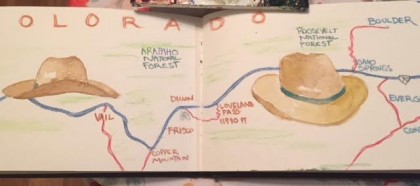
It rose as a new moon, invisible but watching us, on June 13th, the day Mark, Paul, Tom and I headed out to Durango and the 416 fire. It was a trip both across southwestern Colorado and back into 30 years of friendship. Not to mention back to the days of the Pueblo dwellers of Mesa Verde. It was, in a sense, a way to say to each other that, yes, these friendships are for a lifetime. That this lifetime, whatever it may mean individually includes each other–and Bill. When you think about it, affirming the power of our past and honoring the reality of our future, is pretty damned cool.
Ode lays out the trip
It was also on this same trip that I read the essays about ground projects by Bernard Williams and about setting a rejection goal. The first one affirmed my existential sense that life gets meaning from our intentions and our labor to fulfill them; the second has transformed my writing life. A big, huge, amazing, wonderful thing.
Also under the Woolly Mammoth Moon, Alan Rubin and I began digging in to developing a curriculum for 6th and 7th graders in the Religious School at CBE. This work has affirmed the depth of my immersion into the Jewish world of CBE and reconstructionist thought. It also underscores my continuing fascination, see posts below, with the supernatural, or at least the fruits of humanity’s speculation about the supernatural.
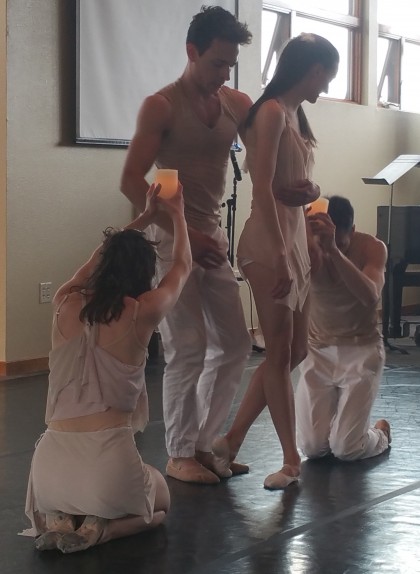
Yom Hashoah, Holocaust Remembrance Day, ballet at CBE
Also under the WMM, I’ve been putting together the Jewish Studies Sunday Sampler series for the 2018/2019 adult education year. This will feature both courses from the Great Courses company and courses from the MOOC aggregator, Coursera plus the odd film or two.
I also met Harv Teitelbaum. He’s the Sierra Club’s lead for their anti-fracking initiative, a big deal here in Colorado. I believe he and I share a similar attitude toward our current political reality and a similar focus on local races while maintaining an emphasis on the Great Work.
My flaxen haired Nordic goddess
It’s been a big, big month for me and I want to say out loud how grateful I am to all of you who’ve made it possible. Yes, Kate, especially you. It’s been a very difficult month for you nausea wise, I know, but you picked up a board membership at CBE and guided the food committee for the Patchworkers. All the time you’ve been supportive, though understandably surprised, at my new commitment to finally, finally, finally submitting my work. You’re the gyroscope in all this, keeping us stable and focused. Thanks, Kate.
Modern technology is so wonderful. Over the last few days I watched all five of the much maligned Twilight movies. You might ask why, at 71, I would subject myself to all those teen hormones, questionable dialogue, and odd acting. First answer, I’m easily entertained. Second answer, I’m revising Superior Wolf right now. Werewolves from their source. Also, a project I work on from time to time is Rocky Mountain Vampire. So, the Twilight saga is in the same genre as my own work, though aimed more at a young adult, tween to teen audience. Which is, I might add, a very lucrative market. Maybe, it just occurred to me, some of them will be interested in my work as a result of their exposure to the Twilight books and movies.
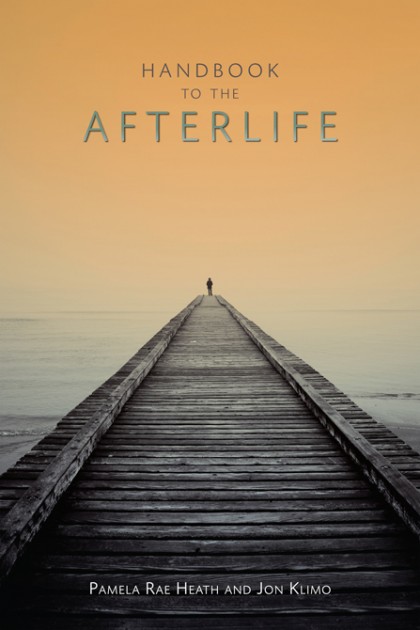
The supernatural is a dominant theme in my life, from religion to magic to ancient myths and legends to fairy tales and folklore. My world has enchantment around every bend, every mountain stream, every cloud covered mountain peak. No, I don’t know if there are faeries and elves and Shivas and Lokis and witches who eat children. I don’t know if anyone ever set out on a quest for the golden fleece or angels got thrown out of heaven. Don’t need to. We wonder about what happens after death, a common horror experience often and always. If we’re thoughtful, we wonder about what happened before life. Where were we before?
Our senses limit us to a particular spectrum of light, a particular range of sounds, a particular grouping of smells and tastes, yet we know about the infrared, low and high frequency sounds, the more nuanced world of smells available to dogs. We’re locked inside our bodies, yet we know that there are multiverses in every person we meet, just like in us. We know we were thrown into a particular moment, yet know very little of the moments the other billions of us got thrown into. My point is that our understanding of the natural is very, very limited, in spite of all the sophisticated scientific and humanistic and technological tools we can bring to bear. Most of what exists is outside our usual understanding of natural, certainly outside our sensory experience.
The expanse of the wonderful, the awesome, the amazing, so vast even in our small human experience, is cosmic outside of it. That’s where the supernatural realm lies. Not only Just So stories, then, but What If stories, too.
Sure, there are gothic stories, horror stories, fantasy that are poorly conceived, poorly written and poorly executed. I’ve contributed to that slush pile, but at the same time there are stories of the supernatural that allow us to get outside our human chauvinism, to imagine, to wonder. The part of me that loved the Ring cycle as a fourteen year old enjoyed Tolkien, King, Wickham, Kostova, and Clarke.
I have a sophisticated, adult aesthetic, too, and I enjoy it; but, I don’t see why I have to leave behind my more childlike appreciation of things like Marvel Comics, the Twilight Saga, Harry Potter, Hunger Games. So, I haven’t. My inner tween/teen needs screen time, as well.
I’m neck deep, ok maybe in over my head, in lesson planning, something I’ve not done before. I realized though that I did do a lot of educating over my twelve years at the MIA and I do have good facilitator, process skills. Even so, I’m having to learn about a key moment of Jewish development, the b’nai mitzvah, oddly, a marker of the very same transition Ruth is in right now. There’s as much culture as theology here, a cultural milieu with which I have little familiarity. But I’m picking it up.
Yesterday I finally got an organizational handle on what I was doing. That’s the moment when a lot of study and thinking begins to sort itself out into recognizable components. In this instance it was a religious school year long calendar, each class for which Alan and I are responsible indicated by date. In other columns there are holidays that occur in a particular month, September, for example, has Rosh Hashanah and Yom Kippur and Sukkot; middah of the month, for example, again, September is hitlamdut or curiosity; a column with one of Maimonides 13 articles of faith for each month. There are also Hebrew letters for each class day, a progression throughout the year that will follow the kabbalist’s tree of life and links to the parsha (Torah portion) for each week.
With these elements identified lesson planning will be easier because content can be plucked from any of the columns to enhance a particular class. There’s another move in the process, integrating the b’nai mitzvah curriculum developed by a national organization called Moving Traditions with those classes for which Alan and I have to develop our own lesson plans. Once how we do that is decided and dates for the b’nai mitzvah classes show up on the calendar, we should be able to move fairly quickly to a plan for the year.
I love this stuff, the pulling together of disparate complexities into one whole. This is a big challenge and I like that, too. Not to mention that I really enjoy the people at Beth Evergreen.
Gertie is apparently blind in one eye. Her left eye has been clouded by a cataract for some time, but an exam Monday revealed she may also have acute glaucoma and her pupil did not constrict when confronted with light. As in dogs in general, it doesn’t seem to bother her. She’s still her wriggly, rascally self.
Rigel seems to have recovered completely from her earlier this year bout with a food allergy. At some moment in the recent past she saw something that interested her out by our far back fence. Now, she lies on the deck, forelegs dangling over, eyes locked on the fence. In the morning she often goes back there to check things out, sometimes she’ll lie in the grass just beyond the shed, again eyes focused on the utility easement that begins just beyond the fence. The easement itself is a wildlife highway since it’s kept clear by IREA (Intermountain Rural Electrical Association) and extends up and down the mountains.
Kate bustled around yesterday in short bursts and defeated the nausea demon by not taking her diclofenac in the morning. Or at least we think that was it. She’s engaged in an experiment right now to test whether the diclofenac might be a major contributor. Problem is that the diclofenac covers her arthritis pain and without it she’s in pain. Difficult and complicated.
We went to the Mussar Vaad Practice group last night. Interesting conversation about faith and trust, the difference between the two. The difference is slippery and of course hinges on what they mean to you. If faith is the equivalent of belief, as in many creedal theologies it often is, then faith is fragile. If, however, faith is about our everyday willingness to live as if life will continue, as if our loved ones will not die at least today, as if abundance is ours to claim and experience, then it is not fragile, but a necessary component of the awakened, vital life. Trust is more transactional, more circumstantial, not global, but specific. It is a willingness to know the other, for instance, and, accept them as they are. Trust is, as a writer quoted last night said, the mother of love and the daughter of truth.
Well, it’s incremental. Down from 14:59 to 14:58 today but the needle has begun to move. By the end of the month daylight will have decreased to 14:56, but, by the end of July, to 14:16. August 13:05. September 11:49. December 21 9:21. That’s for Colorado, of course. Other locations will vary. A lot. But the trend is the same. And, on top of this mountain, welcome.
Started working on lesson plans, a first for me. My task involves the 6th graders of our religious school. Rabbi Jamie has a worksheet I’m using with four columns: Hebrew, Torah, Middah, and Mitzvah. Guess what? The first column is in Hebrew. That makes it a challenge for me. But, in this wonderful age of quick information access I can plug in the word to google’s task bar and get at least a clue quickly.
Glad I learned the quote, “Confusion is the sweat of the intellect.” After yesterday’s work on the lesson plans the metaphorical sweat came easily. It’s no easy feat stepping into another tradition, even one with which I have some familiarity. Yet, it is also rich, resonant.
Not a Jew, but a reconstructionist. That realization about my comfort level at Beth Evergreen has given me a broader insight. It’s a little strange, so bear with me, please.
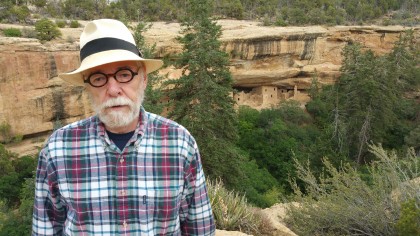
Spruce Tree House, Mesa Verde
I love definite, strong connections to the past, both Christianity and Judaism offer that to their adherents. So does travel. And reading. Among my favorite places to visit are ancient ruins like Ephesus, Angkor Wat, the Great Wall, sites of ancient Rome, Pompeii, Bath, Delphi, Delos, Cahokia, Mesa Verde, Chaco Canyon, even the castles of North Wales like Conway and Dinas Bran, encyclopedic art museums, and worlds created by writers like Ovid, Homer, Dante.
This could make me a conservative, a thinker and an actor with a preference for things as they were, a reluctance to change what works. But, oddly, it has had the opposite effect. I find in the ancient world a panoply of human possibility, ways of coping with this odd gift, life. How we think today, how we feel, has its roots in this vast web of life’s journey. We don’t have to experience everything as brand new, don’t have to figure everything out for ourselves. Others have loved, have doubted, have feared, have wondered, have hoped. So can we.
But, and I might call this the Emersonian turn, we cannot use the offerings of the past without remembering his introduction to Nature: “The foregoing generations beheld God and nature face to face; we, through their eyes. Why should not we also enjoy an original relation to the universe? Why should not we have a poetry and philosophy of insight and not of tradition, and a religion by revelation to us, and not the history of theirs?”
When we wittingly or unwittingly chain ourselves to the experience of others, especially those others from the distant past, we disrespect both them and ourselves. We disrespect them by claiming their authority as if something we had earned. We disrespect ourselves because we cheat ourselves of the present, of our own deep intuition, of our own revelations.
When we recognize though that those previous generations did behold God (bracket content) and nature face to face, that they did have an original relation to the universe, that they did create poetry and philosophy of their own insight, that they did create their religions by access to their own revelation, we learn an important, perhaps the important, lesson. We too live in this world with the same faculties, the same powers of observation and discernment that they had.
Gawain and the Green Knight
It was not those who had a religion of revelation to them that blinded us though. It was men, yes mostly men, of institutions, who tried to make the words of the past govern us. Those who declared scripture inerrant and infallible meant they knew what it meant, once and for all, and we had to obey. Well, I call bull shit on that. Those original beholders of God and nature opened themselves, in their present moments, to the awe and wonder all round about them. What a thing of beauty! Think how the mere record of their lives has effected us down to this day.
It is, though, the record of their lives. Only that. In our present, in this sacred moment, we have the same opportunity that they had, we have the same responsibility that they had. Think how the mere record of your life might effect others as distant from us in tomorrow as those are in yesterday.
Open up. Lighten up. Dance to the music of our time. Rip back the cloth from the temple gate in your life. Peak inside. Tell us what you see. We need to know.
Remember this. Always. “In the coming world they will not ask me—Why were you not Moses? They will ask me—Why were you not Zusya?” Rabbi Zusha of Hanipol
Yesterday was a big day. Up early to write, workout. Lunch with Alan Rubin to start planning for the 6th and 7th grade religious school at Beth Evergreen. Home for a fitful nap. Left at 5:30 pm with Ruth for Boulder. We had a reservation at Japango on the Pearl Street Mall before seeing the Fiske Planetarium show on black holes. Driving home under the waxing gibbous moon with Jupiter below it, Mercury and Venus visible, too, as well as Mars and Saturn. A planetary moment. No twinkling please.
A highlight from the Alan Rubin meeting was deepening my relationship with him, learning more of his history, sharing some of my own. I agreed to take on the task of researching Jewish Liturgical history.
We want to reframe the high holidays, Rosh Hashanah through Yom Kippur, in a reconstructionist way, then help the kids come to their own way of reframing. In the traditional understanding, taken here from the Chabad website, each year on Rosh Hashanah “all inhabitants of the world pass before G‑d like a flock of sheep,” and it is decreed in the heavenly court “who shall live, and who shall die … who shall be impoverished and who shall be enriched; who shall fall and who shall rise.” After ten days to seek repentance from those we have harmed in the previous year, God closes the Book of Life, sealing the fate of each worshiper.
The tradition implies a white bearded, Santa Claus like God who checks on the naughty and the nice. He takes out his celestial quill pen and starts scratching. He pauses, waiting to see what you have to say for yourself, then after a reasonable interval (the ten days), he writes fini.
How did these holidays come to be celebrated in the first place? Why? Who observed them and how? Have the observances and meanings of those observances changed over time? How? This is the exegetical move, gathering as much data as possible about the historical holidays. The hermeneutical move comes after it, asking what in our current circumstance, our present moment, if anything, corresponds to the original intentions. There is, too, a theological move here, asking if the metaphysics of the holiday can still be plausible. If not, that informs the reframing, too.
In my peculiar little world this is great fun. Looking forward to engaging similar research throughout the upcoming liturgical year.
Contrast this with my evening with Ruth. (Ironically, she is exactly the target audience for the above work, being a Jewish girl about to enter 7th grade.) We went to a sushi restaurant in Boulder where she had a sushi Tokyo plate. I had a sashimi plate, chef’s new choices. Green tea, too, for both of us. Ruth said, “You know me so well.”
After the dinner we drove back up Broadway to the Boulder campus of the University of Colorado, about 5 minutes. At the planetarium, where we’ve gone many times, we saw a presentation on black holes. It covered the usual topics of star death, neutron stars, supernovas and the formation of black holes with their extraordinarily deep gravity wells. It also covered recent observation of the long pursued gravity waves at the Laser Interferometer Gravitational-Wave Observatory (LIGO).
From the book of life to the heat death of the universe in one Friday. Quite the journey.
UNESCO and European Union undertake to reconstruct the cultural heritage of Timbuktu
Had an insight the other day about Beth Evergreen. The reason I like it there, feel comfortable there, is that I’m a reconstructionist at heart. Not a Jew, but a reconstructionist.
If I’d known about the concept when I started my reimagining project, I’d have called it reconstructing faith. Now, I do and I think of it that way. Reimagining and reenchanting are still part of this journey for me, but reconstructionist thought captures me in a particular way.
Here’s the key idea, from Mordecai Kaplan: the past gets a vote, but not a veto. That is, when considering tradition, in Kaplan’s case of course Jewish tradition, the tradition itself informs the present, but we are not required to obey it. Instead we can change it, or negate it, or choose to accept, for now, its lesson.
This is a powerful idea, especially when considering religious thought, which too often wants us to turn our backs on the present, get out a prayer rug, put our butt in the air toward the future and stretch out our hands in submission to the past.
Which brings me to another realization I had this week. Just like environmental action is not about saving the planet, the planet will be fine, it’s about saving humanity’s spot on the planet; the idea of living in the moment is not about living in the moment, it’s about remembering we can do no other thing than live in the moment.
In other words, this moment is all we have and all we will ever have. There is no way to be in the past or in the future, not even for a bit. We only live in the present. Living in the moment is not a choice, it’s a necessity by the laws of physics. What is important is realizing that, remembering it. Which goes back, come to think of it, to sharpening doubt.
The past is gone, the future is not yet. Always. We can be sure, confident, only of this instance, for the next may not come. To be aware of the moment is to be aware of both the tenuousness of life, and its vitality, which also occurs only in the moment. To know this, really know it in our bones, means we must have faith that the next moment will arrive, because it is not given. Not only is it not given, it will, someday, not arrive for us. That’s where faith comes in, living in spite of that knowledge, living as if the next moment is on its way.



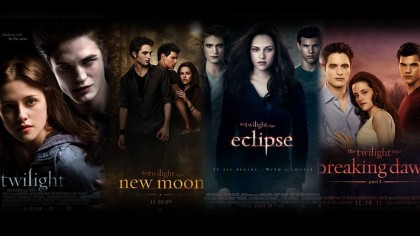 Modern technology is so wonderful. Over the last few days I watched all five of the much maligned Twilight movies. You might ask why, at 71, I would subject myself to all those teen hormones, questionable dialogue, and odd acting. First answer, I’m easily entertained. Second answer, I’m revising Superior Wolf right now. Werewolves from their source. Also, a project I work on from time to time is Rocky Mountain Vampire. So, the Twilight saga is in the same genre as my own work, though aimed more at a young adult, tween to teen audience. Which is, I might add, a very lucrative market. Maybe, it just occurred to me, some of them will be interested in my work as a result of their exposure to the Twilight books and movies.
 The supernatural is a dominant theme in my life, from religion to magic to ancient myths and legends to fairy tales and folklore. My world has enchantment around every bend, every mountain stream, every cloud covered mountain peak. No, I don’t know if there are faeries and elves and Shivas and Lokis and witches who eat children. I don’t know if anyone ever set out on a quest for the golden fleece or angels got thrown out of heaven. Don’t need to. We wonder about what happens after death, a common horror experience often and always. If we’re thoughtful, we wonder about what happened before life. Where were we before?
 Our senses limit us to a particular spectrum of light, a particular range of sounds, a particular grouping of smells and tastes, yet we know about the infrared, low and high frequency sounds, the more nuanced world of smells available to dogs. We’re locked inside our bodies, yet we know that there are multiverses in every person we meet, just like in us. We know we were thrown into a particular moment, yet know very little of the moments the other billions of us got thrown into. My point is that our understanding of the natural is very, very limited, in spite of all the sophisticated scientific and humanistic and technological tools we can bring to bear. Most of what exists is outside our usual understanding of natural, certainly outside our sensory experience.
 With these elements identified lesson planning will be easier because content can be plucked from any of the columns to enhance a particular class. There’s another move in the process, integrating the b’nai mitzvah curriculum developed by a national organization called Moving Traditions with those classes for which Alan and I have to develop our own lesson plans. Once how we do that is decided and dates for the b’nai mitzvah classes show up on the calendar, we should be able to move fairly quickly to a plan for the year.
 Kate bustled around yesterday in short bursts and defeated the nausea demon by not taking her diclofenac in the morning. Or at least we think that was it. She’s engaged in an experiment right now to test whether the diclofenac might be a major contributor. Problem is that the diclofenac covers her arthritis pain and without it she’s in pain. Difficult and complicated.
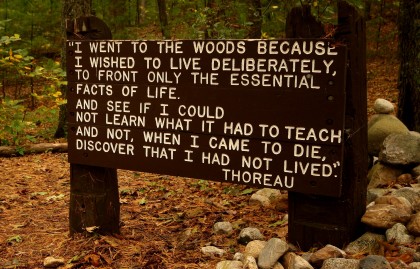 But, and I might call this the Emersonian turn, we cannot use the offerings of the past without remembering his introduction to Nature: “The foregoing generations beheld God and nature face to face; we, through their eyes. Why should not we also enjoy an original relation to the universe? Why should not we have a poetry and philosophy of insight and not of tradition, and a religion by revelation to us, and not the history of theirs?”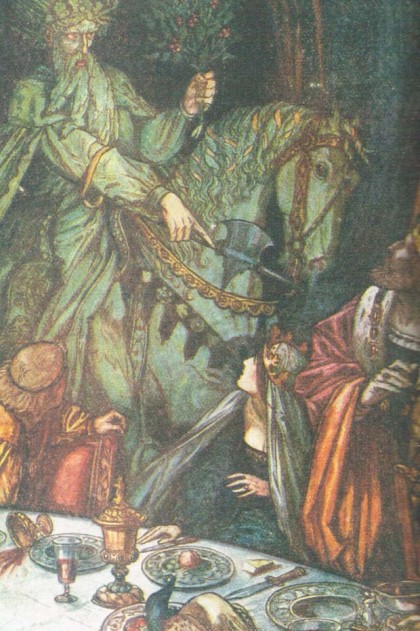
 Yesterday was a big day. Up early to write, workout. Lunch with Alan Rubin to start planning for the 6th and 7th grade religious school at Beth Evergreen. Home for a fitful nap. Left at 5:30 pm with Ruth for Boulder. We had a reservation at Japango on the Pearl Street Mall before seeing the Fiske Planetarium show on black holes. Driving home under the waxing gibbous moon with Jupiter below it, Mercury and Venus visible, too, as well as Mars and Saturn. A planetary moment. No twinkling please.
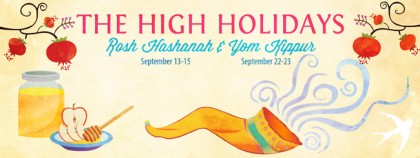 We want to reframe the high holidays, Rosh Hashanah through Yom Kippur, in a reconstructionist way, then help the kids come to their own way of reframing. In the traditional understanding, taken here from the
 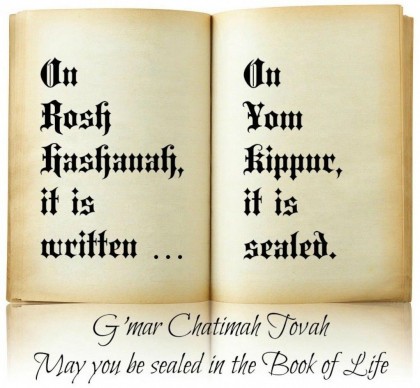 The tradition implies a white bearded, Santa Claus like God who checks on the naughty and the nice. He takes out his celestial quill pen and starts scratching. He pauses, waiting to see what you have to say for yourself, then after a reasonable interval (the ten days), he writes fini.
 In my peculiar little world this is great fun. Looking forward to engaging similar research throughout the upcoming liturgical year.
 After the dinner we drove back up Broadway to the Boulder campus of the University of Colorado, about 5 minutes. At the planetarium, where we’ve gone many times, we saw a presentation on black holes. It covered the usual topics of star death, neutron stars, supernovas and the formation of black holes with their extraordinarily deep gravity wells. It also covered recent observation of the long pursued gravity waves at the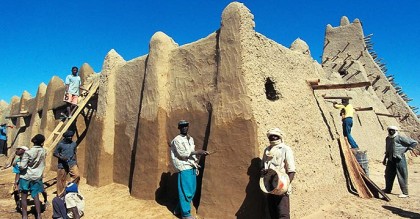
 Here’s the key idea, from Mordecai Kaplan: the past gets a vote, but not a veto. That is, when considering tradition, in Kaplan’s case of course Jewish tradition, the tradition itself informs the present, but we are not required to obey it. Instead we can change it, or negate it, or choose to accept, for now, its lesson.
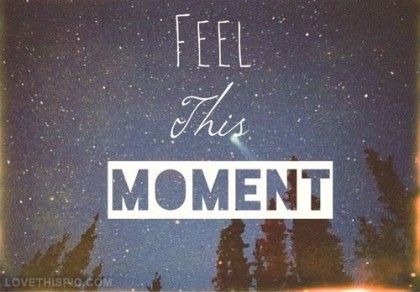 Which brings me to another realization I had this week. Just like environmental action is not about saving the planet, the planet will be fine, it’s about saving humanity’s spot on the planet; the idea of living in the moment is not about living in the moment, it’s about remembering we can do no other thing than live in the moment.
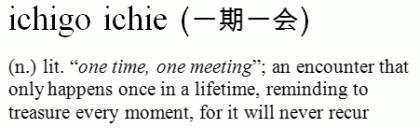 The past is gone, the future is not yet. Always. We can be sure, confident, only of this instance, for the next may not come. To be aware of the moment is to be aware of both the tenuousness of life, and its vitality, which also occurs only in the moment. To know this, really know it in our bones, means we must have faith that the next moment will arrive, because it is not given. Not only is it not given, it will, someday, not arrive for us. That’s where faith comes in, living in spite of that knowledge, living as if the next moment is on its way.