Category Archives: Faith and Spirituality

Night and Death. Yes.

Imbolc                                                                      Imbolc Moon

20180131_185045The Imbolc moon has had its night in earth’s shadow, its night as super and blue and red. Hey, up in the sky, it’s Supermoon! And last night it was wonderful again. High, full, behind a faint veil of clouds. Orion and the moon. My two favorite celestial objects. Well, ok, the sun, too, but I can never look at it.

Something in a full moon moves me to the depths of my soul. I can find myself tearing up, a catch in my throat at the sheer extravagance of its beauty. It’s offered over and over, available to all, free.

So, too, Orion. He rises. Greets any who bother to find him. He stands always ready astride the horizon, a hunter and his dog. I don’t know whether he remembers our nights in Muncie while I watched over the entrance gate at the factory, but I like to think he does.

The night sky, in its shorter versions and in its Winter Solstice maximum, offers solace to those of us who want it. The night is, to paraphrase LP Hartley, a foreign country. They do things different there.
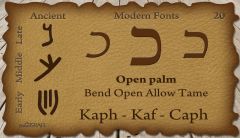
caphLast night I went back to Beth Evergreen, more kabbalah. Studying the kabbalah at night, especially under a full moon. Yes. Learning about more double letters: Pey, Caph, Reish, Tav.

I know this Jewish immersion of mine must seem odd to some of you who read this; but, it’s happened over many years, a sort of there and back again phenomenon. In this current instance Kate’s conversion long ago made us seek out a synagogue, just to see. We found Beth Evergreen, a special place, unique I imagine, even among Reconstructing congregations.

It was long ago though I read Isaac Bashevis Singer. Chaim Potok. Later, Rebecca Goldstein. It was long ago that I walked into the synagogue in Muncie for an anthropology assignment. It was long ago that I dated the jeweler’s daughter, Karen Singer, and found her father’s knowledge of philosophy astounding. Over the years many Jews have come into my life and I’ve always felt comfortable around them. As if we shared a common spirit. At Beth Evergreen that feeling surfaced immediately and has grown deeper over time.

green Natural-Burial--275x275Being part of the tribe? No. Not for me. Walking along with the tribe as it wends its way through this moment in time? Yes.

Let me give you an example. The friend I mentioned yesterday, Bonnie Houghton, the green cemetery and burial, rabbi in training, Bonnie, got me going on the Recycle Me idea. It fits so well with my pagan sensibility and it’s something I can act on through this community.

Yesterday was Tu B’Shvat, the new year of the trees. It’s a part of the Jewish holiday year, just like Yom Kippur, Purim and Passover. Kate and I went to the celebration yesterday before kabbalah. Later, as I rested before returning for kabbalah, an image struck me: a Tu B’Shvat celebration in our yet-to-be green cemetery. We would be honoring trees, trees of all kinds yes, but especially, in this celebration, those trees growing from the graves of deceased members of Beth Evergreen.

Can you imagine? An ancient holiday celebrating trees and the gifts that they offer, now including trees with their roots literally in members of the congregation? How mystical, how wonderful would that be. Out there, on the mountain side, perhaps a mountain stream running nearby, a breeze rolling down the slope and my tree, the tree that is a tree and me, our leaves rustling as the gathered folks sing, pray. Yes.


Re-enchant

Winter                                                                               Imbolc Moon

20180116_183104This is, I know, a terrible picture, although since it was taken at night, with my hand held computing device and from a considerable distance away-I was parked at the side of the road hoping no one would stovepipe me-it’s ok.

This tree is my favorite light display along Brook Forest Drive on the way to Evergreen. There were many. The folks who lit it up must have run a very long extension cord to get to it, because it sits all alone in the woods, on the edge of a precipice. I love its existential isolation and yet its brilliance and its color.

The woods up here, the Arapaho National Forest for the most part, are lovely dark and deep and beautiful because of that, but having this small bit of human intervention tickles me.

It’s a part of a larger picture that’s coming to me. When I mentioned shamanic seeing in the post about the mountain spirits, it made me aware that I need to a third R to my gerundal theology: reimagining and reconstructing AND re-enchanting. This last of the three R’s of an emerging approach to faith may be the most important of all. The first two involve rational heavy lifting, taking something apart and putting it back together in a way meaningful today. Important and critical, yes. But, I’m realizing, not enough.

reenchant_logo10-08-100pxMore than the intellectual work we need the emotional work, a return to shamanic seeing, a return to a view of the world as a magical, mystical place. Which it always has been and continues to be. The empirical method, the scientific method has, like religious dogma, occluded our ability to see wonder. One woman said, during the mussar class in which we discussed the three messengers (angels) from the mountain spirit, said, “How would the mountain know when to send out the messengers?” Beep. Wrong question.
The right question? How can we open our hearts to the intimate communication we get from the natural world everyday? Including those emanating from within our own bodies. It’s our perception that needs to change, not the world. It’s still sending messengers and messages, but we’ve systematically tricked ourselves into thinking we now know too much to attend to them. We don’t.

reenchant.jpg2What does that lenticular cloud hanging over Black Mountain have to say? How about the wind howling down off Mt. Evans? The snow storm about to hit us? The fox or the mountain lion or the bear crossing our yard? The gradual decline of our muscle mass, our mental mass, as we age? Where are our faeries? Why won’t the wood nymphs of the lodgepole pines speak to me? The sun and its perpetual light. That rock fallen on to the road. What do they mean? Not what are they? Not why are they there? But what love note from the big bang do they contain? How would the ancient Greek or the Hebrew on Sinai or the folk who walked up out of Africa relate to them?

No, we don’t have to give up the scientific. No, we don’t have to abjure missing the rock with our car or truck. We only have to ask about our relationship with all these. What is it? How does it convey meaning to me? I like the notion of spirits and gods, goddesses, too. I’m still looking for the Great God Pan. Maybe you’ve seen him?


Life is like an hourglass

Winter                                                                             Imbolc Moon

hourglass

This is a short piece from a book, 365 Tao: Daily Meditations. It’s day 350. It fits so well with kabbalah, as I’m finding Taoism often does.

Life is like an hourglass

Consciousness is the sand

Imagine an hourglass.

Its shape is like the symbol for infinity. Its form recalls the double helix of DNA. Its two sections represent polarity. The material on one side, the immaterial on the other. The male on one side, the female on the other. Hot and cold, positive and negative, or any duality. (dialectic)

The sand runs in a stream, the same stream as the course of energy that runs up your spine, the same stream that is the road of life.

The movement of that sand is what we call Tao. Our consciousness alternates between the various states represented by the hourglass. It is as difficult to grasp as a stream of sand. Therefore, it is foolish to examine things minutely. It is unwise to focus on the material. It is wisdom to understand the movement.


Big Guys Do Cry

Winter                                                                  New Imbolc Moon

Being sick, even mildly sick as I’ve been for four or five days now, takes me into strange territory. Mortality flits across the mind. All the obituaries that include the phrase, “after a brief illness.” Labile. When I saw this video about Ronnie the Donkey, I cried. And, too, when I read about this special organization, Cayleb’s Senior Dog Rescue. Kate and I donated.

Donkey And His Mom Celebrate Their Emotional Journey    This donkey was so depressed after he lost his baby boy. But the woman who adopted him knew exactly what he was going through and figured out the sweetest way to make him feel at home. Today on Party Animals, Ronnie’s mom is throwing him a very emotional 5th rescue-versary party to celebrate their amazing journey 😍

Posted by Party Animals on Saturday, January 6, 2018

Got to wondering about being labile. Why is that part of illness?

I asked Kate. Less energy to maintain your defenses, she said, in essence.

Castle Dinas Bran, Llangollen, North Wales

Which raises a second question. Why the defenses? Why would I need to place a barrier between my feelings and my expression of them, especially feelings of tenderness? Is it too difficult for my sanity to rock my inner world? Somehow I don’t think so. It seems more likely that big boys don’t cry. As our president might say, Sad. Why not recognize when the heart softens, when it takes in a moment of love and responds? Why not just go ahead and cry? Tear up.

Maybe one of the functions of illness is to remind us of our heart truth. When the body feels threatened, insulted, perhaps the mind takes the opportunity to reexamine our spot in this world. Perhaps it allows the cultural constructions, the moats and castle walls we put up, to crumble a bit, so we can know they exist. We do tend to forget about those fortifications, the ones built by stereotype, by social convention.

dinas bran. I visited these ruins in 1995.

We northern Europeans seem to have well-built walls. Perhaps that’s why we can be gulled too easily by ideologues who have burnished their fear of the other, who take their fear and embarrassment as cues for violence rather than compassion. It is a danger we could altogether eliminate, if we let the right feelings in.

As for me, I’m going to try. The moat drained, the walls down. Good. Let them stay that way.

The Grail and the Veil

Winter                                                               Moon of the Long Nights

Sumi Brush“The more I have looked into the Quest for the Grail, it is clear it is a Western form of Zen. There is no grail, it is understanding that the veil is the mystery of existence, it is nothing, but our interactions with everyone and everything.” Woolly and friend, Mark Odegard

Mark is an artist, an author, a sweet guy and a friend of 30 years. He’s done many retreats at a Zen Buddhist retreat center in Minnesota and done calligraphy with that giant brush Zen monks use. He has an ability to come at ideas from the side, or behind, seeing what cannot be seen; the Zen work has informed his sight in substantive ways.

He’s asking the Woolly Mammoths this New Year’s question for their next meeting:

“What personal tool/skill do I need to refine for my quest for the grail’? I will write down your answer to this, and ask you again at the end of the year.

The story represents our own encounter with the mystery of life (often occurring in our late teen years). The meaning is veiled for us, what do you need to lift the veil.”

Mark’s question made me start because I’d just written this, only two or three days ago here on Ancientrails:

“Torah study is about loving attentiveness. It is a way of engaging the sacred world which we can know first from within our own person and which permeates that which we encounter throughout our lives…

God lit up for me. Ah, if I do Torah study, if I engage in loving attentiveness to my Self, my own Soul, and those of others and of the broader natural world, then I can find the knowledge which permeates all things, that very same shards of the sacred that shattered just after the tzimtzum to create our universe. That is God being available everywhere. This is far different from the Latinate imponderable of omnipresence, sort of an elf on the shelf deity lurking in every spot, finding you everywhere. And judging.

No. God is another word for the intimate linkage between and among all things, from the smallest gluon to the largest star. God is neither a superparent nor a cosmic Santa Claus writing down your behaviors in the book of deeds; God is a metaphor for the sacred knowledge which permeates the perceivable, and the unperceivable, world.” Ancientrails

I’m not trying to revive the word God here, nor am I trying to reinsert myself into the thought world which includes God. I’m on the same grail quest I started years ago in Alexandria First Methodist sitting beside the huge stained glass window of Jesus praying in the Garden of Gethsemane. Back then I read the Bible as history, not as mythology. Back then it mattered if there was a Jesus who prayed in that Garden that the burden of crucifixion be lifted.

I pushed those beliefs away long ago, passing through a moment, a long moment of second naivete with them, then moving into the world of the Great Wheel and the cyclical, spiraling time through which all life moves, in fact, all things. Over the last year or so my intense program of Jewish immersion has taken me another big step along this ancientrail, a true Grail quest began when, as a sixteen year old, I began to doubt the stories I’d heard growing up.

Frederick J. Waugh, The Knight of the Holy Grail, c. 1912


My true philosophical (qua religious) home, existentialism, found me in the aftermath of that doubting and my first encounter with philosophy at Wabash College. When I went into my Christian immersion, through seminary and in the Presbyterian years, my faith went mystical, seeing the divine as divinely personal, as a bright light shining within the darkness of my inner world, a light whose purpose was not to dispel the darkness, but to integrate, Taoist style, both of them.

Now, with Rabbi Jamie, I’m studying the kabbalah. Like Zen it insists on not seeing with eyes alone, but with the heart, with a poetic sensibility that understands religious language, I think all religious language, as metaphor, even and especially for the kabbalists, the written Torah.

The veil is a very important metaphor in kabbalistic thought. Like Mark observed above the kabbalists know there is a veil between us and the mystery of existence. The veil underscores the humility necessary for this work and without humility the quest will fail.

canterbury pilgrims
canterbury pilgrims

This idea is ultimately significant. Or not. We cannot penetrate the veil. Ever. Yet we all stand together on the other side of it. To see through the veil, to actually find the Grail, is not given to us, yet that place which we see through a glass darkly is the place where we stand right now. Yes, right now the Grail is in our hands, a cup from which we can drink at any moment.

This ancientrail, the quest for the Grail, the turning of the Great Wheel, the lifting of the burden of our crucifixion, flowing up and down with divine energy through the Tree of Life, is our life, is the life of this world, this cosmic pulsing brilliant reality. Yet we let so many things: work, fear, hope, pride blind us.

winter solstice3The Woolly Mammoths have been my companions, fellow pilgrims, on the way to Canterbury. Or, fellow Tibetan Buddhists inch worming their way around the sacred mountain, Meru. Or, my fellow Torah scholars, davening as we read the sacred texts. Or, fellow Lakotas, our skin pierced and tied to the world tree during the Sun Dance. Or, friends traveling through this life together until it ends.

“What personal tool/skill do I need to refine for my quest for the grail?” Out of far left field, I’m going to answer, “A Sumi brush, rice paper, an ink stone. And the courage to use them.”


Reimagining/Reconstructing

Winter                                                                           Moon of the Long Nights

Alan James Garner - Own work, CC BY-SA 3.0, https commons.wikimedia.org
Alan James Garner  Own work, CC BY SA 3.0, https commons wikimedia org

Last night, third night in a row at Beth Evergreen, was the MVP, the mussar vaad practice group. Tuesday was the unveiling of the third stained glass window. Wednesday was the first class of the third in the first year kabbalah curriculum, the Mystical Hebrew Letters. On a personal, physical level this many evening sessions, which extend well beyond my usual 8 p.m. bedtime and then require a half hour ride home afterward, exhaust me. But on a psycho-spiritual level the nourishment I receive more than compensates.

As I wrote this last sentence, I looked up at Black Mountain and noticed a pink glow, a penumbra at its peak. A good symbol for the new understanding that is beginning to dawn on me.

In the mid-day mussar class, where we are near the end of the Messilat Yesharim, the path of the upright, by the 18th century kabbalist, Rabbi Moshe Luzzato, Jamie commented, “Remember, these are kabbalists. They include proof texts as an invitation to rethink them as metaphor, not to accept their literal meaning.” Jamie has said this before, in the kabbalist classes especially. “The Torah is a metaphor, not history.”

Torah being read at a Bar Mitzvah

A bit later, he asked, “What is Torah study?” This was a topic we covered over a year ago when beginning Luzzato’s work. Torah study is not about content. It is not, in other words, limited to scholarship about Genesis, Exodus, Leviticus, Numbers, and Deuteronomy. Torah study is a method and it involves paying close attention to the person next to you, to the sunrise over Black Mountain, to the cry of a sparrow, to the way a lodgepole pine sloughs off snow, to the needs of the dog sleeping beside your chair. to the nature of fire crackling in the fireplace. Torah study is about loving attentiveness. It is a way of engaging the sacred world which we can know first from within our own person and which permeates that which we encounter throughout our lives.

And, again, aha! The sun, the sacred sun with its life-giving light, just lit up Black Mountain and showed me a sign, a way of illustrating a literally dawning awareness. The wind, the finger of the sacred blows as the ruach, the breath of spirit, the breath of life and moves the lodgepole pines in our front yard. The pines themselves erupt out of the stony Shadow Mountain ground, able to express life in a soil mostly barren of the rich nutrients available in the farmlands of the American Midwest.

Marily, Tara, the Burning Bush
Marilyn, Tara, the Burning Bush

I find this means I can read the word God in a new way. Shortly after Jamie commented on Torah study, we read a sentence in Messilat Yesharim that included the English word omnipresence, as in God’s omnipresence. I asked Jamie what Hebrew lay behind this translation. He looked it up, “Hmm. Something like, permeated knowledge.”

God lit up for me. Ah, if I do Torah study, if I engage in loving attentiveness to my Self, my own Soul, and those of others and of the broader natural world, then I can find the knowledge which permeates all things, that very same shards of the sacred that shattered just after the tzimtzum to create our universe. That is God being available everywhere. This is far different from the Latinate imponderable of omnipresence, sort of an elf on the shelf deity lurking in every spot, finding you everywhere. And judging.

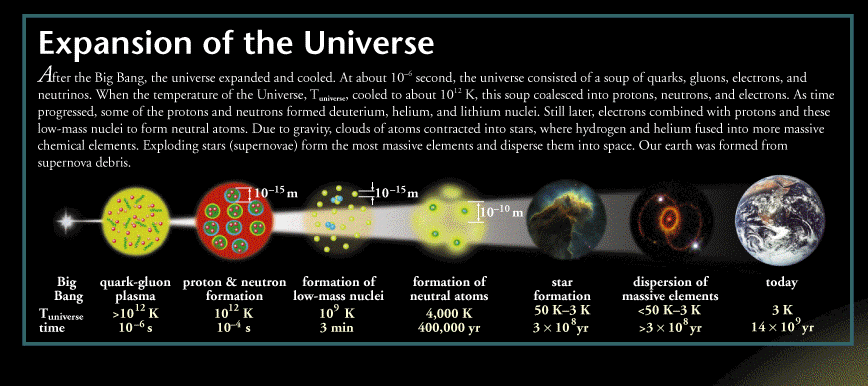
hist_univNo. God is another word for the intimate linkage between and among all things, from the smallest gluon to the largest star. God is neither a superparent nor a cosmic Santa Claus writing down your behaviors in the book of deeds; God is a metaphor for the sacred knowledge which permeates the perceivable, and the unperceivable, world.
Our deeds are, of course, written in the very real book of our life, so they have consequences, not only on our life as whole, but as they impact others and that same world which we all inhabit. You could also see God’s judgment as the manifestation of those consequences, in their positive and negative natures, not as a divine finger shaking or outright punishing, but as ripples from one instance of the sacred to the another.


In the Beginning

Winter                                                              Moon of the Long Nights

AlKabbalah last night. The first session of Mystical Hebrew Letters. Rabbi Jamie began teaching kabbalah at the Kabbalah Experience with this class several years ago. It moves from the broader conceptual fields of Soul and Space, the first two classes this year, to the particular examination of the Hebrew alphabet.
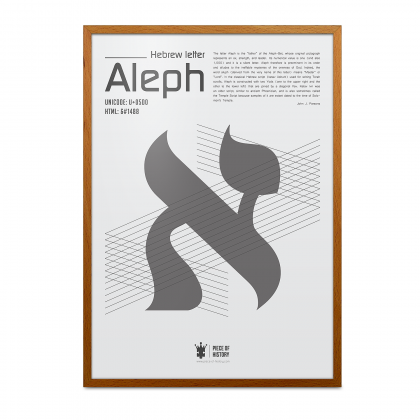
As with all the kabbalistic material, the subject matter gets complicated fast. We began with an overview of this ancient language. According to recent scholarship Rabbi Jamie says, it is the oldest alphabet in the world. Like most early languages, Chinese for example, it began as pictographs.

alephAleph, the first letter, was an ox-head. The word aleph means ox-head, or head of ox, also learning and chieftain. Prior to the use of Arabic numerals each Hebrew letter stood in for numbers with the letter aleph as number one. The word aleph means 1,000. Thus, aleph symbolizes the philosophical notion of the one and the many.
It is silent. Not sure why, but aleph and ayin, though used in the written language, are always silent. As silent and first in the alphabet, it also symbolizes the silence out of which came everything.

(next day) Stopped writing this yesterday when my need for sleep overcame my ability to write a coherent sentence.

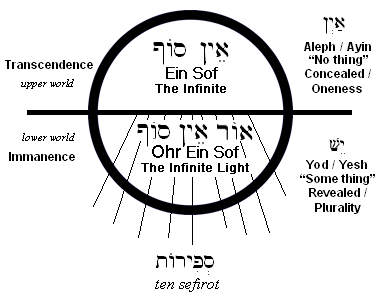
The big idea I took away from this class involved aleph and my reimagining/reconstructing emphasis on incarnation rather than transcendence. Jamie introduced the notion of the alphabet, the Hebrew alphabet, as a funnel flowing from aleph in the ein sof (unlimitedness), its silence standing for the space created when the ein sof contracted, the tzimtzum, and filled with ohr, the first light of creation which fractures and travels down through the tree of life with its 22 channels (connecting lines) to the tenth sephirot, or malchut/shekinah, which is this world. Its letter is tav, the 22nd and last letter.

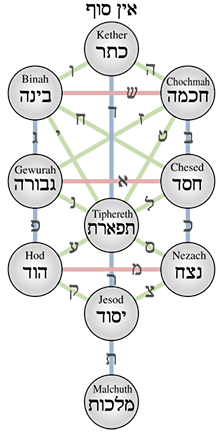
At first I thought, oh this emphasizes transcendence, the physical world developing in a top down fashion from a realm unconnected to it save by the thinnest of conceptual threads. Then Jamie began to introduce the location of the letters on the tree of life and aleph did not appear above the keter (the crown at the top of the tree of life), but on the parallel line of connection between chesed and gevurah, essentially the middle of the tree of life. Huh? How could this be?

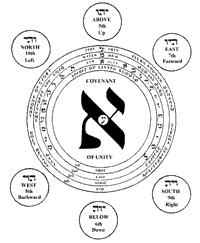
These two images represent the two different ways of understanding this idea:

EinSof

This one shows the first representation of the funnel idea that came to me. It does in fact emphasize transcendence. But, when we remember (difficult to do when material is presented on paper) that the tree of life is three-dimensional and can be seen as a sphere, another possible image presents itself.

aleph

As the rabbi likes to say, Aha! The nub of creation, the contraction of the unlimited ein sof, the movement from the quantum world to the Einstenian/Newtonian this world, the shattering of the ur-ohr, the first light of creation, happens in the center of the sphere and radiates outward. Yes. The divine moves from within all to create, in an outward push, the shekinah, the divine manifested in created matter. This is big-bangy. The tzimtzum just proceeds the big bang which radiated outward from an unfathomably concentrated spot in the beforeness of whatever it was, the ein sof, to create literally everything we know.

This puts the sacred neither above nor below but within. In order to access sacred nature we do not need to cast a prayer upward toward the heavens or outward to a religious institution, but inward to the aleph in our own soul, to that silent spot in ourselves where resides our shard of the ohr, the first light.

Here is an image of the tree of life that shows the location of aleph between chesed and gevurah. Remember that the tree is three dimensional like the DNA helix.

tree_of_life2


Seek? Yes. Claim to have found? No.

Winter                                                                  Moon of the Long Nights

It is not the seeking after God that divides but the claim to have found God and to have discovered the only proper way of obeying God and communing with God. M.M.K., Reconstructionist Prayer Book, page 125

each birth, always
each birth, always

Been thinking about religion. Again. Still. Always. Considering it from a different perspective this last week. I’ve said other times that I believe religion is the philosophy and poetry of the common person, a way to understand deep questions like: Why are we here? What is our purpose? What’s good behavior? Bad? Who am I? Who are we?

Religions are a language a group of people can use to have conversations about these questions, a set of ideas and concepts, history and tradition which give weight to possible answers. We are here to repair the world, to bear the burden of the other. A Jewish response to some of the questions. We are here to love one another as we love ourselves. One Christian answer. We are here to detach ourselves from the world, to float free of attachment and eventually find nirvana. One Buddhist answer. We are here to submit to the will of Allah. We are here as part of the natural world and best served when we align ourselves with it. We will head toward heaven or bardo or the endless wheel of reincarnation or the return of our elements from whence they came.

winter solstice4Inside the particular Jewish or Presbyterian or Unitarian or New Thought or Tibetan Buddhist or Hindu or Muslim community to which we belong we use this language and create a sense of belonging. As we use the language, part of which is ritual and dress, part of which is expected behaviors, we create a semi-permeable membrane, often not very permeable at all, for outsiders. To cross into our community they have to penetrate the language, learn the customs, adjust themselves to the patterns. The membrane works both ways, obscuring our vision as we look out from within our particular tradition. We see a world shaped by and often determined by the assumptions of ours.

This membrane tends to make dialogue across it difficult, sometimes impossible. My point here is that in the world there are many, many of these membrane covered communities. The very thing which makes them rich and wonderful to their participants makes them difficult to understand for outsiders. And, they can’t all have all the answers. Common sense says so.

Birth of Lord Krishna

Many of the new atheists (Dawkins, Harris, Hitchens) have taken these sort of observations and come out with ideological guns blazing, considering themselves in a High Noon battle with the forces of ignorance. I disagree.

Last night at Beth Evergreen, during the Shabbat service, I read through various pieces of commentary in the Reconstructionist Prayer Book. Mordecai Kaplan, the founder of the Reconstructionist Movement and a religious humanist, appears as M.M.K. In a derash, or homiletical interpretation of the Aleynu, the closing prayers for a service, Kaplan’s initials appear below this quote:

It is not the seeking after God that divides but the claim to have found God and to have discovered the only proper way of obeying God and communing with God. M.M.K., Reconstructionist Prayer Book, page 125

I think MMK and I could have been buddies.

Humans don’t try to dominate. We listen. We adjust.

Winter                                                                  The Moon of the Long Nights

lunarflow, Gouache on paper by Heron Michelle

The full Moon of the Long Nights glows in the west this morning, roughly over Evergreen. Its gentle light blots out many stars, but makes up for that in its own silvery beauty.

The moon is a place alien to us in spite of its ubiquity. We see it most nights, know its facing terrain intimately, most of it visible through good binoculars. We’ve even sent a few humans to walk upon it, twelve all told, but that small number underscores rather than challenges its wildness. Even if humans settle on the moon, its surface will still be no place for unprotected human bodies. We were not made for that place even though it is our closest solar system neighbor. It is the first outpost of the wilderness, the strange and foreign place, that is everything else in the vastness of space.

There are still places on earth where we can experience wildness. High Country News, a magazine that focuses on issues effecting the contemporary West, has become a favorite read of mine; and, in its Christmas issue, featured an article by Outside writer and editor, Christopher Solomon, “In the Home of the Bear.”

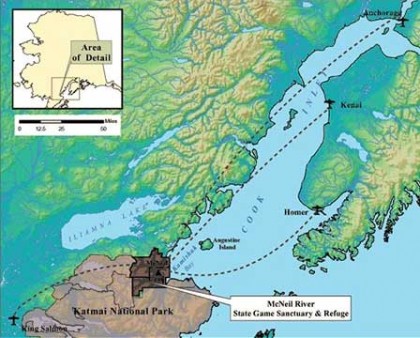
mcneil_travelSolomon recounts a visit to the McNeil River Sanctuary. He won a chance to visit this protected spot for the Alaskan brown bear in an annual lottery. The fairly long quote below has rattled around in my mind since I read it a week or so ago. It reveals, at least to me, a path we could walk to accomplish Thomas Berry’s Great Work for our time, creating a sustainable human presence on this planet, our home in the wildness of space.
The he in the first sentence is Larry Aumiller, a manager of the sanctuary for three decades. He “spent three decades studying how humans could live in harmony with Ursus arctos on the landscape.”

McNeil_Falls_in_July, DrewHH - Own work
McNeil_Falls_in_July, DrewHH – Own work

…over time, he learned how humans and bears could reside together.

And what works? First of all, restraint — not bulling into the landscape. Bears don’t like surprises. Moving slow and being predictable are good starts. That’s why humans walk the same trails, about the same times every day, and in the same group size. Over decades of such long and careful practice, the bears here have learned to see humans as another presence on the landscape — neither the source of a meal, nor the cause of pain or fear. They are “neutrally habituated,” in the argot of this place…

Almost everywhere else, the ability for humans and bears to move easily among each other has been lost. What is different at McNeil is that humans don’t try to dominate. We listen. We adjust. We find out how it all fits together, and where we fit in. “Here we learn that we can live among the great bears,” Fair writes. “Here we learn the human behaviors that allow this.””  In the Home of the Bear, High Country News

Humans don’t try to dominate. We listen. We adjust. We find out how it all fits together, and where we fit in. Oh, what a wonderful world it would be…

Celebrating the Obverse

Winter                                                              Moon of the Long Nights

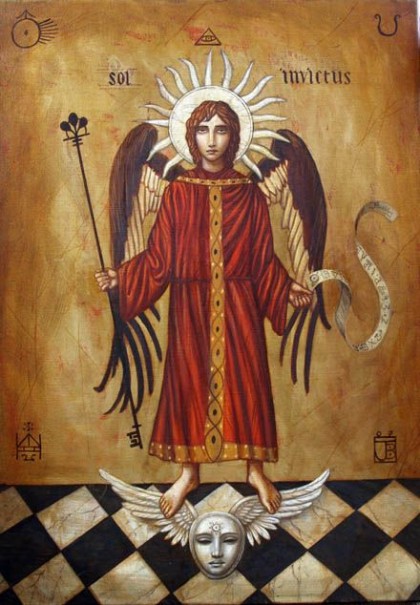
sol-invictusThe solstices mark swings to and from extremes, from the longest day to the longest night, there, and as with Bilbo, back again. Darkness and light are never steady in their presence. The earth always shifts in relation to the sun, gradually lengthening the days, then the nights.

Most folks celebrate the Winter Solstice for its moment of change toward increasing light. Sol Invictus, the Roman sun god, added a martial spirit. The ancients feared that the nights would continue to grow in length, and act as a shroud thrown over the earth marking an end to growing seasons, to warmth, to life. It’s no wonder that relief at the return of the sun, revealed by small increases in the length of the day, caused holidays to be born around this subtle astronomical change.

There are also bonfires and songs and drinking and sex on the Summer Solstice. The sun manifests itself as light giver, light bringer, with the longest days. The growing season is well underway then, the miracle of life that the sun’s increasing light creates is the very relief anticipated on the Winter Solstice. Fear and the vanquishing of fear. Sol Invictus, the conquering sun.

Yet even in ancient times there had to be a few outliers like myself. We don’t begrudge the return of the sun, nor deny all the miracles that its return makes possible, that would be silly; but, for some psychic reason, perhaps not clear even to us, we reverse the common sensibility and find succor in the gradual lengthening of the nights that begins at the Summer Solstice and reaches its maximum on the night of the Winter Solstice.

We know that the cold and the darkness, the fallow time whose genesis each year happens on the longest day, is also necessary, also worthy of honor. It is earth’s sabbath, a time for all the generative powers to rest, to regather themselves, to ready themselves for the next florescence. I suspect somehow in our psyches we honor slight dips into depression or melancholy, knowing that in those times we regroup, rest the eager forward creative parts of our souls and the gradual lengthening of the darkness outside mirrors that.

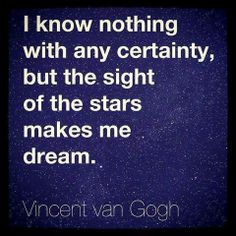
winter solstice4In these long nights the cold often brings clear, cloudless skies. The wonderful Van Gogh quote that I posted a few days ago underscores a virtue of darkness, one we can experience waking or asleep. Dreaming takes us out of the rigors of day to day life and puts us in the realm where ideas and hopes gather. So, the lengthening of the nights increases our opportunity to experience dream time. Whether you believe in Jung’s collective unconscious or not-I do, the rich resources of dreaming are available to us with greater ease when the nights are long and the cold makes sleeping a joy.

It was, too, many years ago when I pushed the notion of transcendence out of my spirituality in favor of immanence, incarnation over a god in the sky. My focus moved to down and in, not up and out. Our inner world is a mystery, a place of fecundity, but also a place often occulted by the demands of the day. When we shift our focus to the night, to the half of the year when darkness grows, we can use that external change as a trigger to lean inside, to find the divine within. If we can make this discovery, the god that we are, we can stiff arm the notion that revelation stopped thousands of years ago.

each birth, always
each birth, always

Every moment of our existence is a revelation, the path of a god, the most fundamental ancientrail of all. No, we are not omnipotent, that’s an illusion created by the idea of transcendence, the need to find validation outside of our own soul. This is the true polytheism, the one that folds its hands, says namaste, bows to that of god in everyone, in every animal, in every plant and stone and star.

When you reach out in love to another person, to a dog, to a crocus blooming in the snow, you bring the finger held out by the white haired floating god in Michelangelo’s Sistine Chapel ceiling. That moment of creation is always, ongoing, a joint effort between and among us all, human and inhuman, animate and inanimate, the cosmic dance of Shiva brought into this mundane world. He or She is not out there, waiting to be called by prayer, but in here, waiting to be called by the quiet, by the joy, by the persistence held in the soul container that is you.