Fall Hunter Moon
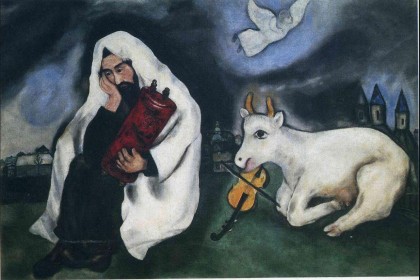
On erev Rosh Hashanah I went to Beth Evergreen with Kate. The beginning of the Jewish New Year, 5777. Last night I went to the kol nidre service which starts the holiday of Yom Kippur, the end of the 10 days of awe. This morning Kate and I went to the main service for Yom Kippur. It began at 9:30 am and finished at 1:00 pm. Surprisingly, it went so smoothly that I barely noticed the time passing.
 Beth Evergreen’s sanctuary has multiple clear glass windows that offer views of Bergen Mountain and Elk Meadows. The view next to the Torah Ark had a mountain side filled with lodgepole and Ponderosa pine. Almost to the peak of the mountain though there was a small stand of aspen, golden still, in a perfect heart shape. All through the service I had a symbol, an accident of nature, created by my view, my perspective that synched up remarkably well with the overall theme of Yom Kippur, atonement. Also, up and to my right, at the roof of the sanctuary, a square window framed the tip of a Ponderosa pine. It looked like a painting by a member of the Kano school of Japanese art.
On this day Jews (and those of like mind) look back over the last year and consider the ways they have fallen short. A prompt to discover how you might have done so are the al chets. For example:
For the mistakes we committed before You through having a hard heart.
For the mistakes we committed before You through things we blurted out with our lips.
For the mistakes we committed before You through denial and false promises.
There are 44 such prompts at this website. A woman who spoke during the service made a very helpful distinction, “Christians,” she said, “are sinners. We sin.” And, Yom Kippur is a day when Jews can acknowledge their sin, atone for it and enter the new year a new creation. This makes abundant sense to me. We are limited creatures, bound to err, even as we strive not to. This does not make us essentially bad (original sin); it makes us human. It is no wonder that Yom Kippur is the most sacred day of the year for Jews.
There was much music. A choir. A jazz band. Last night a cello. Guitars, Rabbi Jamie Arnold and a former member of the congregation. A grand piano. The cantor Tara Saltzman. A lot of congregational singing. A congregational songbook of 30 pages contained songs for the congregation to sing, several of them written by Rabbi Jamie.
This was interspersed with events like members of the congregation lighting candles, taking the Torah in its full dress and carrying it throughout the congregation, short speeches and Torah readings. The Reconstructionist prayer book provided the traditional liturgy, but one filtered through the reconstructionist theology.
Congregation Ohr Tzafon
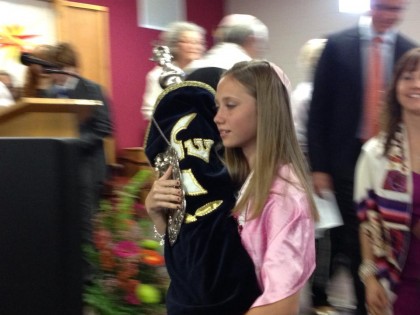
When the Torah in its red cover and its silver ketel (crowns) on its atzei chayim (the wooden shafts that hold the scroll itself) and a torah shield hanging from the atzei chayim went among the congregation on the shoulders of a congregant, people reached out with their with High Holy Day prayer books, touched it and kissed the book. Others with prayer shawls lifted a corner of the shawl and touched the Torah, kissing the shawl where it had touched the Torah.
At other moments those who had a death in the last week stood and gave the names of the one who died. Remembrance of those who have died and recognition of those in mourning are parts of each service, not just Yom Kippur. This recognizes the tribal nature of the congregants, their intimate relationships with each other through blood. The Yahrzeit, the year anniversary of a death, is also important and recognized during each service.
This was my first experience of the ten days of awe, the period from Rosh Hashanah to Yom Kippur. It reinforced my view of Judaism as a practical, humanistic faith, one that knows the human animal for what we are, not what we pretend to be. Yes, for many it still has a God at the center, but for many it does not. Oddly, it works just as well either way. At least from where I sit.
 When Kate and I drove home from the kol nidre service at Beth Evergreen last night, the Hunter Moon lit up a sky covering labyrinth of white fluffy clouds. Occasionally, a few clouds would become very bright, then a hole would open, briefly, and the three quarter moon would not only backlight the cloud cover, but provide a luminous presence, too. It was a magical sky, a sort that seems particular to the onrushing fall. Aspens still blaze bright gold in some places, in others the leaves have turned brown and blown away leaving stands of naked branches as harbingers of the winter months.
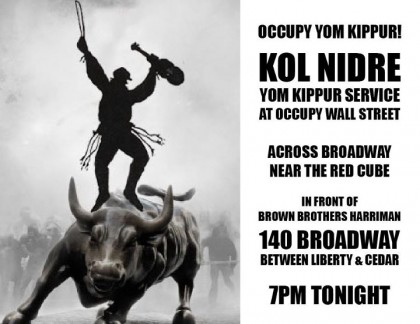 I feel odd at Beth Evergreen. My physiognomy is out of place. The language of many of the prayers and songs is foreign to me. I don’t feel, and don’t expect to feel, part of the tribe. Yet, Kate feels, is, part of the tribe. Also, much of the content resonates with my own faith reimagining project.
 Speaking of seasons, this is not the silly season; it’s the Insane Clown Posse season. When a reactionary like Mike Pence gets kudos for a stable debate performance, the world has gone seriously out of whack. This is a guy who tried to abrogate the first amendment, destroy unions, and denigrates women. The only reason he looked less than totally unappealing is the comparison to his running mate, Donald the Hair Trump. OK, Kaine wasn’t much better, but, hey, these guys were picked as Vice-Presidential candidates for a reason. Whatever it was.
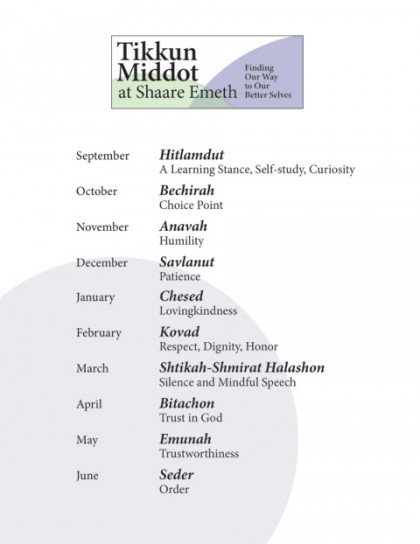 Yesterday was a reading day, getting up to speed on the middot (character trait) of watchfulness. The notion of Mussar is to take character traits like watchfulness, explicate them, then practice them. Literally. Mussar encourages taking a character trait like watchfulness, then working over the period of a month to manifest it in your life or raise your observance of it to a higher level. Watchfulness entails what a Jesuit might call examen. Paying attention to your behavior, becoming conscious of it rather than letting it flow by out of habit unnoticed, that’s the first part.
 Yesterday included three separate trips into Evergreen. First, I took Kate in for the morning Rosh Hashanah service at Beth Evergreen. Then, I came back to answer questions, be available for the electrician and the painter. At noon I went back to pick up Kate and eat the after service lunch with her. All these trips included waits in two spots on Brook Forest Road for culvert repair. Stop. Slow. Stop. Slow.
 There were kugels in aluminum pans, bagels with lox and cream cheese or chopped egg, fresh cut vegetables, fruit. Paper plates and plastic forks. Lots of eating and greeting. Some very short skirts. Some men carried small cloth pouches containing prayer shawls and yarmulkes. Kids ran around,
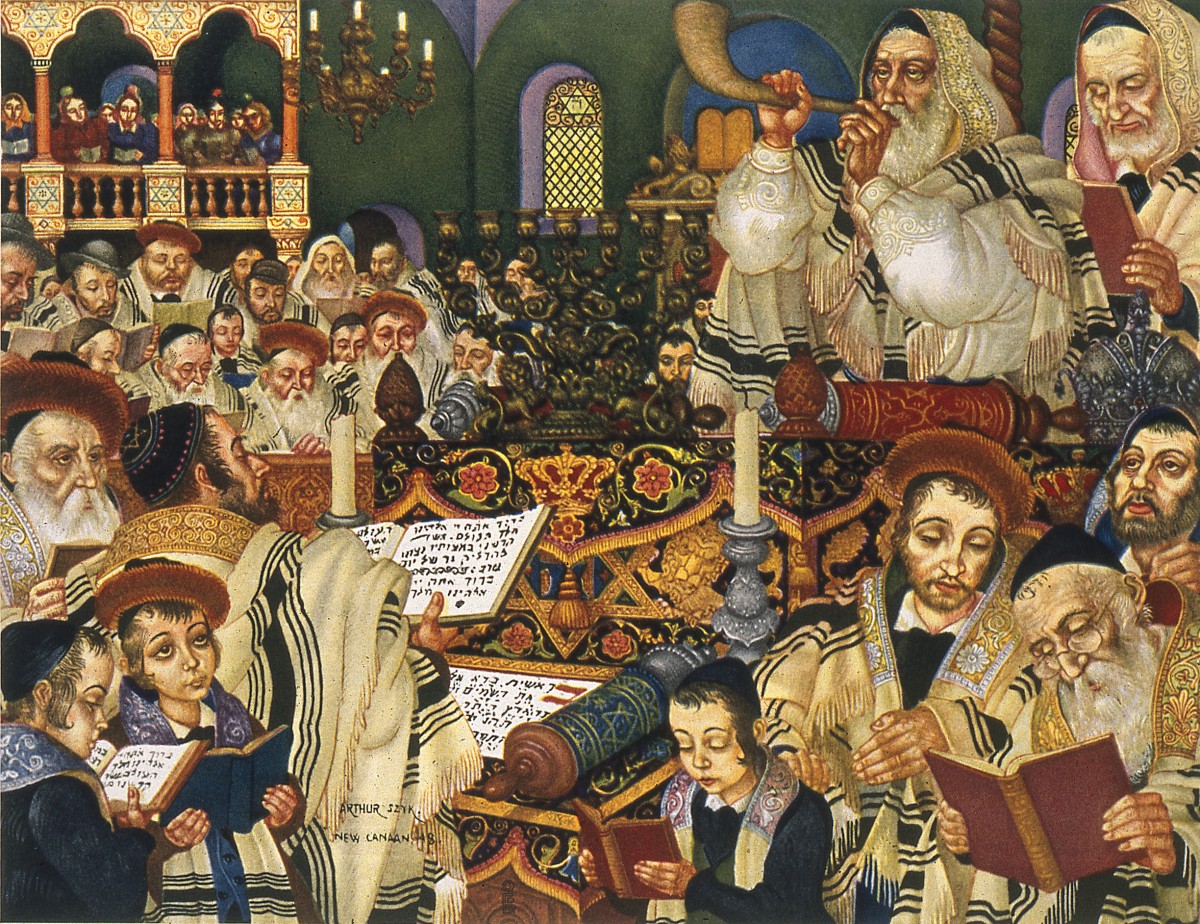
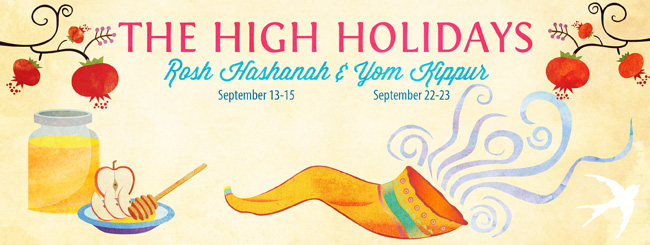
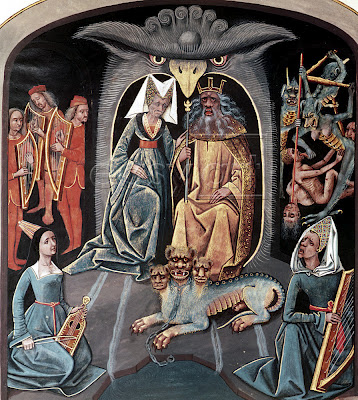
 This conforms to Michaelmas as the springtime of the soul. Sadness is a way we consolidate past experiences and sort them out, learning from them and choosing which aspects of the past to embrace and which to let go. When our tears are over, we are cleansed and renewed, ready for the next phase of life. Autumn gives us an annual opportunity for self-renewal. This Great Wheel, natural cycle phenomena matches up exactly with Rosh Hashanah and its climax, Yom Kippur.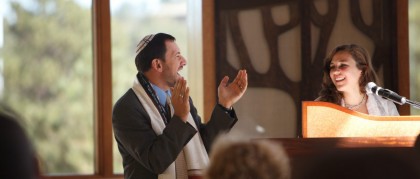
 My fellow traveler shoes are beginning to get a lot of mileage on them at Congregation Beth Evergreen. The Rabbi there, Jamie Arnold, is a very sweet guy, empathetic, bright, learned, good singing voice. At the Mussar midday session yesterday we looked again at the first chapter of Mesillat Yesharim. There are many important ideas in it, two stand out for me right now.
 The second idea is that we can be tempted, pulled away from delight and joy, by both prosperity and adversity. Recalling this simple, but far from obvious truth about the human condition helps us see that our material advantages are not the core focus of our lives. Our material success is incidental to the spiritual journey-unless it distracts us from it.

 Interesting intersection of past and present yesterday. In my Christian days, I explored many different forms of spiritual practice, including a Benedictine form called lectio divina. Turns out a Rabbi is teaching a version of lectio to other rabbis for use, in particular, with Torah study. Bonnie, a rabbi in training who attends Beth Evergreen, modified it to use in our Mussar study.
 Black Mountain, which is covered in lodgepole pine and actually green as a result, has small gold flecks this morning. Those few aspen groves on its slopes have begun to turn, as have more and more aspens between here and Evergreen, but not those on our property. Too, Orion appeared in the southern sky a week or so ago, the early morning southern sky. On Shadow Mountain Orion and the changing of the aspens are true harbingers of autumn.