Fall Harvest Moon
 The tree of life, the tree of immortality guarded by the angel with the flaming sword; the tree itself still growing in paradise, concealed by language, by our senses, by the everydayness of our lives; the path back to the garden often forgotten, the exile from paradise a separation so profound that we no longer know the location of the trail head and even harder, we no longer have a desire to search for it.
Metaphor? Of course. But in these three words lie a trap for the unwary, a trap in which I allowed myself to get caught and held, a mindhold trap. My life seems like a sine wave of grasping, then losing the significance of metaphors.
When young, I felt the mystery behind the communion wafers and the grape juice at Alexandria First Methodist. At the tenebrae service, when we extinguished the little candles with their paper drip guards and the sanctuary went dark, I thrilled to the change from ordinary experience, sensed the power rolling over us as the memory of crucifixion and death came hurtling through the centuries to land in our small Indiana town, in the very spot where I sat.
The sunrise services held on Easter morning lit up my whole inside. The power of the tenebrae had been defeated and life did go on forever, death only a mistake, an illusion, misunderstood as a cruelty when in fact it was a gateway. I suppose on those days, repeated over many years, I had a glimpse of the path back to the garden.
My mother’s death, I think, shattered this instinctive faith. Those feelings occasioned by grape juice soaked squares of bread, darkness and the rising of the sun, were a true path and one I lost when the brutal reality of grief smeared the way.
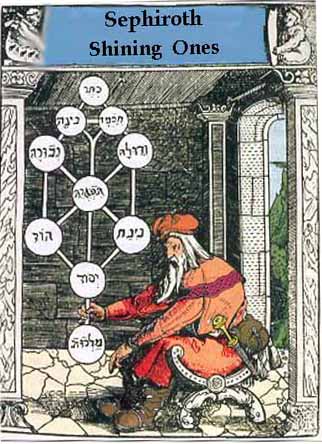
But the memory of that way remained. So I moved up from the instinctive triad of netzach-hod-yesod, forced by fear and loss to skip the next triad chesed-gevurah-tiferet and go to the one easiest for me to access, hochmah-binah-daat. I know these hebrew words may mean nothing at all to you, I’m still at the base of a steep learning curve with them myself, but they do appear on the illustration above so you can see where they are on the tree of life.
In simple, but not simplistic terms, the triads are netzach-hod-yesod, the realm of instinctual behavior, chesed-gevurah-tiferet, the realm of emotions and hochmah-binah-daat, the realm of the intellect. Movement in the tree of life goes from the keter to malchut and back from malchut up to keter, so there is no real top or bottom, only different spots in an ongoing process of creation.
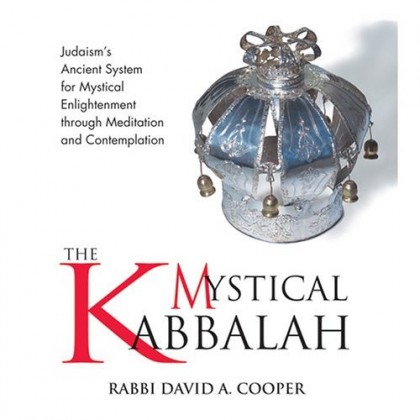 But here’s the trap. Metaphor, of course! I studied philosophy, religion, anthropology in college. Then, after a few years stuck in unenlightened instinctual behavior-the storied sex, drugs and rock and roll of the sixties and seventies-I moved to seminary. The trap tightened. I learned about the church, scripture old and new, ethics, church history. It was exhilarating, all this knowledge. I soaked it up. I remained though stuck in the intellectual triad, pushing back and forth between the polarity of intuitive wisdom, hochmah, and analytical thought, binah, often not going on to daat, or understanding. I learned, but did not integrate into my soul.
There was a time, after seminary, after ordination, as I groped my way around in the work of ministry, that I found the path again. It was in mystical traditions like the Jesus Prayer, or the use of lectio divina, contemplative prayer. I had spiritual directors who guided my prayer life and I meditated often, daily for years, went on private retreats for days at a time. In those years I found my way back to the netzach-hod-yesod triad, traveling again on the instinctual path formed so long ago.
The trap sprung another time, though, as I got better at my ministry, more able to apply organizational development paradigms to congregational life, more able to pull the levers of political power for the good of various purposes: affordable housing, unemployment policy, economic development for poor neighborhoods, fighting off corporate takeovers of those same poor neighborhoods, more able to navigate the internal politics of Presbytery life. I became stuck in malchut, the material world which we experience everyday. So stuck that eventually I could see nothing else and the path disappeared again.
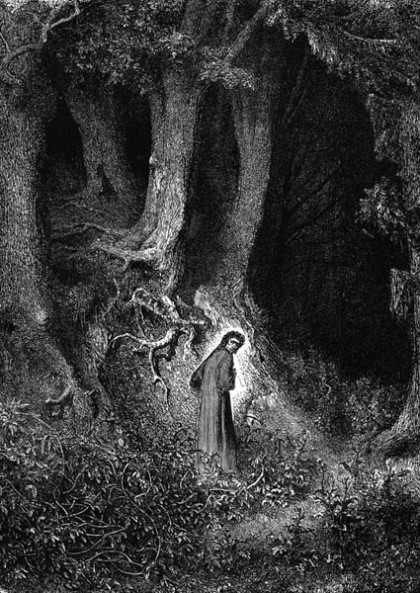 My heart knew I had gotten lost, in exile once again. In Dante’s words in Canto 1 of the Divine Comedy:
“In the middle of the journey of our life, I came to myself, in a dark wood, where the direct way was lost.
It is a hard thing to speak of, how wild, harsh and impenetrable that wood was, so that thinking of it recreates the fear. It is scarcely less bitter than death…
I cannot rightly say how I entered it. I was so full of sleep, at that point where I abandoned the true way.”
This time I knew I had to extricate myself from the subtle trap, get out of the thought world that had me lost in the dark wood, the direct way lost. It was a wild, harsh, seemingly impenetrable forest.
It was clear that for me the Christian faith had gotten muddled up with ambition, immersion in the world of power. And, most problematic of all, it had become part of the metaphor trap. The metaphor had gone stale, had become a barrier instead of a koan. Not the fault of the faith itself, but of my journey within it.
 At the time of its crumbling another path had begun to open for me. Fiction writing emerged when, ironically, I began writing my Doctor of Ministry thesis. Instead of working on it I ended up with 30,000 plus words of what would become my first novel, Even The Gods Must Die. Irony in the title, too, I suppose.
In the train of that shift came a decision to look into my Celtic heritage as a source for my fiction. While researching Celtic religion for the fantasy novels I wanted to write, I discovered the Great Wheel.
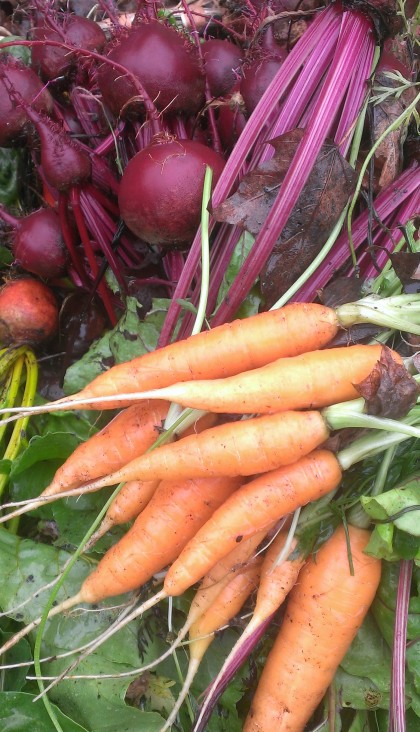
It grounded me. So to speak. My spiritual life became tactile, bound up in soil amendments, bulbs, corms, seeds, spades and hoes, fruit trees, raspberries and bees. And, of course, dogs. Always dogs.
Meeting Kate enabled me to move gracefully out of the ministry and into a pagan worldview. I was back in the netzach-hod-yesod triad, but now firmly attached to malchut, the queendom of this world.
Writing fiction found me exploring the chesed-gevurah-tiferet triad, having to reach into my heart for believable characters, story lines. Over the course of those years, the years since leaving the Christian ministry and now, I began to gradually integrate the triads, at least the three: intellectual, emotional and instinctual. The combination of family life, the Andover years, writing, and working as a docent at the MIA began to slowly weave them into my soul.
 Even so, I sat behind the barrier, the flaming sword, the metaphor trap. Beth Evergreen and Rabbi Jamie Arnold have started me on a journey back to where I began, immersed in the dark. Seeking for the light, yes, but happy now in the darkness, too. The Winter Solstice long ago became my favorite holiday of the year.
When I left Christianity and took up my earth-bound spirit, I shut off access to the fourth triad, the one subsumed under keter: faith-joy/pleasure-will, and its source of energy, the ein sof, the infinite One, perhaps god in small letters. Today, as I write this, I’m more pagan than I’ve ever been, more embracing of the body, the mountains, the stars, the elk and the mountain lion, than any words from any source.
 But. At Beth Evergreen I have begun to feel my way back into the fourth triad, the mystery I first encountered on the hard wooden pews in Alexandria, the one pulsing behind the metaphors of tenebrae, of crucifixion, of resurrection, and now of Torah, of language, of a “religious” life. I knew it once, in the depth of my naive young boy’s soul. Now, I may find it again, rooted in the old man he’s become.
 Inside the particular Jewish or Presbyterian or Unitarian or New Thought or Tibetan Buddhist or Hindu or Muslim community to which we belong we use this language and create a sense of belonging. As we use the language, part of which is ritual and dress, part of which is expected behaviors, we create a semi-permeable membrane, often not very permeable at all, for outsiders. To cross into our community they have to penetrate the language, learn the customs, adjust themselves to the patterns. The membrane works both ways, obscuring our vision as we look out from within our particular tradition. We see a world shaped by and often determined by the assumptions of ours.
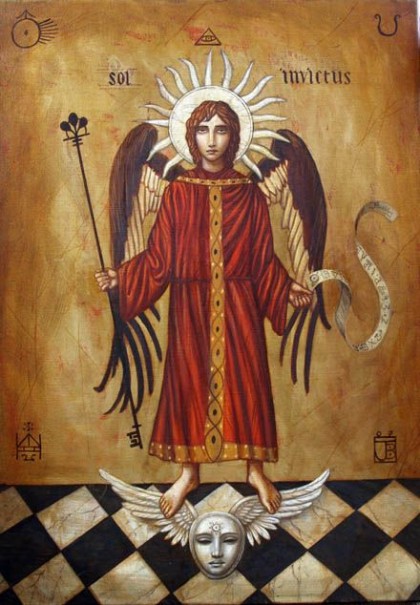 The solstices mark swings to and from extremes, from the longest day to the longest night, there, and as with Bilbo, back again. Darkness and light are never steady in their presence. The earth always shifts in relation to the sun, gradually lengthening the days, then the nights.
 When Hanukkah ends tonight, it will only be two days to the Winter Solstice. I long ago kicked transcendence out of my religious toolkit, believing it encourages authoritarianism, the patriarchy, and body negativity. How, you might ask? If we find our source of authority outside of ourselves, either up in heaven or with a divine father figure or anywhere outside of our body, we give away our own deepest connection to divinity, the sacred that lies within us. BTW: locating revelation in written texts does the same.

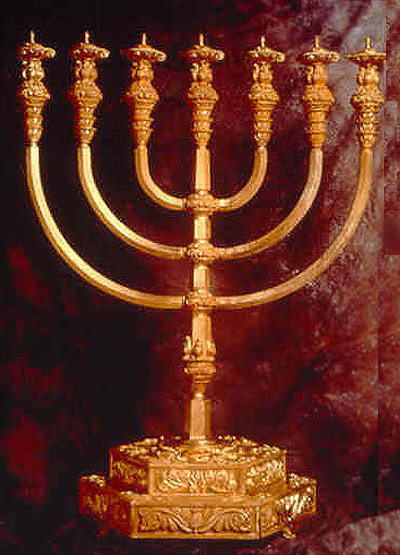
 Think I’ve figured out my kabbalah presentation. Still a bit rough around the edges but that’s going to be part of it. It’ll be a how to think with the tree of the life as a touchstone example, using the Great Wheel as an instance.
 This a crucial difference between a secular, scientific world view and a mystical one. Entropy posits, as I mentioned in a post not long ago, that all things die, including death, I suppose. The Great Wheel and the tree of life challenge that grim metaphysics with an alternative.
 God became fractionated during the tzimtzum, the contraction of divine energy that made the finite possible. This idea is still difficult for me, but I’m just accepting it for the purposes of this presentation. During the tzimtzum the infinite light, ohr, tried to manifest in the finite, filling the space created by the contraction, but the vessel, things, (ein sof = no-things, infinity) could not hold it and shattered. That shattering created all the elements that now make up our universe. (and other universes, too) Trapped inside all of these elements is the ohr. The ascent and descent of divine energy, from the keter to malchut and backup through the sephirot to the keter from malchut, is the way the ohr will once again join with the infinite. How? No clue.
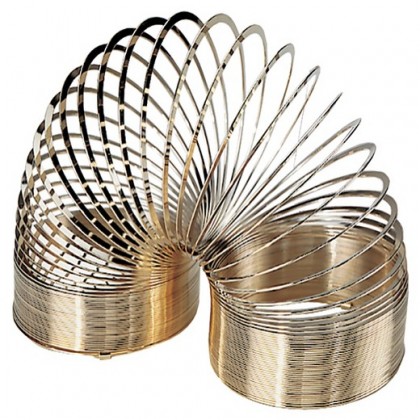 This is a malchutian manifestation, I think, of the ascent and descent and ascent again of divine energy represented by the tree of life. Why? Well, until the divine energy passes through yesod and becomes real in malchut, it is hidden, invisible, just like the vivifying function of the soil and the air and the sun is hidden during the fallow time. Both represent the cyclical nature of things coming into existence from apparent no-thing, then returning themselves to the invisible, the hidden.
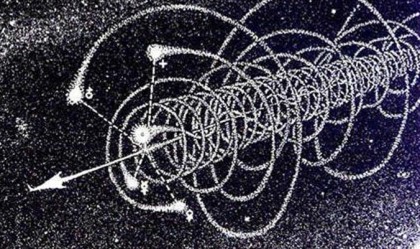 The slinkys I will hand out, tiny one-inch ones, illustrate what I mean. The Great Wheel turns through one year, one orbit around the sun, then repeats and is, in that, cyclical and not chronological. But, if you link this orbit to that one we get a spiral as our rapidly moving planet follows our solar system around the galaxy at unimaginable rates of speed. The Great Wheel then extends in space, in a spiral, this year’s revolution becoming another while the whole planet and its sun captive neighbors push further and further around the Milky Way. And, just to add complexity, as the whole galaxy moves, too.
 The day after the day after. See, there’s the sneaky part of our language. This is the day after the day after Thanksgiving. Yet, really, this is another day, neither after nor before, just a day on its own. Yes, it’s a little further along the third planet’s track around the sun, but it’s a spot on the orbit, so different than yesterday and tomorrow, but no different as a day than either of them save for the slightly less light occasioned by the planet’s tilt, now away from the sun for those of us in the northern hemisphere.
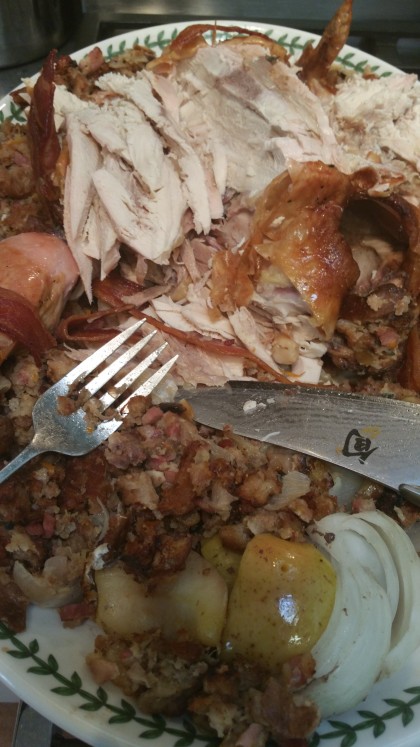 Anyhow leftover capon, pancetta and fig stuffing, green beans, mashed potatoes, sweet potato pie and caramelized sweet potatoes, pecan pie and deviled eggs rest in the fridge, awaiting their moment. The slow and the stuffed have gotten up off the couches, the beds, the chairs and started to move around again within their lives.
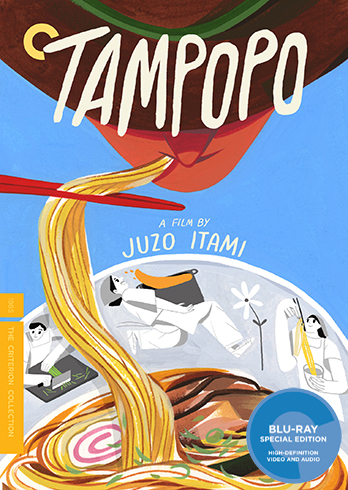 Jon, Ruth and Gabe and I went to Katsu Ramen for lunch. It’s close to their house, sort of, and I’ve wanted to eat there for a while. Ramen places are a very typical Japanese restaurant, more common there, I imagine, than sushi ones, because ramen is food for the masses, a sort of fast food. “Tampopo”, a Japanese movie from the mid-1980’s, features two truck drivers who learn how to cook great noodles.
 Marvel has expanded its media presence to both movies and television. Spider Man, the Hulk, the X-Men, Guardians of the Galaxy, the Fantastic Four, Thor, Doctor Strange, Captain America, Iron Man all have at least one movie, some many more than that. Now on television Marvel has pulled off a rather stunning feat, populating streaming services like Netflix and Hulu with original made for television serials featuring many other Marvel characters. Right now you can watch (and I do) Daredevil, Jessica Jones, Luke Cage, Iron Fist, the Punisher, the Gifted, the Runaways, the Inhumans, Agents of S.H.I.E.L.D., the Defenders and Peggy Carter.
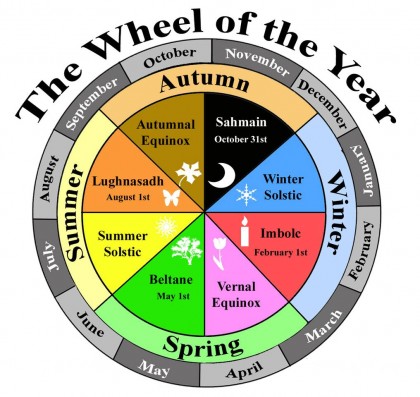 In one sense then the Great Wheel, focused as it is on this earth, can only be of malkuth, that is, of the sphere of the actual, the bottom circle below the hand of the kabbalist in the illustration. In another sense, since all sephiroth contain all others, what is of malkuth must also be of the others, the spiritual dna of the whole universe. So, if we take the Great Wheel as a metaphor for the creating, harvesting and ending of life, a cycle without end, then the Great Wheel is, too, a Tree of Life. That is, the inanimate becomes animate, the animate lives, then dies, returning its inanimate particulars to the universe which, through the power of ongoing creation, rearranges them in living form so the cycle can go on.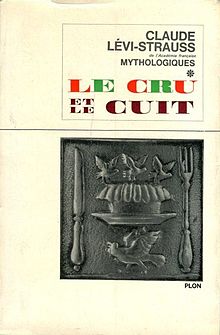
 I really like cooking, used to do a lot more. It requires mindfulness and produces a meal for others to enjoy. Just popping up from my days of anthropology:
  We’re not like dogs in that fundamental sense. As Emerson observed, “The days are gods.” Another binary opposition is the sacred and the profane, like the holy and the secular, ordinary time and sacred time. We imbue, out of our speculative capacity, the passing of time with certain significance. The day we were born. The yahrzeit notion in Judaism, celebrating the anniversary of a death. A day to celebrate the birth of a god, or to remember a long ago war against colonial masters. We identify certain days, a vast and vastly different number of them, as new year’s day, the beginning of another cycle marked by the return of our planet to a remembered spot on its journey.
 When we merge our speculative fantasies with the chemistry of changing raw food into a beautiful cooked meal, we can have extraordinary times. The natural poetics of wonder join the very earthy act of feeding ourselves to create special memories. Very often on those days we gather with our family, a unit that itself memorializes the most basic human purpose of all, procreation of the species. We don’t tend to think of these most elemental components, but they are there and are sine qua non’s of holidays.
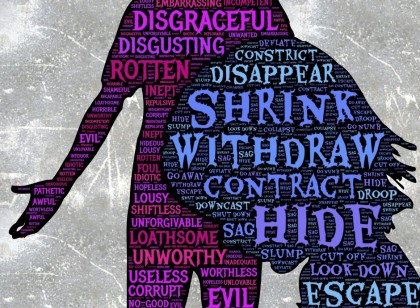
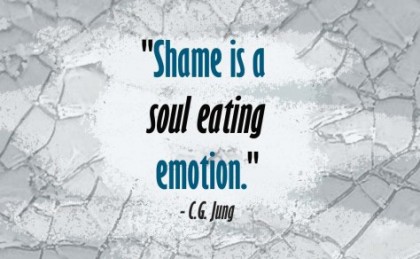 Shame. It’s a quiet burning just under the skin, a turning of the inner face away from the self, embarrassed. What have I done? I suppose its power comes in the possibility that the person who acted like this could be the “real” me. And, it doesn’t have to be an egregious act to call it up.
 Getting to the point here. I’m a student, probably since my first conscious thought. How the world works fascinates me. History, too. Literature. Art. Religion. Philosophy. Politics. Last night for example, before I went to sleep, I focused on my breath as I often do. I began to wonder, “OK. I know about inspiration, the lungs take in air, blood in the lungs binds the oxygen to the hemoglobin. But what about expiration? How does that work? Where do the exhaust gases, the carbon dioxide, come from? How do they get expelled? Why don’t the two processes interfere with each other?” Still don’t know the answer, btw, but I’m going to ask Kate at breakfast.
 I shrank back in my chair, at least metaphorically, vowing, again, to keep my hand down. To keep that curiosity publically in check. To filter my thoughts, about whether they need to be expressed. Hard for me. I’m eager when it comes to learning and part of learning is bouncing ideas off each other. But there’s that balance idea, the sweet spot between curiosity and taking up too much space, the need to honor the contributions and questions of others, to not privilege my own at other’s expense.
.jpg" title="Fair use of copyrighted material in the context of The Raw and the Cooked">Fair use</a>, <a href="https://en.wikipedia.org/w/index.php?curid=45649279">Link</a>)