Category Archives: Commentary on Religion

Shifts and Changes

Spring                                                                      New (Passover) Moon

2010 01 19_3454Writing can lay bare something hidden, perhaps something that needed excavation or something attached to a thread, even a flimsy thread, by which it can be pulled from the inner world. Things get lost in there, pushed behind stacks of unused memories or stored with a faulty label. Sometimes ideas once full and vibrant get partially severed from their context, crucial links of thought go missing and the idea fades away.

“I’ve continued to write and study, my primary passions.” March 21, 2017 This sentence is an example, a recent example. It stares back at me, rather baldly. Oh. Well, that’s right, isn’t it?

I love to read, follow an idea through its growth and changes, learn about something in depth, wonder about it, tease out of it new implications or old truths.

I love to write. I don’t know why. Might be an inheritance from my newspaperman father. Might just be long established habit. Whatever the reason writing is my painting, my sculpture, my photography. I have to do it to feel whole.

2010 01 19_3455Which, speaking of ideas, then links to the idea of the third phase. That quote comes from recent thoughts on the third phase. A primary wondering for me, I think for all third phasers, is this: what am I about in this last phase of my life?

The Trump catastrophe, a miserable wound of our country’s own making, pulled on the 60’s radical thread always near the surface for me. I’ve been trying to put that mask back on, to become the political activist I once was. I felt obligated. You know, if you’re not part of the solution, you’re part of the problem.

But it hasn’t been happening. I just haven’t connected with other activists. I haven’t been doing much more than writing about it. (a clue here, by the way) Grousing and complaining, yes, sure. But not acting.

Writing and study. Third phase. Beth Evergreen. With Kate I’ve found a community that cherishes study, scholarship, a community that finds writing an understandable vocation. Right now I’m thinking, wondering. Should I lean into my primary passions? Stay with them. Dig deeper. That feels right.

Here’s a confession, too. I’ve never liked politics. The person I become, the masks I put on then, feel far away from my core Self. Why then have I spent so much of my life in one political arena after another?

611333-ancient-roman-wall-with-street-nameboardPart duty. For whatever reason I came out of Alexandria with fully formed political ideas about justice, equality, fairness. They were strong, rooted in the powerful union movement among my friend’s parents who worked for General Motors, reinforced by the liberal politics of my Roosevelt Democrat parents and then pushed toward action in the turmoil of the 60’s.

Part ego. It feels good to lead, to have people hang on my ideas, to see change occur when something I’ve helped shape makes things happen. But this is part of what feels far away from my core, introverted Self. That ego drive also presses forward an angry, demanding, often insensitive persona. A persona I dislike.

Part religious conviction. The almost random way in which I ended up in seminary, then the ministry came from following political conviction away from graduate academics and toward an institution willing to pay me to organize, to act politically. There was a merger of political passion and the prophetic line of a certain strain of liberal Christianity, even radical Christianity.

No conclusions here. Not yet. Just more of the shifts and changes, movements in my soul. Something will come out of all this. Not sure what. Not right now.



Learning How To Live

Imbolc                                                          Anniversary Moon

Teeth cleaning a.m. Kate and I now schedule teeth cleaning and annual physicals together. I call it medical entertainment. Just like going to the Tallgrass Spa together. Almost.

mussar

Mussar afternoon. Soul cleaning together, too. I’m learning a lot about Judaism with her. And, I’m impressed with what I’m learning. Here’s the key new insight: Judaism has, from a long time ago, insisted that abstract ideas like mercy, compassion, judgment, faith have embodied reality. That’s what all those laws are about, how to make the faith work in daily life.

This is very different from the Christianity in which I was trained. Christianity unhitched this very earthy, practical religion from the notion of embodied abstractions, letting the abstractions become dominant. This led to a growing gap between dogma and actual practice. Of course, many Christians work at making their faith inform their lives, but the tools are not as good the ones in Judaism. It’s not the laws themselves, but the spirit of actively grappling, every day, every moment with what it means to show mercy, to judge, to practice loving kindness, to exhibit patience that gives Judaism its lived flavor.

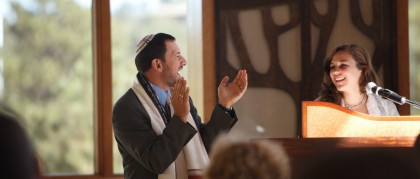
Rabbie Jamie and congregant

Still don’t want to be a Jew, no interest in converting, but I have a lot of interest in learning how to live from the community of Beth Evergreen. Probably the best religious experience of my life.

My Holy Scripture

Imbolc                                                                     Anniversary Moon

The World Is Too Much With Us

The world is too much with us; late and soon,

Getting and spending, we lay waste our powers;—

Little we see in Nature that is ours;

We have given our hearts away, a sordid boon!

This Sea that bares her bosom to the moon;

The winds that will be howling at all hours,

And are up-gathered now like sleeping flowers;

For this, for everything, we are out of tune;

It moves us not. Great God! I’d rather be

A Pagan suckled in a creed outworn;

So might I, standing on this pleasant lea,

Have glimpses that would make me less forlorn;

Have sight of Proteus rising from the sea;

Or hear old Triton blow his wreathèd horn.

In, but not of

Imbolc                                                                    Valentine Moon

“Solitude” by Marc Chagall, 1933

In, but not of. Yesterday at mussar, a spiritual/ethical system within the Jewish tradition, I had a complex moment. We were discussing truth and mercy, the relationship between them. To compare mercy and truth I defined mercy as suspension of judgment. Truth though is a sword and a judgment. If that’s correct, then not all truth is merciful. Rabbi Jamie started to dispute that, but had to leave for his daughter’s wisdom teeth extraction.

truth

In the conversation that followed afterward my use of the sword metaphor was identified as a Christian trope, “I come to not bring peace, but a sword.” I’ve been working very hard over the last year to bracket my mode of theological thinking while absorbing a Jewish style of thinking. This requires effort because though I abandoned Christianity over 30 years ago, my seminary education and professional life as a clergyman reinforced my already strong Judaeo/Christian enculturation. Christianity does still define much of how I think and feel about matters religious and secular.

While that’s obvious, I still felt a flush of embarrassment at being identified with a New Testament informed concept. That flush, as mussar teaches, is an important signal about where growth is necessary.

On the way back up to Shadow Mountain I described my situation to Kate as similar to traveling. “I love to go where the culture is very different from mine, where I’m a stranger. It helps me know my self.” Kate’s journey is one of a Jew deepening her own understanding, her own identity as part of a religious world. My journey is closer to travel, “It feels like I’m traveling on the inside.” In this case no geographic change is necessary for me to be a stranger.

travel

This inner travel exhilarates me, but it also confuses and, in a mild sense, scares me. I’m trying to gain wisdom and personal growth from Beth Evergreen while maintaining my own identity as a pagan. But, not only that. My life as a pagan is not divorced from my enculturation as a Christian. I’m a cultural Christian in many ways. That means I encounter many shocks to my inner world, shocks that wake me up, like a Zen koan, but that also and in the same instance disorient me.

Yaowarat
Yaowarat

It’s like being on Yaowarat Road in Bangkok on a weekend night. On Friday and Saturday night the sidewalks of Bangkok’s Chinatown, of which Yaowarat is the main street, fill up with small restaurants, often two tables, some chairs and a street vendor style kitchen with a wok, propane tank, utensils and a stack of plates and soup bowls. What food are they serving? I don’t know. I speak neither Thai nor Mandarin. Many people are there who do understand the food offerings, how to eat them, but I’m not one of them. I’m in, but not of the street life. Observing, yes, eager to learn, yes, but even after sampling some food and gaining some insight, I will go back to my hotel, a stranger traveling through.

I’m grateful to the folks at Beth Evergreen and Kate for putting up with my being present as a stranger and an inner traveler. A long journey, barely begun.

You know, daily life.

Imbolc                                                                      Valentine Moon

Sundays still exist out of time for me, as if they’re not quite real. They are my rest day from exercise and I usually read, watch TV or movies, do something outside the house. This is psychological residue from years as a Methodist, then Presbyterian. I often worked on Sundays, but just in the mornings. Now, with a pagan sensibility, that old imprinting, the mood of Sundays, still prevails. Seems odd to me, but it happens anyway.

Today is Kate’s colonoscopy. She’s been prepping since 6 pm yesterday. For those of you who’ve had one, you know that’s the fun part. The actual test itself, tinctured with some conscious sedation, is not a big deal, unless of course it reveals some precancerous polyps or actual cancer. They’re relatively quick, over in a half an hour. Then, a good lunch.

Ruth, here for a day of President’s Day skiing with her dad, got sick yesterday afternoon. She spiked a fever in the late evening. “I want my daddy!” Daddy was in Denver finishing up the move I mention below. He did finally get home and things took a turn for the better.

Red flag warning tomorrow, high winds and low humidity mean real and present danger of wildfire. Time to find the pole saw and get to work. The next phase of fire mitigation, which I didn’t finish last year, involves trimming branches on the lodgepoles up to 10 feet above the ground. Branches lower than that potentially become ladder fuel, allowing a grass fire to climb up the ladders into the tree itself.

Well, time for my workout. I’ve successfully shifted them to the early morning, mimicking my appointment times at physical therapy. It will be better in the summer months, too, when the heat builds in the afternoon and mornings are still cool.


Strangers in their Own Land

Imbolc                                                                           Valentine Moon

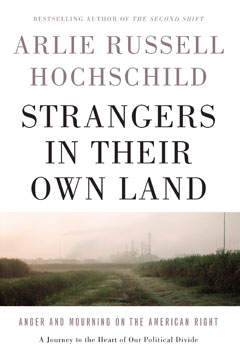
strangersJust finished reading Strangers in their Own Land by Arlie Russell Hochschild. It’s subtitle is: Anger and Mourning on the American Right. I found the book by reading this article, Why We Need Empathy in the Age of Trump. Here’s an excerpt from near the end that points to part of the way forward, according to Hochschild’s research.*

After finishing the book, I’m not so sure there is a way forward for this particular work though I hope I’m wrong.

Here’s why. In my own analysis, shared by many on the left, we failed to address the economic situation of the working class over the last 40 years or so. As a result of that, it was easy for the right to cherry pick them by focusing on so-called “values politics.” Values here meant hot issues like abortion, gay marriage, affirmative action, climate change. By appealing to the baser elements, the fears and anger of the white working class, they were peeled off from their natural political home, the Democratic Party, and inserted, very clumsily, within the big tent of the Republican circus.

lewishine-nationalarchive

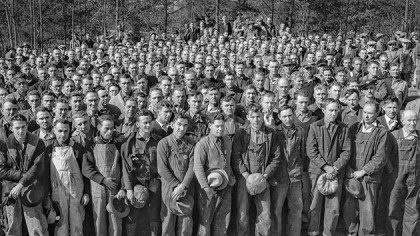
What this simplistic analysis (I’m calling myself out here.) misses is the genuine love of God, church and country that the white working class already had. When the Republicans convinced this constituency that they were the party of Christian (right-wing Christian) values and the only party consistently behind a flag-waving form of patriotism, many (most?) of this demographic switched allegiances, some as early as Nixon’s Moral Majority, some later first as Reagan Democrats, then transforming into Tea Party Republicans.

What I missed, and really shouldn’t have since I grew up in this exact milieux, was the sincerity, the authenticity of the religious and patriotic values of working class whites. These values are more important to them than economic self interest and Hochschild’s book makes this very clear. What happened in the late 20th century was a gradual shift away from economic self-interest voting to voting patterns based on cultural values as well.

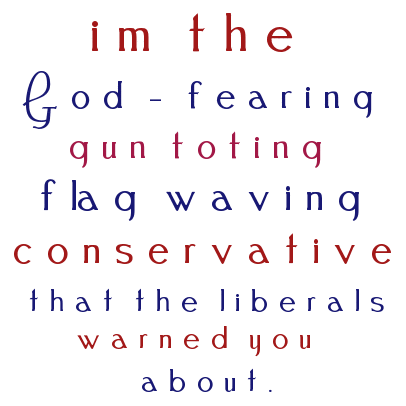
CONSERVATIVEThe Christian right metaphysics mixed with flag/gun/anti-government passions, honestly held and sincerely believed, makes allying with secular globalists like myself and everyone else in the progressive movement seem most unlikely. I don’t like seeing it this way. It makes me sad and a bit fearful for the immediate future. Perhaps dialogue can help, but when what Hochschild calls the deep stories are so profoundly different, it means the assumptions with which we start the conversation may defeat the effort at its inception.
It still seems to me, however, that policies aimed at working class, high school education or less, Americans must be advanced. As we resist Trump and his gang of mediocres, we also have to stand for something. That something can be economic justice for those left behind by our educational system, by our economy, by big corporations and by automation. It’s important whether or not it convinces the working class white folks of Tea Party/Trump inclinations to shift allegiances. And I fear it won’t.

Still thinking about this, about what might come next. No real good ideas yet. You got any?


* “In fact, they are very friendly toward Bernie Sanders, these people on the far right. Bernie is standing back and asking some big questions. Now, they’ll say, “He’s a socialist. We’re Americans, we can’t be socialists.” But they sense him as a populist. There are possible connections we can make across class—and perhaps re-connect with people we have lost.

We are not looking at that loss. And we feel morally armed to not look at the reasons for that loss, because we are anti-racist, anti-sexist, and so on. Our moralism—our moral convictions—are getting in the way of really understanding people that are making the Democratic Party a shadow of its former self. I think we need to dig deep. That’s the hard thing. It doesn’t mean giving in to it. It’s just the opposite. It means looking at people who feel alien to you, and understanding how they think.

We have to reach out. We need school-to-school crossovers. We need church-to-church crossovers, union crossovers—people on different sides of the political divide learning to listen, and turning their own moral alarm system off, for a little while. They don’t need to turn into somebody else. It’s just listening, and getting smart about what you’ve learned.”

Imbolc, 2017

Imbolc                                                                                 Valentine Moon


Feb

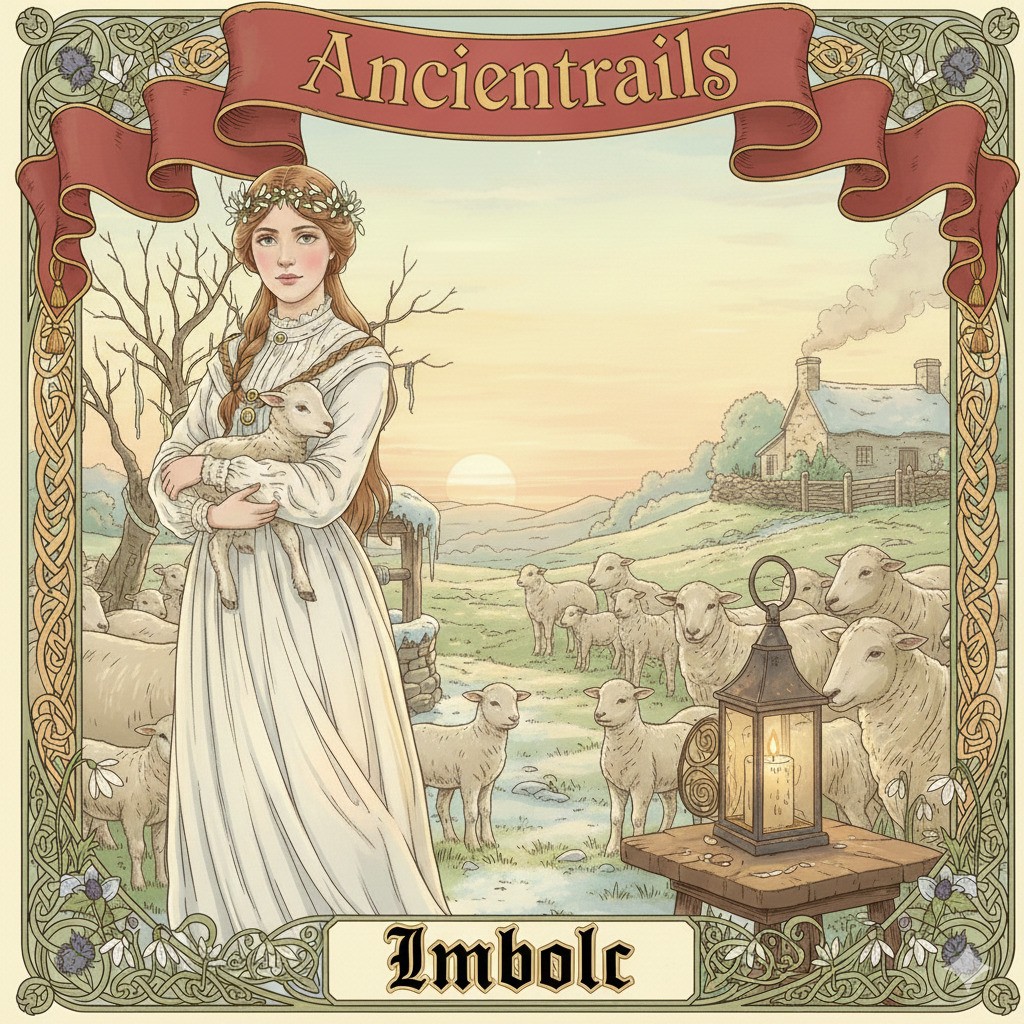
Imbolc, or in-the-belly, celebrates the time in Ireland when the ewes would freshen. Their pregnancies meant milk would be available after the long fallow season that had begun at Samain, Summer’s End.

Pregnant ewe
Pregnant ewe

Imbolc lies halfway between the Winter Solstice and the Spring Equinox, what the Celt’s called a cross-quarter holiday since it falls between two quarters defined by the solar year. That milk is also a promise, like the gradual lengthening of days after the longest night of the year in late December, that spring and the growing season will come.

It’s easy for us in our refrigerated, grocery stored world to gloss over these signals of the natural world. It seems like we don’t require them anymore. After all we can buy milk, cow’s milk, at any time of the day or night, 365 days a year. And the growing season particular to our latitude and longitude also seems irrelevant since it’s always the growing season somewhere on earth. The occasional gaps that even modern transportation can’t resolve can often be filled by greenhouse or hydroponically grown produce. We’re good, right?

I’m afraid not. Celebrating Imbolc or any of the Great Wheel holidays will not resolve our alienation from the sources of our sustenance, the sun and mother earth, but this ancient tradition exists to call us back home. The Great Wheel is a reminder that the cycle of life continues, even when the fields and animals are barren. The power of the sun, working in harmony with the soil, with plants, with animals that eat the plants does not disappear. It can be trusted.

awakening

It is though, that alienation, evident in so many ways, that drives climate change, that creates produce modified for harvest and storage, not human well-being, that underwrites the paving over of cropland and wetlands. We imagine that somehow the droughts in California will stop there. We hope they’ll be confined to somewhere else, somewhere where we’re not. Global agriculture means we’ll be affected wherever the damage occurs.

Colorado River Basin

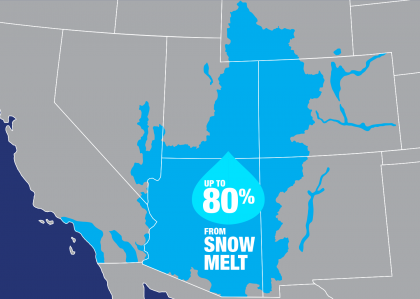
Right here in Colorado we have a key example of the interdependence for which the Great Wheel stands. Our snowpack, high in the Rockies where the Colorado River rises for its journey south toward its ancient destination in the Gulf of California, determines the amount of water available to nine states. Including California. Winter snowfall, melted by the increasing warmth of spring and summer, nourishes millions of people, cities like Las Vegas, Phoenix and Los Angeles.

common ground

In the age of Trump and rising nationalist, right wing populism, the need for the Great Wheel has never been more profound. It softens our in the moment, human conflicts by lifting up the long term, the cycles of life in which all humans, all life participate. The Great Wheel reminds us that there is no other when it comes to living on this planet. We’re all here and bound to one another, connected. My hope is that someday, perhaps someday soon, we’ll all realize that and adjust our politics accordingly.


A Druid and a Radical

Winter                                                                                      Valentine Moon

OK. I admit it. I occasionally take the quizzes that pop up on facebook. I mention this because one set of quizzes seems, well, accurate. The same quiz website offered two recently: What kind of ancient religion would you follow? What kind of philosopher are you?

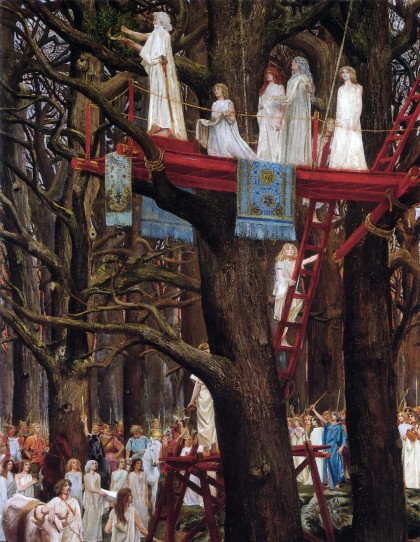
Druids&Mistletoe
Druid Harvesting Mistletoe

Though I thought I’d saved the piece about ancient religion, I didn’t. Still. The ancient religion that matched my answers? Celtic Druidism. How ’bout that? In the year leading up to my leaving the Presbyterian ministry I was in spiritual direction with John Ackerman at Westminster Presbyterian Church. When I told him I no longer believed in Jesus/God/Holy Spirit, but was more focused now on how I fit into the natural world, he said, “Well, you might be a druid.” He meant it. Not a flippant observation. Prescient.

Since then, the Great Wheel has become my liturgical calendar. I’m much more like what I would once have critiqued as a flat-earth humanist. That is, the metaphysical realms of the world religions seem like poetry to me rather than statements about ontology. I am not a new atheist, a scorner of faith and its many, many permutations. And, yes, I recognize the role religion plays in human conflicts, but I know that most of the time religions gather people of similar demographic characteristics. When conflict emerges, it often has roots in economic and political realities that align closely with religious preferences.

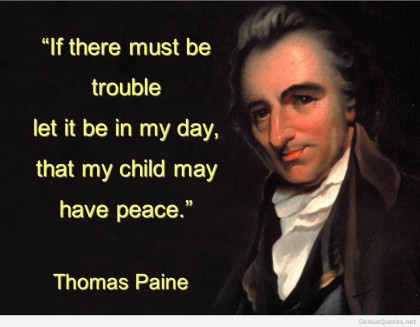
Thomas-Paine-Amazing-quote

I did save the note about which philosopher I’m most like.* This also seemed apposite. It surprised me, in both instances, how the 29 questions they ask managed to get somewhere close to how I see myself.

*Your mind works like the philosopher: Thomas Paine

An anarchist who championed reason and free thought, Thomas Paine was never afraid to speak his mind no matter how unpopular or revolutionary his theories were. Like Paine, you see life as full of possibilities and love to shake up the status quo by thinking outside the box. You are spontaneous and communicate confidently and fluidly. Could you write a post to inspire world-transforming events like Paine’s pamphlet ‘Common Sense’ influenced the start of the American Revolution? Who knows? (But we think it might be worth a try.)

I suppose

Winter                                                                         Valentine Moon

bagelry1

I suppose.

Kate and I supplied bagels, schmear and fruit for the bagel table at Beth Evergreen yesterday. The bagel table is a casual shabbat service that includes the prayer book and the torah reading. Yesterday the parsha was va-er, Exodus 6:2-9:26, for the most part the story of the plagues sent by God on Egypt.

Rabbi Jamie said that in one instance the verb usually translated as go, as in Go to Pharaoh, is actually come. The meaning shifts a good deal with this understanding. Come to Pharaoh implies, according to Jamie, that God will be acting through Pharaoh. This falls under the difficult to understand category for me.

Kate and I talked about this idea as we drove up Brook Forest Drive. After some conversation, we decided that if you pull back, look from a historical view, then the actions of Pharaoh do work as part of God’s efforts on behalf of the Jewish slaves. His hardened heart provides the impetus, eventually, for the Exodus.

Endurance

We then turned to our contemporary Pharaoh, the Trump. Could God (whatever you want to insert into this metaphysical placeholder) speak to us through the Trump? Jamie’s point was that we have to see the potential for God to speak us especially through those things or persons that we fear or despise. I suppose. Let’s try here.

Pulling back, taking the historical view, what possible liberating impulse could come from Trump’s presidency? (I take liberating impulse to equal God.) It’s true that Trump’s election highlighted the plight of the white working class, those with no more than a high school education. And, it may be, policies to address their concerns will lift all of the working class, high school educated folks. That would be an astonishing and welcome outcome, at least to me.

with her

Too, we might consider the orders to build the wall, block Muslim refugees from certain countries, repeal the ACA, gut environmental regulations as a hardening of the heart, a so-obvious step away from justice and fairness, a big step away from a sustainable future for humanity on this planet, that the reaction to them will part the climate denying sea and create the political will for single payer health care, a return to Ellis Island immigrant welcoming that so many of us yearn for. Maybe. I suppose it could happen that way. May it be so.

As you can tell though, I’m skeptical. But, if it can be, I’ll be the first in line to admit my skepticism unwarranted.

Yamantaka for the New Year

Winter                                                              Cold Moon

Existentialism is a philosophy for the third phase. No matter what other metaphysical overlays you may have the tick-tocking grows louder as you pass 65. When this clock finally strikes, it will take you out of the day to day. Forever. Strangely, I find this invigorating.

In case you don’t get it the occasional medical bomb will go off to make sure you pay attention. Last year, prostate cancer. This year, that arthritic left knee. Kate goes in for an endoscopy on January 3rd. She’s waiting approval for a biologic drug to help her rheumatoid arthritis. All these are true signs of the pending end times, but they are not the end itself. These medical footnotes to our lives press us to consider that last medical event.

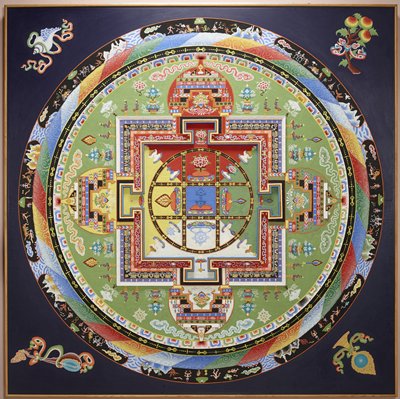
I’ve followed, off and on, the Buddhist suggestion about contemplating your own corpse. I imagine myself in a coffin, or on a table somewhere prior to cremation. This is the work of Yamantaka, the destroyer of death, in Tibetan Buddhism. I’m not a Buddhist, nor do I play one on TV, but I became enamored of Yamantaka while learning about the art of Tibet and Nepal at the Minneapolis Institute of Art.

yamantaka-mandala
yamantaka-mandala

This mandala is a profound work of art on view in the South Asia gallery (G212). Adepts of Tibetan Buddhism use this mandala as a meditation aid to make the journey from samsara, the outer ring representing the snares that keep us bound to this world, and the innermost blue and orange rectangle where the meditator meets the god himself. The impact this work and the portrait of Yamantaka that hangs near it have had on me is as intimate and important as works of art can evoke.

Death is more usual, more understandable, more definitive than life. Life is an anomaly, a gathering of stardust into a moving, recreating entity. Death returns us to stardust. Yamantaka encourages us to embrace our death, to view it  not as something to fear but as a friend, a punctuation point in what may be a longer journey, perhaps the most ancientrail of all. Whatever death is, aside from the removal of us from the daily pulse, is a mystery. A mystery that has served as muse to artists, musicians, religions and poets.

Yamantaka has helped me accept the vibration between this life and its end. That vibration can be either a strong motivating force for meaningful living (existentialism) or a depressive chord that drains life of its joy. I choose joy, meaningful living. Perhaps you do, too.