Winter Waxing Moon

I’m gonna say between 12 and 15 inches over the last 36 hours. We’ve been plowed twice and our contract specifies 6 inches as the minimum for a push. I’ve cleared the back decks 4 times, or 5, and this morning it was as much as it was yesterday morning, maybe more. I’m pretty weary from it. With the new palette/deck it increases the amount of snow I have to move and reduces the places I can put it. Creates a tough situation.
All of us up here love the snow, in part for the beauty and in part for the practical reasons I mentioned yesterday. That doesn’t mean it’s always easy to remove or a joy to drive in. Right now, I could wait a bit for our next big storm. Nothing on the horizon right now.
Considering some snow shoeing. I’ve not done that much here. Great cardio and beautiful, quiet here in the mountains.
 Gonna look at material for the religious school class on the 16th. Alan will be back from Argentina. Our lesson theme is yirah, awe. Getting fifteen inches of snow over 36 hours creates yirah. We do not impact the weather, at least not directly. Yes, climate change is effecting the sorts of weather we get, but we don’t get to choose the diverse effects of our self-genocide. Fifteen inches of snow is like a volcanic eruption or a tsunami or a tornado, sudden, unpredictable except just before the fact, a natural act that changes the immediate environment dramatically. Though not as devastating as those violent manifestations, a great snow storm does show the power of the natural world, something to which we have to adapt rather than something we can manage.
Those of us inside homes with heat, water, plumbing, a full refrigerator, a kitchen can, and often do, ignore the rain, the snow, the high winds, perhaps only remarking casually, “Listen to the rain.” “The snow’s so beautiful.” “Those winds are really howling.” In doing so we shield ourselves from yirah. Yirah is the Hebrew word often translated as fear in the Torah, as in fear of the Lord. Remember Moses and the burning bush? Yirah.
 Yirah and kadosh, holy or sacred, go together. Rudolf Otto defines sacred as an experience of awe, yirah, and the mysterium tremendum et fascinans: mysterious, awesome, urgent, attractive in spite of our fear. “As mysterium, the numinous is “wholly other”– entirely different from anything we experience in ordinary life.” Kenyon College. I disagree here. We experience natural acts, acts that have a cause in the world we know, that are so far beyond our control that though we do find them in ordinary life, they are also, at the same time, wholly other. Ask anyone who’s seen the ocean recede, then come blasting in as a tsunami hits. Ask anyone who’s felt the earth, the solid stable never-changing earth, shake beneath their feet. Anyone who’s been been faced with pyrocastic flow.
When I was 10, back in 1957, I visited my aunt and uncle in Mustang, Oklahoma. About 3 am one morning, my uncle Rheford came in and shook me awake. “We have to go.” I followed him out the backdoor of the house and into the ground. Wind and rain battered us as we went down the steps into the storm shelter. The wooden doors closed behind us and a thick chain was passed through inside door handles then linked to a hook set in the concrete floor. When the tornado crossed over us, the oxygen got swept up and out of the shelter, the doors banged and clanged like living things. Afterward, we went back up the stairs, fearing what we might see. The post office, attached to the front of Uncle Rheford and Aunt Ruth’s house, was gone. Just. No. Longer. There.
 Something experienced in ordinary life but also wholly other. I’ve been following a sailing race, the Golden Globe, in which several skippers competed against each other in solo jaunts around the world. Ask any sailor, solo or not, who’s navigated the roaring forties about yirah and mysterium. They’re manifesting every day, every hour in places most of us will never go; but, a few do. Wholly other, but also part of the same puzzling universe which coughed us up into life.
A long road to an old observation, the sacred in the ordinary. Religion has too long tried to cordon off the domains of holiness, of the sacred, of the divine. And not only cordon them off, but claim control over the experience of them. This is human, yes, to identify our own experience as unique, as special to us and ours. But it is not true that either awe or mysterium tremendum et fascinans, is only wholly other, and it is especially not true that Christianity or Hinduism or Tibetan Buddhism or Islam or Mormonism has the only safe way to encounter them.
In just a moment I’m going to go back downstairs in a world transformed by snow. It’s awesome and mysterious. And right here, right now.


 Richard Feynman, the physicist, had
  OK. Let’s start with food. Where does food come from? The grocery store. Well, that’s where we buy it. But where does the grocery store get the food? From trucks? OK. How about the trucks. Where do they get the food?
 Did you notice that a lot of the food the animals eat comes from plants? Acorns, grass, roots, tiny plants that live in water? What about the rest? Insects, other fish? What do insects eat? Some do eat other insects, that’s right. Praying mantises, for example. But most insects eat plants. Grasshoppers do. Leafchewers. Some eat plant roots. Some eat the nectar, like bees.
 How do they do it? Even scientists have a hard time explaining it, but somehow the leaves take sunlight, water, and other things from the soil and make what the plant needs to live. Amazing, right? Sunlight, water, and nourishment from the soil. Nourishment? What does it mean? It just means anything that helps you live, or helps plants live. And you know what’s also amazing? Guess what the plants send out into the air when they’re done making food? Oxygen! That’s right, plants feed animals and they give off the thing we need to breathe to stay alive. Wow. Go, plants!
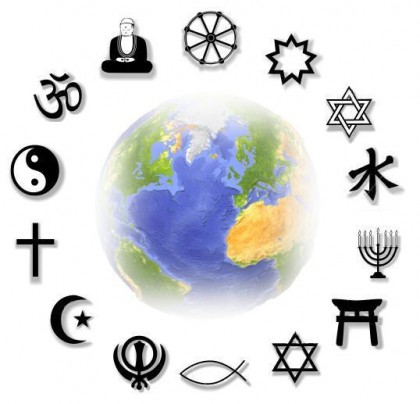 I used to be a Christian, a while back. But, not anymore. What is a religion, do you think? There’s so many different ones that it’s hard to say. To me religions are about what is most important to you. What matters. It might be your relationships with your mom and dad, or Ruth, or your friends. How are you supposed to treat those close to you? It might be about animals and how you’re supposed to treat them. Do you remember when Herschel died? Your great-grandma? Your great-grandpa? Did you ever wonder what happened to Herschel and your great-grandparents after they die? Me, too. I’m not sure, but it is a question most religions try to answer.
 Think of it, Gabe. The sun, that distant star that gives us daytime, the one we see everyday, provides us with the heat and energy to live. Mother earth, the ground we walk on everyday, that holds us up, that we see in parks and farm fields and mountains, provides a home for us and nourishment for the plants. The plants provide food for animals. And animals and plants make food for us. They also make our oxygen. You just breathed some in right now.
 I think of the holy as something both amazing and mysterious. Imagine all the time you spent inside your mom’s womb, growing from two cells into the boy you are now. Amazing and mysterious. Think about a plant’s leaf taking energy from sunlight, mixing it somehow with water and nourishment from the soil to create food, give off oxygen. Amazing and mysterious. Or, how about the change from winter to spring when the cold goes away. Flowers come up. Trees put out their leaves. Grass turns green. Up here in the mountains you see fawns and elk calves. Amazing and mysterious. All holy.
 Aging brings with it an inevitable glance over the shoulder. Did I matter? If so, how? If not, why? Does it matter if I mattered? I suppose it would be possible to disappear into regrets or vanity or even anguish. But, why?
 On the drive over to Tony’s Market to pick up Christmas dinner I got to thinking about ohr, the shards of divine light kabbalists believe actually make up the known universe. When I bow to the divine light in you and you bow to the divine light in me, we say that makes sense in that framework. So there can be the ohr, the light of the divine blasted apart at the moment of creation; but, I thought, there’s also the more immediate light, that of the sun.
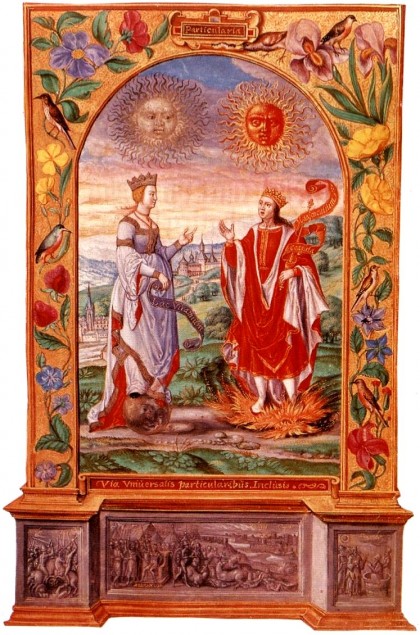 It is this dance, the days of the dancing star, that we are thrown into this world to execute. Sure, you could take this and conclude a scientistic flat-earth humanism, minus the divinity, but it seems to me you end up in the same place with a reductionistic refusal to see the simcha, the joy, of life as part of, not separate from. It is the bondedness we have with our star and our planet which is divinity, we are part of a dialectic between power and fertile elements, a fruit, in fact, of its creative tension.
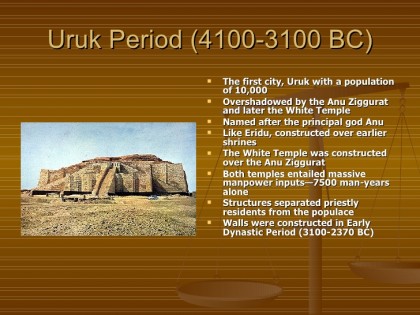 In ancient Uruk residents opened all city gates, lit bonfires and sang hymns timed to the rising and the setting of certain stars in the sky. This all night vigil honored many Sumerian deities, but most of all Anu, king of the gods, and special protector of the city. In the Congo the Mbuti hunters clap, sing, and dance around a fire at night, the Molimo Ceremony. This is not only a solstice observation, but for significant events. If there has been a death, they sing to the forest: “If darkness is, and the darkness is of the forest, then the darkness must be good.” from the Lapham Quarterly, Winter 2019
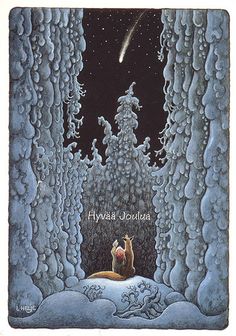 Then Kate can heal over the longest night of the year. Fecund darkness, calm and quiet night, holy night, sacred night. A 98% full moon. With all the energy of a still waxing moon, one very near fullness, she will receive the best energy this long night can offer. If you have a moment once the darkness falls, feel your way into it, perhaps in the moonlight, and remember Kate.
 Tomorrow is the winter solstice. I haven’t gotten yet to the six new rituals I found in Lapham’s, but I will either later today or tomorrow. The dark, the long night, to me symbolizes healing, fecundity, a depth experience for the Self, a soulful journey. It’s what I need right now, a time out of time, time with the ancientrail that winds in and down, following the shamans toward the center of the earth, the center of the soul.
 Bought this ceramic container a few years back, probably during a Woolly Mammoth retreat at Valhelga, the Helgeson’s family retreat on a lake close to Collegeville, home of St. John’s Monastery. It reminds me of the modest clay cylinders that held the Dead Sea Scrolls and I loved the brown to black glaze, the whoosh.
 I’ve not been idle. Using some small, 5×7, canvases I’ve begun to use oil paints. My first effort is here. Doesn’t pop like I hoped it would. I have three more of these small canvases painted with an undercoat. One yellow, one sap green, and one violet. Trying color field painting. Mark Rothko is my favorite abstract painter, so I thought I’d see what I could make using him as my inspiration.
 After 12 years as a guide and docent at the Minneapolis Institute of Arts, art became an integral part of my life; yet, I’ve struggled to keep art in my life since moving to Colorado. The museums here are not compelling and driving down the hill takes time. Reading about art, looking at it online or in books has not given me the satisfaction I’ve searched for. Painting myself, which necessitates a look into art materials, theory, and careful looking at artists whose work I’d like to use as inspiration, may. I’m not there yet, but I’m having a hell of a lot of fun.