Category Archives: Great Wheel

A Satisfied Mind

Fall                                              Waning Blood Moon

Yesterday I dug potatoes.  It was the first time I’d done that save for a few new potatoes I dug during the growing season.  It was wonderful.  You loosen the soil with a spading fork then dig around hunting for buried treasure.  Each time I came up with a potato I felt great.

A garden combines several satisfactions.  The first is co-creative as you care for the soil and the seeds, then the plants as they mature.  As with the bees, it is a mutual endeavor, the gardener and the plant world.  The garden itself yields wildgrapes09intellectual puzzle after intellectual puzzle.  What’s going on with that plant?  How do I improve the soil?  How do I keep the dogs out? (ooops. sorry.)  Solving those puzzles is part of the fun.
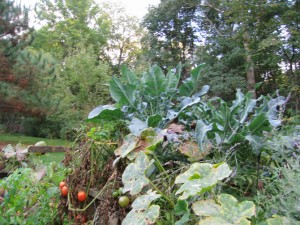
Then, too, the garden has an aesthetic.  Flowers add color, but so does the blue green kale and the purple and green of the egg plant.  The beauty has a seasonal dimension, too, as the wonder of germination gives way to maturation.  Each plants fruits then add yet another layer:  tomatoes in red, yellow, orange and white, potatoes white and covered with soil, purple and white egg plants, beans with purple and yellow pods, graceful carrot and parsnip fronds.

Toward the end of the growing season those vegetables planted for storage and preservation then come into the house for canning, freezing and drying.  As the snow storms come, they will fill in for the fresh vegetables eaten straight from the garden.

The act of harvesting is so primal I wouldn’t doubt our response to it swims in our genes.  Carry in a wicker basket filled with ripe tomatoes, squash, cucumber, carrots, beans, egg plant, greens and the planning and digging and nurturing all makes sense.  In a physical, basic way.

Eating of course is the satisfaction most apparent and is nothing to disregard, but it comes late in the process.

For those of us who find decay a fascinating part of the natural process there is another satisfaction.  The reduction of the plant bodies themselves to compost returns nutrients to the soil and completes the cycle.

There is too one last satisfaction.  As the snow swirls outside and the temperatures are far, far below survivability for any vegetable, I can plan next year’s garden with colorful seed catalogs.   This includes the February and March and April sowing of seeds for plants to transplant into that very garden.

So, take that Rolling Stones, I got my satisfaction.

It’s About Time

Fall                                      Waxing Blood Moon

On the I-Google page there is a widget that shows the progression of night and day across the globe.  In Singapore it is Friday already, 12:30 p.m. Lunch time.  Here in the middle of North America we have blackness.  This is another of the rhythms of nature, the one so familiar it can come and go for weeks, months, even years with little remark.

Yet imagine a 24 hour period when the day/night cycle changed in some unexpected way.   What if at 12:30 p.m. it became night?  Or, what if, at midnight the sun came up?  No, I don’t mean the poles, I mean right here on the 45th latitude halfway between the equator and the pole.  Earthquakes challenge a core assumption we carry unknowing, especially those of us in the relatively quake quiet Midwest.  The assumption?  That the earth beneath our feet is solid, unmoving.  The regularity of day and night is also a core assumption, one we carry unaware.

It is these rhythms, day and night, the changing of the seasons, the growth of flowers and vegetables, their constancy that gives us stable hooks on which to hang the often chaotic events of our lives.  Even if a death in the family occurs we say the sun will come up tomorrow.  Flowers will bloom again.

Bringing these changes into our consciousness, the moon phases for example, can give us even firmer anchors.

They give me a feel for the continuity that underlies the messiness of human life and the apparent vagaries of time.  It is a continuity of positive and negative, yin and yang, dark and light, the dialectical tension between these opposites which cannot be without the other.  Taken all together they can give us a confidence in the nature of the 10,000 things.

They make understanding space-time possible for me, in spite of my lack of mathematical sophistication.  That space and time create a matrix which holds everything makes sense in a universe where day follows night and winter follows fall, then happens all over again in the next cycle.  This is not a linear model, it is not chronological, it is deeply achronological.

Fall Clean-up

Fall                                         Waxing Blood Moon

Out in the garden this morning taking down plants that have finished their labors.  Large cruciform vegetable plants grew from the seeds I started inside, but they never developed any fruits.  They’re in the compost now.  All the tomato vines save one have come down.  The last tomato harvest went inside today, too.  A few straggling yellow and orange tomatoes and a cluster of green tomatoes for a last fried green tomatoes.

A new crop of lettuce, beets and beans are well underway, lending an air of spring to the dying garden.  While examiningdieback091 carrots I have in the ground awaiting the frost, I discovered golden raspberries large as my thumb.  A real treat at this late stage in the year.  They await the vanilla ice cream I’m going to buy when I go to the grocery store.

The 49 degree weather made doing these choirs a pleasure.  Odd as it may seem, I like the fall clean-up part of gardening as well as I do any other part, perhaps a little bit more.  Most of these plants I started as seeds in February, March or April and they have matured under my care, borne their fruits and run through their life cycle.  From some of them I have collected seeds to plant for next year.  The clean up then represents a completion that goes one step beyond the harvest.  It honors these living entities by caring for their spent forms in the most full way possible:  helping them return their remaining nutrients back to the soil.  I want no less for myself.

Got a new toaster and a new ladder in the mail yesterday from Amazon.  Boy, shopping has changed.  I rarely go to a big box store anymore, once in a while to Best Buy to check out DVD’s or for some computer accessory.  I still go to hardware stores and grocery stores, the things you need weekly or right now or fresh, but everything else I buy online.

The bee guy, Mark Nordeen, had to cancel again today.  His wife, Kate’s colleague, got kicked in the head by her brand new black mare.  E.R. and a concussion later she’s home off work.  Guess I’m gonna have to figure out how to over winter my bees all by myself.

Kate the Earth Mother

Fall                                         Waxing Blood Moon

Kate made pasta sauce(s) from our tomatoes.  She also made an eggplant (ours) parmesan that we had with one of her sauces along with a toss salad of our tomatoes, basil and mozzarella.  Pretty tasty.  Kate has preserved, conserved, cooked and sewed on her two days off.  In this environment where her movement does not have to (literally) bend to her work her back and neck don’t flare as much.

After the 40 mph wind gusts I went out and walked the perimeter again, checking for downed limbs.  Just a few stray branches, none big.  I did find an insulator where the rope had pulled away.   I used the insulator itself and plastic case to nudge the  hot wire back into place.  The fence does its job, but it requires constant surveillance.  Fortunately, the energizer has an led that flashes while the fence is hot.  That makes checking on the juice much easier.

Friend and Woolly Bill Schmidt said he enjoyed the fence saga from his apartment.  He said he spent many nights, often at 2 am, shooing cows back in the field.  Electric fences are part of farming and he had many helpful hints.  He didn’t seem nostalgic for installing or maintaining a fence.

Both grandkids are sick.  Jon and Jen face the dilemma of all working parents, how to handle sick kids and work.  This is never easy and can create unpleasant situations.

I’m grateful for the rain and the cool down.  Cooler weather means plants ratchet down their metabolism so they need less water and food.  It’s time for that.  The rain helps our new shrubs and trees.   They’ve got the rest of the fall to settle in and get their roots spread out in their new homes.

Picking Grapes With Hilo

Fall                                       Waxing Blood Moon

As the sun went down this evening, I picked grapes.  Picking grapes reaches back in time, especially wild grapes, as these are.  It reaches back to our hunter-gatherer past, a past much longer than our post neo-lithic, agricultural and urban  world.  This vine grows here because it can.  Maybe someone planted grapes long ago here, but these small grapes, almost like miniatures, offer themselves in the eons old rhythm of plant reproduction.

To get at the clusters, all smaller than the palm of my hand, I found it easier if I first removed a covering of vines and leaves that obscured the grapes.  Do these leaves shade the grapes, keep them from desiccating too soon?  Is there some part of the grape’s maturation that requires a cooler, shadier environment?  I don’t know, but the layering of leaves, then grapes up near the main vine, where it crawled across the top of the six foot fence we have toward the road, appears intentional, at least intentional in the way that evolution works through its blind selection of more adaptive characteristics.

Hilo, our smallest whippet, accompanies me when I work outside.  She hangs around and watches me, wanders off and finds something smelly to rub on her shoulder, watches other animals go by on the road.  Her companionship also reaches back into the  paleolithic when humans and shy wolves began to keep company, fellow predators brought together by the similarity in the game they hunted and the also similar method of hunting in packs.

This time of year, the early fall, would have been good then too.  The food grows on vines and on trees, on shrubs and certain flowering plants.  Game eats the same food and becomes fat, a rich source of nutrient.  My guess is that there was a certain amount of anxiety, at least in these temperate latitudes, for the older ones in clan would know that winter comes after this time of plenty and that somehow food had to be preserved.

Kate takes the grapes and turns then into jelly and apple-grape butter.  The act of preservation, though now more sophisticated technologically, was essential back in the days prior to horticulture and agriculture.

The resonance among these fall related acts and our distant past adds a poignancy mixed with hope to them.  We have done it, we do it, others will do it in the future.  As the wheel turns.

Mabon (Fall) 2009

Fall                               Waxing Blood Moon

Equinox.  Today is the fall equinox.  In spring we celebrate the shift towards yet more light and warmth as the trend toward lengthened days sees daylight overtaking the night.   Now the shift has a different, more somber direction.  At the Summer Solstice the hours of daylight began to shrink in relation to the hours of darkness.  At this equinox the night begins to predominate, an acceleration that will reach its peak at the Winter Solstice.

Contemporary Wiccans (some at least) call this equinox Mabon and see it as the final harvest festival.  My own understanding and practice sees Mabon as the second of three harvest festivals:  Lughnasa (ended yesterday), Mabon and Samhain (Summer’s End).  Here on the 45th latitude the gardening year does begin to wind down now.

On farms, however, the corn harvest lasts well into October and even in our garden we have carrots, parsnip, garlic and potatoes still in the ground.   In the ancient British Isles the end of summer meant deciding how much livestock you could feed through the winter.   If there was too little food for your herd, a certain number of animals would be slaughtered and their meat prepared to sustain the family over the winter.

In either case though the fall equinox is the moment when the Great Wheel takes a decisive turn toward darkness.  That shift, along with the senescence in the garden and in the trees and fields, makes this an appropriate time for taking stock.  Kate and I are in the midst of preserving through canning, drying and storing the fruits of our summer’s work.  Grain and corn gets driven to the cathedrals of the plains in open trucks filled to the brim with yellow or golden seeds.  The elevators fill up as does our newly built store room.

On a personal level this turn of the Great Wheel offers us a similar opportunity, that is, a time to take stock of the summer, the last year, even the course of our life.   Experience the joy of taking in to yourself the fruits you have harvested as a result of your own hard work.  Yes, money may be a part of that, but it is not the most important.  How have you increased in wisdom?  Have you and a significant other grown in your relationship?  Has a relationship that needed to come to an end done so and allowed you to move into a new phase of life?

This is a wonderful festival for gratitude.  In fact, if you do nothing else to acknowledge this transition, take a moment to make a list of people and things for which you are grateful.  You could take this one step further and make others in your life aware of your gratitude.

Finally, on a life level, the Great Wheel’s turn at Mabon symbolizes the autumn of our lives.  If this is where you are on your ancient trail, Mabon prompts you to consider the gifts and lessons we have embraced along the way.  The Great Wheel turns toward the final harvest, that day when we will be gathered up into the abundance from which we came and to which we return.  Present to us now that the years ahead are fewer than the ones behind this knowledge can enrich these autumnal days.  Life becomes more precious, an experience to be savored, lingered over, greeted with joy hour by hour, day by day.

In the end the Wild Hunt comes for all of us, the just and the unjust.  The Great Wheel teaches us that even after it comes, life will go on and that, in some fashion, we will all be part of it.  Come to think of it, this may be my best answer to the question about the after life.

The Afterlife

Lughnasa                                Waxing Blood Moon

The energizer box, a low impedance model, has a connection to the rope.  There is not enough high capacity underground wire left to do the grounds so I’ll stop by Fleet Farm on my way to Wayzata tonight.  The Woolly meeting convenes on the grounds of the old Cenacle retreat center, now an addiction treatment center.

Tomorrow morning we’ll power up and see if the damn thing works.  My best guess right now is that it will.  Then we wait for word from Rigel that it has begun to serve its intended function.

Warren has posed a question about the afterlife for tonight’s Woolly meeting.  What do we believe about it?

A few years ago I used this  analogy for the question of the afterlife.  It still expresses what I feel.

Think of the universe as a great tapestry woven from the life and death of stars, the solar winds, the orbits of planets and the emergence of life, especially on the planet we know intimately.  Our life, lived as best we can, blinks on at some point in this tapestry and adds color, texture, intensity and vitality to the design.  This tapestry never loses anything and it extends as far as the Great Wall of Reality extends.  Without your life the tapestry would be a poorer, less beautiful creation.

This is my Credo:
From the very stuff of this cosmos we were made.

Each life is a unique, energetic organization of this stuff.

Human life is neither less nor more unique than any other, with one exception (maybe):  consciousness.

Each of us has a Self into which we try to live.  The Self pulls us and prods us to be who we are.

You are a special and important contribution to the story of the Universe, so you must live as who you are.  If you live as you believe others would have you be, then the world loses your unique and precious story.

Economic justice is a means of assuring each persons chance to be who they are.  Therefore, political action in support of economic equity is important to the universal story.

We need the world of plants and animals, oceans and sky far, far more than they need us.  So, work to protect them, and you will protect your loved ones.

The human family and friends we love and support in this life will, in all likelihood, be our primary legacy.

An open heart and an open mind keeps the Self fresh, defeats stagnation, and assures a vital life at any age.

Learning from our gardens, our children, our friends, our spouses or partners, and from the collected wisdom of others connects us to the past and links us to the future.

Art, children, dogs, jazz, and travel have the capacity to jolt us into new perspectives.

Waiting for Rigel to Come Home

Lughnasa                       Waning Harvest Moon

Vega returned home.  Kona let all the dogs inside (her major outdoor trick) and Vega walked into our bedroom where I had laid down for a bit.  When I got up to see if Rigel had come home with her, she apparently got up on the bed because I found many burrs and stickers deposited on my side of the bed.

Rigel is still out there, somewhere.

Until she comes home or we decide to try and find her an alternate way, I won’t take Vega out to discover their escape hatch.  I want Rigel to use it to come home.  There’s probably a subtle psychological truth in that, but I’ll leave it to you to discern.

On another note, this is a holiday, a holiday of ending.  Labor Day, aside from its apparent purpose, has acquired a status, at least here in the northern US, as the end of summer.  This comes not only from the meteorological changes, September 1st is the end of meteorological summer, but also the return of kids to school.  Here in Minnesota people go up to their lake cabins to shut them up for the winter and the whole atmosphere becomes one of back to work, time to get serious again.

As a holiday, it has a certain numinosity, a feeling of difference, of quiet, of peaceful.  Today I have a sense of lassitude, a languor.  That’s partly from the intense work of the last week in researching and writing Roots of Liberalism and partly my body’s response to holidayness, perhaps you could call it its holiness, a time set apart, different from all other days.

Waiting for Rigel.

Machado, The Pathmaker

Lughnasa                                Full Harvest Moon

At about 8:00/8:30 pm I drove over to Than Do to pick up some take out.  At the end of our cul de sac, a bit above the tree tops, was a golden harvest moon.  It stopped me.  The moon always catches me, draws my breath  up from deep within, a rush of exspiration.  Many of us have it, a mystical connection to the lesser light, its waxing and waning, the crescent moon with venus nearby, the full red moon of a lunar eclipse, the outsized floating golden orb of an October full moon, even the dark sky of the new moon, pregnant.

Many of my friends in the Woolly Mammoths devour poetry books.  I’m not a regular reader of poetry, more episodic, sometimes in binges.  I get onto poets through odd routes, like Antonio Machado whose poem, Pathmaker, now occupies the upper left of this webpage.  Paul Strickland has a mentioned Machado many times.  Machado is one of many non-English language poets Robert Bly has translated.

Machado, whom I had not read, appeared in an article I read about attempts to name the crimes of the Franco era in Spain and the strange reluctance of Spaniards to talk about the Spanish Republic which Franco overthrew, then destroyed with brutal force.

Machado is a poet/saint of the Republicans, buried in exile across the northern Spanish border in France where many of the Republicans fled when Franco defeated them in Spain.  The author of this article, a resident of  Barcelona, wrote of a moving celebration at Machado’s grave, a remembrance for those who fought and died, lost forever to their loved ones by burial in mass graves.

A single woman began chanting this poem, the Pathmaker, and all the others joined in, there at Machado’s tomb.

When I read it, I realized it was the perfect poem for Ancientrails.

Pathmaker, the path is your tracks,
nothing else.

Pathmaker, there in no path,
The path is made by walking.

And turning the gaze back,
Look on the trail that never will be
Walked again.

Pathmaker, there no path,
Only the wake on the sea.

Night, Cool Night

Lughnasa                        Full Harvest Moon

Cool nights and perfect days, high 60’s to 70.  Blue sky with puffy clouds.  The occasional cirrus formation, mare’s tails prancing in from the north.    Clear air.   Bright stars and a moon full enough to navigate a country road without headlights.

This is the time of year, in the midst of the harvest, when the growing season pretty much comes to a stop here in the northern central U.S.  Garden clean up lies not far ahead, digging potatoes and pulling carrots, too.  Parsnip and garlic will sleep over the winter in their beds.  A few beets left to pull, a lot of squash still maturing and the beans have a bit more time before the pods dry up.

Life changes with the seasons.  Just how is not always predictable, but cooler weather inspires different activities than the heat of  mid-summer.  Snow and bitter cold different activities again.  You either enjoy these changes or you move somewhere else.