71 times Valentine’s Day and I have shared a moment. This was a quiet one, a good one. Decided I would cook Kate a special meal. In all our years together I’d never done that. It felt great. Went to Tony’s Market (upscale groceries, great meat). Bought a ribeye and some model thin asparagus. Kate found some tiny potatoes. Candles and jazz from Kate’s Pandora Satchmo and Ella channel. Just right. Later, a dusting of snow.
Based partly on the Rumi poem* I posted, sent to me by Tom Crane after I wrote about that old debil melancholy,I’ve decided to lean into my uncertainty and ambiguity. Life purpose seems to be up for reconsideration. Or, perhaps, reconstruction, reimagining. Or, best, reenchantment. But, instead of forcing my way into a new life, I’m letting it come to me. Waiting. Testing. Entertaining.
Bits and pieces that have floated in. All my 70’s, barring some very unusual event, will be lived in Colorado, hopefully in the Rockies. So, this decade, the one I’m now firmly in, is a Western, arid lands, mountain decade. It also has a strong Jewish accent, spoken in a Beth Evergreen dialect.
At one point concentrating on Colorado and the west. At another, more Taoism. Stop writing novels. Read more. A lot more. A year of the Tao or a year of the West. Travel. In our immediate region. As much as possible. Continue with the sumi-e. Take classes? Go to a Progoff workshop?
Not sure where this is going, but for some reason turning 71 has made me unsettled, willing to reject or set aside old purposes, find new ones. Or, possibly, reaffirm current ones. I’ll know when I’m done with this, moving into a new chapter. But, I don’t know when that will be.
*”This being human is a guest house.
Every morning a new arrival.
A joy, a depression, a meanness,
some momentary awareness comes
As an unexpected visitor.
Welcome and entertain them all…” Rumi, The Guest House
1948. Polio at one and a half, paralyzed for six months, some time in an iron lung. Relearned to walk. The beginning of childhood. October, 1964. Mom dies of a stroke. 17, childhood’s end. Just realized this last week that my childhood had these two inflection points. Strange to think of childhood that way.
Hard to know the true pathways of the mind. But. Alcoholism. Smoking. An anxiety disorder. A constant focus on existential questions. Maybe. Maybe these were causative. Or, rather, my responses to them.
At 71 all that seems so long ago. I call those times the long ago and far away. Isn’t true, of course. That little boy still struggles with learning how to walk. That high school senior still grieves, is shocked, stunned. Compassion for the young man in his twenties, the one who lived after, unconscious largely, angry, hurt, determined, passionate. He didn’t understand the powerful psychic currents pushing and pulling him, making him yearn for knowledge, making him demand a changed world. Wish I could go back and hold his hand, comfort him. Reassure him. He needed it.
No matter our birthday, 19 or 99, our past selves come along to the party. I’m unclear about the reality of self or soul though I believe in them both. Whatever the self is, it’s a composite, a melange of key moments and the reactions to those moments. And, as time goes on, the reactions to those reactions.
Whatever the soul is, it represents that of us common with other souls, that of us common with the unimaginable creativity resulting in life. As such, the soul is our literal birthright, unimpeachable by our actions, our hopes, our nightmares. No matter how sullied or glorious our life our soul retains its pristine quality, its eternal character of universality. The afterlife, if there is one, lies hidden behind the veil; but, if anything passes into it, it will be this. Would the soul be stripped of the barnacles attached by our long or short lives? Hell if I know.
I’m happy to have lived this long, 71 years. And, I can see now that answers are not part of the search. It was always the questions. As Kate and I lived in the move for the 9 months before we left for Colorado, so have I always lived in the questions. Then, in the long ago far away, and now, in 2018 on Shadow Mountain. Tomorrow, too.
The first day of Lent falls, this year, today. That means, as Allan Metcalf, the author of the article quoted below says, that we’re dealing with hearts and ashes. Makes sense to me that my 71st would fall on such a day. Since hitting three score and ten a year ago, I’ve passed into birthdays that commonly show up in the obituary pages. Ash Wednesday reminds us that we deconstruct, returning our enlivened elements. #Recycle Me as the green burial folks said.
This reminder, a mark made from the ash of palm leaves used a year ago, would be good for all of us. It doesn’t have to come with the whole freight train of Catholic dogma. We could use soot from the chimney or ash from a burned log in the fire place.
Minneapolis Institute of Arts
It invites comparison to Yamantaka. “Yamantaka is a violent aspect of the Bodhisattva Manjushri, who assumes this form to vanquish Yama, the god of death. By defeating Yama, the cycle of rebirths (samsara) that prevents enlightenment is broken.” Met Museum
The holiday of Easter, which comes at the end of Lent, celebrates a god who conquers death. We do not defeat physical death though Christianity posits that great wakin’ up mornin’ sometime in a future dimly understood. Mebbe so. Mebbe so.
As for me, I’m with Yamantaka whose wonderful mandala hangs in the Minneapolis Institute of Arts. It encourages a focused meditation on your own death so that the Bodhisattva can help you clear your mind of fear. That is the victory over death that Yamantaka offers, release from the fear of physical death. An ash mark on the forehead once a year is a start, but the Catholic one comes with strings created by texts. So let’s create our own and use it to recall our work with Yamantaka.
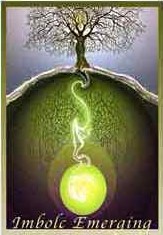
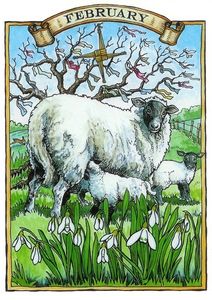
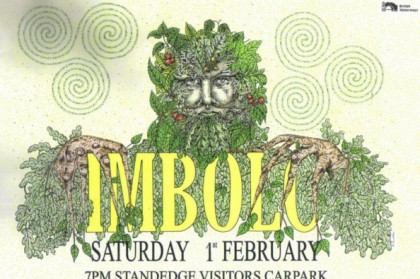
Imbolc, as long time readers of this blog probably recall, means in the belly. This cross-quarter holiday comes between the Winter Solstice and the Spring Equinox. It lies at the most desperate point of the year for an agricultural culture with no refrigeration. If it was a good harvest before the beginning of the fallow season at Samain, all right; but, if it was a poor or even mediocre harvest, then supplies might be running out.
This might mean awful choices must be made. Do you eat the seed grain, which you need to plant next year’s crop? Do you slaughter an animal which you need to breed, because you can’t feed it and your family?
A potential salvation lay in the sheep. The ewes, now pregnant, a lamb in-the-belly, would begin to freshen, produce milk, a source of nourishment that might be enough to get the family, the village, through until spring. Even in good years the freshening of the ewes was a time of celebration. It meant the fallow time was drawing to a close. Spring was near and the growing season would commence.
The Great Wheel turns. The sabbath for the land continues through Imbolc, awaiting the warmer temperatures and rains around the equinox.
An interesting annual spiritual practice I found at Heron’s Rook, but could not relocate even after searching there, begins at Samain. Heron, the witch who writes this blog, calls the annual focus, the great work. I’m going to reimagine it here. The general idea is hers, but the specifics are as I vaguely remember them or as my reimagining suggests they could be.
We go fallow at Samain, too, letting the last year’s work feed us as we consider what might make for a good crop in the coming year. On the Winter Solstice go deep into your own darkness, celebrate what roots in your soul, what is even now gathering nourishment from the soil of your inner garden.
On Imbolc, where we are right now, let the spiritual or creative elements of that which grows within you come to the surface, give you sustenance as you await the fullness of its birth.What you await is a purpose, a project, a great work strong enough to sustain focused energy over the growing season or several seasons. At Imbolc it’s still nascent, unformed, perhaps unrecognizable as what it will become. But its growth has already begun to feed you.
Around the vernal equinox let it out, bring it into the sunlight of the new spring. Let it gambol in the fields of your heart. Feed it. Embrace its newborn animal nature. You might see it as a puppy or a kitten, a lamb. It’s new in the world and must be fed, but just as much as physical needs it has a need to explore, to greet the new world in which it now lives.
This is the moment to run like crazy with that potential new work, examine all the ways it can go, let it loose. See what it needs to explore, to learn. By Beltane, the beginning of the growing season, you will know the skeletal structure of your new work. You will have followed its maturation from the dark of the Winter Solstice through its puppy like eagerness, to the now formed project or direction.
Over the course of the growing season you will give this great work for the year what it needs to thrive. Plenty of sunshine, water. You’ll weed around it. Provide it food. If its completion coincides with Samain, then the process will begin again.
As I wrote this, I realized that for me, I’d probably flip it. That is, I’d start the incubation process at Beltane, let the new great work grow over the Summer Solstice, let its creative energy begin to emerge around Lughnasa, bring it into the world around Mabon, or the fall equinox, and get down to serious work on it at Samain. This is because I find the cold and the bleakness of the fallow time most conducive to creative work.
The Imbolc moon has had its night in earth’s shadow, its night as super and blue and red. Hey, up in the sky, it’s Supermoon! And last night it was wonderful again. High, full, behind a faint veil of clouds. Orion and the moon. My two favorite celestial objects. Well, ok, the sun, too, but I can never look at it.
Something in a full moon moves me to the depths of my soul. I can find myself tearing up, a catch in my throat at the sheer extravagance of its beauty. It’s offered over and over, available to all, free.
So, too, Orion. He rises. Greets any who bother to find him. He stands always ready astride the horizon, a hunter and his dog. I don’t know whether he remembers our nights in Muncie while I watched over the entrance gate at the factory, but I like to think he does.
The night sky, in its shorter versions and in its Winter Solstice maximum, offers solace to those of us who want it. The night is, to paraphrase LP Hartley, a foreign country. They do things different there.
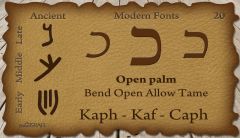
Last night I went back to Beth Evergreen, more kabbalah. Studying the kabbalah at night, especially under a full moon. Yes. Learning about more double letters: Pey, Caph, Reish, Tav.
I know this Jewish immersion of mine must seem odd to some of you who read this; but, it’s happened over many years, a sort of there and back again phenomenon. In this current instance Kate’s conversion long ago made us seek out a synagogue, just to see. We found Beth Evergreen, a special place, unique I imagine, even among Reconstructing congregations.
It was long ago though I read Isaac Bashevis Singer. Chaim Potok. Later, Rebecca Goldstein. It was long ago that I walked into the synagogue in Muncie for an anthropology assignment. It was long ago that I dated the jeweler’s daughter, Karen Singer, and found her father’s knowledge of philosophy astounding. Over the years many Jews have come into my life and I’ve always felt comfortable around them. As if we shared a common spirit. At Beth Evergreen that feeling surfaced immediately and has grown deeper over time.
Being part of the tribe? No. Not for me. Walking along with the tribe as it wends its way through this moment in time? Yes.
Let me give you an example. The friend I mentioned yesterday, Bonnie Houghton, the green cemetery and burial, rabbi in training, Bonnie, got me going on the Recycle Me idea. It fits so well with my pagan sensibility and it’s something I can act on through this community.
Yesterday was Tu B’Shvat, the new year of the trees. It’s a part of the Jewish holiday year, just like Yom Kippur, Purim and Passover. Kate and I went to the celebration yesterday before kabbalah. Later, as I rested before returning for kabbalah, an image struck me: a Tu B’Shvat celebration in our yet-to-be green cemetery. We would be honoring trees, trees of all kinds yes, but especially, in this celebration, those trees growing from the graves of deceased members of Beth Evergreen.
Can you imagine? An ancient holiday celebrating trees and the gifts that they offer, now including trees with their roots literally in members of the congregation? How mystical, how wonderful would that be. Out there, on the mountain side, perhaps a mountain stream running nearby, a breeze rolling down the slope and my tree, the tree that is a tree and me, our leaves rustling as the gathered folks sing, pray. Yes.
Hippity hop to the ortho shop. Kate’s got an appointment at Panorama Orthopedics today. Her right shoulder. She can no longer hold things up with her right arm and has to use two hands to put dishes away, sometimes to lift a cup. Annoying and painful. Screws up her sleep, too. She needs some kind of solution, more than likely a shoulder replacement. This is the first step, a consult to see what her options are.
A friend of Kate and mine is having surgery for breast cancer today, too. It’s a cancer that has the improbable, but very desirable, cure rate of 100%. In the sort of piling on that getting older can deliver, her husband, only a week later, got a diagnosis of idiopathic pulmonary fibrosis. It’s a killer, but slow, maybe 5-10 years. He’s mid-70’s. Mortality is always stalking us, but seems to knock on the door more often past three score and ten.
Sister Mary tells me she’s been invited as a visiting professor to a university in Kobe, Japan this summer. Very close to Kyoto. And, great beef. Congrats to Mary. Brother Mark is in Bangkok right now, chillin’ in the tropical heat.
An interesting week ahead. A session on green burial tomorrow night at CBE. It’s part of a conversation about creating a Jewish cemetery up here in the Evergreen/Conifer area. Oddly, I think I’d like to work on that. The next night, Wednesday, is Tu B’Shevat, the New Year of the Trees. Judaism has a lot of pagan inflections, Tu B’Shevat and Sukkot, a harvest festival at the end of the High Holidays, for example. Looking forward to this one because there’s a seder, too, with seven species of fruit and nuts. I’ll explain more on Wednesday. After the this celebration is another Kabbalah session, more double letters in the Hebrew alphabet.
Rigel has her second appointment at the Vet Referral Clinic with Dr. Bayliss this Friday, too. I’m excited about it because we’ll get a clearer picture of what’s going on with her. And, it’s not the dire prognosis we anticipated when we took her in a week ago last Friday.
Meanwhile, I’ve finally levered myself back into writing, now on both Jennie’s Dead and Rocky Mountain Vampire (only a working title). Not sure exactly how I did it, just did it, I think.
Getting closer to using the sumi-e brushes, maybe today. Yesterday I tied string at the base of each new brush after applying a bit of glue all round, too. That had to set for a day. I gathered some towels, watched a couple more videos. Youtube is a fantastic resource for all kinds of things. Jon watches Japanese woodcrafting videos to calm down, for example.
Next week is Kate’s quilting retreat in Buena Vista.
The solstices mark swings to and from extremes, from the longest day to the longest night, there, and as with Bilbo, back again. Darkness and light are never steady in their presence. The earth always shifts in relation to the sun, gradually lengthening the days, then the nights.
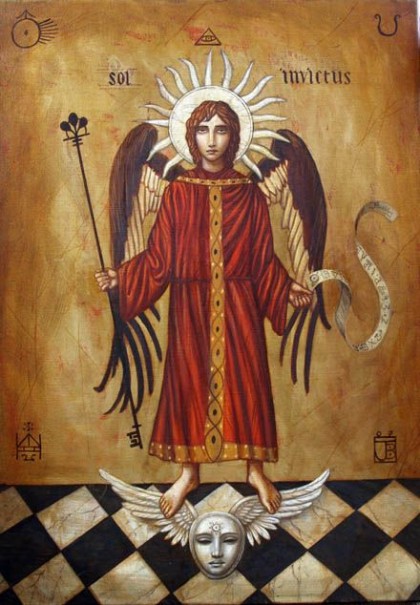
Most folks celebrate the Winter Solstice for its moment of change toward increasing light. Sol Invictus, the Roman sun god, added a martial spirit. The ancients feared that the nights would continue to grow in length, and act as a shroud thrown over the earth marking an end to growing seasons, to warmth, to life. It’s no wonder that relief at the return of the sun, revealed by small increases in the length of the day, caused holidays to be born around this subtle astronomical change.
There are also bonfires and songs and drinking and sex on the Summer Solstice. The sun manifests itself as light giver, light bringer, with the longest days. The growing season is well underway then, the miracle of life that the sun’s increasing light creates is the very relief anticipated on the Winter Solstice. Fear and the vanquishing of fear. Sol Invictus, the conquering sun.
Yet even in ancient times there had to be a few outliers like myself. We don’t begrudge the return of the sun, nor deny all the miracles that its return makes possible, that would be silly; but, for some psychic reason, perhaps not clear even to us, we reverse the common sensibility and find succor in the gradual lengthening of the nights that begins at the Summer Solstice and reaches its maximum on the night of the Winter Solstice.
We know that the cold and the darkness, the fallow time whose genesis each year happens on the longest day, is also necessary, also worthy of honor. It is earth’s sabbath, a time for all the generative powers to rest, to regather themselves, to ready themselves for the next florescence. I suspect somehow in our psyches we honor slight dips into depression or melancholy, knowing that in those times we regroup, rest the eager forward creative parts of our souls and the gradual lengthening of the darkness outside mirrors that.
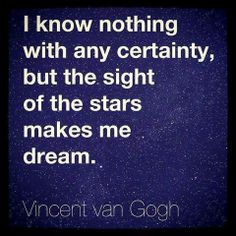
In these long nights the cold often brings clear, cloudless skies. The wonderful Van Gogh quote that I posted a few days ago underscores a virtue of darkness, one we can experience waking or asleep. Dreaming takes us out of the rigors of day to day life and puts us in the realm where ideas and hopes gather. So, the lengthening of the nights increases our opportunity to experience dream time. Whether you believe in Jung’s collective unconscious or not-I do, the rich resources of dreaming are available to us with greater ease when the nights are long and the cold makes sleeping a joy.
It was, too, many years ago when I pushed the notion of transcendence out of my spirituality in favor of immanence, incarnation over a god in the sky. My focus moved to down and in, not up and out. Our inner world is a mystery, a place of fecundity, but also a place often occulted by the demands of the day. When we shift our focus to the night, to the half of the year when darkness grows, we can use that external change as a trigger to lean inside, to find the divine within. If we can make this discovery, the god that we are, we can stiff arm the notion that revelation stopped thousands of years ago.
each birth, always
Every moment of our existence is a revelation, the path of a god, the most fundamental ancientrail of all. No, we are not omnipotent, that’s an illusion created by the idea of transcendence, the need to find validation outside of our own soul. This is the true polytheism, the one that folds its hands, says namaste, bows to that of god in everyone, in every animal, in every plant and stone and star.
When you reach out in love to another person, to a dog, to a crocus blooming in the snow, you bring the finger held out by the white haired floating god in Michelangelo’s Sistine Chapel ceiling. That moment of creation is always, ongoing, a joint effort between and among us all, human and inhuman, animate and inanimate, the cosmic dance of Shiva brought into this mundane world. He or She is not out there, waiting to be called by prayer, but in here, waiting to be called by the quiet, by the joy, by the persistence held in the soul container that is you.
For my unconquerable soul.” William Ernest Henley, Invictus
astronomy today, formation of the moon
The Winter Solstice. Today and tonight. 23.4 degrees of tilt. Explanation for the tilt is not settled science though at least part of the answer seems to lie in the accretion of matter and the occasional outright collisions that occurred during our planets formation early in the history of the solar system. Another interesting theory, perhaps part of the answer too, is that any large imbalance, say a supervolcano with a huge mass, could have caused the earth to tilt so that mass ended up near the equator.
Whatever the exact reason, the current tilt, which remains constant as the earth revolves around the sun, creates our seasons. As the earth orbits, the tilt causes a reduction and increase of the energy of the sun’s light by either concentrating it during the summer solstice (leaning toward the sun) or by spreading the light over a wider area (leaning away from the sun) during the winter solstice. Today at 9:28 MST the northern hemisphere will be at its maximum tilt away from the sun while, of course, the southern hemisphere is thrust toward the sun and celebrating its summer solstice.
All of this is a continuing evolution caused by forces set in motion by the big bang over 13 billion years ago. The fact that I’m sitting at 8,800 feet on a chunk of rock thrust up by the Laramide orogeny, watching snow drift down as the air up here cools toward below zero temperatures, waiting for the longest night of the year, 14 hours and 39 minutes here in Conifer, showcases the violent origins and their ongoing impacts on earth and her sister planets. When we settle into the chair tonight, or hike outside with a headlamp, or listen to some quiet jazz or Holst’s The Planets, the darkness enveloping us is an in the moment result.
As the earth leans away from the sun, we can lean into the darkness, the long night when the woods are lovely, dark and deep. As we do, we have the opportunity to sink into the fecund darkness within us, a soul link with the darkness all around us and our tiny solar system. In it we can recall sleeping animals in their dens, beneath chilled lake waters, in their lodges made of sticks and branches. In the darkness we can rest a moment beneath the surface of the snow and cold covered soil where roots and microbes work feverishly transmitting nutrients and available water into plants slowed, but not killed by the seasonal temperatures.
In the darkness we can attend to the dark things within us, the places in our souls where our own origins and their ongoing impacts create a climate for our growth, down below the conscious considerations of our day-to-day lives. We can embrace this darkness, not as a thing to fear, but as a part of life, a necessary and fruitful part of life.
I’ll sit in my chair this evening as the night unfolds (I love that imagery.) and consider death, my death, my return to the woods, lovely dark and deep. And, I’ll hug close to my heart the life I’ve been given and this opportunity, granted by the stars, to meditate on it.
When Hanukkah ends tonight, it will only be two days to the Winter Solstice. I long ago kicked transcendence out of my religious toolkit, believing it encourages authoritarianism, the patriarchy, and body negativity. How, you might ask? If we find our source of authority outside of ourselves, either up in heaven or with a divine father figure or anywhere outside of our body, we give away our own deepest connection to divinity, the sacred that lies within us. BTW: locating revelation in written texts does the same.
You could argue that cavalierly jettisoning a millennia old religious idea, celebrated and loved by millions, is anathema. Yes, may well be. OK with me. You could say if transcendence is real, then denying it is misguided or just plain wrong. Yes, you could say that. But if the downside of accepting transcendence includes self-oppressing, self-negating ideas, then it’s functionally bad, whether it’s true or not. So out with it.
If not up and out, then what is the direction for spiritual enlightenment? In and down. In your body/mind, and down into the depths of your soul. You say soul links us to the transcendent. Yes, you might say that. I’m more in the metaphysical world of Jungian thought though, where the soul connects us to collective unconscious, a deep stream of reality to which we belong and which belongs to us. Or, another way to think about it, the soul is our direct link to the nature of reality. It is the part of us that is eternal, that is divine and to know eternity, to know the divine, we only need know ourselves, as the Delphic Oracle said long ago.
Image Artwork by Susan Seddon Boulet
All this to say that the Winter Solstice is my high holiday (or, low holiday) because it encourages us to go inside, to sit in the darkness, to be part of the Gaian womb from which life emerged. As we head toward it, I’m considering my eternal soul, that divine spark within which makes me holy. And you, too.
The holy scripture I choose to read starts at my fingertips, but extends into the reality around me. When I look at the lodgepole pine and its elegant means of sloughing off snow, or at Maxwell Creek as it slowly carries Shadow Mountain toward the sea, or the lenticular clouds over Black Mountain, my sense of wonder and awe increases. These close by things and I share the same building blocks, the stuff, the things that burst out so long ago in the great expansion. Just after the tzimtzum, the great contraction. There is no transcendence here, only interpenetration, the universe and its evolutionary marvels.
Down we go, into the longest night. A darkness profound enough to reshape our lives, to help us see.
I also recalled yesterday that I’ve had this end of year let down often. When I worked for the Presbytery, I noticed that no congregation wanted a church executive around during the run up to Christmas and the week after, through New Year’s. This may have been a post-school rationalization to give myself a winter break. Whatever it was I think the pattern is probably there, triggered this time by the end of kabbalah.
It feels ok now that I know what it is. I’m going to ride it out through New Year’s, continuing to write Ancientrails and exercising, but other than that trying to follow a more unpredictable path. Getting some work done around the house. Reading outside my current Judaism concentration. Movies. More cooking. Enjoying holiday time and visits.
For lack of a better term, this is my winter break.
It also occurred to me that I live in the mountains, a spot in the U.S. that literally millions come to see every year, then go home. Maybe I’ll get out and about a bit more over the next couple of weeks. Strap on those snow shoes. Oh, yes, we did have snow. Not a lot, but enough for snow shoeing, I think.
 71 times Valentine’s Day and I have shared a moment. This was a quiet one, a good one. Decided I would cook Kate a special meal. In all our years together I’d never done that. It felt great. Went to Tony’s Market (upscale groceries, great meat). Bought a ribeye and some model thin asparagus. Kate found some tiny potatoes. Candles and jazz from Kate’s Pandora Satchmo and Ella channel. Just right. Later, a dusting of snow.
 At one point concentrating on Colorado and the west. At another, more Taoism. Stop writing novels. Read more. A lot more. A year of the Tao or a year of the West. Travel. In our immediate region. As much as possible. Continue with the sumi-e. Take classes? Go to a Progoff workshop?
 No matter our birthday, 19 or 99, our past selves come along to the party. I’m unclear about the reality of self or soul though I believe in them both. Whatever the self is, it’s a composite, a melange of key moments and the reactions to those moments. And, as time goes on, the reactions to those reactions.
 The first day of Lent falls, this year, today. That means, as Allan Metcalf, the author of the article quoted below says, that we’re dealing with hearts and ashes. Makes sense to me that my 71st would fall on such a day. Since hitting three score and ten a year ago, I’ve passed into birthdays that commonly show up in the obituary pages. Ash Wednesday reminds us that we deconstruct, returning our enlivened elements. #Recycle Me as the green burial folks said.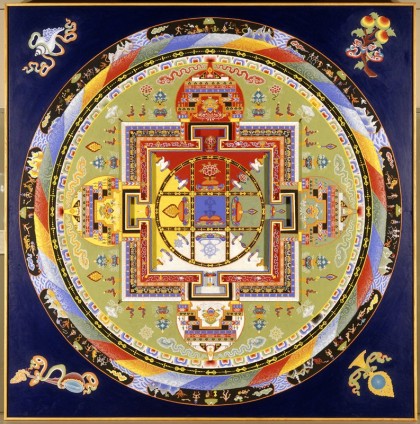
 Imbolc, as long time readers of this blog probably recall, means in the belly. This cross-quarter holiday comes between the Winter Solstice and the Spring Equinox. It lies at the most desperate point of the year for an agricultural culture with no refrigeration. If it was a good harvest before the beginning of the fallow season at Samain, all right; but, if it was a poor or even mediocre harvest, then supplies might be running out.
 An interesting annual spiritual practice I found at
  This is the moment to run like crazy with that potential new work, examine all the ways it can go, let it loose. See what it needs to explore, to learn. By Beltane, the beginning of the growing season, you will know the skeletal structure of your new work. You will have followed its maturation from the dark of the Winter Solstice through its puppy like eagerness, to the now formed project or direction.
 The Imbolc moon has had its night in earth’s shadow, its night as super and blue and red. Hey, up in the sky, it’s Supermoon! And last night it was wonderful again. High, full, behind a faint veil of clouds. Orion and the moon. My two favorite celestial objects. Well, ok, the sun, too, but I can never look at it.
 Last night I went back to Beth Evergreen, more kabbalah. Studying the kabbalah at night, especially under a full moon. Yes. Learning about more double letters: Pey, Caph, Reish, Tav.
 Being part of the tribe? No. Not for me. Walking along with the tribe as it wends its way through this moment in time? Yes.
 Hippity hop to the ortho shop. Kate’s got an appointment at Panorama Orthopedics today. Her right shoulder. She can no longer hold things up with her right arm and has to use two hands to put dishes away, sometimes to lift a cup. Annoying and painful. Screws up her sleep, too. She needs some kind of solution, more than likely a shoulder replacement. This is the first step, a consult to see what her options are.
 An interesting week ahead. A session on green burial tomorrow night at CBE. It’s part of a conversation about creating a Jewish cemetery up here in the Evergreen/Conifer area. Oddly, I think I’d like to work on that. The next night, Wednesday, is Tu B’Shevat, the New Year of the Trees. Judaism has a lot of pagan inflections, Tu B’Shevat and Sukkot, a harvest festival at the end of the High Holidays, for example. Looking forward to this one because there’s a seder, too, with seven species of fruit and nuts. I’ll explain more on Wednesday. After the this celebration is another Kabbalah session, more double letters in the Hebrew alphabet.
 Rigel has her second appointment at the Vet Referral Clinic with Dr. Bayliss this Friday, too. I’m excited about it because we’ll get a clearer picture of what’s going on with her. And, it’s not the dire prognosis we anticipated when we took her in a week ago last Friday.
 The solstices mark swings to and from extremes, from the longest day to the longest night, there, and as with Bilbo, back again. Darkness and light are never steady in their presence. The earth always shifts in relation to the sun, gradually lengthening the days, then the nights.
 In these long nights the cold often brings clear, cloudless skies. The wonderful Van Gogh quote that I posted a few days ago underscores a virtue of darkness, one we can experience waking or asleep. Dreaming takes us out of the rigors of day to day life and puts us in the realm where ideas and hopes gather. So, the lengthening of the nights increases our opportunity to experience dream time. Whether you believe in Jung’s collective unconscious or not-I do, the rich resources of dreaming are available to us with greater ease when the nights are long and the cold makes sleeping a joy.


 In the darkness we can attend to the dark things within us, the places in our souls where our own origins and their ongoing impacts create a climate for our growth, down below the conscious considerations of our day-to-day lives. We can embrace this darkness, not as a thing to fear, but as a part of life, a necessary and fruitful part of life.
 When Hanukkah ends tonight, it will only be two days to the Winter Solstice. I long ago kicked transcendence out of my religious toolkit, believing it encourages authoritarianism, the patriarchy, and body negativity. How, you might ask? If we find our source of authority outside of ourselves, either up in heaven or with a divine father figure or anywhere outside of our body, we give away our own deepest connection to divinity, the sacred that lies within us. BTW: locating revelation in written texts does the same.
 I also recalled yesterday that I’ve had this end of year let down often. When I worked for the Presbytery, I noticed that no congregation wanted a church executive around during the run up to Christmas and the week after, through New Year’s. This may have been a post-school rationalization to give myself a winter break. Whatever it was I think the pattern is probably there, triggered this time by the end of kabbalah.