Category Archives: Memories

Small Town, U.S.A.

Imbolc                                                                    Valentine Moon

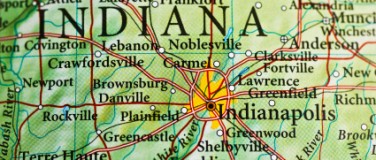
Indiana-map-copy-312948_376x160Woke thinking about the subtitle to the book Strangers in Their Own Land: Anger and Mourning on the Right. I realized I knew this one from personal experience.

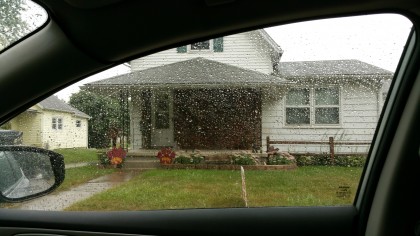
In 1956 my family, then Mary, myself, Mom and Dad lived at 311 E. Monroe Street. I was nine. Diane Bailey lived next door, the Kildow kids and the Meyers kids lived about a block away as did Candace. The Carver boy, whose name I can’t recall, lived at the bottom of the hill, Ronnie Huffman lived a block back toward Lincoln.

311 E. Monroe
311 E. Monroe

These were all modest homes, not Baltic Avenue, but maybe Tennessee, Virginia. Ours had an oil burning stove in the middle of the second room on the ground floor, a grate above it allowed the air to rise to two small bedrooms upstairs. A smallish living room and a kitchen completed the downstairs. In the living room, unusual for this time period, sat a small black and white television, a gift from the owner of the newspaper, The Times-Tribune, for which my Dad was editor.

Summer days and nights found all of us kids out, playing with each other, coming home at supper time or after dark. We had secret forts in the field, empty ground about two blocks away, a baseball diamond in the Carver’s side yard, a hill down which we rode bicycles and sleds, often putting up ramps for jumps. Once it got dark we’d play hide and go seek or kick the can. Sometimes we’d throw rocks up in the air to watch bats swoop down after them. It was not an unusual childhood, not for those times.

Continue reading Small Town, U.S.A. →

Glad We Live Here

Winter                                                            Valentine Moon

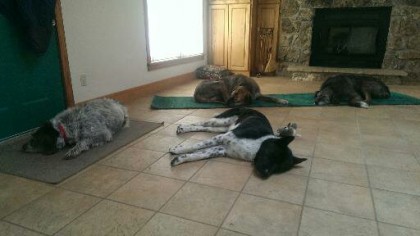
The dogs after delivery by Tom Crane
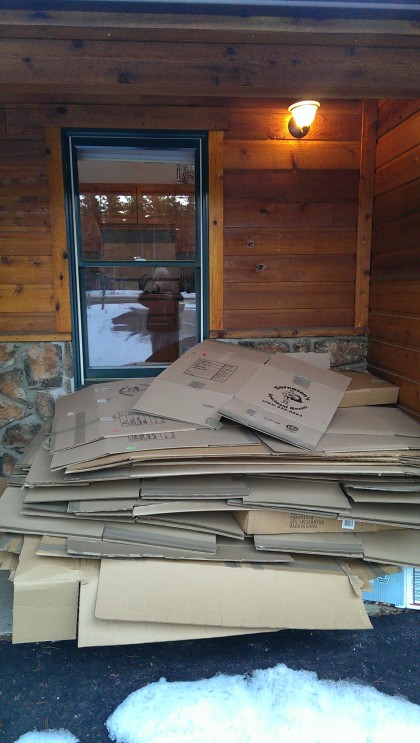
The dogs after delivery by Tom Crane and Kate, before the boxes

The move, two years plus later. On October 31st, Summer’s End of 2014, we closed on 9358 Black Mountain Drive. Later that same year, on December 20th, the Winter Solstice, we moved in. At the time we still owned our home in Andover, Minnesota. When the boxes piled up in all spaces of our new house, we looked at them, breathed in and out heavily and took a nap. We were to breathe in and out heavily for three months or so as our bodies adjusted to life at 8,800 feet.

The winter weather on Shadow Mountain that preceded and followed our move was snowy and cold. Even for two Minnesotans. We had to learn mountain driving on snowy, slick roads though the Jefferson County snowplows did do an excellent job of clearing and sanding our main road, Black Mountain Drive (Hwy. 78).

IMAG0927_BURST002
Progress, January 2015

Even so, living in the mountains was what we wanted and it was everything we hoped and more. Every drive took us past rocky, conifer covered mountain sides. We were on and among the Rocky Mountains.

Of course, yes, we moved out here to be closer to the grandkids and to Jon and Jen, family, 900 miles closer. Jen had expected us to move closer to them and was upset we decided to live in the mountains. We never did get her to understand that our move had two related, but distinct purposes: the first was to live in a place that we loved; the second to be with people we loved. Now that the divorce is over and the apres divorce time underway we are certainly glad we chose our home based on our dreams rather than hers.

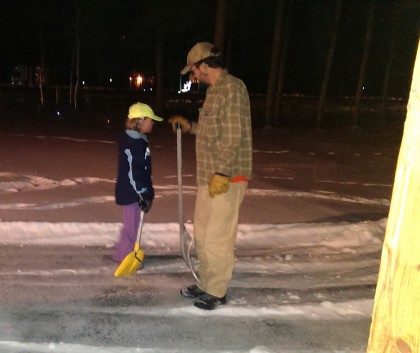
Jon and Ruth clear our drive before the moving van comes

Kate rapidly found a quilting group, the Bailey Patchworkers, and began meeting with them monthly. Out of that group came an invitation to a smaller group of needle workers who also meet monthly. I didn’t find that kind of local connection until a few months ago when we both started attending Congregation Beth Evergreen. Since then, I’ve also found Organizing for Action-Conifer. We’re both gradually becoming part of our community here in the mountains; actually, communities, because we have as much affiliation with Evergreen, perhaps more, than we do with Conifer.

It’s been a medically eventful two years for me with prostate cancer in 2015 and the total knee in 2016. Kate’s rheumatoid arthritis led to hand/wrist surgery over a year ago and she continues to have degenerative disc disease related pain. Combined with the divorce, which began in earnest in May of 2016 and continues as Jon still lives with us, it means we’ve been very inwardly and family focused the whole time so far. We both hope this year gives us a break on the medical front and that Jon finds a new home for himself, Ruth and Gabe.

20151114_111107
fire mitigation, 2015. Just before the solar panels were installed.

Every once in awhile, we say to each other: I’m glad we moved here. And we are. The mountains teach us, every day, what it means to be mountains and what it means to live among them from snowy weather to elk and mule deer to rushing spring streams to less available oxygen. We’re very glad we’ve been here to support Jon and the grandkids. Those two reasons for the move have both manifested themselves in positive ways.

We’ve begun our third year on Shadow Mountain. Can’t wait to see what happens next.

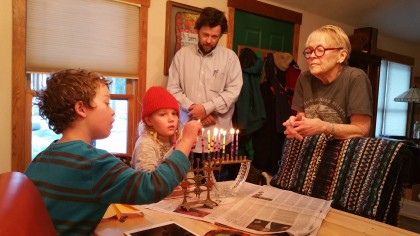
Hanukkah, 2016
Hanukkah, 2016

Multitudes

Winter                                                                      Cold Moon

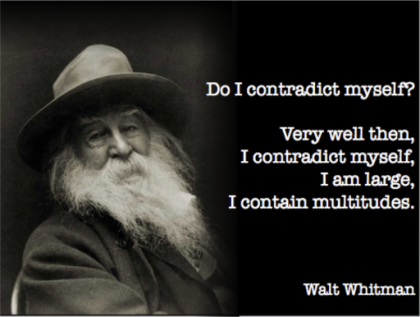
walt-whitman-i-contain-multitudes

In the Nix (see post below) the author Nathan Hill takes a side excursion into the difficult, thorny problem of the self. The idea he presents helped me, gave me a middle ground beyond the no-self notions of the Buddha and several contemporary psychologists and philosophers and the Western view of one true self.

The dialectic between no-self and one true self has always found me much closer to the one true self pole. It’s the one that I accept intuitively. In fact, it was the unquestioned truth until mid-college, so unquestioned that any other idea seemed literally absurd.

“Oh, that’s her true self.” We might say this when we see someone angry, apparently peeling back the onion, layers of false selves, to reveal the enduring self located, well, somewhere; or, when some other extreme behavior allows us, or so we think, to peer into the interior of another. This is the radical western reductionist view of the self, perhaps linked to the notion of soul, the essence of a person.

The Buddhist notion, which I don’t pretend to understand well, posits no I, no we, only a consciousness that responds to whatever shows up in the present moment, our self a narrative, a story we tell ourselves, but having no “real” existence.

In Hill’s notion there is a third, perhaps a middle way, between these two poles. A character says, oh, her true self has been hidden by false selves. No, Hill’s other character says, not by a false self but by another of her true selves. Ah. Not split personality or multiple personality, not that idea, rather the idea that we each have more than one “true” self.

This makes so much sense to me. The self that writes this blog is the writing me, the self that wants somehow to turn my inside out so others can see in. I have a husband self who acts in relation to Kate and to the history of relationships I’ve had. There is a grandparent self brought into existence by Ruth and Gabe. A Woolly self. A friend self, perhaps as many friend selves as I have friends. There is an art lover self, a physical self focused on the body, a reading self, too, who willingly opens all these selves to influence by another. Each of these true selves, and many others, have their own history, their own agenda. You might call these selves the specific wanderer on each of my several ancientrails.

Given the quote above from Whitman, I’ll call this the Whitman theory of self. It is, for now, the one to which I adhere.


My Avatar in Minnesota

Winter                                                                             Cold Moon0

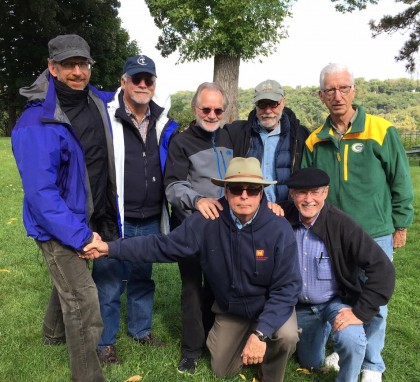
I was at the table last night when the Woolly Mammoths gathered at Scott Simpson’s house in Minnetonka, Minnesota. Scott and I tested the Skype connection earlier, both on his laptop and on his new phone. When Mark Odegard came early, I spoke with him using Scott’s phone, able to see and be seen. Video phone calls! No flying cars, but…video phone calls!

Mark told me of his desire to go to Burning Man, holding up a coffee table sized book featuring various art installations from this annual festival of strangeness. He’s always got a next adventure coming on line. This was involves camping out, carrying in all your food and water (a gallon a day for the weeklong event), and required participation. “No observers” is a Burning Man rule.

Later on I was able to check-in along with Bill Schmidt, Warren Wolfe, Frank Broderick, Scott and Mark. This time I was on the laptop at one end of the table, able to see most of the guys, though when individuals checked in, somebody would turn the laptop so I could see that person.

Part of the beauty of 30 year old relationships is knowing the backstory. When Frank talked about helping a young dancer, I knew about his relationships to the arts, especially opera. When Ode talked about Elizabeth and her family, I knew them, having married Ode and Elizabeth. As Scott talked of being snubbed in his workplace, I knew the story of his transition from counselor to financial planner and his plans underway to retire. Warren spoke of cleaning things up at home. I knew about the time when he owned four houses. Bill had positive news for his venture, U-Face-Me, a possible investor. I knew about his coding, his work on mainframe data storage, his life as a Jesuit. Just as, when I spoke of Shadow Mountain, of my new knee, of the book I’m writing, they knew about my past as a Presbyterian minister, of my two ex-wives.

We can hear the subtle resonance of words and feelings, know often where the current dilemma fits into a life. I felt lucky to be part of the meeting last night. Not the same as being there physically, but nourishing in its own way.

Rambling

Winter                                                       Cold Moon

When I worked for the church, the days between Christmas and New Years were an enforced break. No church wanted Presbytery executives in that time frame, everyone was coming down from the Advent, Christmas Eve, Christmas push. I took to using the time for research, usually on one topic. In those days it was organizational development, urban politics, a political issue coming to prominence, matters related directly, in some way, to my work.

This might be a way to use this enforced down time. Until the knee pain goes away and I’ve returned to a more normal routine, I could use the time to research a given topic. Not sure what yet, but something will occur to me.

Realized the other day that I’ve gone from an office halfway underground in Andover to a second story loft on a mountain. The Andover house was a walkout. The basement was open to the outside on two sides and built into the earth in front. Here on Shadow Mountain I look out at Black Mountain to the west and can see the sunsets. In Andover I saw sunrises.

Weary of the whole pain, stiffness thing. I know it’s part of the healing process. I know it’s going to recede and eventually vanish. Yet yesterday it got to me. Too damned long with a painful knee, reminded of its presence at every step, every sitting and rising. I couldn’t sleep, couldn’t get comfortable sitting or lying. Next morning now and I got some sleep last night so feeling better.


Roots

frosty-santa-1951Winter                                                                Moon of the Winter Solstice

Christmas eve. I could measure my distance from my roots by the casual, almost unaware attitude I have to these two days. When I was a child, I had the same Santa dreams, the sleepless nights, the hopeful journeys downstairs to the Christmas tree that now infect millions of children worldwide. Tonight we celebrate the first night of Hanukkah. It’s not the Jewish ritual that marks the distance but my overall lack of engagement in Christmas music, decorations, gift buying, church going.

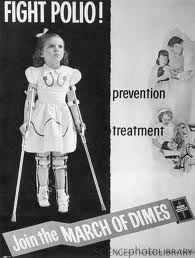
Though there is one way that I am not distant from my roots, not distant at all. It came to me yesterday. I got a heart level glimpse into the mind and will of my two-year old self. It was that two-year old who ignored, because he couldn’t understand, the doctors who said he’d never walk again. Paralyzed on the left side for six months and spending some time in an iron lung, the conclusion was that I’d missed the chance to walk, could not relearn it.

polio-posterMy mother and my Aunt Virginia helped me. At the family farm in Morristown, Indiana I drug myself along the sofa, my head often collapsed on the floor, getting rug burns as I pulled it along with the rest of my body. They helped, but it was only that young boy who could move his legs, drag his body along. He did it. Since then, I have identified walking upright in the world as a major theme of my life.

The connection came during my physical therapy, walking for the therapist so she could check my gate. That little guy, so far away now in time, brings tears to my eyes. I’m grateful to him for the chance I have now at 69 to regain use of my left knee.

Knee, Birthday, 60s, Cold

Samain                                                                       Thanksgiving Moon

A diverse day, yesterday. Down to Orthocolorado for a “class” about my knee surgery. Not bad, not great.

20161103_130418At 12:30 we drove over to Evergreen for mussar at Beth Evergreen. It was Rabbi Jamie’s birthday and each woman brought a cooked or purchased offering of some kind. We had cranberry juice with tea and mint, apple juice, brie and a wonderful soft cheese, warm carrots, pistachios, cashews, strawberries, grapes, melon, crackers, chips, guacamole, a birthday cake, sea-salt caramel and chocolate brownies (Kate, see pic), with Halloween plates and napkins.

Later in the afternoon, around 5, we went down Shadow Mountain and spent an hour or so at Grow Your Own. This is a hydroponics shop, a head shop, a wine shop and a place to hear local musicians. Last night there was a former member of Steppenwolf playing guitar, a singer from a group called the Bucktones and a guy named Stan, who looked like the aging owner of a hardware store, playing bass. Time erodes the vocal chords so the singing was spirited and practiced, but range and timber suffered. Guitar chops however seemed undiminished.

The crowd was Kate and me like, gray hair, wrinkles. That question that comes to me often these days was germane: what did you do in the sixties? I don’t ask, at least not yet, but I do wonder what long-haired, dope-smoking, radical politics lie beneath the walkers and penchant for the music of yester year.

Then home to a boiler that’s out. After just having been serviced. The perfect end to an interesting day.

Racism. Long. Hard.

Fall                                                                               Hunter Moon

540546_405303126228787_1694483271_nRacism. Is complicated. Very complicated. And, yes, I believe all white Americans are part of its grip on our culture. I’m going to try to boil down a very thorny subject into a few words, see if I can convince you that you are part of the problem if you’re white and live in the U.S.

Power. Racism is not about prejudice, it is about power. An analogy is rape. Rape is not about sex, it’s about power. So, just as rape is about power, not sex, racism is about power not race. Race, a spurious concept in the first place, not supported by DNA evidence, is a cultural idea, not a biological one.

At the beginning of our country, as the founders drafted the much admired and revered U.S. Constitution, a beacon of liberty and freedom for all nations, there was conflict between southern slave holding states and northern states. It concerned how to count slaves for the purposes of determining a state’s population. In our system of government the number of representatives a state gets in the House of Representatives follows from the state’s population. More population=more representation.

antislavery_medallion_largeSlaves did not vote, but if counted as full persons for population purposes they would have given slave states and the whites who did vote greater representation in the U.S. House. This would have unbalanced power between the North and the South.

The three-fifth’s compromise was the result, stating, in our founding document, that slaves were only three-fifths a person for census purposes. From the start both North and South willingly manipulated the fate of the enslaved for their own purposes. Not only did the north instigate the three-fifth’s compromise, they did it to retain slavery in the U.S. Slavery was then a powerful economic engine that underwrote a large amount of the total U.S. economy.

This legal idea of a slave as a three-fifths a person contributed to the general devaluation of the enslaved. And who benefitted? Every citizen of the new country who benefitted from the slave economy. Everyone did. Thus whites in the U.S. had from this early date in our history an unearned advantage, an unearned economic advantage over persons of African descent.

build-a-tableThey also had an unearned advantage in their social status as at least higher than that of the slave, the three-fifths of a person enslaved. This unearned social status gave low income whites, often share-croppers, a psychological and social boost which had nothing to do with their personal merit. They were better, at least, than those who toiled without compensation and freedom. That unearned and undeserved lift in personal status persists in the minds and hearts of all white Americans.

The advantage in economic circumstances held by whites in the aggregate over the descendants of the enslaved has its roots in this wholly unequal economic baseline. Our wealth, as whites, depends in part on the advantage we had as a segment of the U.S. population, a segment that received the economic benefit of goods and agricultural products made cheap by the unpaid labor of the enslaved.

chomskyThe civil war, you might say, shows the inherent goodness of the north and the hostile debasement of southerners. You might say that if you don’t factor in the unearned economic and social advantages even northerners gained from the enslaved. You might say that if the wreck of reconstruction hadn’t resulted in Jim Crow laws throughout the south. You might say that if you hadn’t grown up near Elwood, Indiana which had a sign at its city limits, No Niggers In Town After Sundown. This was taken down only after the civil rights act in 1964.

You might say that if the disparity in white/black economic fortunes hadn’t persisted to this very day. You might say that if prisons were not filled disproportionately with persons of color, especially African Americans. You might say that if systematic attempts to prevent African-Americans from voting weren’t front and center in this very election-all those cries against non-existent voter fraud and for voter i.d. laws that would make it difficult for the poor to vote at all.

i-am-not-a-racist-i-am-against-every-form-of-racism-and-seggrationHow have all these terrible realities managed to remain in place? Because those with power rarely give it up willingly. We white Americans, through our avoidance of these issues, have capitulated to the structures already in place. Why? Because those structures: biased employment choices, biased voting requirements, lack of affordable housing, lack of available health care, still unequal education, are on the fringe of our lives, happening to someone else, some other African-American self. And to fix them would cost us in taxes, in our unearned advantage in employment, in our ability to control local and state and national elections.

Are these conscious decisions for most of us? No. But they do not have to be. It is our assumption that the way our culture organizes itself is just and fair that makes us all complicit. This is institutional and institutionalized racism. It is the result of either our conscious decisions or our unconscious capitulation to things as they are. We, we white Americans, are all part of this, and, in this very real and potent sense, racist.

Sexual Aggression.

Fall                                                                                  Hunter Moon

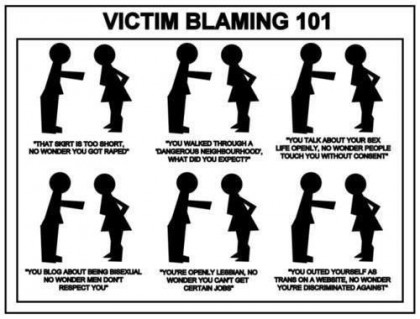
sexual-aggressionSexual aggression and its effects. #PussysGrabBack is a hashtag encouraging women to vote and to vote against the would be pussy grabber in chief. The Access Hollywood video tape with its lewd, rude, casually mentioned and approved sexual assault language has caused an outpouring of actual stories from women in all walks of life and of all ages.

I want to add a male perspective, not because it’s more profound, it isn’t; but, because its relative rarity can underscore the climate of fear this despicable breaching of personal boundaries produces.

When I was young, my parents not only allowed me to travel by myself, but actively encouraged it. I would go down to the Greyhound Bus Stop by Stein’s Tailor Shop, load my suitcase underneath and go up the stairs to my seat. On my lap would be a fruit basket from Cox’s Super Market. Wrapped in a colored cellophane would be apples, bananas, perhaps some grapes, food for the journey.
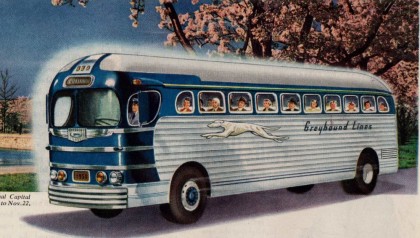
greyhoundThe Greyhound was not then the dismal transportation method it has become today, but an affordable way of moving long distances. And I traveled long distances, going from Alexandria, Indiana, 60 miles east of Indianapolis, to Oklahoma City, Oklahoma. All of my father’s side of the family lived in or near Oklahoma, so this was a way for me to get to know them. And never, on any of those trips, did anything untoward ever happen to me.

It was different though when I boarded the train headed for Arlington, Texas. This was a really big adventure for me, my first time riding a train. When we reached St. Louis, I had a long layover so I put my bag in a locker (this was before the time of bombs in lockers), took my brownie camera and went out into the humid heat of a Missouri summer afternoon.

brownieA Sunday, downtown was empty of workers and there were no tourists on the streets. I had stopped by a doorway to stand in the shade while I took snapshots of buildings. A man came back, noticed me squatting down changing the film in my camera. He said something, I don’t recall what and I replied because I was a courteous boy from the Midwest. He squatted down, pretending to be interested in my camera.

Then his hand was in my crotch, kneeding my testicles. I stood up, bolted up more like it, said, “You shouldn’t do that,” collected my camera and clutching it to my chest ran back to the train station where I remained until the train came that would carry me onto Texas. He didn’t pursue me, gave me no resistance. But I was shaken in a way that at that age I could barely comprehend. I was maybe 11 or 12.

During college there were various situations in which gay friends came onto me in a sexual manner, but I never considered that assault. It was the exploratory process, learning how to be sexual in a time of drastically altered mores, the late 1960’s and early 1970’s.

Just three weeks ago, in Minnesota, I had a very unsettling experience. I had driven for two days, leaving Conifer on a Wednesday, staying overnight in Lincoln, Nebraska, then on the road Thursday. It was about 4 pm and I was tired, my leg hurt and I was looking forward to getting to my hotel.

ford-truckWhen I reached the intersection of Broadway and Central in Northeast Minneapolis, I noticed a Ford pickup, black with large tires that made it ride high. The driver gunned the engine, came up suddenly on cars in the lane beside me. Jerk, I thought. Then, he did it again. Very aggressive driving.

The second time he did this brought him parallel to me. I looked up, wondering what the guy (I assumed it was a guy.) looked like. He turned his head toward me. Cupping his right hand, he moved it back and forth in front of his mouth while pressing his tongue against the side of his cheek. A rude gesture, especially in a very casual, momentary encounter. He nodded at me, took his right hand and gestured again, this time to himself, then to me and indicated that I should follow him. He was much bigger than I was and had a rough looking face.

I turned my head away, looked forward and turned left away from him. He was in a lane that had to go straight. The encounter ended. It was brief and reasonably safe. I was in my own car and would have had no difficulty losing him even if he had decided to pursue me. But it didn’t feel safe, not at all. It shook me. I felt frightened and, yes, violated.

Neither of these two instances, and they were 50+ years apart, resulted in any physical damage. Both of them resolved quickly. Yet, they both left me repulsed and feeling vulnerable. They both made me rethink my normal assessment of the world as a safe place to be.

I can only imagine how I would view the world if I experienced these encounters regularly, as seems to happen to women. (I say seems because I’m not a woman.) I would feel that my world required constant diligence, constant attention to dangerous surroundings. My sense of safety in the world would probably be compromised beyond repair. And this is in the usual, the day to day.

It does not include a time when a candidate for the Presidency openly brags about such aggression, about the privilege that celebrity brings, about being able to do whatever he wants. This is a validation of sexual aggression, a lived experience for many, many of us, most women, a granting of legitimacy to these acts from a person vying to become the nation’s leading political authority figure.

Adding this abomination to the gradual accretion of insults caused by cat calls, by presumptive hands or body checking, by date rape and rape culture, makes our common space seem fraught with peril, even on a normal day. This is not acceptable. Fear is not the norm we want for our daughters, granddaughters, wives and mothers, sisters.

It’s a problem only solvable by alliances between men and women. Let’s strengthen them over the coming weeks and months.
Do You Know Any Stars?

Fall                                                                             Hunter Moon

orion_head_to_toe-www-deepskycolors-comLooked at Orion on the way up here this morning. He warms my heart like a familiar friend, a friend who comes for the season. I have greeted his return each autumn for 48 years. We first became acquainted during the 11-7 shift at Magnetic Cookware in Muncie, Indiana. I worked there as a security guard. When I see him in the southern sky, I smile.
Hokusai, the great Japanese ukiyo-e printmaker, followed the Northstar sect of Buddhism. In one sense we obviously project our sensibilities on these celestial objects. That’s clear when we look at the different names various cultures have given to the same identifiable stars or constellations.

In another sense, and more important to me, we see the Drinking Gourd, or the Big Dipper, or the Great Bear, or Orion as distant reminders of the changing seasons here on earth and we use them as sailors and caravans in the Rub al Khali, as farmers and hunters have used them, as guides. They are not, therefore, far away from us in the collaborative sense. The vast distances that separate us from these solar engines are irrelevant to their purpose as way finders and markers of seasonal transitions.

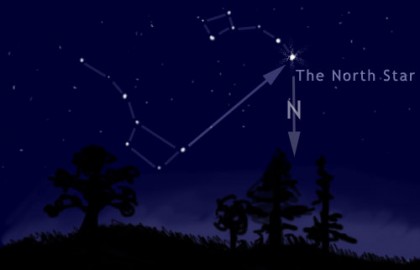
northstarNo wonder, in a world lit only by fire, that the stars were the work of gods. We might think we know them better now, now that we can identify their chemistry, understand their age and locate them in a 3-D universe, but that’s only a material, physical way of knowing. Important in its way, yes. Perhaps even key to the future of human existence. Still, very different from that night beacon lighting the way to freedom for escaping slaves. And, very different from Orion as my friend and companion for 48 autumns and winters.

In these latter uses the stars are important parts of our life right here on this planet, giving us direction and even emotional sustenance, clueing us to the coming of spring or the dog days of summer or the fall harvest.

As the squat Welshman asked me at St. Winifred’s Holy Well in Holywell, “Do you know any stars?”

photo credit: Orion Head to Toe, by Rogelio Bernal Andreo, creative commons license at Orion