Spring Rushing Waters Moon

The mountain streams we see regularly: Shadow Brook, Maxwell Creek, Bear Creek, Cub Creek have begun, a bit early, I think, their post-ice plummet toward sea level. In May these streams are often boiling, filled with snow melt and pushing the limits of their banks. On any given day driving past them as they speed downhill, down the mountain, they look interesting, worth watching for the tumult; but, in fact, these racing streams are much more than merely interesting.
They are the levelers of mother earth. They take the mighty and strip them down to size, pebble by pebble, rock by rock, chunks of soil by chunks of soil. A defining characteristic of a mountain is its imposing size, its thereness. Mountains dominate their landscape, putting up barriers to human passage that often forced the pioneers of nineteenth century America to go around them rather than over them. They seem, in the moment, eternal.
When living in or visiting a relatively young mountain range like the Rockies, no reasonable person would ever expect them to look any different than they do right now. Colorado is proud of its fourteeners, those summits exceeding 14,000 feet. Mt. Evans, for example has a summit of 14,265 feet. That’s precise. And, would you add it to a website or book or road sign if you expected it to change? No.

But it will. One only has to drive east toward the Atlantic to see what’s in store for even Mt. Evans. Look at the Appalachians. Their mountain building episode (orogeny) happened around 480 million years ago. When it was done, the Appalachians stood as tall as the contemporary Rockies. The Rocky Mountain orogeny was a quite recent, geologically speaking, 80 million years ago. They too will wear down.
In the spring we see this process at its most obvious as mountain streams from every summit in every range of the Rocky Mountains, including here in the Front Range, obey gravity and try to find the lowest points available to them. Of course, the streams are not the only process at work. Drive on Highway 285 out of Conifer, as we do often going down or returning from Denver, and you will see large steel mesh hanging over some cliffs. In other places there are bolts driven into the side of rock faces, giving them a slightly Frankensteinian look. In other spots massive retaining walls of concrete encase an especially troublesome chunk of mountain.
These CDOT efforts are not always successful, witness the many Watch for Falling Rocks signs sprinkled throughout Colorado. Freezing and thawing splits the rock faces and they come tumbling down, creating talus or road obstructions. Just this last year, near Glenwood Springs, a large boulder broke loose from its millions of years long position and crashed down on an SUV on I-70, killing the driver. Winds, too, often reaching high double digit speeds, also wear away the rock.
These forces are slow, miniscule in appearance, but massive in their results over long periods of time. When driving by a mountain stream in full force, remember the Appalachians. They’re coming, but not soon, to a Rocky Mountain range near me.
 Today I’m making chicken noodle soup and Kate’s making Vietnamese pho. We’ll serve this at a Beth Evergreen leadership dinner for
 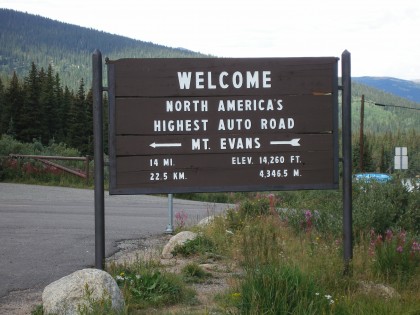 So I renewed my effort to connect with the Mt. Evans’ local group of the Rocky Mountain Chapter of the Sierra Club. Colorado seems to work more through these regional clusters than as a whole. There are nine of them, covering the entire state. The Mt. Evans’ group includes our part of Jefferson County, Clear Creek County and a northern portion of Park County. It’s titular feature, Mt. Evans, is a fourteener (over fourteen thousand feet high) which has the highest paved road in North America leading to its summit. According to locals here it’s also the weathermaker for our part of Conifer.
 Easter morning. Sunrise services somewhere. The celebration of the resurrection and, by implication, the incarnation. As Passover defines Jews, Easter defines Christians. Whether you find the idea of resurrection absurd or inspiring, it heralds, as does Passover, the coming of spring. It’s not difficult, at least for me, to see the power of resurrection in the emergence of spring ephemerals: daffodils, crocus, grape hyacinth, early tulips, snowdrops, pasque flowers, bloodroot.
 Moses reminds the slaves, and God, of the covenant made with Abraham long ago. That covenant is the bulb planted in the hiddenness and darkness of bondage. When God finally forces Pharaoh to let the slaves go free, the bulb begins to push its stalk toward the surface. Though it takes forty years of wandering for the stalk to break the surface in the Promised Land, the beauty of freedom’s flower has dazzled those struggling with their own personal or political bondage ever since.
 So on this great wakin’ up morn, I’m greeting the sun, the greening lodgepole pines, the daffodils, the pasque flowers and bloodroot with a religious fervor.
 Well. The sun is out, the snow has melted on the roads and it’s a cheery day here on Shadow Mountain. The changes here are fast and often extreme.
 Switched my work routine around, now writing on Superior Wolf in the early morning, breakfast, Latin, workout, lunch, nap. So Ancientrails comes later in the day. Like now, at 3 pm.
 Yesterday when I came out to let Gertie and Rigel out of the garage, around 5 am, I looked up at the stars, as I always do, enjoying the clear skies here. That long evolved predator/prey seeking eye caught, right away, a high object streaking across the sky. Was it a satellite, the space station? I don’t know, but I do know that in my childhood, my own childhood, no person on earth could have gone outside, looked up at the sky and seen such a sight. Until Sputnik the only streaking objects in the sky were meteors and comets. Nothing moved quickly across the darkness, up with the stars, yet did not fall or disappear around the sun.