Category Archives: Reimagine. Reconstruct. Reenchant.

The Sweet Life

Lughnasa                                                                      Monsoon Moon

CBE (1)Discovering an odd phenomenon. My feelings bubble up with less filtering. I don’t feel depressed, not labile. Not really sure how to explain this, though it may be a third phase change? Or, maybe just me, for some reason.

At the MIA last week, for example, there was the strong feeling of grief in the Asian collection. Warm feelings for my friends in Minnesota were also strong. On the way home I was happy on the road. Noticeably. Kate triggers a powerful, more powerful than ever feeling of love. When I watched a TV program in which the main character’s mother died suddenly of a stroke, I was right with him emotionally. Yesterday, at the Bat Mitzvah of Gwen Hirsch, I kept shoving back the occasional tear. Her initial struggle with being upfront, her beautiful voice and the clear joy with which she overcame her fright, so evident when she carried the torah scroll around the sanctuary, made it appear she was becoming a different person, right then. Her transition/transformation was breathtaking and so sweet.

Ruth at DomoIn fact, there’s another example. Over the last few months I’ve been using the word sweet a lot. Our dogs are sweet. Ruth. The folks at Beth Evergreen. Minnesota friends. The loft. My life. I seem to see sweetness more now. I haven’t lost my political edge, my anger at injustice or a willingness to act, but the world has much, much more nuance now at an emotional level.

This change in my inner life has made me more resilient, I think, more able to identify the emotions, accept them, learn from them, respond or not, and move on. Enriched. It’s as if there’s more color in my day to day. Who knows? It might be a phase or I might be melancholy, my feelings are usually closer to the surface then, but I don’t think so. This feels like a permanent change.

Seeing the holy soul, my mussar practice for this month, accentuates this. I saw Gwen’s holy soul yesterday and it was a thing of beauty. I see the hosta struggling with a dry spell, but I know their holy soul makes them strong even in this sort of adversity. Gertie’s blind eye and painful rear quarter, her missing teeth have not dimmed her holy soul, it moves her into a bouncing, happy girl in spite of them.

slash from beetle killed lodgepole pine

I can, too, see the holy souls with damaged personas. Occasionally, I’ll see an aggressive dog or one that cowers, yet beneath those defensive outer layers, the warm and kind dog soul is still visible although it might be hard to reach. People, too. The young boy with violent tendencies, with a stubbornness that might be on the spectrum, with the sweetness for those who are sick, his holy soul is, even at this young age, hidden, so hard to find. Or, another, her reason so tortured by ideology, her essential kindness most often blocked by bitterness. Or a lodgepole pine dying of pine beetle infestation. Even as its needles turn brown and it begins to dry out, its holy soul keeps it upright as long as it can. We can never err when we search for the holy soul in others.
Look insideI see my own holy soul, now claiming more space, taking back some of the aspects of my life I had given over to achievement, to striving. This is strange because it comes as I’ve begun to reach for achievements I’ve blocked for decades. The work of submitting my writing feels both unimportant and necessary. I’m immersed in a community, Beth Evergreen, which encourages the growth and expansion of my holy soul. This is true religion, with the small r, the connecting and reconnecting of our inner life with the great vastness, our part in it highlighted, made clear at the same time as our limitedness.


Fear and Honor

Lughnasa                                                                 Monsoon Moon

After a swim, from September, 2015
After a swim. September, 2015

Yesterday and today are about reentering mountain world. Tired yesterday, probably today, too, from the journey. The electric panel needed a gentle push to return power to the eastern wall of Kate’s sewing room. E-mails needed to be sent back to the auld home, thank yous and follow ups. Pushed Superior Wolf out the door to an agent, the biggest toe I put back in the world of daily life, save one.

The biggest. Mussar Vaad Practice (MVP) group last night. I have three clusters of commitments in Colorado: family/home, Beth Evergreen and the Sierra Club, my writing. The time last night with the MVP was a return to the world of Beth Evergreen. Both Kate and I had significant matters to share.

The practice this last month focused on bitachon, trust. We placed bitachon on a continuum with trust at one end and fear on the other. I chose to concentrate on fear, specifically the fear that has held me back for almost thirty years, fear of submitting my work for publication. While on the Durango trip, I read an essay about setting a rejection goal and, as I said before, I set 100 rejections as my goal for the year. Pushing that article together with my commitment to practice facing my fear resulted in my first organized and disciplined approach to submitting my work.

Aboard the lucky dragon

In group last night I admitted/confessed/shared the results. Each rejection I’ve received, two so far, hurt, made me ashamed of my Self in such a deep way that I can’t describe it. Like the grief I experienced at the MIA last week the shame in this instance came unexpected. Why shame?

At one point last night I buried my head in my hands to emphasize both that searing feeling from the rejections and the less searing, but still real, shame of not facing this fear before now. After I talked, I didn’t disappear, melt down like the Wicked Witch of the East. No one ran out of the room, too disgusted to still talk to me. In fact, the reception of my experience was careful and kind. As I like to think I would be to someone sharing something similar.

Now, in the way of these things, the angst drained out by exposure, I imagine submitting work will become a routine matter. These dates, this agent, that magazine, following up. Writing more work. Continuing the work of writing.

20180725_171404
At the ICE protest. July, 2018

Kate shared an even more profound realization. While it’s really hers to share more publicly, I can report that after she spoke, her confidence level rose and I could hear, see a lighter Kate. Both of us helped ourselves change our own lives. That’s a powerful result for an hour and a half.

Kate remarked that kavod*, honor, is not only person to person, but can be applied to a community. We both regard Beth Evergreen with great respect. That’s the character virtue, soul trait, for next month.

My practice is seeing the holy soul. At the meeting I said my practice would be seeing the holy soul in others, but on reflection, I want to see it also in myself and in animals and plants. This broadening of the practice came when I realized last night that I have a gift for seeing the holy soul of dogs. I relate to all dogs as if they were presenting their most sacred self. I see cows and horses, mule deer and elk the same way, though with much less experience. And, can I treat my own holy soul, my own most sacred self as respectfully as I treat that of others. This last may be the key challenge for the month. We’ll see.

Rigel, being beautiful, July, 2018
Rigel, being beautiful. July, 2018

The term meaning honor and respect is very important in any society, but even more so in Middle Eastern societies. The English word “respect” means “look back (again), regard”; honor means “regard with great respect, dignity.” The Hebrew kavod is related to kaved, meaning “heavy.”* Indeed, until not long ago, the heavier a person was, the more respectable he or she was, for rich people could afford to eat whatever they wished, whereas poor people were undernourished, eating very little and looking light, unimportant. A related word is kibbud, meaning “honoring (parents, teachers)”; as well as “(serving the guests) refreshment” (thus showing them respect).

*Also related to kaved “liver,” the bodily organ assumed to be the source of dignity, just as the heart is the source of emotions and intellect.Jewish Journal

Building a Self

Lughnasa                                                                           Monsoon Moon

The basilica, Minneapolis. From my hotel room.

Morning, Black Mountain out the loft window, cool air, dry. Home. Made supper last night. Pork cutlets, tomato, onion, cucumber salad, hash browns from left over tater tots. Put the dogs to bed. Fed and pilled the dogs a half hour ago. Took out the trash and retrieved the Denver Post from the newspaper tube. Sitting down at my desktop, ergonomic keyboard under my finger tips. Checked the calendar for the week and month ahead, plenty to do. Reinserted into mountain life. On the daily level it’s as if I never left. The stuff I do.

But. There’s now the 2018 trip to Minnesota. The one where I went to every place I ever lived in the Twin Cities metro. The one where I saw Tom, Mark, Bill. The one where Mark had his no good, terrible, very bad week. The one where I spoke at Groveland for their Covenanting Community celebration. The one where I discovered a profound grief about art, Asian art in particular. The one where I went into a funky basement room and listened to jazz. You remember. That one.

JazzCentral, Minneapolis

This slow accreting of memories is the essence of building a self. The same 4-year old boy who flinched when the dragon in the apartment building on Lincoln called for more coal has been collecting these moments for over 67 years. Throughout, of course, the strange fact of never leaving the present, never able to go back to any of those moments, yet holding them in reserve, as clues available right now about living.

Our Self is the internal agglomeration of that particular, that ultimately particular, set of memories, but not as static moments. No, they are the data we use to respond, to grow, to cry, to laugh, to plan, to hope, to learn what it means not only to be human, but to be the unique human that we are.

Have to go create a new breakfast memory. Gertie says so.


Seeking God Is Not The Problem

Lughnasa                                                     Monsoon Moon

Liberal religion. An odd term. Maybe oxymoronic? I mean, what is more conservative than our human wonderings about death and about how to live? What is older than those questions?

And the variety of answers are endless. Taoism, Buddhism, Southern Baptists, Mithraism, Santa Muerte, Hinduism, Catholicism, Judaism and many, many others. Bahai, Druze, Islam. And, no, they don’t all have the same message, hardly.

Back in 1992 or so, I’d given up on one of those answers, Christianity. My reasons were emotional, the rationale came later. Mostly, I’d begun to find my spirituality in a very different locale, in my interior life and in the soil, in plants, in animals. Didn’t work so well in the pulpit.

I needed a place where I could be who I had become. I found a group of folks meeting in a round room over a library. A library. Worshipping in one of my favorite institutions, artifacts of human searching arrayed below us. This was the early Groveland. 25 years later here we are, celebrating your persistence, celebrating the spot you’ve carved out of humanity’s endless quest for knowing how things are with ourselves, with our planet, with time itself.

“The problem lies not with seeking God, but with those who think they’ve found God.” Mordecai Kaplan, founder of Reconstructionist Judaism. In an odd twist to my own seeking, Kate and I have become members of Congregation Beth Evergreen in Evergreen, Colorado, close to our home on Shadow Mountain. It’s a Reconstructionist congregation. No, I’ve not converted. They’re fine with me being what I call, for simplicity’s sake, a pagan.

“The past gets a vote, but not a veto.” Kaplan again. By this he means, quite heretically within traditional Judaism, that Judaism itself is always changing, always reconstructing itself and that literally nothing is sacred. He was not, for example, a supernaturalist.

I tell people that I’m not a Jew, but I am a reconstructionist. And, I am. Here’s the interesting part. According to Rabbi Jamie Arnold, Kaplan got his approach from, drum roll… Emerson. I don’t know that this quote is the exact place, but it’s sentiment is clearly Kaplan’s and current reconstructionist:

“Our age is retrospective. It builds the sepulchres of the fathers. It writes biographies, histories, and criticism. The foregoing generations beheld God and nature face to face; we, through their eyes. Why should not we also enjoy an original relation to the universe? Why should not we have a poetry and philosophy of insight and not of tradition, and a religion by revelation to us, and not the history of theirs? Embosomed for a season in nature, whose floods of life stream around and through us, and invite us by the powers they supply, to action proportioned to nature, why should we grope among the dry bones of the past, or put the living generation into masquerade out of its faded wardrobe? The sun shines to-day also. There is more wool and flax in the fields. There are new lands, new men, new thoughts. Let us demand our own works and laws and worship.”

I offer this brief excursion into Judaism as a way of underscoring the liberal religious pilgrimage. It is one that says, yes the questions of religion are important because they are deeply human questions, so important in fact that we should hold all of the answers loosely, hold them as clues, as trail markers, not as destinations. That we should remain open to new clues, new trails, new ways of approaching this ancient probing of what matters most.

When we do, as Emerson did, as you here at Groveland do, we can never tell the impact of it. We might transform that Muslim cleric, that Hindu priest, or, that Conservative Rabbi, Mordecai Kaplan.

“It is not the seeking of God that is the problem.” No, as Kaplan says, the problem is with those who calcify the pilgrimage, enshrine the past, stop up their ears, their eyes, close their minds. You, Groveland, are caravan serai on the oldest ancientrail of all. And, a necessary one. Necessary for what? Unclear. And that’s the point.

Unexpected

Lughnasa                                                        Monsoon Moon

70+ miles I drove yesterday morning. First over to Oak Grove, close to here, then to Stevens Square where I photographed the first Community Involvement Programs building, then the second one. I lived in both. Forgot the place on 1st Avenue, but I’ll get that. Over the course of the morning I visited streets and neighborhoods I’d come to know intimately, St. Paul, New Brighton, Andover, Minneapolis. More on the feelings from this homecoming later

The biggest surprise of the day came at the Minneapolis Institute of Arts. I got there about 2:30 or 3:00. Picking up my badge was long in the past, but my body remembered. Passed the guard desk by. The lobby area is completely, well, almost completely different. Tables, a big coffee shop, redone gift store. Pleasant.

I walked all the way back toward the rocks shaped in Lake Tai. Called scholar’s rocks their strange forms, curves, sharp edges, diversity reminded Chinese literati of the mountains, their power and mystery, but most importantly, of the Tao.

Up the first flight of stairs and I was in the Asian arts wing. It holds an extensive collection of Chinese and Japanese art as well as more modest exhibits of Indian, Tibetan, Vietnamese and Thai art. A collection I came to know very well. There were various Buddhas, some calling the earth to witness enlightenment, others with the mudras of reassurance, of wish granting.

A favorite part of the collection for me is the large hall containing Chinese paintings, just off the Buddhas display. Moving from one depiction of mountains to another, often scrolls longer than I am tall, there were the fantastical shapes towering up, up, up, with some small human, usually a lone scholar, sitting watching a waterfall, gazing up at the clouds. The closer I looked, and I examine these painting very carefully, the more an unexpected feeling crept me over me. Grief.

It was subtle at first, felt like simple nostalgia, a sort of sadness mixed with the wonder I’ve always felt among these objects. Slowly though, as I saw the Fergana stallions, the famed blood sweating horses from the area of the ‘stans, and noticed the upcurled lip of the copper sculpture, a rare, fine piece of work, and realized I’d never taken in his mouth before, the feeling became clear. I missed this place so much. It was an ache, a hole in my heart. Unexpected. Very.

The feeling stayed with me as I looked at a long scroll depicting a festival along a river, the Wu family reception hall, the new arrangement of the Japanese collection. It came most into focus when I looked at the tea implements, the tea house.

As I left the Asian collection and went into the excellent rearrangement of the African collection, the feeling dissipated. It did not return while I visited the Native American and Latin American galleries. Nor did it return when I saw a couple of my favorite paintings, Goya’s Dr. Arrieta and the MIA’s Kandinsky. I don’t recall its title. In theses collections I was merely a museum goer, a knowledgeable one, yes, one familiar with the art, deeply familiar in some instances, but no longer experiencing that hole in my heart.

I’m not sure what to make of it, but it was strong, very strong and it has a significance I’ve not yet sorted out.

From the MIA I went over to the Red Stag, sight of many Woolly meals over the years. Tom and Bill were already there. Ode, a colonoscopy prep victim on Monday, got good drugs at the procedure, enough to make him lose a whole day. He forgot. When reminded by Tom’s call, he came down.

It was a good visit, normal in its way. A place we’d been before, together. We’d been together many times, this was one more. Yet it was also abnormal since 900 miles separates me from this normal moment. These are life-long friends and life isn’t over yet.

Teshuva

Lughnasa                                                       Monsoon Moon

With gray skies, moisture in the air, lakes not far from any spot in the metro, far horizons, deciduous trees in abundance, no mountain peaks close by or in the distance, I know I’m back in the Midwest. The need to memorialize the coming of the monsoon rains would be pointless here. Lucky here.

Oddly, the club level of this hotel, which I am unintentionally on, has breakfast and substantial enough hors d’oeuvres to eat for a meal in the evening. Last night, over mushrooms stuffed with sausage, honey dew and salami, caesar salad, and a small club sandwich, I engaged one of aging’s priceless treasures. I turned off my hearing aid so the millennial buzz would soften. Ah.

Easing into the week here. Slept in until 7:30 (6:30 at home). Leisurely breakfast overlooking the convention center and Central Lutheran. Gonna get in the car in a bit and take photos of as many of the places I’ve lived in the Twin Cities that still exist. It will take a while. I moved a lot. Later on I’ll see Tom, Mark, and Bill at the Red Stag. Old friends in an old haunt.

Is it a pilgrimage when you return rather than when you seek a far destination? In Judaism the term for repentance is teshuva, return. Is this teshuva to the Twin Cities a form of repentance? It may be because it has the character, this time, of reliving, re-membering. Perhaps the pilgrimage to home literally re-members us, reclaims those pieces important to us that we left there, long ago.

When you make a move, as Kate and I did, to a new, very different place after 40 years, it involves, among much else, severing the physical cues to memory. They are out of sight, perhaps not out of mind, not entirely, but they are not refreshed. Coming back means seeing Central Lutheran and the convention center remind me of the visit of the Dali Lama, the time the Presbyterian General Assembly was here. I helped move a baptismal font, heavy marble, on a small wheeled dolly from Westminster to the convention center, served communion to a thousands. 40 years is a long time in human years.

So this is a voyage, a teshuva to mySelf, my soul, as well as a visit. The whole, at least in biological terms, is more than the sum of the parts, but it is also not less than its parts. I have parts remaining here and I want to return them to their vital place in my soul.


Losing Daylight

Summer                                                                Monsoon Moon

The big Dodge Ram sits in our garage, so it won’t get hit with hail in case we have a thunderstorm. Nothing says I don’t give a damn like returning a pock marked car to the rental folks. Supposed to go back today.

Kate had a couple of days clear of nausea, then got hit hard yesterday. It’s difficult to describe how debilitating it is to experience this inner discomfort regularly. I can see it. I can sort of imagine it, but she’s dealing with it. No. Fun. At. All. I feel bad for her, with her.

Here in Conifer we’ve already lost 20 minutes of daylight since the summer solstice, 14:59 on June 21, 14:39 today. I go to bed at 9 pm and I can already tell the difference. It’s beginning to get dark now at 9. The darker it gets the happier I am and, as an added bonus, the darker it gets the cooler and wetter it gets, helping sleep and mitigating wildfire probabilities.

Feeling a little sad this morning. Kate and I had an argument last night. It happens, but I never feel good when it does and the feeling lingers. Reminds me that our moods are fickle, sometimes referented, sometimes not, but always changing. Not becoming attached to one mood or another, up or down, being equanimous (yes, it’s really a word. either that or it was made up in our Mussar group) helps level out our moods. Although, I do appreciate both a good up and a good down. Vitality does not lie in sameness.

Looking forward to seeing Minneapolis and friends the first week of August. Groveland Unitarian-Universalist celebrates becoming a Covenanting Community in the UUA on August 4th. They wanted me to come and I’m pleased they do. Like the days in Durango I’ll get a chance to catch up with folks with whom I’ve had long term relationships, seeing Woollies and I hope docent friends as well as the Groveland folks.

Plus, I’m staying at the Millennium Hotel which is on the edge of Loring Park. I lived in Loring Park up on Oak Grove, a wonderful third floor apartment that, thanks to its location on the hill, had a beautiful view of downtown. That was back in 1975/1976. Which is, wait for it, 43 years ago or so. 28. Whoa.

I’ll get to see the statue of famed 19th century fiddler, Ole Bull. When I was chair of Citizens for a Loring Park Community,  we turned down the Daughters of the Sons of Norway who asked us to let them move it somewhere cleaner and safer. Than our neighborhood? Come on. I’ll also get to walk to the nearby Walker Art Museum and the somewhat further away Minneapolis Institute of Arts. When I head to the MIA, I’ll pass through Stevens Park, which was my first home in Minneapolis. I was a live-in weekend caretaker and janitor for Community Involvement Programs. The old Abbott Hospital was right across the street. Lots of Stevens Park stories.

Not to mention that wonderful road trip across the Nebraska plains. Which I actually enjoy when enough time lapses after I’ve done it.


In My Dreams

Summer                                                                   Monsoon Moon

AbrahamSacrificesIsaacIcon_smThe strange things that come to me before I drop off to sleep. Thinking about Lycaon, the anti-hero protagonist of Superior Wolf. He sacrifices his own son, Nyctimus, at a once every four year festival, the Lykaia, to Zeus Lycaeus (Wolf Zeus). Stray thought then. Sounds like Abraham and Isaac. Oh. Wait. Abraham was a polytheist before his covenant with G-d.
moloch william blake
Moloch william blake

What if? What if the Abraham and Isaac story recorded a very different intention than the one we Westerners, long infected by the idea of monotheism, have imputed to it? What if the context was one of child sacrifice? In other words, the religions around Abraham, perhaps even his own previous to the covenant, might have required child sacrifices. I know about Moloch who certainly did.

In the context of gods requiring child sacrifice, the story would read more like this. This new God requires sacrifice, his beloved son Isaac. Nothing new there. Many gods require the sacrifice of children. Yes, it’s always fraught with heartache and pain, but that’s just what Gods do. What’s new here is that this God relents, aborts the sacrifice and accepts an animal in place of a human child.

In this reading then Abraham’s new God evolves from a ruthless eater of human flesh to one who says, no, we no longer do that. The story becomes one of triumph and joy, this new god is better, much better.

A Lunar Month of Significance

Summer                                                                     Woolly Mammoth Moon

Rustic Ranch, Bailey, breakfast on the Durango Trip. Sweet cream pancakes.

As the Woolly Mammoth Moon phases away toward a new moon, its month, the same lunar month we always have, yet also a different lunar month from any we’ve ever had, all spiraling through space as we follow the sun while orbiting it, I just wanna say thanks for what happened under its gentle influence.

It rose as a new moon, invisible but watching us, on June 13th, the day Mark, Paul, Tom and I headed out to Durango and the 416 fire. It was a trip both across southwestern Colorado and back into 30 years of friendship. Not to mention back to the days of the Pueblo dwellers of Mesa Verde. It was, in a sense, a way to say to each other that, yes, these friendships are for a lifetime. That this lifetime, whatever it may mean individually includes each other–and Bill. When you think about it, affirming the power of our past and honoring the reality of our future, is pretty damned cool.

Ode lays out the trip

It was also on this same trip that I read the essays about ground projects by Bernard Williams and about setting a rejection goal. The first one affirmed my existential sense that life gets meaning from our intentions and our labor to fulfill them; the second has transformed my writing life. A big, huge, amazing, wonderful thing.

Also under the Woolly Mammoth Moon, Alan Rubin and I began digging in to developing a curriculum for 6th and 7th graders in the Religious School at CBE. This work has affirmed the depth of my immersion into the Jewish world of CBE and reconstructionist thought. It also underscores my continuing fascination, see posts below, with the supernatural, or at least the fruits of humanity’s speculation about the supernatural.

20180415_155755
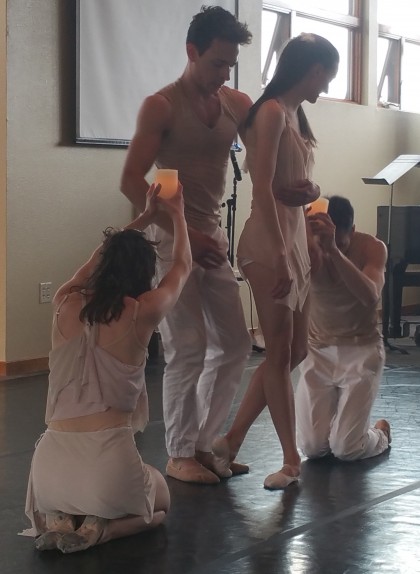
Yom Hashoah, Holocaust Remembrance Day, ballet at CBE

Also under the WMM, I’ve been putting together the Jewish Studies Sunday Sampler series for the 2018/2019 adult education year. This will feature both courses from the Great Courses company and courses from the MOOC aggregator, Coursera plus the odd film or two.

I also met Harv Teitelbaum. He’s the Sierra Club’s lead for their anti-fracking initiative, a big deal here in Colorado. I believe he and I share a similar attitude toward our current political reality and a similar focus on local races while maintaining an emphasis on the Great Work.

My flaxen haired Nordic goddess

It’s been a big, big month for me and I want to say out loud how grateful I am to all of you who’ve made it possible. Yes, Kate, especially you. It’s been a very difficult month for you nausea wise, I know, but you picked up a board membership at CBE and guided the food committee for the Patchworkers. All the time you’ve been supportive, though understandably surprised, at my new commitment to finally, finally, finally submitting my work. You’re the gyroscope in all this, keeping us stable and focused. Thanks, Kate.

Fangs and Claws

Summer                                                                     Woolly Mammoth Moon

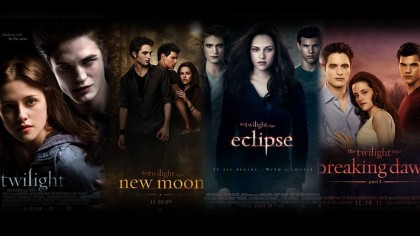
twilightModern technology is so wonderful. Over the last few days I watched all five of the much maligned Twilight movies. You might ask why, at 71, I would subject myself to all those teen hormones, questionable dialogue, and odd acting. First answer, I’m easily entertained.  Second answer, I’m revising Superior Wolf right now. Werewolves from their source. Also, a project I work on from time to time is Rocky Mountain Vampire. So, the Twilight saga is in the same genre as my own work, though aimed more at a young adult, tween to teen audience. Which is, I might add, a very lucrative market. Maybe, it just occurred to me, some of them will be interested in my work as a result of their exposure to the Twilight books and movies.

20180711_065526The supernatural is a dominant theme in my life, from religion to magic to ancient myths and legends to fairy tales and folklore. My world has enchantment around every bend, every mountain stream, every cloud covered mountain peak. No, I don’t know if there are faeries and elves and Shivas and Lokis and witches who eat children. I don’t know if anyone ever set out on a quest for the golden fleece or angels got thrown out of heaven. Don’t need to. We wonder about what happens after death, a common horror experience often and always. If we’re thoughtful, we wonder about what happened before life. Where were we before?
670HandbookAfterlifeOur senses limit us to a particular spectrum of light, a particular range of sounds, a particular grouping of smells and tastes, yet we know about the infrared, low and high frequency sounds, the more nuanced world of smells available to dogs. We’re locked inside our bodies, yet we know that there are multiverses in every person we meet, just like in us. We know we were thrown into a particular moment, yet know very little of the moments the other billions of us got thrown into. My point is that our understanding of the natural is very, very limited, in spite of all the sophisticated scientific and humanistic and technological tools we can bring to bear. Most of what exists is outside our usual understanding of natural, certainly outside our sensory experience.

The expanse of the wonderful, the awesome, the amazing, so vast even in our small human experience, is cosmic outside of it. That’s where the supernatural realm lies. Not only Just So stories, then, but What If stories, too.

Sure, there are gothic stories, horror stories, fantasy that are poorly conceived, poorly written and poorly executed. I’ve contributed to that slush pile, but at the same time there are stories of the supernatural that allow us to get outside our human chauvinism, to imagine, to wonder. The part of me that loved the Ring cycle as a fourteen year old enjoyed Tolkien, King, Wickham, Kostova, and Clarke.

I have a sophisticated, adult aesthetic, too, and I enjoy it; but, I don’t see why I have to leave behind my more childlike appreciation of things like Marvel Comics, the Twilight Saga, Harry Potter, Hunger Games. So, I haven’t. My inner tween/teen needs screen time, as well.