Category Archives: Reimagine. Reconstruct. Reenchant.

Imbolc, 2017

Imbolc                                                                                 Valentine Moon


Feb

Imbolc, or in-the-belly, celebrates the time in Ireland when the ewes would freshen. Their pregnancies meant milk would be available after the long fallow season that had begun at Samain, Summer’s End.
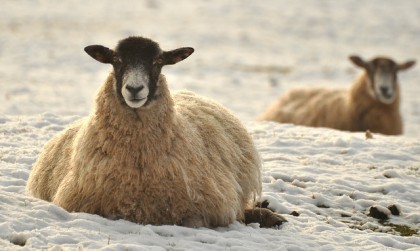
Pregnant ewe
Pregnant ewe

Imbolc lies halfway between the Winter Solstice and the Spring Equinox, what the Celt’s called a cross-quarter holiday since it falls between two quarters defined by the solar year. That milk is also a promise, like the gradual lengthening of days after the longest night of the year in late December, that spring and the growing season will come.

It’s easy for us in our refrigerated, grocery stored world to gloss over these signals of the natural world. It seems like we don’t require them anymore. After all we can buy milk, cow’s milk, at any time of the day or night, 365 days a year. And the growing season particular to our latitude and longitude also seems irrelevant since it’s always the growing season somewhere on earth. The occasional gaps that even modern transportation can’t resolve can often be filled by greenhouse or hydroponically grown produce. We’re good, right?

I’m afraid not. Celebrating Imbolc or any of the Great Wheel holidays will not resolve our alienation from the sources of our sustenance, the sun and mother earth, but this ancient tradition exists to call us back home. The Great Wheel is a reminder that the cycle of life continues, even when the fields and animals are barren. The power of the sun, working in harmony with the soil, with plants, with animals that eat the plants does not disappear. It can be trusted.
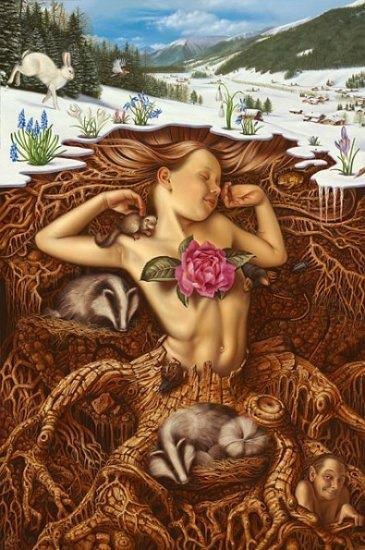
awakening

It is though, that alienation, evident in so many ways, that drives climate change, that creates produce modified for harvest and storage, not human well-being, that underwrites the paving over of cropland and wetlands. We imagine that somehow the droughts in California will stop there. We hope they’ll be confined to somewhere else, somewhere where we’re not. Global agriculture means we’ll be affected wherever the damage occurs.
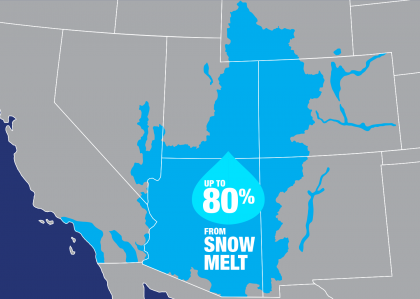
Colorado River Basin

Right here in Colorado we have a key example of the interdependence for which the Great Wheel stands. Our snowpack, high in the Rockies where the Colorado River rises for its journey south toward its ancient destination in the Gulf of California, determines the amount of water available to nine states. Including California. Winter snowfall, melted by the increasing warmth of spring and summer, nourishes millions of people, cities like Las Vegas, Phoenix and Los Angeles.

common ground

In the age of Trump and rising nationalist, right wing populism, the need for the Great Wheel has never been more profound. It softens our in the moment, human conflicts by lifting up the long term, the cycles of life in which all humans, all life participate. The Great Wheel reminds us that there is no other when it comes to living on this planet. We’re all here and bound to one another, connected. My hope is that someday, perhaps someday soon, we’ll all realize that and adjust our politics accordingly.
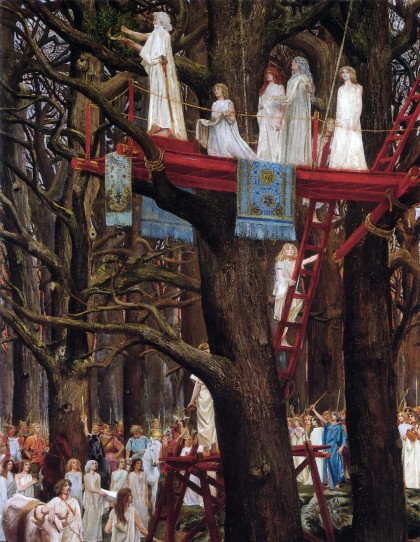
 

A Druid and a Radical

Winter                                                                                      Valentine Moon

OK. I admit it. I occasionally take the quizzes that pop up on facebook. I mention this because one set of quizzes seems, well, accurate. The same quiz website offered two recently: What kind of ancient religion would you follow? What kind of philosopher are you?

Druids&Mistletoe
Druid Harvesting Mistletoe

Though I thought I’d saved the piece about ancient religion, I didn’t. Still. The ancient religion that matched my answers? Celtic Druidism. How ’bout that? In the year leading up to my leaving the Presbyterian ministry I was in spiritual direction with John Ackerman at Westminster Presbyterian Church. When I told him I no longer believed in Jesus/God/Holy Spirit, but was more focused now on how I fit into the natural world, he said, “Well, you might be a druid.” He meant it. Not a flippant observation. Prescient.

Since then, the Great Wheel has become my liturgical calendar. I’m much more like what I would once have critiqued as a flat-earth humanist. That is, the metaphysical realms of the world religions seem like poetry to me rather than statements about ontology. I am not a new atheist, a scorner of faith and its many, many permutations. And, yes, I recognize the role religion plays in human conflicts, but I know that most of the time religions gather people of similar demographic characteristics. When conflict emerges, it often has roots in economic and political realities that align closely with religious preferences.

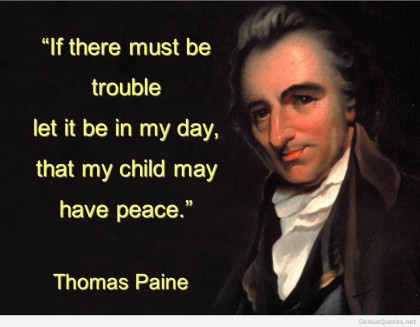
Thomas-Paine-Amazing-quote

I did save the note about which philosopher I’m most like.* This also seemed apposite. It surprised me, in both instances, how the 29 questions they ask managed to get somewhere close to how I see myself.

*Your mind works like the philosopher: Thomas Paine

An anarchist who championed reason and free thought, Thomas Paine was never afraid to speak his mind no matter how unpopular or revolutionary his theories were. Like Paine, you see life as full of possibilities and love to shake up the status quo by thinking outside the box. You are spontaneous and communicate confidently and fluidly. Could you write a post to inspire world-transforming events like Paine’s pamphlet ‘Common Sense’ influenced the start of the American Revolution? Who knows? (But we think it might be worth a try.)

I suppose

Winter                                                                         Valentine Moon

bagelry1

I suppose.

Kate and I supplied bagels, schmear and fruit for the bagel table at Beth Evergreen yesterday. The bagel table is a casual shabbat service that includes the prayer book and the torah reading. Yesterday the parsha was va-er, Exodus 6:2-9:26, for the most part the story of the plagues sent by God on Egypt.

Rabbi Jamie said that in one instance the verb usually translated as go, as in Go to Pharaoh, is actually come. The meaning shifts a good deal with this understanding. Come to Pharaoh implies, according to Jamie, that God will be acting through Pharaoh. This falls under the difficult to understand category for me.

Kate and I talked about this idea as we drove up Brook Forest Drive. After some conversation, we decided that if you pull back, look from a historical view, then the actions of Pharaoh do work as part of God’s efforts on behalf of the Jewish slaves. His hardened heart provides the impetus, eventually, for the Exodus.

Endurance

We then turned to our contemporary Pharaoh, the Trump. Could God (whatever you want to insert into this metaphysical placeholder) speak to us through the Trump? Jamie’s point was that we have to see the potential for God to speak us especially through those things or persons that we fear or despise. I suppose. Let’s try here.

Pulling back, taking the historical view, what possible liberating impulse could come from Trump’s presidency? (I take liberating impulse to equal God.) It’s true that Trump’s election highlighted the plight of the white working class, those with no more than a high school education. And, it may be, policies to address their concerns will lift all of the working class, high school educated folks. That would be an astonishing and welcome outcome, at least to me.

with her

Too, we might consider the orders to build the wall, block Muslim refugees from certain countries, repeal the ACA, gut environmental regulations as a hardening of the heart, a so-obvious step away from justice and fairness, a big step away from a sustainable future for humanity on this planet, that the reaction to them will part the climate denying sea and create the political will for single payer health care, a return to Ellis Island immigrant welcoming that so many of us yearn for. Maybe. I suppose it could happen that way. May it be so.

As you can tell though, I’m skeptical. But, if it can be, I’ll be the first in line to admit my skepticism unwarranted.

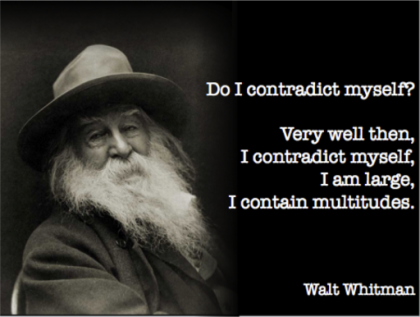
Multitudes

Winter                                                                      Cold Moon

walt-whitman-i-contain-multitudes

In the Nix (see post below) the author Nathan Hill takes a side excursion into the difficult, thorny problem of the self. The idea he presents helped me, gave me a middle ground beyond the no-self notions of the Buddha and several contemporary psychologists and philosophers and the Western view of one true self.

The dialectic between no-self and one true self has always found me much closer to the one true self pole. It’s the one that I accept intuitively. In fact, it was the unquestioned truth until mid-college, so unquestioned that any other idea seemed literally absurd.

“Oh, that’s her true self.” We might say this when we see someone angry, apparently peeling back the onion, layers of false selves, to reveal the enduring self located, well, somewhere; or, when some other extreme behavior allows us, or so we think, to peer into the interior of another. This is the radical western reductionist view of the self, perhaps linked to the notion of soul, the essence of a person.

The Buddhist notion, which I don’t pretend to understand well, posits no I, no we, only a consciousness that responds to whatever shows up in the present moment, our self a narrative, a story we tell ourselves, but having no “real” existence.

In Hill’s notion there is a third, perhaps a middle way, between these two poles. A character says, oh, her true self has been hidden by false selves. No, Hill’s other character says, not by a false self but by another of her true selves. Ah. Not split personality or multiple personality, not that idea, rather the idea that we each have more than one “true” self.

This makes so much sense to me. The self that writes this blog is the writing me, the self that wants somehow to turn my inside out so others can see in. I have a husband self who acts in relation to Kate and to the history of relationships I’ve had. There is a grandparent self brought into existence by Ruth and Gabe. A Woolly self. A friend self, perhaps as many friend selves as I have friends. There is an art lover self, a physical self focused on the body, a reading self, too, who willingly opens all these selves to influence by another. Each of these true selves, and many others, have their own history, their own agenda. You might call these selves the specific wanderer on each of my several ancientrails.

Given the quote above from Whitman, I’ll call this the Whitman theory of self. It is, for now, the one to which I adhere.


The Holidays

Winter                                                                   Cold Moon

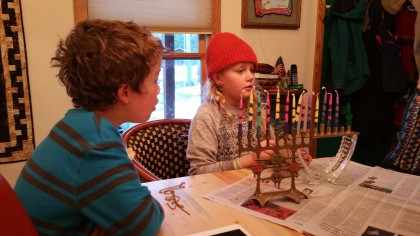
20161229_161534The grandkids have been here since December 23rd, with the exception of one day. That means a full house, lots of zigging and zagging. Adding Hanukkah to the mix leaves empty boxes, unfurled wrapping paper and gifts cluttered in the living room. Lots of watches this holiday: Ruth, Gabe, Kate all got watches. Too. There were legos, several games like Pandemic, Mexican Train, Rock of Archimedes, Mille Bourne, an assortment of clothing items like socks, ski jackets, t-shirts and the odd book or dvd.
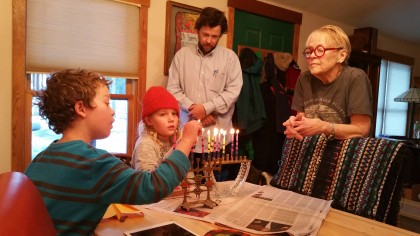
While their presence here is a blessing and one of the really good things to happen as a result of the divorce, it gets pretty stressful with five people in the house, two under 11. Not to mention that Kate has had a wounded me to care for, in addition to the other work she does for the grandkids like laundry and cooking. We will miss them when they leave tomorrow, but both of us will require some time to decompress and get back to our usual, slower old folk rhythms.

20161229_161617_001Gabe enjoys the dogs, sometimes too much. Yesterday he squeaked and squeaked and squeaked a nerf football at Kepler. Eventually, Kepler told him to stop that. He did.
Ruth and Jon went skiing again yesterday, a wonderful warm day with reasonable numbers of folks at A-Basin even though it was New Year’s weekend. Ruth loves to help. She offers to get the mail, feed the dogs, help make supper, buy presents. And then does just that.

Her audition for the Denver School of the Arts is January 7th. She has an hour before an admissions committee. By herself. At age 10. She has a portfolio of work she’s done, a lot of work, much of it prints. That weekend I’m going to take her to this place, The Inventing Room. She’s been there and loves its emphasis on nitrogen fixing of food.

The knee. So much better now. Still achy, but not bad. Biggest problem now is that it still interrupts my sleep. My workouts for p.t. are a lot of bending the knee, straightening the leg, strengthening muscles that support the knee. I have to do 3 sets. Since my p.t. is scheduled at 7:30 a.m., I’ve shifted my workout from the afternoon to the mornings. I’ll likely keep it there since it’s much cooler then in the summer.


Yamantaka for the New Year

Winter                                                              Cold Moon

Existentialism is a philosophy for the third phase. No matter what other metaphysical overlays you may have the tick-tocking grows louder as you pass 65. When this clock finally strikes, it will take you out of the day to day. Forever. Strangely, I find this invigorating.

In case you don’t get it the occasional medical bomb will go off to make sure you pay attention. Last year, prostate cancer. This year, that arthritic left knee. Kate goes in for an endoscopy on January 3rd. She’s waiting approval for a biologic drug to help her rheumatoid arthritis. All these are true signs of the pending end times, but they are not the end itself. These medical footnotes to our lives press us to consider that last medical event.

I’ve followed, off and on, the Buddhist suggestion about contemplating your own corpse. I imagine myself in a coffin, or on a table somewhere prior to cremation. This is the work of Yamantaka, the destroyer of death, in Tibetan Buddhism. I’m not a Buddhist, nor do I play one on TV, but I became enamored of Yamantaka while learning about the art of Tibet and Nepal at the Minneapolis Institute of Art.

yamantaka-mandala
yamantaka-mandala

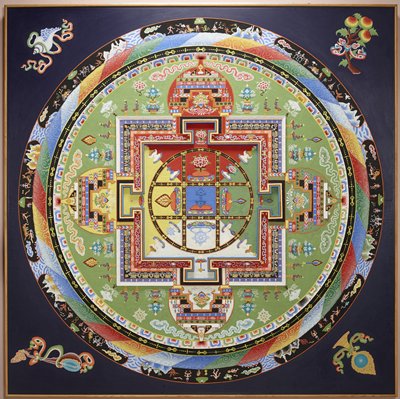
This mandala is a profound work of art on view in the South Asia gallery (G212). Adepts of Tibetan Buddhism use this mandala as a meditation aid to make the journey from samsara, the outer ring representing the snares that keep us bound to this world, and the innermost blue and orange rectangle where the meditator meets the god himself. The impact this work and the portrait of Yamantaka that hangs near it have had on me is as intimate and important as works of art can evoke.

Death is more usual, more understandable, more definitive than life. Life is an anomaly, a gathering of stardust into a moving, recreating entity. Death returns us to stardust. Yamantaka encourages us to embrace our death, to view it  not as something to fear but as a friend, a punctuation point in what may be a longer journey, perhaps the most ancientrail of all. Whatever death is, aside from the removal of us from the daily pulse, is a mystery. A mystery that has served as muse to artists, musicians, religions and poets.

Yamantaka has helped me accept the vibration between this life and its end. That vibration can be either a strong motivating force for meaningful living (existentialism) or a depressive chord that drains life of its joy. I choose joy, meaningful living. Perhaps you do, too.


The Morn

Winter                                                            Moon of the Winter Solstice

twas-the-night-before-christmas-a-visit-from-st-nicholas-by-clement-c-moore-with-pictures-by-jessie-willcox-smith-published-1912-3Christmas. Today. Right now the electricity of children twirling in their beds after a sleepless night, the clatter of little feet racing down stairs, bleary eyed parents waking up, wondering why all of this has to happen so early in the morning cause psychic vibrations to pulse through the country, hitting even the top of Shadow Mountain. If they were lit, they would put the northern lights to shame.
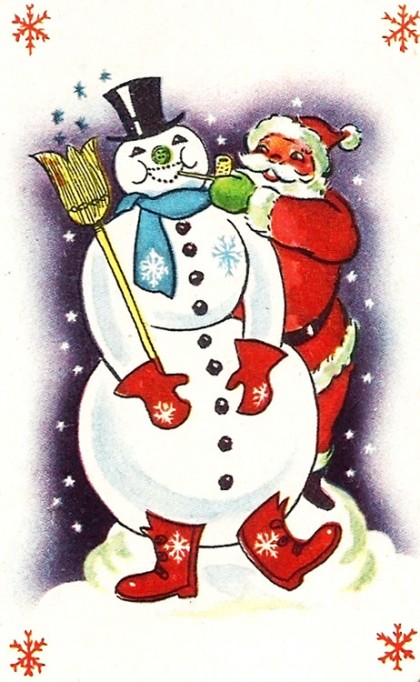
It’s sweet in its way though there is a slight tinge, ok maybe not slight, of greed, of concupiscence being lodged in innocent hearts. This morning I’m traveling with the innocence of wonder and hope and pleasure, the sounds heard through the night of reindeer on the roof, some sort of clattering in the chimney or on the stairs or in the elevator shaft. As I do, I realize this is a true aspect of American culture, not practiced by all Americans to be sure, but enough that the magic of Christmas morning is a part of us we all recognize.

druid santa
druid santa

While it happens elsewhere, up here on Shadow Mountain we woke up to a light dusting of snow, a cloudy sky and the dying crescent of the winter solstice moon occluded, but partially visible. It would not surprise, in this mood, to see a long string of reindeer push up above black mountain, a victorian sleigh attached and a jolly old elf holding the reigns. I would be pleased in fact.

Whatever the inner push that moves you this morning, take a moment to drink in the flavor of this old family holiday, so disconnected from the notion of incarnation, but not too far from pagan joy in the evergreen tree and its brave lights.

Roots

frosty-santa-1951Winter                                                                Moon of the Winter Solstice

Christmas eve. I could measure my distance from my roots by the casual, almost unaware attitude I have to these two days. When I was a child, I had the same Santa dreams, the sleepless nights, the hopeful journeys downstairs to the Christmas tree that now infect millions of children worldwide. Tonight we celebrate the first night of Hanukkah. It’s not the Jewish ritual that marks the distance but my overall lack of engagement in Christmas music, decorations, gift buying, church going.

Though there is one way that I am not distant from my roots, not distant at all. It came to me yesterday. I got a heart level glimpse into the mind and will of my two-year old self. It was that two-year old who ignored, because he couldn’t understand, the doctors who said he’d never walk again. Paralyzed on the left side for six months and spending some time in an iron lung, the conclusion was that I’d missed the chance to walk, could not relearn it.

polio-posterMy mother and my Aunt Virginia helped me. At the family farm in Morristown, Indiana I drug myself along the sofa, my head often collapsed on the floor, getting rug burns as I pulled it along with the rest of my body. They helped, but it was only that young boy who could move his legs, drag his body along. He did it. Since then, I have identified walking upright in the world as a major theme of my life.

The connection came during my physical therapy, walking for the therapist so she could check my gate. That little guy, so far away now in time, brings tears to my eyes. I’m grateful to him for the chance I have now at 69 to regain use of my left knee.

Acquainted with the Night

Samain                                                           Moon of the Winter Solstice

“I have been one acquainted with the night.
I have walked out in rain—and back in rain.
I have outwalked the furthest city light.”    Acquainted with the Night, BY ROBERT FROST

The month of the winter solstice has come. The world itself, at least in the northern latitudes, has begun to go dark since the fall equinox. That cycle, repeated each year, reaches its zenith, or nadir depending on your perspective, on Wednesday, December 21st. That will be six months before the longest day on the Summer Solstice.

winter-solstice3During holiseason many cultures celebrate holidays of light: hanukkah, diwali, christmas, for example. They are rituals that stand against the primal fear occasioned by the winter solstice; that the sun will never return, that the world will continue to grow dark. Even last night at mussar we spoke of the light of the candle, finding the light reflected in unusual places, the light that can get us through this period.
I want to speak a word for darkness. I eagerly await, each year, the darkening. On the long night of the winter solstice, I am at my most peaceful, my most tranquil, wrapped in the silence. Darkness is home to fecundity: the seed sleeping in the soil during winter’s cold, the babe in the womb, the slow decay on the forest floor, the next poem or book or painting waiting in the mind’s dark places.

We can, on that night, become one with the darkness. We do not have to banish it with brave strings of light or loud parties or burning huge bonfires. No. We can sit in it, quiet as it is quiet, fecund as it is fecund, joyous as it is joyous. We can let go of our need to see, to touch and embrace the outer darkness just as it is.

This is not to say that I prefer the night to the day. I don’t. I do prefer the alteration, the relief from the day that comes when night falls and, in turn, the rising of the sun.

It does bear mentioning that life is a journey between two profound darknesses, the womb and death. In this perspective the winter solstice can be a holiday to celebrate the beginning and the end of life. And to rejoice in both of them.


A Secular Sabbath

Samain                                                                           Thanksgiving Moon

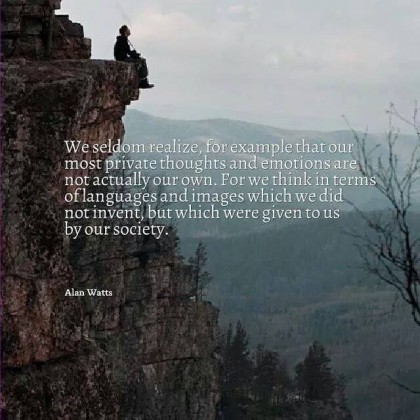
alan-wattsThe sabbath experiment. I liked it for the most part. There was a couple of hours + for reading. I reread the material on zeal in the Mussar text translated by Rabbi Mordecai Kaplan. I also read the Torah portion for this week, the story of Sarah ending with the death of Abraham. Finally got into Judaism as a Civilization by Mordecai Kaplan. Very, very interesting guy. I also read a book, The Queen of Blood, recommended by a sci-fi fan review. A good yarn. By the time night fell and the sabbath ended though I was ready for it to be over.

The time away from my normal routine was refreshing, but I did get antsy, wanting to do something. But, I think that will recede if I go to services, keep up my reading program and we learn to put up meals for Saturday. The focus on spirituality, family and inner work is valuable. Even more valuable is the cut out of time place the sabbath offers. The work week, even the work week of a retired guy, vanishes in the rear view.

I’m going to continue for a while, 3 months or so, just to see how this fits into life, but it feels good right now. My suspicion is that this is like a holiday every week, 24 hours snatched from the jaws of ordinary time and placed in that sacred space we reserve for the Winter Solstice, Christmas, Yom Kippur. A holiday a week sounds good to me.