Imbolc Valentine Moon
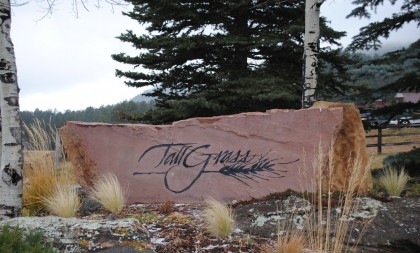
Tallgrass Spa on Upper Bear Creek Road. We had originally intended to go to Maui for my 70th birthday. We wanted to celebrate at Mama’s Fish House, where we’ve had both anniversary and birthday meals. The divorce and its impact on our time created a different focus for this February. Our plan was to celebrate our mutual entry into the 7th decade, Kate having preceded me, as she always does, in things age related.
We decided, instead, to combine our upcoming 27th anniversary (27!) with my birthday and Kate’s of last year by having a couples afternoon at the Tallgrass Spa in Evergreen.
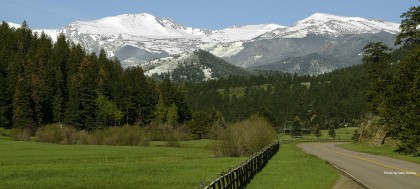
As you drive in to the spa, this is the view toward the west. The mountains give any trip, no matter how short, a sense of majesty. The thirty minute drive from Shadow Mountain to Tallgrass is especially beautiful.
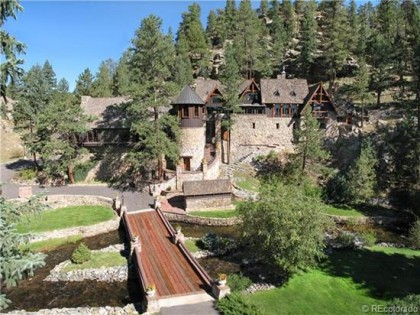
Upper Bear Creek Road begins at Evergreen Lake and continues for some miles. Along it are homes, many of them, that are big, stony or wooden, with elaborate grounds. This one sold recently for $2,300,000.
That was getting there. Once in the Spa we were given sandals to wear, shown to a room where we could change into Tallgrass robes (blue, one size fits all) and then taken to a quiet lounge area, beautiful with a fireplace, and a view of the mountains.
First, we had an 80 minute massage lying on tables next to each other with lots of hot oil, slippery hands, the scent of eucalyptus and mint and bergamot and, for me, a heated blanket, not for my Scandinavian wife.
In their relaxation of muscles the hands of the masseuse triggered memories, ones held in the body, not sure how they were resident there, but they were. An obvious one was her treatment of my knee, still somewhat swollen from the surgery. When her hands were on it, the journey of the last three months came forward. At another spot I remembered a moment in Rome on our honeymoon.
The biggest revelation though was the amount of tension, of anxiety I carried. As she relaxed me, I could feel my body tense, trying to get back to the state with which it had become familiar. We both knew the last nine months had been difficult ones for our family, but like all things, even that difficulty can become normal. On that table at Tallgrass my body told me so.
After this was a spa lunch, turkey sandwich for Kate, brie and fig sandwich for me. It was a pleasant time, sharing the lunch in the quiet lounge. We were creating a memory, probably the long time result, perhaps an alternative body narrative, too, for the last few months. That is, it was possible to relax even in the midst of family turmoil.
The last event of our day there was a pedicure. I’ve gone 70 years, literally, without ever having had a pedicure. The process fascinated me. In this room there were four throne like chairs lifted above the floor on risers, two steps up to them. Below the chair is a basin, a small sink, filled with soapy water. The pedicurist sits at the basin. Bare feet go into the water and the pedicurist cleans them, a very biblical, foot-washing moment and surprisingly intimate.
Did I want short or long nails? Short. She clipped my already short nails with a nail clipper. An implement somewhat like a dental pick but with a flattened end went underneath and around the toenails. Cuticle cream, tan and squirted on in small dabs, softened the cuticles, allowing Becky to clip my cuticles. I forgot the emery board which she used to smooth off rough edges.
All the while conversation was going back and forth among Kate, her pedicurist, Becky, me, and the woman getting her feet done in the chair next to Kate. The woman next to Kate was having a spa day paid for by her employer. Her husband was a chef. “I only make reservations,” she said, a line she’d obviously used before.
The talk turned to animals, llamas, dogs, mastiffs and rescues and bulldogs. Kate’s pedicurist, whose name I don’t recall, had a pitbull mix that had been attacked by a mountain lion a month and a half ago, but survived. She and Becky both live in Bailey. Sobering. Kate, whose throne was in the middle, could see out into a meadow across from Tallgrass where a herd of mule deer and several elk bucks wandered.
Exfoliation with a salt scrub came next. Becky rubbed a gently scratchy substance onto my feet, one at a time, sloughed it off with water, foliation and hydration with oil followed.
Touch, human touch, was the theme of the whole day. Where the massage was quiet, the pedicure was chatty, friendly and the lunch was just for us two. I’m now launched into my seventh decade, partnering with Kate as she walks the path, always ahead of me.
 Been experiencing an unusual phenomenon, at least unusual for this period of my life. I’m getting all kinds of anxiety signals from my body. My feet rest on their balls when I sit down, not flat on the floor. My gut has this hollowed out and tense feeling. My jaw has small aches as my teeth grind unconsciously. This also makes facial muscles twitch. When lying in bed, I’ll notice that my legs are tight, again an unconscious contraction.
 When we had our couple’s escape at Tall Grass Spa, I first noticed these physical manifestations. It was during the relaxing, 80-minute massage. As certain parts of my body felt calmer, others, like my legs and my gut, began to call out to me.
 A follower of gestalt therapy in my younger days, I learned to pay attention to and interrogate a jumpy stomach, a twitchy foot. These are not disconnected from my psyche, to the contrary they reveal things occurring in that inner world hidden from view to my Self.
 Zero K examines, in a minimalist world, our obsessions with death, immortality and technology while recounting a strained father-son relationship. It’s stark and strange, featuring, for example, a compound somewhere in the ‘stans. At this compound, mostly underground, is the center for a cryogenics movement funded by wealthy folk hoping to live forever, or at least until there’s a cure for whatever they have right now.
 Underground Railroad imagines a real railroad, with tunnels and station masters, which carries escaped slaves. It is not so much the railroad though that commends this novel, but the story of the slaves who escape. This novel puts you inside the minds of slaves on the plantation and as they decide to flee and the ambiguous world that faces them even in relative freedom. Claustrophobic, scary, uncertain life on the run sometimes contrasted favorably with enslavement, sometimes furnished prisons and punishments that did not. I appreciated the chance to live in this world for the time it took to read this novel.
 The Nix uses massive online video gaming, the Chicago protests of 1968, and the life of a disappointed assistant professor of English and his estranged mother to reflect on what it means to be human.
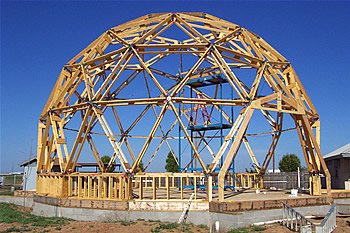 If the Donald wins, I’m not leaving for Canada. That would just leave the country to him and his kind. Not acceptable. But I will build a transparent dome around our house. The dome will have a semi-permeable membrane for its skin. Only healthy, clean, non-stupid ideas will be able to come onto our property whether delivered by newspaper, internet, or television. I haven’t figured out what to do when we leave our dome home, a work in progress.
 Since 9/11 our politics have become polarized, mean, unbending. The Donald has only ridden that cresting wave; he did not create it. Like any demagogue he has an instinctive feel for the anguish of ordinary citizens and an ability to say things that seem to give it voice. As a representative democracy, we rely on politicians for taking the pulse of their constituents. Yes, that’s true.
 The big news here on Shadow Mountain. Orthopedic surgeon William Peace added some surgery days. Result: total knee replacement on December 1st. I’m excited because this pain is distracting and medication intensive. Currently using CBD’s and acetaminophen during the day and vicodin at night. This works, sort of, but I still can’t exercise, hike, twist suddenly, get up and down easily.