
Fall Healing Moon
I missed seeing Kate yesterday for the first time since that Friday when we went to the Swedish Hospital’s E.R. And, I missed seeing Kate.
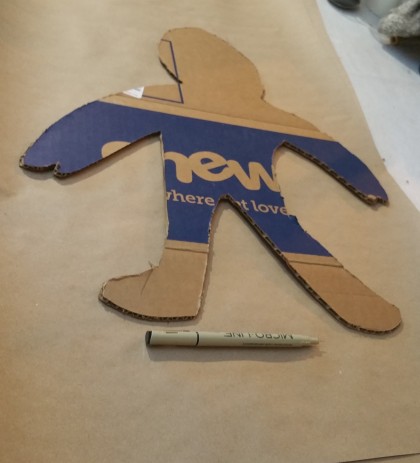 Odd experience yesterday. I led an exercise that involved body outlines I made from this template. (they actually looked better than this picture might suggest.) The kids responded to several prompts, among them: first school memory, early friends, where were you born, childhood hobby, childhood dream, then illustrated them on their body outline. The results are beautiful in many cases, revealing in all of them.
They were into it, using markers and crayons and stickers. The latter many of them used to decorate their faces as well. It felt energetic and engaged, the exercise, but I couldn’t get a conversation going about the results, so it felt like a failure to me. Alan, on the other hand, thought it was a great success. So did all the teachers who looked at the results.
The idea was to get the kids thinking about their childhood as they shift from childhood to being a teen. And, in that sense, yes, it worked. Where it failed was in having a discussion about commonalities and differences among the results.
Afterward, like the first two times I taught, all I wanted to do was sit down. Like a hard workout. Exhaustion. Attending to the little sprays of emotion, provocations of other students, even their eagerness and desire to do a wonderful job (which most of them had) was difficult. At least for me. Very difficult.
At the staff meeting afterwards exhaustion and an attendant lability found me looking out at the others: Rabbi Jamie, Alan, Tara, Debra, Karen, Tal from inside. Hard to describe. I was there, listening, understanding, but it was as if there was an invisible barrier of weariness between the watcher within and the physical circumstance he inhabited in that moment. I spoke very little, in spite of a fascinating introduction to the method of studying torah that resulted in the talmud.
In another instance I might have said I was depressed. The physical sensations were very similar: subdued, a feeling of distance, limited affect, low energy. That led me to my refrain over the last almost three weeks. I’m ok. No, I’m not anxious. Yes, I’m in the moment, responding to now, not imagining the future or regretting the past. I have believed that of myself, believed it was my experience, but was it?
As far as anxiety goes, I’m exquisitely sensitive. Generalized anxiety disorder will do that to you. I am, at least I think I am, an expert on my own anxious responses, what they feel like, how they manifest. As long as the ambit was Kate, her medical care, the dogs and their needs, my own needs, I felt fine. No, of course, I wasn’t joyous, nor was I unconcerned, but at no time did the usual stomach flutters, sweaty palms, shallow breathing signal an OMG moment. Was I repressing them? I really don’t think so.
But, there was a high stress level. That’s undeniable. It was a fraught situation, especially the first two weeks with Kate bombarded by tests, procedures, transfusions, and finally the bowel resection. Even so, the stress did not trigger anxiety. It did, however, exact a price and that price was exhaustion, depletion. As long as I was only handling the temporarily resectioned world I described in an earlier post, I was fine. Being alone with all this was not a difficulty for me, in fact, I prefer it.
When, however, I took this still existing high stress level-Kate’s still gone from home, driving in and out takes a toll, for example-into a social setting, I believe it surfaced the stress in a much different way. I was no longer in my temporarily resectioned world but in that ongoing life that is the world, the ongoingness that seems so strange from within a bubble of stress or grief. Yet, it is not strange, it’s the usual, the normal, the everyday, it was my stress that was unusual.
I was not able to fully enter into the casual flow, the ordinary ongoingness. I wanted to, but the effort required was just beyond me. This doesn’t seem aberrant to me, but it did make me realize the degree of stress, of the energy required to cope that I’ve been experiencing.
Final note here: People want to help and I truly appreciate that. But, I’m not real good at knowing what kind of help I need, what would be useful. I’ve always been a very private person, one inclined to handle my life on my own terms with my own energy. I know the pitfalls in that, but it’s a lifelong habit. And, one I generally admire. Right now I think it might be in my way, but I’m not sure what to do about it.
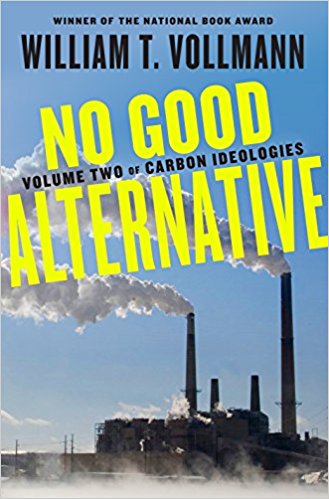 Though I haven’t begun to read them yet, William Vollman’s two volume work: No Immediate Danger and No Good Alternative, the Carbon Ideologies paints a bleak picture. So does the
  If we cannot slow down the rate of climate change (which is the most we can do, since so much climate change is already baked in), then we move to mitigation and adaptation. Geoengineering will become a buzz word as various strategies are tried. Climate refugees will become more and more disruptive across the world, especially those moving from coastal areas into interiors and onto higher ground. The already underway shifts in plant and animal eco-systems, climate refugees all, will bring them with different disease vectors, disruption to agriculture and sea life.
 We will not be known for Vietnam, civil rights, feminism, ruining health care, electing fascists to high office, but as the generation that allowed an earth compatible with human populations to slip away. Hard as it is to imagine the results of this inaction will be far, far more damaging than all the wars, holocausts and pogroms. How will we explain this to our grandchildren, to Ruth and Gabe in our instance? I understand the political and economic forces that have gotten us here, but explaining them will not alter the misery.


 As I drove home yesterday from


 End note. I realized as I wrote that last paragraph that a key sticking point right now is uncertainty. Will Kate’s various medical issues resolve? That is, will she get well enough to leave for rehab? If so, when? If she’s in rehab, how long? How much care will she need when she comes home? I’m not wracked by any of these questions, but they illustrate the fundamental issues in play right now, with no clarity about any of them available. That’s what makes knowing how I might react so difficult right now.


 There was some talk of how Zen my approach to all this has been. Thought about that. Really, wu wei. Often translated, inaccurately, as inaction. It’s a Taoist idea better expressed by Alan Watt’s book title, The Watercourse Way. Taoism and Buddhism in China created Chan Buddhism, the immediate influence on what Japanese Buddhist monks came to call Zen. Wu wei is a critical idea in that mix.
 Instead with wu wei I try to follow the path of the chi, where vital energy is flowing. If Kate needs medical care now, I take her to the emergency room. If she needs diagnostic procedures or interventionary procedures, I learn what I can about them to help make decisions, to help both of us understand the implications. I interact with and try to make all of this happen as easily and effectively as possible. I’m not trying to force her medical care in a direction in which I think it should go.
 What I can observe from this last week plus is that these attitudes, these ways of approaching Kate and mine’s current reality, has allowed me to sleep, not despair, not become anxious. In turn it means I’ve been able to show up in each instance where I was needed. To show up to what is actually going on, not what I wish was going on or what I think should be going on. Much, much simpler to follow the chi.
 Had an experience yesterday that opened my eyes a bit to the world of micro-aggressions. Due to all the driving in and out I ate up the miles to my next oil change, but couldn’t get an appointment at Stevinson Toyota, so I went to a Mobile Express here in Conifer. It’s run by a former Jefferson County Sheriff’s captain. I ponied up keys, said no to synthetic oil, and went over to the chairs along the wall.