Beltane Sumi-e Moon
- I know how well you have succeeded in making your earthly life so rich and varied, that you no longer stand in need of an eternity. Having made a universe for yourselves, you are above the need of thinking of the universe that made you.
- On every subject, however small and unimportant, you would most willingly be taught by those who have devoted to it their lives and their powers. … How then does it come about that, in matters of religion alone, you hold every thing the more dubious when it comes from those who are experts?
- Friedrich Schleiermacher, On Religion: Speeches to its Cultured Despisers, 1799
 Faith. The middah of the month for Beth Evergreen. Emunah. Last night at MVP, the mussar vaad practice group, we talked about emunah. Rabbi Jamie and Marilyn said that in the early days of mussar classes at Beth Evergreen, some time ago, the middah that caused the most consternation was this one.
I can see why. Faith is a word often used, but little understood. Faith is also a word often abused both by religion’s adherents and by religion’s cultured despisers. (Friedrich Schleiermacher) Faith is a sine qua non inside any mega-church in America. Either you have faith or you don’t. Black and white. It was true for me as a clergyman in the Presbyterian church. When I could no longer claim with authenticity that I had faith in God (whatever conception of God I was using at the time), I could no longer serve in that role.
Religion’s cultured despisers, a term coined by Friedrich Schleiermacher in 1799 in his book of the same name, often use faith as a straw concept with which to flog the irrational religious. Faith makes people blind. Faith makes people malleable to cult leaders. Faith makes people believe in a magical world. Faith blots out a person’s capacity to see the world as it is.
 One of us in the group last night said, “The universe is for me.” I have other friends who believe the universe is a place of abundance, or, as author Gabrielle Bernstein titled her book, “The Universe has my back.” I don’t buy it. This abundant universe will kill you. It will kill you. This is not a matter of faith, but of oft repeated experience. The universe offers up all we need to live, then takes it all away.
I don’t believe the universe gives a damn. The problem for me is placing a value judgment on the actions of this vast context into which, thank you Heidegger, we were thrown. I don’t believe the universe is out to get me; nor do I believe it has my back. I’m a part of that universe and I can choose to live into my part, follow the tao as it manifests in my life, or I can resist it and struggle, but in either case the universe will keep on evolving and changing. Maybe what I’m saying here is that I’m not willing to shift the religious notion of God’s agency to the universe, no matter how construed.
If the universe is, as I believe it is, neutral to us and our lives, or, said another way, if we are no more privileged than any other part of the world, the cosmos, then what can faith mean? What is there in which to have faith?
 Turns out quite a lot. Another of us last night told a story of night diving. A favorite activity of hers. She said she turns off her diving light and floats in the night dark ocean. While she’s in the dark, she imagines a shark behind her. The shark may kill her in the next moment, but until that moment she is keenly alive. This is, for me, a perfect metaphor for faith. Each day the shark is behind us. A car accident. A heart attack. A lightening bolt. A terminal diagnosis. Yet each day we float in the dark, suspended between this moment in which we live and the next one in which we are dead. And we rejoice in that moment. There is faith.
 This is the existentialist abyss of which Nietzsche famously said, “If you stare into the abyss, the abyss stares back at you.” Living on in spite of its direct glare, that’s faith. This sort of faith requires no confidence in the good or ill will of the universe, it requires what Paul Tillich called the courage to be. I would challenge that formulation a bit by altering it to the courage to become, but the point is the same.
Here’s the interesting twist. Doubt and faith are partners. As a quote Rabbi Jamie offered last night says, they live in the same apartment building. Here’s the big learning I got last night. Doubt is the true sine qua non for faith. And to the extent that we have doubt, I would identify doubt with awareness of the shark, we have faith. There is, and this is the aha for me, a frisson between doubt and faith that makes life vital.
 So. My practice for this month involves, in Rabbi Jamie’s phrase, sharpening my doubt. I will remember the shark as often as I can. I will recognize the contingent nature of every action I take, of every aspect of my life. And live into those contingencies, act as if the shark will let me be right now. As if the uncertainty of driving, of interacting with others, of our dog’s lives will not manifest right now. That’s faith. Action in the face of contingency. Action in the face of uncertainty. Action in the face of doubt.
I want to sharpen doubt because I want to taste what it feels like to live into doubt, to choose life over death, to have the courage to become. If I only use the automatic responses, make money, achieve fame, watch television, play with my phone, immerse myself in the needs of another, or several others, then I blunt the bravery, the courage it takes to live. I do not want a life that’s but a walking shadow, a poor player that struts and frets his hour upon the stage. I do not want a life that is a tale told by an idiot, full of sound and fury, signifying nothing. (Macbeth, Act 5, scene 5)
I want a life that flourishes not in spite of the uncertainties, the contingencies that are all to real, but because of them.
 Started a long project yesterday. I’m printing out all of Ancientrails. Been wanting to do a total backup and I will at some point, but if it’s going to be useful to my ongoing work, hard copy is better. Besides, think how satisfying it will be to hold a copy of all this. Then, I got to thinking. Oh, but a fire! I’m going to make a copy of the copy when it’s done, then make copies of all my hard copies of my novels. I’m going to ask Jon if I can store those copies in his garage in Aurora. Yes, all the novels are on flashdrives (and in a safety deposit box, all except my work on Jennie’s Dead and Rocky Mountain Vampire) and all of Ancientrails is in the cloud, but the hard copies are important, too. The things that come up before we fall asleep.
 If I’m understanding his primary argument, time at the Newtonian level is a result of blurring. This may seem like an odd idea, and it is, but it’s not so hard to grasp if you think about the blurring that is necessary for us to perceive the world around us. Example. If you shrank to the atomic level and tried to walk across a table top, you’d fall in. It’s blurring of the quantum world that makes the table seem solid to us. Time is a result, again if I’m getting this, of the blurring of the transitions from event to event which, at the quantum level have no prescribed order.
 Rabbi
Rabbi  As soul we become aware of our direct links to other people, to the world we live in and we understand them as part of us and ourselves as part of them. Shapiro says that such dictums as love thy neighbor as thyself become axiomatic at the soul level. When we know the true face of the other, which we can do at soul level, then we have to treat them with loving kindness. This includes the earth.
 He refers to himself as a perennialist. Here’s what that means:

 In the present, which has never existed before and will recede as if it were never there, all things can be made new. This is a subtle idea, at once obvious and at the same time almost impossible to grasp. Yet it is true that the 71 years of my life have passed in moments, always in the now. Even in 1947 my life passed moment to moment in increments, the very same as the increments I experience today in 2018.
 Turns out I missed a key move on powering up the sound board.
 I had to call Alan Rubin, a new Beth Evergreen friend, who is the A/V sage. He said he was sitting by his pool enjoying the weather. It was a blue sky, white cloud, warm but not hot, Colorado day. After some false starts, Alan isolated the problem, I poked a button and, right at 2, the sound. Whew.
 However. All this meant I had not had time to arrange the tables for folks to take notes, so they sat in chairs looking up at the screen. I also had not given sufficient thought to the pedagogy of the afternoon. How would we interact? What questions might prompt discussion? The fact that everyone faced front rather than seeing each other across a table made getting a conversation started difficult. Though I don’t think the audience cared, I’d hoped for a more interactive event and I didn’t facilitate that.
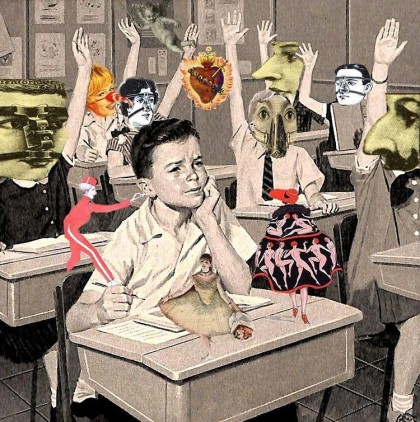 Back in the day, the now further and further away day, I always went to class. I might have missed a few, but it was rare. I enjoyed learning from lectures, getting in the mix of dialogue, thinking out loud. Last night I was the only student in the qabbalah class on Time.
 Being human is a daunting task, steeped in misdirection, existential isolation, perception clouded by tradition, by language, even by our body. Qabbalists and taoists and ch’an buddhists have worked, hard, to peel the onion of our awareness. They are subtle, in their own way as subtle as particle physics or genetics or neuroscience, attempts to understand this task, the one none of us can jettison, save through suicide. They differentiate from the narrowing tendency of science by insisting on a full, a comprehensive positioning of this strange creature that we are in the wild.
 Thought experiments like taoism, qabbala, ch’an or zen buddhism try to shock us out of our stupor, the life lived without seeing the wilderness for what it is, the life lived within the conventions of a particular time, a particular language, a particular place, a life lived without knowing what life is. Most people find little reason to peak behind the curtain of this emerald city that we think is what is. The apparent life, the one with family and money and the NFL and food and houses and sunlight and night, seems to be all that could be. We do not question, we try to paddle the little barque of our body on this river (life) often using only our hands over the edge of the boat.
 And yet there is more, not more in the sense of more layers or more depth, for those layers and depths, the wilderness, always surround us, are the water to which we are the fish, but more in terms of what we can know, what we can access, what we can use to help us become awake. Woke, in the current vernacular, not woke to racism and sexism and oppression in this instance, but woke to the true majesty and wonder of life itself, of this wilderness journey, this most ancient of ancientrails.
 Another recovery hallmark. Kate drove yesterday, went out on her own for the first time since March 22nd! The bank, a few groceries, gas. When doing these errands feels routine, they can be mindless or even a nuisance; but, this sort of moment allows us a glimpse into the ordinary miracles that make up what we think of as normal, usual. We can get up from the chair, pick up the keys, start the car, drive to the grocery store, the gas station, the bank.
 Mussar Vaad Practice Group last night. Vaad = sharing without comments. Mussar = Jewish ethics focused on developing middah, character traits. This is a group, partly because of its nature, partly because of its members that has become a Woolly Mammoth equivalent for me, a place where I can be transparent, share, look inside, gain from the ancientrails that others walk.
 Yesterday was d-2 of the new dishwasher era. I have now seen the wonderful word, CLEAN, on its external panel twice. And, after checking, it’s true! I believe, barring trouble, that this brings the dishwasher saga to an end. Blessed be.
 After the initial overwhelm (what’s a whelm*, I wonder?), I’ve been surprised by the good feelings that have come from my part in Kate’s recovery. Doing more, enjoying it more. Though. I will be happy when Kate’s back to full functioning.
 Earth Day. Thanks, Gaylord Nelson. Gabe’s birthday, too. 10 this year. He got a fidget spinner, an infinity box and a red envelope with money, $10 for each year. This year Earth Day is also Kate’s one month mark after surgery. She’s on an upswing in many ways, weight, pain, nausea.
 In addition to having an Akido studio that is one of the oldest in the country, Domo has a museum of rural Japanese objects, many related to farming or carpentry. They also have art hung in many spots, but in an unobtrusive, organic way. It’s located in an older, warehouse looking building in what is now a rapidly growing part of Denver. A brand new apartment building is under construction right next to it.
 It’s been an unusual weekend visually with the suspended bee hives and the elk Saturday, the 4/20 celebration at Happy Camper on Friday and Domo yesterday. There is, too, of course, always the mountains. When we drive down the hill into Denver, we leave them behind for a bit, decanting ourselves onto the terminus of the great plains, still high at 5,280 feet, but flat all the same. Last night when we came home, a mountain in the distance toward Evergreen was a flat, pastel teal with pink ribbons of clouds behind it. Only Cezanne could have done it justice.


