Things I think about while falling asleep. Life. A stream rushing down the mountain of time, a branch into a tributary, tributary to river, river to the gulf of eternity, a small part of the sea of infinity.
Project print ancientrails update. Got into May of 2015. Then, printer spooling error. Spent an hour on it yesterday, got tired. Learned long ago to quit at a point when I’m doing the same thing over and over. Come back the next day with fresh eyes. Later this morning I’ll be back at it.
Looked out the bedroom window this morning. Frost. Rained over night and the temperature is just below freezing. A nubbly ice covered the deck and the stall mats, but the driveway was only wet. Saw a mule deer crossing Eduardo and Holly’s yard.
The sun is now well up at 5:30. The victory of the light will peak in three weeks. I look forward to the Summer Solstice as the moment when night begins to claw its way back into prominence.
Jon and Ruth left Gabe here yesterday while they went skiing. A-Basin. It still has peak snow cover, may be open until July 4th. Unusual. When they got back, Ruth and I made spaghetti and meatballs. She’s turning into a sweet, loving person. A real pleasure to see.
While walking back to the house after getting the paper this morning, I thought about her and Gabe. We moved here to have these kind of interactions with them, casual and frequent. It was the right thing for us to do.
50th High School Reunion, Alexandria, Indiana
When I was in school in Alexandria, Memorial Day marked the end of the school year. Summer begins! Days of freedom wandering alleys collecting pop bottles for small change. Going to the field with Rick Meyers and the Kildow boys to play army. Playing blackjack every weekday afternoon in the paper boys shack of the Times-Tribune. The occasional pickup softball game. Riding bikes around town. Outside until well after dark. No thoughts of pedophiles, school shooters, terrorists. No climate change worries. No computers. No cell phones.
Here in Colorado school typically ends in June though Ruth, because of McCauliffe’s schedule, got out a couple of weeks ago. This is Gabe’s last week. They will both start school again in the second week of August, both at McCauliffe for this one year, Ruth in the 8th grade and Gabe in the 6th.
Ruth, as do most of her friends, has a season pass to Elitch Gardens, an amusement park that serves as summer day care for many Denver teens. They have rides named Brain Drain, Mind Erase. You can see the attraction after school’s over.
It’s another Colorado day. Blue sky, sun, a bit chilly. Mountains. Pines. Fresh air.
Mother Cabrini Shrine
At 12:15 I head over to the Mother Cabrini Shrine where this Progoff workshop will take place. It’s about 40-50 minutes from here depending on the route. Close to Golden. Being a commuter will be a new experience for me.
Kate will be alone. My phone will be on vibrate and I enabled voice messaging. She asked me to. I actually prefer not to get voice messages. I like text or e-mail. Woke up this morning realizing I need to make a few things for her to have. Food.
Brother Mark has decided to head to Bangkok after his year in Arar, Saudi Arabia. Bangkok will be different. Humid. Also hot. But a society with a different past, a different religious inflection, Buddhist not Wahabi Muslim, a very different architectural heritage and cultural mores. I admire his having taught in Arar for the whole year. He’s going on vacation.
Mary and Mark, Andover
My sister Mary has become an international figure in her field, speaking and teaching in Finland, the Philipines, Indonesia, Greece, other places I’ve forgotten. They both traverse our planet often, going from place to place.
I’d like to write here about my boy but he’s asked me not to for opsec reasons. Operational security. Geez.
In part due to caregiving and in part due to my own spiritual journey the cancer has not dominated my life. At least not yet. The Progoff workshop will give me a chance to explore it from within and should help with residual anxiety.
The week after the workshop Kate has an appointment with her pulmonologist and later gets her actual crowns. Cue God Save the Queen. I have the axumin scan, a glaucoma check, swapping out the snow tires for all seasons, and a visit with the radiation oncologist Dr. Gilroy. By the end of that week many things will be clearer.
The air conditioner in our Rav4 will get a diagnostic shot of a gas that glows under a black light when they change the tires. After a few hundred miles I go back to see if they can find a small leak. If not, we may need to replace the air conditioning unit. Much cheaper than a new car.
The Rushing Waters Moon is down to a thin crescent. 2% of the lunar surface illuminated. Maxwell, Cub, Blue, Shadow, Brook, and Bear Creek are still pulsing, but they will begin to slow as we move deeper into Beltane. Alan Watt’s little book, The Water Course Way, comes to mind when I write about these patient devourers of mountains. Soft wins over hard.
Cool today. 29 when I got up. Snow all gone for now. The prediction is for a wetter and cooler May, something both of these former Minnesotans can enjoy. Good sleeping. Too, coming after a wet winter, this sort of May will further reduce fire dangers. Told Kate yesterday it could be cool and wet right up to the monsoons, late August. A summer without fire worries would be nice.
Got an e-mail yesterday from Dave, of Deb and Dave, who own On the Move Fitness and have been my personal trainers for two years. He sent it to all those who use their small fitness center. Dave has brain cancer, up until this last week in remission. Not now. Resonates for me. I wrote him back. “Cancer’s a bitch.” Both he and Deb responded. Deb said, “I agree, cancer’s a bitch.”
Michelle is a mussar friend. Her husband has prostate cancer, too. Already metastasized. Leslie, also a mussar friend, has had her breast cancer reemerge twice. I mention these because it underlines that cancer is probably in your circles as well. Yes, treatments have improved life expectancy and some prevention efforts have helped, but cancer itself, in its multiple manifestations, continues to be an agent of Azrael, the angel of death.
In itself, as I’ve written before, I consider whatever ultimately kills me as a friend. Life is not forever. We cherish our mothers who bring us into this life. (Well, we cherish some mothers.) Why not cherish what completes our cycle? No, I’m not rooting for prostate cancer to be that friend. And, yes, I’ll wait as long as I can to meet my friend, yes.
In “Free Solo”, the documentary about his free climb of El Capitan, Alex Honnold says to his girlfriend, Sanni McCandless, “No, I’m not going to optimize the length of my life.” The comment hit me a couple of ways. First, it’s so contra-normative for this health obsessed age in which this diet or that exercise regimen or those supplements will ensure you’re not only healthy, but will live long. (and, maybe prosper) No keto diet or paleo diet or spinning class or hot yoga or ginseng will extend your life beyond a human’s natural limits. And the death angst that causes folks to fantasize that maybe this intervention will do just that is fantasy. Denial. Fear. I like Honnold’s up front recognition of death as a part of life.
Second, he’s not giving up his central purpose, to push climbing as far as he can, because it might kill him. Neither should we put any part of our life on hold because we’re going to die. Yes, cancer puts that right up in your face, like climbing free solo, but it does not control your response. If you’re brave enough to say with Alex, “No, I’m not going to optimize the length of my life,” then you’ve found a platform firm enough to withstand whatever existential threat comes along.
This is what Yamantaka wants to teach us. Our death is sure. Our fear is unnecessary and interferes with our ability to live. Life is precious, rare, and finite. It is a gift bestowed upon us without condition, ours to use, to enjoy, to contemplate, to share, to embrace. Don’t let anything get in your way.
Had to go at this head on, today, while it’s fresh. When I got to my appointment with Anna Willis, Dr. Eigner’s P.A., the first person in the room was Eigner himself. Grayer and thinner, he smiled, shook my hand. When I said it was good to see him, he said, “It’s good to see you, too, but I’m not happy about the reason.” When I told him my anxiety made me move the decimal place on my PSA, his relief was obvious, “Thank god.” Anna came in about then.
They both remembered me. Anna remembered my glasses and our visits. Eigner remembered me partly because I’d sent him a couple of emails over the years thanking him, telling him about my life. It was one of the warmest visits I’ve had in a doctor’s office and that felt good.
Davinci robotic arm, Sky Ridge (where I had my surgery)
Turns out though. “When you’ve been perfect (a .1 psa which means essentially undetectable) and that changes, it’s scary.” He went on to say that it most likely does mean a recurrence, a relatively rare thing for those who choose prostatectomy, even rarer if the pathology report read, as mine did, clear margins. Clear margins means no cancer was found on the outside of the prostate. The best news.
Dr. Eigner took out a piece of paper and drew a sort of oblong on it. “This is the prostate. They can’t take sections from every part, so they take representative slices. If the cancer is between those slices, it won’t show up on the path report.” Oh, shit.
Since it is three and a half years since my surgery, and since the number for the uptick is relatively small, it means the recurrence is probably local, that is, in the area where the prostate used to be. That’s good news, much better than metastasis.
The plan is to redo my PSA in three months, doing the super sensitive one that can take the numbers 3 or 4 places rather than just two. If it’s still rising, I’ll get a referral right away to the oncologists to discuss radiation. “We’ll just go in there and kill it,” he said. “If you were older, I’d tell you not to do anything. This will take ten years to manifest anyhow, but at 72 you’ve still got a lot of life ahead of you.” That’s my opinion, too.
the Prostate Specific Antigen
Radiation has some potential downsides, so I hope we don’t have to go that route. But, as I said to Kate, I’ve always chosen treatments that offer the best chance to remain active, and alive. I chose repair for my torn Achilles even though it means two months of no walking and crutches for a good while after. I chose knee replacement over other treatment options because I wanted to continue exercising. I chose a radical prostatectomy because that gave me the best shot at a cure. Likewise here, if radiation is the option that gives me the best chance to survive and thrive, I’ll choose it. No doubt.
All that’s the rational side, and that’s pretty damned important because these are high risk, high reward decisions. But they’re not all of it.
On the way back from Eigner’s I drove through Deer Creek Canyon. When my biopsy confirmed my prostate cancer in 2015, I drove Deer Creek Canyon, too. Going through there I felt the rock, rock so old that our human scale word ancient is quaint. This rock rose millions of years ago and it will slowly soften, the rough edges frozen and thawed, rained on, plant roots will crack them, and Deer Creek will carry the pebbles and sand to the Platte River on its way to the Gulf. Not only will I be dead long, long before then, it may be that the human race will have ended itself well before then, too. This comforts me.
Laramide Orogeny, 70 million years ago, begun. 35 million years ago, ended. Built the Rockies
William Cullen Bryant’s “Thanatopsis” came to mind. See the opening stanza below.* He goes on to make the point that the earth itself is a great tomb, holding all those who once lived. Again, this comforts me. Death has not chosen me for a special fate. No, death itself is a universal for all who live. It seems harsh and cruel, yet it is, rather, the opposite. Death ends suffering. Allows the world to carry many creatures, but not all at once.
Here there were Utes and Apaches, Comanches, too. And even they were not the first. Older humans preceded even them. And before all came the Rockies, then the trees, the lodgepole pines and the ponderosa and the bristle cone, the aspen. Mountain lions, deer, elk, rabbits, raccoons, pikas, prairie dogs, bison, moose, wolves, fox, martens, fishers, beaver. All here before humans, most will be here after we are gone. I can look at the lodgepoles in my front yard and know that their direct ancestors flourished here thousands of years ago and will do so after I’m dead.
All this brackets whatever troubles I may experience, even cancer. And cancer may be that friend that carries me off to the mighty sepulchre. Or, it might be something else. Whatever is my death-friend will not be an enemy, but the specific cause of my life ending. And that is, for all of us, in spite of our fears, a good thing.
Kindred Spirits by Asher Durand William Cullen Bryant and Thomas Cole
* “To him who in the love of Nature holds
Communion with her visible forms, she speaks
A various language; for his gayer hours
She has a voice of gladness, and a smile
And eloquence of beauty, and she glides
Into his darker musings, with a mild
And healing sympathy, that steals away
Their sharpness, ere he is aware. When thoughts
Of the last bitter hour come like a blight
Over thy spirit, and sad images
Of the stern agony, and shroud, and pall,
And breathless darkness, and the narrow house,
Make thee to shudder, and grow sick at heart;—
Go forth, under the open sky, and list
To Nature’s teachings, while from all around—
Earth and her waters, and the depths of air—
Comes a still voice—
Yet a few days, and thee
The all-beholding sun shall see no more
In all his course; nor yet in the cold ground,
Where thy pale form was laid, with many tears…
The oak
Shall send his roots abroad, and pierce thy mould…
Took Kate yesterday to her electro phys (pronounced, fizz) appointment. This one monitors her pacemaker. Unremarkable in terms of her health, really, since it hardly ever fires, but if necessary it’s there. What was interesting to me is the building. It looks like Valhalla for cardiologists. After that final operation, after that final payment on the Maui condo, after that last beat of their own hearts, cardiologists might gather in this Viking long house and feast on Sæhrímnir, the ever dying, ever resurrecting beast that feeds the fallen doctors of the heart. If such a final destination is anywhere, here near the Rockies seems appropriate. May they upcode in peace.
Max Bruckner (1836-1918), The Walhalla, backdrop for the scenic design of The Ring of the Nibelungs by Richard Wagner (1813-1883). Bayreuth, Richard-…
Afterward we went to Tony’s Market. I like Tony’s because you can spend a hundred dollars and still only have one bag to carry to the car. We’ve kicked our frequent eating out down two notches and do it at home now. We buy things at Tony’s like a tenderloin roast. Expensive? Yes. Compared to tenderloins at a steak house? Not at all. Tonight with asparagus, home cooked bread, boiled potatoes.
Kate’s much better. Her stamina has improved enough that we went to CBE last night for the Grateful Dead shabbat. Rabbi Jamie loves to perform and the CBE house band is better than good. Steve Posner on lead guitar rips it out. The harmonica player is wonderful. Drummer and bass ditto. Cheri Rubin, my friend Alan Rubin’s wife, an accomplished musician, plays the piano. She made a living in New Orleans before turning to reinsurance. Four singers, two men and two women, provided voice backup.
This particular Grateful Dead shabbat, they occur occasionally, honored Leah, who recently left her position as synagogue administrator. She’s a Dead-head who sells tie dyed shirts and other craft items at Grateful Dead tribute concerts. She had a small shrine to the Dead over her desk. What was remarkable about this evening was that Leah’s leaving the job was not completely voluntary.
In a small community this could have been cause for bitterness or dissension. Instead folks got up and told Leah how much they appreciated her. Rabbi Jamie altered the words to a Dead song, changing the name of the woman in the song to Leah. She came up and sang with the two women in the backup group. It was delightful, charming, and altogether unlikely (in my experience of leave takings in churches that weren’t voluntary.). And, Leah responded by saying that she looked forward to getting back into the congregation, volunteering. Pretty damn amazing.
Things we think about here. The snowpack, in all regions of the state, is way above average, nearly 150%. That means three things: an easing of the drought that has plagued the state, especially the southwest corner, a solid supply of water for the Colorado River basin states, and a much lessened fire danger over this summer. So much nicer to go into the summer months with good water supply. The arid west.
It means one other thing, too. Rushing waters. As the snow melts, our mountain streams will swell, spill over their banks. Our waterfalls will peak, like the ones just below us, the Maxwell Falls. The sound of these streams racing toward the South Platte (up here, anyhow) is one of my favorite mountain sounds. The soughing of the winds. The bugling of the elk. Late spring streams full and bubbling, babbling, crashing.
These are the Rockies now and have been the Rockies for thousands upon thousands of years. We’re here for a moment. We living things witness. It may be our most important act. We are the universe aware of itself and its wonders.
April, 2016 Gwangju. Just before the wedding
Kate had a not so good day yesterday. Some nausea. A Sjogren’s flare, maybe related. I hate to see her that way. I wish her recovery was one smooth arc from 77 pounds to 100, 105. It’s not and it will not be, but I wish it anyway.
Ruth had her third or fourth Destination Imagination state contest appearance yesterday. D.I., as she calls it, is a national program that has kids join with 4 or 5 of their peers, invent plays, and, this year, respond to improv challenges. There are judges and her team has placed at state the last couple of years in their age bracket. Don’t know how she did yet.
Jon says he’s tired of living in an unfinished house. Due to remodeling at his school, he gets done much earlier than normal this year, April 21st. He plans to use the long break to get a lot of work done. He’s done rewiring, replumbing, cleared out the old kitchen and purchased newer appliances. He’s done work on the kid’s rooms first, building Ruth a platform bed and Gabe a desk.
The first glimmers of new work. I’m taking my cousin Diane’s idea seriously. She wrote: “I think your writings deserve a wide (wider?) daily audience — they so compellingly chronicle daily life along with stretching the readers’ mind — and also possibly they could be gathered/edited in to a book that would appeal to our age group. Have others suggested any such to you?”
My plan is to print out all of ancientrails. I started a while back, but gave up pretty far from completion. That way I can fuss with them in the physical world, compile sheets and posts. Much harder to do, ironically, on the computer. Not sure what I plan to do, but that’s the place to start.
Probably going back to Jennie’s Dead. It’s unfinished and I want to complete it. Though. I may take time, too, to start the book Elise and I talked about, the one that comes from the heart. Main point, work is beginning to reassert itself after the long barren period.
Painting? Yes, that too. Not yet, but soon.
Ta for now. Gotta go down and take Kate off her feed bag. She’ll be free for 10 hours. She sounds much better.
Tom Crane sent me this street poet’s work, found on Maui. I wrote him back after reading it and said we could go for an epic third phase. I meant legendary, but epic appeared anyhow. He wrote back, said he’d like that, too, but didn’t know how. I agreed. Beginner’s Mind, eh? We’d have to redefine epic, Tom replied. Yes.
And, we don’t want to get stuck in the success trap. That trap can consume the second phase, career and family, but it can be set aside in the third. So the question could be, what would a legendary third phase look like? Better than epic. Epic has that Hollywood feel, doesn’t it? Let’s forget I transmuted legendary into epic and go back to the poem.
Sadhu
What does an open spirit look like in the third phase? What risks might we take if we had one? What risks are particular to the third phase? To get an idea of where this might go, I looked up the Hindu sadhu. A sadhu intentionally creates a fourth phase of life.* Of course in a Minnesota winter like the last one the Jain option of wearing nothing would require modification unless the sadhu phase was to be short.
I wonder if other cultures have similar ideas? Don’t know. What I do take from the sadhu is that they have an open spirit, moving toward moksa means getting free from samsara, the worldly enmeshment that the second phase presses upon us with such vigor.
Part of a legendary third phase might involve letting go, leaving the old desires of life, shaped by education, work, and family behind. But, if they’re left behind we might be left wondering, what else is there? Those desires are the ones that motivated us, got us up in the morning, out the door coffee in hand, ready to do. The old finish line model of retirement pretended that this was as easy as buying a set of Pings, selling the house in Kenwood, and moving to a Del Webb village to drive, chip and putt. Or, head out to Margaritaville, collect umbrellas in the sand next to your beach chair. Doesn’t sound like a sadhu approach, does it?
Song dynasty
Another image, similar to the sadhu, was the Chinese scholar who would retire from the bureaucratic life, paradigmatic of the second phase in that culture, and move into the mountains to write poetry and live amongst wildlife and forests. This is a Taoist vision, one that took over from the Confucian when either work was over or changes in the political life forced a scholar out of the court. I like this one a little better than the sadhu because I like clothes.
Wu wei: “a state of being in which our actions are…effortlessly in alignment with the ebb and flow of the elemental cycles of the natural world” is the Taoist principle these mountain hermits follow. And, a sound one, though as I’ve written before, I’m also a “take arms against a sea of troubles and by opposing end them” sort of guy. This may be the key attitude that prevents me from fully letting go of success, of my set of Pings, that beach chair.
I’m not talking here about monastics or hermits who take to those lives, as Thomas Merton did, in the midst of their second phase. These are escapist lives, profound in their way of course, but ones that set aside the second phase much earlier. What I want to consider is the legendary third phase possible after the more traditional transition from work and raising a family.
Look forward to any ideas you might have. This preliminary look suggests some things to me. Let go. Seek spiritual liberation. Attune life to the seasons, to the natural world. Live in some seclusion from the old, second phase world.
“The sādhu is solely dedicated to achieving mokṣa (liberation), the fourth and final aśrama (stage of life), through meditation and contemplation of Brahman. Sādhus often wear simple clothing, such saffron-coloured clothing in Hinduism, white or nothing in Jainism, symbolising their sannyāsa (renunciation of worldly possessions).” wiki
BJ returns to the Beacon Hotel and Broadway today. She suggested taking the train to the airport, so I’ll be taking her down to the Federal Center station. It’s very close to Ortho Colorado where I got a new knee and Kate got a new shoulder. We’ll wave to our now spare parts as we pass by.
It’s been a good visit. She and Kate made spritz cookies yesterday. They also sorted through Kate’s stash of yarn. The result is a box I’ll mail to Idaho. Something for BJ to do next summer while she manages renovation of her home there before the Grand Teton Music Festival starts up in August.
We had five inches of snow the night BJ came. It’s gone now from the driveway and roads. Some remains in the shade and on the thicker snow that has been here for a while. As I said yesterday though, we’re not done. Our second snowiest month starts today. Not April Fool’s either.
Not sure exactly what prompts them to do this, but Kepler and Rigel take turns lying down in the narrowest part of our home, the passage between the kitchen and the living room. As a meal is under preparation, they watch. Hope. Then, when it’s ready, they lie there and watch as food gets carried from kitchen counter to dining table, then back. This is beneficial because it promotes good balance as we step between legs and over bodies.
Friend Tom Crane sent a picture from Maui. They’re in, I think, a set of condos just to the right of Whaler’s Village if you’re facing the ocean. He and Roxann were in Lahaina yesterday. Its whaling history had Tom wanting to harpoon something. He said he wouldn’t though because that’s bad juju. Yes. But, maybe he could find a whale of deal in one of Lahaina’s many shops and art galleries. Harpoon that.
Beyond those condos is the Sheraton. It publicizes Pu‘u Keka‘a (Black Rock), a spot where divers sometimes jump into the ocean. Notes from travelers say that such diving is frowned upon. As it well might be, since this rock was, in traditional Hawai’ian lore, the jumping off spot for soul’s to the after life.
halema’uma’u Jules Tavernier
There is a real and probably unresolvable tension between the booming tourist industry on all the islands and the native population. Many places sacred to the natives, like Pu’u Keka’a, draw tourists. Another such spot is Halemaumau crater on Kilauea. This crater, which has undergone rapid transformation since the most recent eruptions of this active volcano, is the traditional home of Pelé, the Hawai’ian goddess of volcanoes. On any visit in the past there would be offerings scattered around the crater, fern fronds, flowers, bottles of alcohol. Pelé is not an abstract, far-away goddess, but one who upends life on the Big Island often. Even non-native locals give Pelé her due.
Pele
Though the USA claims to be a non-imperial power, Hawai’ian history proves otherwise. We took it, dethroned the monarchy, and made the islands safe for sugar plantations. Michener’s Hawai’i tells the tale in easily readable prose.
The stories of these islands have a geologic tale of great scientific interest. They have a Polynesian mariners’ tale that unveils the navigational skills of thosw who took to the seas in catamarans, sailing north to populate these islands. They have a long story of their descendants and their battles, their taboos, their human sacrifice.
They have a shorter history of the haoles, non-native Hawai’ians, who came from Asia and the U.S. Some worked the sugar plantations, later the pineapple and coffee fields, mostly from Japan and Korea. Others came with money and power.
Hawai’i has a more than a soft spot in my heart. It’s a second home. Yes, that’s not too strong. We fell in love with the islands long ago and would have lived there if we had enough cash. Yes, in spite of the imperial history and in spite of the tourist industry. They are beautiful, enchanting, mesmerizing. The scent of loamy soil, gardenias, and jasmine are as fresh for me now as when we first went. The combination of lush landscapes, the vast Pacific, and the unimaginable power of the volcanoes that created them, casts a spell, one which we willingly let enchant us.
Picked up sister-in-law BJ at DIA yesterday. She’s an experienced traveler with a single roll-on bag and bright blue, hard-shelled case which carries her violin. It goes everywhere with her, including in to Sushi Win for lunch. “Cold is not good for it. Changes in humidity.” She’s the concert master for the New Jersey Symphony Orchestra, so the blue, hard-shelled case carries her means of earning a living.
We talked about the arts over lunch. Interestingly, her s.o. Schecky Ballentyne, a student of the cello great, Leonard Rose, and a teacher of the cello as well as an international soloist, thinks a renaissance of the arts gestates among millennials. A while back when he taught his students could count on getting jobs as professional musicians. More recently his students have gone on other careers instead. Medicine. Scholarship. Computer programming. But. They keep up the instrument, have chamber music evenings with other part time players, and keep their art alive. Schecky believes these folks will create an artistic renewal when they become more settled in their lives. May it be so.
Shecky and a pianist with whom he often works, Hiroko Sasaki, have a performance scheduled at the Merkin Hall in NYC. May 24. Here’s the info in case you’re in the Big Apple over that time:
In the 20 years spanned by the music in this evening’s performance, Beethoven revolutionized music and single-handedly created the modern cello sonata. By juxtaposing works from each major period of his life, Ballantyne and Sasaki highlight this composer’s unique musical and spiritual development. For an even more immersive experience, please join Emmy nominee George Marriner Maull, well-known for his PBS and radio specials about music, for a pre-concert lecture at 6:30 in the balcony lobby.
Artists
Scott Ballentyne, cello
Hiroko Sasaki, piano
Program
Pre-concert Lecture: The Music of Beethoven by George Maull at 6:30
BEETHOVEN – Sonata Op. 5 #2 in G minor (1796)
BEETHOVEN – Sonata Op. 69 in A Major (1807/1808)
BEETHOVEN – Sonata Op. 102 #2 in D Major (1815)
Another 5 inches plus of snow here over night. Temperatures cooled down after the overheated week we had. This is powder though so it was easy to shovel the deck. Still snowing and in the teens.
Sandy, our house cleaner, came yesterday. She cleaned the loft, especially the bathroom after the unseating and resealing of the toilet. Always nice to get this space cleaned, about every other time she comes.
Kate continues to gain weight, do her ot/pt which gives her more strength and stamina. The hi-resolution CT next Tuesday should complete the diagnostic work of this whole ordeal. It will identify or rule out any lung disease. Then we’ll know whether she can go ahead with the j-tube placement. If Gupta, the pulmonologist, gives her the ok, that could happen fairly quickly.
All three dogs love the snow. Rigel and Gertie both go into the drifts nose first, come up shaking their heads, then do it again. Rigel hunts the rabbits that live under the deck and the shed, but she’s never caught one here, as far as I know. Back in Andover, every once in a while. Kep likes to wander in the snow, his black and white body moving in and out of the drifts as he investigates. He’s usually the last one back inside. His genes, after all, hail from the Akita prefecture in Japan, famous for its mountains and snow.
First workout today here in my loft gym for almost two months. If it’s anything like Thursday, I’m gonna need some help to get back downstairs. My quads are still complaining from that session.
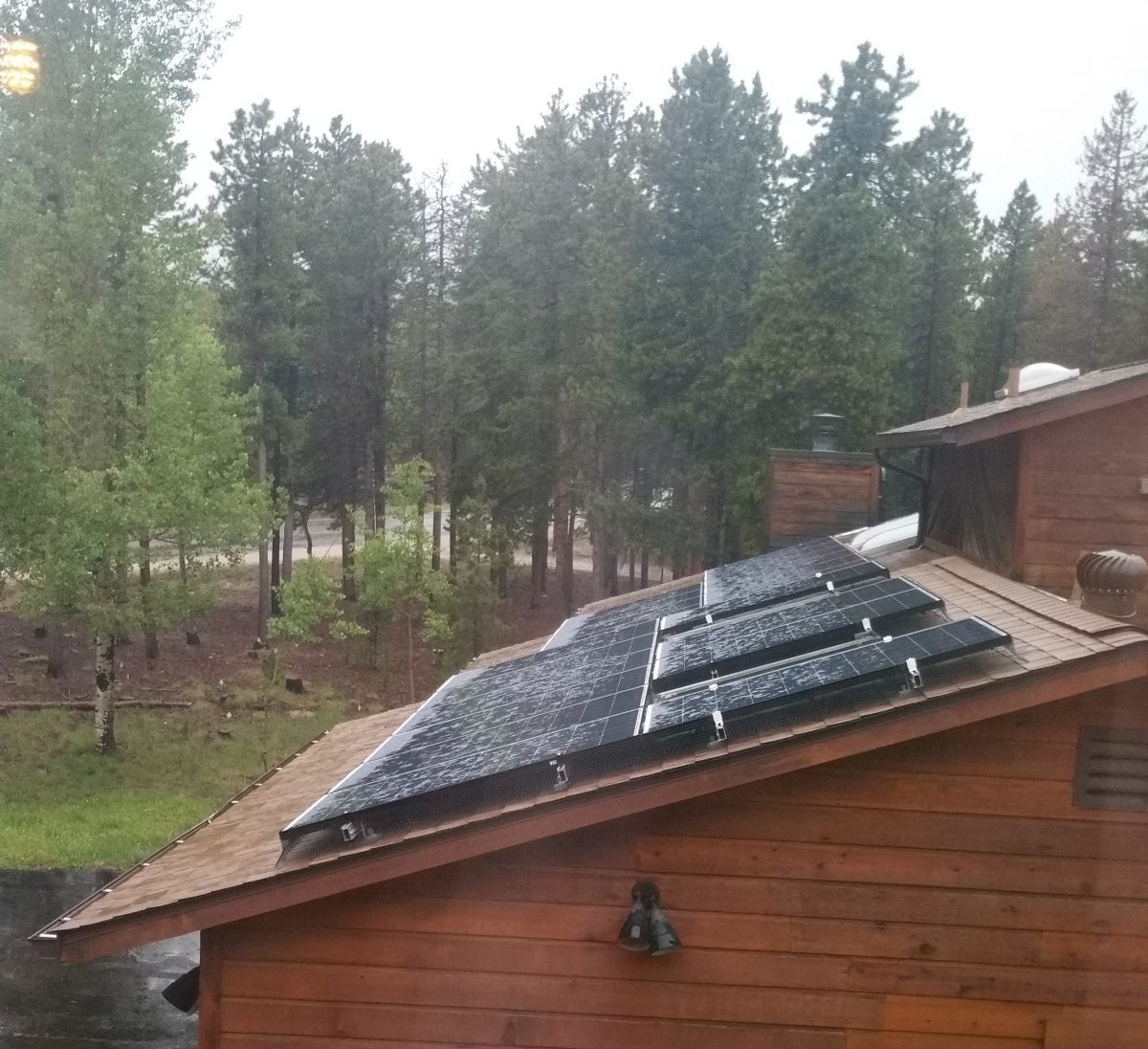
In the way of Colorado this snow will be gone by Monday. 44 that day. Right now though it’s beautiful, falling gently on the lodgepoles, the naked aspen, our solar panels. Traction law is in effect. If you have bad tires and cause an accident or obstruct traffic, a big fine. Spring and winter will alternate with each other, probably all through April, perhaps even into May. Heavy snows, then 50 degree + days. Normal for us.
Ooff. Beware what you wish for. Got back to working out yesterday. Huffing and puffing. Resting between sets. My legs were rubbery when I left the gym and this morning when I got out of bed. Detrained. Starting back, even slow, was difficult. No other way to get there though. And, just two sets plus cardio. A ways to go. Glad to have begun, however.
This is an ancientrail that didn’t use to exist. Back when we were mostly farmers or laborers, back when we were still in the veldt hunting and gathering, exercise wasn’t necessary. It came with the day. Run down some game. Climb a tree for fruit. Hoe the field. Gather in the grain. Hitch up the oxen. It’s only since farming and manual labor diminished that we’ve been getting the modern, sitting disease. Now we live in cities, drive or otherwise ride to work, and find desks a more common habitat than the field. We are victims of our more brain less strain lifestyle.
This means we have to find time in a life occupied by other things, gathering money rather than tubers, for example, to move our bodies and stress our muscles. It seems unnatural, the treadmill or the bike, the weights, the bands, the various exercises, yet in fact it is exercising the body that is natural and our modern daily routine that is not.
Here in Colorado getting outside hiking, climbing, biking, camping, hunting, fishing are popular. Our spectacular natural amenities the mountains, the snow, fast flowing rivers and streams beckon, are visible even from downtown Denver. Yet 5280, a glossy magazine covering the Denver metro scene, had a recent issue devoted to work/life balance. Seems metro folk work more hours per week than most other cities in the U.S.
When you read the literature, it’s clear that exercise is not only beneficial, but necessary for good health, especially as we age. I didn’t start until my late 30’s and it took me a while to get regular at it. Now it feels weird to me if I don’t get in my workouts on a regular basis. The last two months were an anomaly and one I didn’t like.
Exercise not only benefits the body, but the mind as well. Yes, endorphins release if you go hard and that’s reinforcing, but for me, the real advantage is the knowledge that I’m caring for myself. If you do what you can, diet and exercise (and my diet is ok, barely), then what comes is part of the aging process.
The trick, at least for me, was staying with it long enough for exercise to become a habit, one that felt more normal than ignoring it. It wasn’t easy and I had long stretches where I could have quit. Glad I didn’t. Not sure what kept me at it. I’m a believer at age 72. When my personal trainer said I moved better than a lot of the 30 and 40 year olds she saw in the gym, I was surprised, but pleased. Worth it.