Beltane Rushing Waters Moon
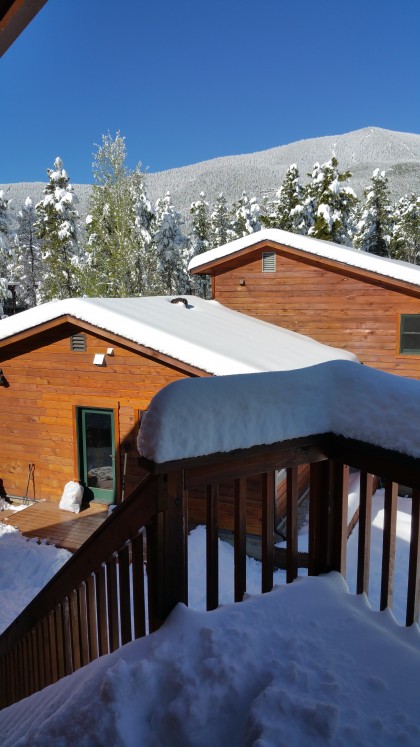
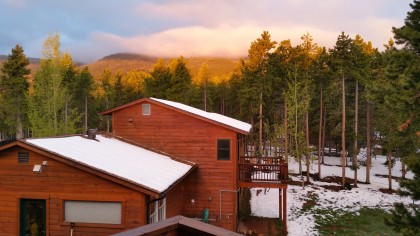
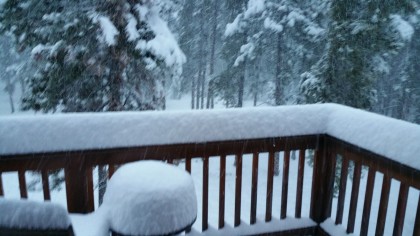
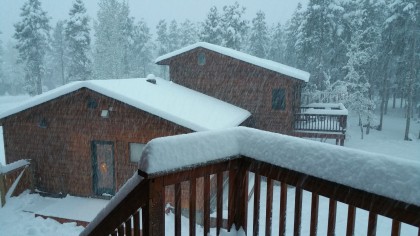
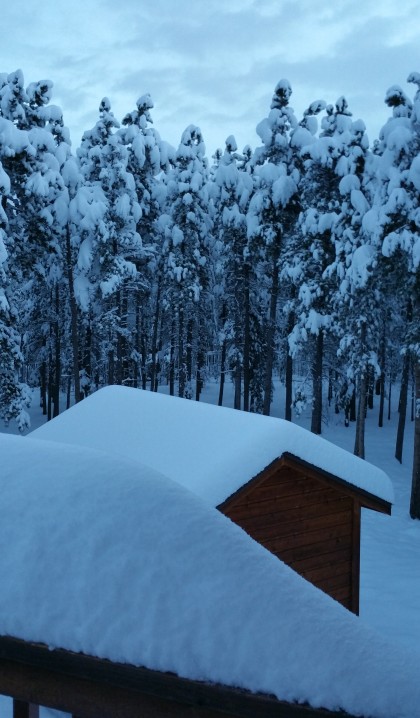 White and gray. The 18 inches or so of snow lies thick on our roof, solar panels hidden from our star. That unusual characteristic of snow to move upwards with the shape of an obstacle like a fence post, a statue, mailbox, or birdbath has created several objects in our yard with white caps reaching skyward, simulacrums in snow of the surface beneath them.
The lodgepole pines have puffy sticky snow that conforms to their branches, weighing them down, pointing them towards Shadow Mountain. One by one the weight will become too much and the whole pile on one branch slides off with an oof and a powdery white trail following it to the ground followed by another, then another until the branches spring back up, ready to receive sunlight. Until then, the trees, like our solar panels, are cut off from the source of their power.
A member of Beth Evergreen sent an e-mail from Boston yesterday, “It’s a hot, sticky 95 here.” This reminded me that the legendary speaker of the house from Boston, Tip O’Niell said, “All politics are local.” So to with weather.
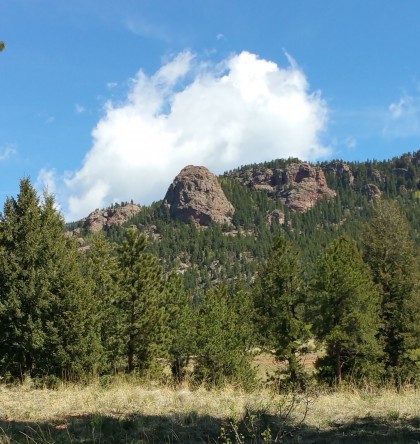
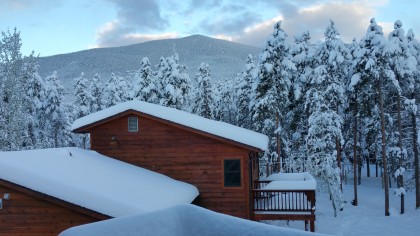 The storm seems to have quieted overnight. No snow falls now. The sun, already well up over Denver, has begun to light the clouds over Black Mountain, accentuating the blue sky. The whiteness of the scene from my loft window seems to impose a silence borne of the color itself, soundlessness corresponding to the fresh, but otherwise colorless, snow. Along with the silence comes a profound stillness, as if for the moment nothing moves. Perhaps the mountain lion has retreated to its den, the bear to its former place of hibernation, the mule deer and elk bedded down among the willows and dogwood out of the wind.
As for this mammal, I’m sitting here, quiet and thoughtful, happy to have a meditative scene out my window. Black Mountain is my writing companion, often my muse. In fact, just now I watched the sun’s light slowly descend from Black Mountain’s peak toward the shelf of rock well below it. The peak itself shines as the sun reflects back off the high albedo of its snow cover. The sun itself, our own star among the heaven’s billions or trillions, seems to have picked out Black Mountain saying, “Behold this wonder so near to you, yet so different.” The sun, God’s spotlight.
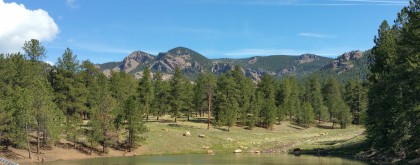
 A welcome headline in the Denver Post yesterday: Cool spring dampens fire risk. It looked bad back in February and March when we were dry and unseasonably warm, then it began to snow. And snow. Then rain. The temperatures have been seasonal or below for the most part since late April. May it continue.
 Beltane Moon of the Summer Solstice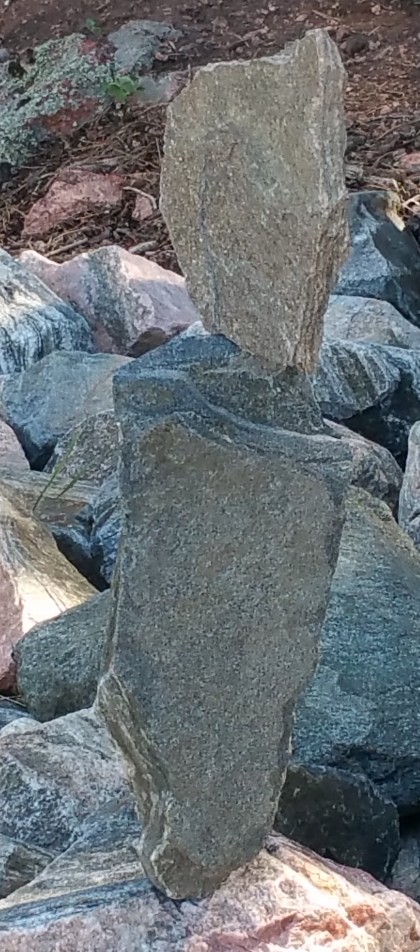

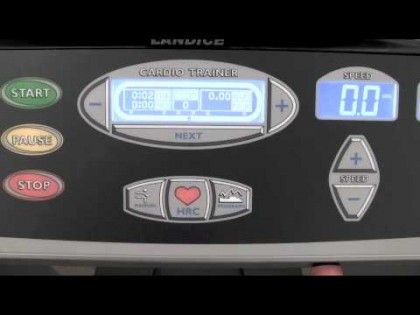 I put myself in a corner with my workouts. In an effort to get to 10,000 steps a day I began to place more and more emphasis on cardio, increasing my time on the treadmill and on the elliptical for high intensity. Problem. I got too tired to do my resistance work. I prioritize cardio since a heart attack or stroke is a real risk for a white male in his 70’s and cardio can help lower the risk. Even so, balance and a certain amount of functional muscle strength is important to daily life so I don’t want to ignore those either.
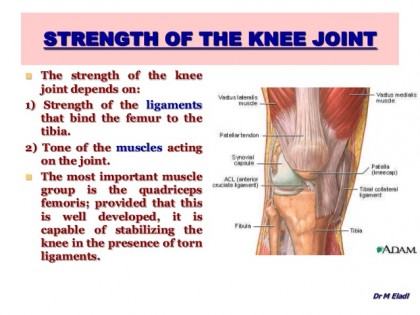 Hire a personal trainer. I went to a small fitness center situated next to Select Physical Therapy where I did my post-op p.t. Both are in store front settings in a small mall with a raised boardwalk and other businesses like a hairdresser and Altitude Martial Arts.
 Still working on how I will lead our mussar class next week. It’s been hard for me, mildly anxiety producing. First, I don’t have the depth, any really, in Jewish thought. The
  Thirdly, the whole Jewish immersion experience I’m having at Beth Evergreen is like learning a new language. I have some words and a very limited amount of grammar. I don’t want my naivete getting in the way of other’s learning.
 Our next Sierra Club meeting will be on June 19th, one day before the summer solstice. Sierra Club work is paganism stripped bare of its mythic content. There is passion for sure, but not the poetry, no ritual, no inner work. It’s all outer work: hike, lobby, analyze, network, persuade. We may, for example, show the next Al Gore movie, Inconvenient Sequel: Truth to Power. See trailer below.*
 Somehow I need to find a way for my inner work to imbue my outer work. Todd, a long-time member of the Mt. Evan’s local group to which I belong, talked about a hike he took yesterday in Reynold’s Park. He named a particular orchid that he found and his face lit up. “A bullsnake, too.” It may be that these folks, tied to the very local region encompassed by our borders, find their inner work in being on the trail, hiking Mt. Bierstadt, taking the Mt. Evan’s road, helping clear trail.