Encountered something yesterday, a dark vessel that rose up from 33 years deep. Grief. I’d forgotten. When I lost my hearing in my left ear at the age of 39, it happened suddenly. Over a period of six months it waned, then was gone. At the time I was doing a bible study in Horn Towers, an affordable living senior high rise on the West Bank in Minneapolis. The women there, probably of my age now, helped me through this first mortality signal. That was the first insult. My body, which had worked just fine up until then, could fail. And, not in minor ways, but in ways that effected my life on an ongoing basis. (polio was a memory more than an experience.)
Since then I’ve dealt, sometimes well, sometimes poorly with the disability. Three years ago the hearing in my right ear began to diminish enough that I required a hearing aid. One good thing about that deaf left ear, I only needed one hearing aid. Cheaper! The hearing aid, while light and unobtrusive, is still a foreign object on my ear. It gets in the way of my glasses, sends sharp feedback noises if I put my watchcap on over it, requires batteries and maintenance. It helps. Not as much as I’d like, or need, but it does help. Even so, I don’t like wearing it.
When I went downstairs yesterday after a hard day at the easel (hah), I had my hearing aid in, but still didn’t hear something Kate said. I asked her to repeat it. She waved me off dismissively. Most of the time, I get it. It’s no fun having to repeat yourself. It can feel like I’m not paying attention or being respectful. Over and over. For some reason though, the dark vessel constructed in those first days of my deafness in my left ear, a vessel built to carry the notice that my body would someday fail me altogether, surfaced.
33 years I’ve had to contend with an invisible disability, one that manifests, for others, only briefly. A huh? Or, ignoring you if you’re speaking to me from my left. Or, if there’s a lot of people, or waterfall like noises, or a loud air conditioner, a plane overhead. It screams at me occasionally when an unheard or misheard emergency vehicle suddenly appears as if out of nowhere.
Most of the time, as with most disabilities I imagine, it’s background, forgotten for me. Up here in the loft, for example, I rarely wear my hearing aid. No one to listen to, a quiet room. When driving, I often reach up and turn it off because a whooshing noise gets amplified into an annoying cascade of sound.
In the wake of Kate’s dismissal 33 years of grief, of annoyance, of having to explain, of being handicapped-always, broke into consciousness. I felt overwhelmed by the accumulated sadness, anger, discomfort. Didn’t know I carried within me this complex. I’m imagining a black submarine navigating the seas of my inner world. When its bow first broke through the waters of my attention, it stunned me. Knocked me back. I took it out on Kate. Not good.
Calmed down. We talked. Got through that maelstrom. Happens once in a while. Surprised by the freight.
I’m sure we all have our dark vessels, a divorce still knifing away at the gut, a lost job, an embarrassing public moment, a failed opportunity. When they surface, these dark vessels, chthonic gods James Hillman would call them, demand our fealty. Maybe even sacrifice. Taking the Jungian approach these vessels carry gold, keeping it to themselves, for themselves, but when they pierce the barrier of consciousness, that gold can be recovered, reclaimed, salvaged.
Not sure quite yet what’s in the chest I took off the sub, but I suspect it will become clear. Someday.
I’m gonna say between 12 and 15 inches over the last 36 hours. We’ve been plowed twice and our contract specifies 6 inches as the minimum for a push. I’ve cleared the back decks 4 times, or 5, and this morning it was as much as it was yesterday morning, maybe more. I’m pretty weary from it. With the new palette/deck it increases the amount of snow I have to move and reduces the places I can put it. Creates a tough situation.
All of us up here love the snow, in part for the beauty and in part for the practical reasons I mentioned yesterday. That doesn’t mean it’s always easy to remove or a joy to drive in. Right now, I could wait a bit for our next big storm. Nothing on the horizon right now.
Considering some snow shoeing. I’ve not done that much here. Great cardio and beautiful, quiet here in the mountains.
Gonna look at material for the religious school class on the 16th. Alan will be back from Argentina. Our lesson theme is yirah, awe. Getting fifteen inches of snow over 36 hours creates yirah. We do not impact the weather, at least not directly. Yes, climate change is effecting the sorts of weather we get, but we don’t get to choose the diverse effects of our self-genocide. Fifteen inches of snow is like a volcanic eruption or a tsunami or a tornado, sudden, unpredictable except just before the fact, a natural act that changes the immediate environment dramatically. Though not as devastating as those violent manifestations, a great snow storm does show the power of the natural world, something to which we have to adapt rather than something we can manage.
Those of us inside homes with heat, water, plumbing, a full refrigerator, a kitchen can, and often do, ignore the rain, the snow, the high winds, perhaps only remarking casually, “Listen to the rain.” “The snow’s so beautiful.” “Those winds are really howling.” In doing so we shield ourselves from yirah. Yirah is the Hebrew word often translated as fear in the Torah, as in fear of the Lord. Remember Moses and the burning bush? Yirah.
Yirah and kadosh, holy or sacred, go together. Rudolf Otto defines sacred as an experience of awe, yirah, and the mysterium tremendum et fascinans: mysterious, awesome, urgent, attractive in spite of our fear. “As mysterium, the numinous is “wholly other”– entirely different from anything we experience in ordinary life.” Kenyon College. I disagree here. We experience natural acts, acts that have a cause in the world we know, that are so far beyond our control that though we do find them in ordinary life, they are also, at the same time, wholly other. Ask anyone who’s seen the ocean recede, then come blasting in as a tsunami hits. Ask anyone who’s felt the earth, the solid stable never-changing earth, shake beneath their feet. Anyone who’s been been faced with pyrocastic flow.
When I was 10, back in 1957, I visited my aunt and uncle in Mustang, Oklahoma. About 3 am one morning, my uncle Rheford came in and shook me awake. “We have to go.” I followed him out the backdoor of the house and into the ground. Wind and rain battered us as we went down the steps into the storm shelter. The wooden doors closed behind us and a thick chain was passed through inside door handles then linked to a hook set in the concrete floor. When the tornado crossed over us, the oxygen got swept up and out of the shelter, the doors banged and clanged like living things. Afterward, we went back up the stairs, fearing what we might see. The post office, attached to the front of Uncle Rheford and Aunt Ruth’s house, was gone. Just. No. Longer. There.
Something experienced in ordinary life but also wholly other. I’ve been following a sailing race, the Golden Globe, in which several skippers competed against each other in solo jaunts around the world. Ask any sailor, solo or not, who’s navigated the roaring forties about yirah and mysterium. They’re manifesting every day, every hour in places most of us will never go; but, a few do. Wholly other, but also part of the same puzzling universe which coughed us up into life.
A long road to an old observation, the sacred in the ordinary. Religion has too long tried to cordon off the domains of holiness, of the sacred, of the divine. And not only cordon them off, but claim control over the experience of them. This is human, yes, to identify our own experience as unique, as special to us and ours. But it is not true that either awe or mysterium tremendum et fascinans, is only wholly other, and it is especially not true that Christianity or Hinduism or Tibetan Buddhism or Islam or Mormonism has the only safe way to encounter them.
In just a moment I’m going to go back downstairs in a world transformed by snow. It’s awesome and mysterious. And right here, right now.
Geez. Talk about over performing. The WeatherGeek, a nearby Conifer Mountain resident who posts on Pinecam.com, says he cleared 12 inches off his drive this afternoon. 8-10 inches here, at least. Maybe 12. Certainly will be a foot plus by the time the snow ends early tomorrow morning. The mountains feel weird if they stay dry and brown well into January as has largely been the case until today.
Reminds me of Per Hansa’s death in Giants in the Earth. Our house.
Our first major snowstorm of the season is upon us. We’ve gotten 4 or 5 inches already and it’s only been snowing since midnight. May get 8-10 inches. Black Mountain has disappeared behind a gray-blue curtain, the lodgepoles look like flocked Christmas trees, and our solar panels have a 4 inch white blanket between themselves and the sun. No appointments today, no meetings. We can take this storm in as it comes, not see it as a barrier. We’ll get plowed today, I’m sure, so no worries there either. Let it snow.
Snow is so important here. Obviously it fuels the winter tourism economy, giving skiers destinations like Breckenridge, Aspen, Copper Mountain, Vail, Crested Butte. It transforms the mountains from gray eminences to white peaks that sometimes look like whipped cream on the horizon. But these are ancillary benefits.
There are two other effects that are critical to life both here in the Colorado Rockies and in the southwestern U.S. A good snow season reduces the threat of wildfire in the spring and summer until the monsoons come. That effects Kate and me and our neighbors directly. It feels much better going into summer having had plenty of moisture for the trees and the soil. A good snow season also recharges our aquifers, makes sure we’ll have water throughout the next year. This is an immediate, right here result of good snow.
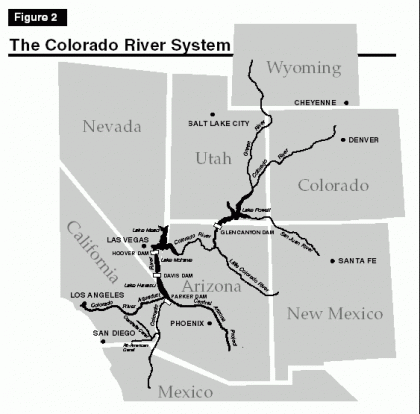
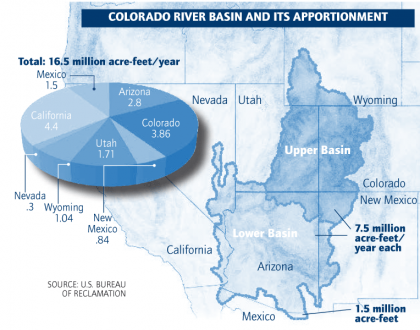
But effecting even more people is the snow melt* carried by the Colorado River downstream. Arizona, California, Colorado, Nevada, New Mexico, Utah, and Wyoming take an allocated and collective 16,400,000 acre feet per year. Problem is this amount, agreed to in a 1928 compact, is an inaccurate estimate of the actual annual flow of the Colorado. Based on tree ring data it’s somewhere between 13,200,000 acre feet and 14,300,000 acre feet a year. This is known by folks who deal with this complicated issue as “the gap.”
“Total population in the Colorado River Basin (CRB) increased from 4.56 to 9.44 million people from 1985 to 2010. Most of those people were in the lower CRB, with 86 percent of the total in 1985, and 90 percent of the total in 2010.”** The snowpack numbers, created by our annual snowfall, are critical not only here, because the Front Range and the Denver Metro rely on the Colorado River, but throughout the seven state CRB. These figures, almost invisible to the population of the humid east, are never far from the minds of government officials at the state, county, and municipal level here in the arid west, or the population as a whole.
The gap is a problem for obvious reasons. Drought years, like last year when the snowpack was well below normal, and the increasing population in the CRB both reinforce and multiply the effects of the gap. As the Water Defenders fighting the Dakota Access Pipeline repeatedly said, “Water is life.” These are not trivial matters, so seeing a healthy snowfall is a joy and a relief to all of us living out here.
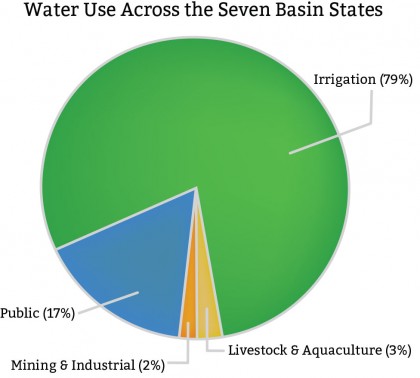
Finally, here is the problem that bedevils all those effected by The Law of the River, a web of compacts, federal laws, court decisions and decrees, contracts, and regulatory guidelines.* As this graph clearly shows irrigation is the largest claim on the CRB’s water by an order of magnitude. Add to that the allocation for livestock and aquaculture and 82% of the allocation goes to agriculture of one kind or another. We need food, those who grow our food need water. With public uses only 17% of the pie even the most draconian water policies in cities and areas like the Front Range will not move the needle much in total water use. Add to this the problem of the gap, droughts, and rapidly increasing populations, five of the fastest growing states in the nation are part of the CRB, then you can begin to imagine the tense negotiations required to maintain the status quo, let alone plan sensibly for the future.
So, as I said at the end of the first paragraph, let it snow. Please.
Kate’s wanting to get out and not just visits to medical facilities. Her stamina has improved some, she’s eating more. She’s still in the 80-82 zone, but I’m looking forward to her cracking 83. Then up from there. She’s laughing and smiling, things I didn’t see often over the last three months. Enjoying these moments. Both of us.
My Jewish Studies January event is past. My solo act as teacher of the 6th and 7th graders was yesterday. Both of these, the Jewish Studies and the religious school class weighed on me. In both cases I had the full responsibility for them and that old bugger, what if things don’t go well and what can I do to take make sure that they do syndrome. Not a bad thing under normal circumstances, even ordinary, but in these two instances I felt exposed, reluctant. I suppose it was garden variety anxiety, but it clouded my days for a week plus.
Tara teaching Hebrew with my class
When I went to H-Mart with SeoAh, I picked up ingredients for an Israeli salad. I had collected stories of loving-kindness, made a plan for using them. When I got to CBE, the vegetable dicer came out, a knife from the drawer and I got to slicing and dicing. Red pepper. Crunch. Whack. Roma tomatoes. Deseed, cut. Whack. Crunch. Persian cucumbers. Garlic. Parsley. Whack. Whack. Whack. A little olive oil, some lemon juice, a bit of mint. Toss. All the time I was talking to Leslie, a retired architect and city planner. She wanted to know how Kate was doing. The conversation veered to art. Leslie’s a docent at D.A.M., the Denver Art Museum. She offered to sponsor me when the next docent class comes up.
The kids began to come in. Isaac and his brother from the charter school up the hill. Sam from gymnastics. They trickled in, signing their names in Hebrew as an attendance check. Ryan, always on Ryan, came in with his mischievous smile. Robbie, tall Robbie. Charlie Mulvihill, whose bar mitzvah is on the 16th of February. Gwen. Liya. Jordan and Adam. Aaron. Gabe, who keeps bees with his dad, Dan.
Ryan, Tara, Liya
The class went well. The kids were attentive during a discussion of loving-kindness. I read stories of kindness from within the Jewish tradition and asked them to match me story for story. Soon they were pulling out stories from movies, books, their personal lives. Several mentioned Hunger Games. Witness. Wonder. One girl bought her sister a toy her sister couldn’t afford. Another gave $20 he’d received for toys to a homeless man. Tara, the director of religious education, then came in and did a Hebrew class on chesed, loving-kindness, reinforcing what we’d experienced from stories.
At 5:30, we start at 4 and finish at 6, they’d been so responsive, I suggested we play games. These are 6th and 7th graders and they have a lot of energy. They come to religious school directly from school so they’ve also been behaving all day. Fortunately we have the whole carpeted social hall for our class. We played (yes, I got down on the floor, thank you work outs) duck, duck, goose. Statue. And zap, the rules of which I never understood. At 6 they weren’t ready to leave.
My point in recounting this is to say why I continue to do these things. They bring such joy, if I can manage my anxiety. Which I usually can. With a little help from Zoloft, years of analysis, and a generally positive disposition. It’s a balance, taking responsibility and living a retired life. It can, and does, get out of whack like it has for me recently. When other matters keep up a drumbeat of stress and vigilance, the teeter totter can suddenly take a dive.
A good class, for example, reminds me why I put myself out there. Sheer joy.
Dull Knife/Sharp Knife, William Wegman (American, born 1943), Gelatin
A dull glaze coats my mind. Not all the time, but some. Forgetting things. Urgency softened, what to do next unclear. Forgot Deborah was doing the meditation at Jewish Studies. Slower at prepping for my Wednesday class. No painting. No writing. Drifting. Even with SeoAh and Murdoch’s energy infusing the house. Don’t like it, but it goes with the steady beat down of uncertainty, of traumas large and small. Yesterday, for example, I sat down in my reading chair, closed my eyes for just a minute. Woke up an hour and a half later. I’m getting good sleep at night.
We need good news unalloyed with hesitation or new symptoms. Though I feel Kate’s beginning to recover, she’s not gained weight. She had three days with nausea unrelated to eating. She sleeps several hours at night and naps often. I suppose chronic illness puts this patina on any couple after an extended time.
A friend from mussar has a vicious, rare degenerative disease called multiple systems atrophy, MSA, in its end stage. Another CBE friend is in the middle of seventeen weeks of chemo for cancer. Yet another is still recovering from a fall that broke her femur. Another CBE friend cared for her husband for several months until he died. We’re not alone. This is the present.
Even as I write this I can feel it lifting. Writing can be therapy, taking what’s inside, putting it outside where its outline clarifies, where it doesn’t rattle around contaminating the rest of the mind. There’s a stress element. There’s also an oh, I’ll just lean back and let things go past inertia. I can’t be on all the time. And, if I’m honest, I sometimes hit this slump without any outside influence.
Maybe it’s melancholy, a low grade version. Whatever it is, I’m tired of it. Exercise helps a lot and I’m back to that. Writing helps, but I’m stuck there right now. New novel trying to come to life; Jennie’s Dead still incomplete. Submissions stalled. Had the painting time with Ruth, then stopped. I feel guilty about this since SeoAh’s here taking off the cooking load.
Going to regain my verve. How’s not exactly clear, but I’m going to. Sorry for the Debbie downer tone here, but it’s where I am right now.
Richard Feynman, the physicist, had a technique for learning. It’s pretty straight forward in its explanation:
Choose a Concept
Teach it to a child
Identify Gaps and Go Back to The Source Material
Review and Simplify (optional)
I’ve not used it before, but I’m going to try now with reimagining/reconstructing faith. I hope that by clarifying it this way, I can further my year theme: Seeking the myth beyond reason.
To Gabe. What do you need to stay alive? Food, yes. Oxygen, yes. Anything else? A house or place to live, yes.
OK. Let’s start with food. Where does food come from? The grocery store. Well, that’s where we buy it. But where does the grocery store get the food? From trucks? OK. How about the trucks. Where do they get the food?
From farms? Right. And, gardens. And, orchards. And, the ocean. Can you guess my next question? Where do the farms and the gardens and the orchards and the ocean get the food? What’s that? Plants and animals? Right again. You’ve got this, Gabe.
Think about the animals for a minute, Gabe. What kind of animals do we eat? Pigs and chickens. Check. Cows. Check. Fish. Check. Shrimp and turkeys. Check. That’s enough for now. So. Where do the pigs, chickens, cows, fish, shrimp, and turkey get their food? You don’t know? What’s that? Grass. Yes, good. Cows eat grass don’t they? What about chickens? Insects? For sure. How about pigs? Well, some pigs eat acorns. Others eat roots, fruit, fish. Yes, fish. That seems strange doesn’t it? What about shrimp? What do they eat? They eat tiny, tiny plants that live and grow in the water. Fish? What do they eat? Some eat plants that grow in the water, some eat insects, some eat other fish and other ocean animals.
Did you notice that a lot of the food the animals eat comes from plants? Acorns, grass, roots, tiny plants that live in water? What about the rest? Insects, other fish? What do insects eat? Some do eat other insects, that’s right. Praying mantises, for example. But most insects eat plants. Grasshoppers do. Leafchewers. Some eat plant roots. Some eat the nectar, like bees.
Here’s the thing, Gabe. When you really, really look at what animals eat, even if they eat other animals, you’ll find that the animals they eat get their food from plants. That’s strange isn’t it? Does that mean we all get our food from plants? Well, yes, in a way. If the hamburger you like tastes good, it’s because the cows ate grass and corn and beans. Can you guess my next question?
Exactly. Where do the plants get their food? What an interesting question. Land based plants dig deep into the soil with their roots. Their roots take water from the soil and some other things the plant needs to live. Here’s what might seem like a weird question. What color are plants?
Green. That’s right, Gabe! What part of the plants are green? Their leaves. Right again. What? Oh, their stalks, too? Yes. On many plants that’s right. They’re green, too. Here’s the really, really weird part, Gabe. Those green leaves? They make food for the plant from sunlight and water and vitamins from the soil.
How do they do it? Even scientists have a hard time explaining it, but somehow the leaves take sunlight, water, and other things from the soil and make what the plant needs to live. Amazing, right? Sunlight, water, and nourishment from the soil. Nourishment? What does it mean? It just means anything that helps you live, or helps plants live. And you know what’s also amazing? Guess what the plants send out into the air when they’re done making food? Oxygen! That’s right, plants feed animals and they give off the thing we need to breathe to stay alive. Wow. Go, plants!
Now let’s see. Where are we, Gabe? You told me you need food to stay alive. And, oxygen. What’s that? Water. Water, too. We tracked down where food comes from, didn’t we? It all starts with plants and the sun and the soil and water. Plants get what they need from the sun, from mother earth and from the water on mother earth.
Sun. Mother Earth. Oxygen. Water. Without any of them, Gabe, you and Ruth and your mom and dad couldn’t stay alive. You’d die without oxygen which plants put into the air. You’d die without food, which plants create from the sun and water and nourishment (remember what nourishment is?) from mother earth.
Sol Invictus by Jake Baddeley
When it comes to what I’m thankful for Gabe, I’m grateful for you, of course, and your family, but I’m also grateful for the sun. The sun provides us with light, heat, and now we know it also plays a key role in providing us with food. Without sun the plants can’t make their own food. I’m grateful for mother earth. She provides nourishment for the plants and through them for us. I’m grateful for the water we have to drink. Did you know it gets made good to drink by going into clouds and coming back down as rain and snow? It’s true. I’m grateful for clouds and rain and snow, too. I like fresh water to drink.
Gabe, I know you’ve been raised Jewish. That’s the religion of your mom. I don’t know how important it is to you right now, but I remember it was important enough that you didn’t like Christmas when you were five. There are a lot of religions, aren’t there? Let’s see if we can name some. Christianity. Judaism. Islam. Hinduism. Do you know that one? It comes from India. Buddhism. Taoism. You may not know that one. It comes from China. Lots and lots more, too.
I used to be a Christian, a while back. But, not anymore. What is a religion, do you think? There’s so many different ones that it’s hard to say. To me religions are about what is most important to you. What matters. It might be your relationships with your mom and dad, or Ruth, or your friends. How are you supposed to treat those close to you? It might be about animals and how you’re supposed to treat them. Do you remember when Herschel died? Your great-grandma? Your great-grandpa? Did you ever wonder what happened to Herschel and your great-grandparents after they die? Me, too. I’m not sure, but it is a question most religions try to answer.
Do you suppose a religion could be about food and where it comes from? Oxygen and where it comes from? Staying alive is pretty important. We agreed on that earlier. Right now my religion, my thoughts on what are most important, is about food, oxygen, and the things that make them. The sun and mother earth are like a god and a goddess to me. Together they make it possible for you and me to be alive. Through their children, the plants and the animals, they make possible the whole wonderful world of zebras, dogs, Ruth, you Gabe, forests, seaweed, whales, tuna, peanuts, apples, and oranges. Pretty amazing.
Think of it, Gabe. The sun, that distant star that gives us daytime, the one we see everyday, provides us with the heat and energy to live. Mother earth, the ground we walk on everyday, that holds us up, that we see in parks and farm fields and mountains, provides a home for us and nourishment for the plants. The plants provide food for animals. And animals and plants make food for us. They also make our oxygen. You just breathed some in right now.
That’s enough for me, Gabe. The sun, mother earth. Their children. Us. When I drive through the forest, I’m driving in my church, my synagogue. When the rain or the snow falls on my head, it’s a holy act made possible by mother earth through her clouds. What’s that? You don’t know the word holy?
I think of the holy as something both amazing and mysterious. Imagine all the time you spent inside your mom’s womb, growing from two cells into the boy you are now. Amazing and mysterious. Think about a plant’s leaf taking energy from sunlight, mixing it somehow with water and nourishment from the soil to create food, give off oxygen. Amazing and mysterious. Or, how about the change from winter to spring when the cold goes away. Flowers come up. Trees put out their leaves. Grass turns green. Up here in the mountains you see fawns and elk calves. Amazing and mysterious. All holy.
And here’s one more amazing and mysterious piece. You were born on April 22nd, Earth Day, a day dedicated to Mother Earth. And, guess what. April 22nd was a Sunday that year. So you were also born on the day of the week that honors the sun. The sun and mother earth. You share a special relationship with them, Gabe.
It’s beginning to look a lot like Christmas, a couple of days late. 1 below this morning, fresh snow, just a bit. Black Mountain has on its winter dress. When I went to get the paper, the snow crunched beneath my feet and the air slapped my cheeks until they were red. One of the things I love about the snow is that it records at least some of the critters that came through our property. Rabbit, this morning, I think. Two. The waning gibbous Stent Moon was in the south, over Eduardo and Holly’s.
10 degrees on Shadow Mountain. A couple of inches of fluffy powder fell over night, a minor storm compared to what had been predicted earlier. The lodgepoles have white flocking. Black Mountain hides behind a gray blue cloud. The neighbor’s Christmas lights, now past their expiry date, still glitter.
Frustrated here by realpolitik. Can’t say more about it.
Kate’s Sjogren’s flare has subsided. She’s still fatigued, both from all the insults her body has received since September 28th and Sjogren’s. There may be an anemia component in there, too. Fatigue, when it’s constant, carries with it its own malaise. Sleep, get up for a bit, sleep some more day and night. Her face does not, however, have the stress lines brought on by repeated bouts of nausea and cramping, bouts that followed every meal until last Friday. That’s a marker on the road leading out of this mess.
I’m working in a slightly larger format now, 8×10 canvases, trying to think more about design. The Western icons idea will require more gathering of props. I turned to items I had close to hand. My favorite tools. Those of you who know me well know I’m not a shop guy, not a handy guy, but I do have some tools I love.
The learning curve in both astrology and oil painting slopes almost straight up for me. My mind gets short of breath at times. I remember this from Latin. Slog. Slog. Slog. Oh! “Confusion,” I read, “is the sweat of the intellect.”
Back in 1966 I was a very young student of symbolic logic. My second semester at Wabash. German had already defeated me and I was feeling the shock of intellectual challenges that seemed beyond me. Larry Hackstaffe, the professor who wandered around on off days with a six-pack of Bud hanging by one of its plastic rings from his belt loop, was a good teacher. After the D on a German test, a D!, my sense of myself was in trouble. Study. Study. In the library, in a carrel. My safe place.
The mid-term. When I sat down, my palms were sweaty and my socks uncomfortably moist. My neck hurt from slumping over in the study carrel. Larry passed out the blue books and the exam. And away I went, developing proofs, using the symbols like I’d had them from birth. That exam was a revelation to me. With hard work I could master something difficult, really difficult. I didn’t need the grade after that, though it was an A and I was glad. I had taught myself a life lesson, not in logic, but in persistence.
At almost 72 I’m no longer naive enough to think I can master anything, but I’ve proved to myself over and over that with patience (difficult for me at times) and either a good teacher or a lot of autodidactic effort, I can learn new things. Even new things that might seem unusual for me. Organic gardening. Beekeeping. Raising perennial flowers. Writing novels. Teaching Jewish religious school. Living at altitude. Cooking. The downside of this valedictory life, that’s a thing, is that I’ve not become Tolstoy or a commercial beekeeper or Top Chef, certainly no Latin scholar. But I have had the chance to peek behind the curtain of numerous activities I might have once thought, like German, beyond me.
A lot of blather to introduce you to some paintings by me. As you can tell, I’m still breathing hard, looking for handholds on the ancientrail of creating beauty, of making pigments tell their story, but I’m having a hell of lot of fun. As I am with astrology.
Not long after my December 1st, 2016, knee surgery, I had an odd moment. It was Hanukkah. Gabe and Ruth were plowing through their presents, and I sat on the couch, my leg up and some combination of pain meds circulating, morphine and oxycontin, I think. Ruth lit the menorah. A sudden, overwhelming (undoubtedly drug accelerated) sense of dislocation came over me. Sadness, too. What was I doing in this house? No Christmas tree. No decorations. This exotic holiday had pushed all that away and left me on the outside.
It was true nostalgia.* And it was painful. I swirled down, feeling a deep longing to get back to the seasons with which I was familiar. To push away this foreign intervention. To put myself under the Christmas tree on 419 N. Canal Street. All the way back. Not Colorado. Not Minnesota. Not Wisconsin. Indiana. An old fashioned, true to my culture Christmas.
Meanwhile Gabe was click-clacking a Rubik’s cube. Ruth held a money jar Kate had made for her. A fire crackled in the fire place and the menorah burned quietly on the dining table. No one knew I was somewhere else, sometime else. Here’s something from that day’s post:
2016
“The Christmas spirit that still flows around this secular, pagan heart saw them. (Hanukkah presents) And rejected the moment. What followed was a period of dislocation, the closest analogy I can give is culture shock.
What was I doing in this house with this holiday underway? Mom, Dad, Mary and Mark rose up. I missed them all, a lot. Further the friends from Minnesota. Why was I here in cold Colorado, in the mountains, when my family and friends were dead or far away?“
Having experience with the not so subtle influence of drugs on the mind, I knew this was both a false response and a true one. It was false in that I loved these kids, Kate, Jews all, and had begun to get more involved at Congregation Beth Evergreen. It was true in that Christmas spirit is a real thing, a tangible and mostly positive emotional state engendered by the church, by family, by memories of Christmas past, and, of course, by your favorite retail establishments. And at that moment I missed it.
Two years later the knee is fine, better than fine actually. I’m not using any drugs. (except at bedtime) And I’m much further along in the assimilation process I mentioned a few posts ago. My peri-Jewish identity has congealed around my membership at CBE. I’m part of a community I love, surrounded by people who love us and have shown that over and over again in the last few months. Love is a verb, after all.
Angelic host proclaiming the wonder of your birth
Last night was the night before Christmas. Today is Christmas day. The festive part of the day will be the big meal at noon and seeing Jon, Ruth, and Gabe at 2 pm. I’m ok with that. It feels like the right amount of celebration for us.
So. Christmas now has two components. One is much more tempered nostalgia than I felt in December, 2016, a warm spot from days now gone by. The second, and more important to me, is as a festival of incarnation, a celebration of the divine and human mixed inextricably together. As the bells ring out this Christmas day and churches the old familiar carols play, I’ll recall the folks I love, the animals I love. I’ll see past the mundane and look into their souls. There is the ohr. There is the divine. There is the sacred. And guess what? When I look in the mirror, I see the same thing.
*”…the term was coined by a 17th-century Swiss army physician who attributed the fragile mental and physical health of some troops to their longing to return home — nostos in Greek, and algos, the pain that attended thoughts of it.” The Guardian, Nov. 9, 2014
 Winter Waxing Moon
 When I went downstairs yesterday after a hard day at the easel (hah), I had my hearing aid in, but still didn’t hear something Kate said. I asked her to repeat it. She waved me off dismissively. Most of the time, I get it. It’s no fun having to repeat yourself. It can feel like I’m not paying attention or being respectful. Over and over. For some reason though, the dark vessel constructed in those first days of my deafness in my left ear, a vessel built to carry the notice that my body would someday fail me altogether, surfaced.
 In the wake of Kate’s dismissal 33 years of grief, of annoyance, of having to explain, of being handicapped-always, broke into consciousness. I felt overwhelmed by the accumulated sadness, anger, discomfort. Didn’t know I carried within me this complex. I’m imagining a black submarine navigating the seas of my inner world. When its bow first broke through the waters of my attention, it stunned me. Knocked me back. I took it out on Kate. Not good.
 Gonna look at material for the religious school class on the 16th. Alan will be back from Argentina. Our lesson theme is yirah, awe. Getting fifteen inches of snow over 36 hours creates yirah. We do not impact the weather, at least not directly. Yes, climate change is effecting the sorts of weather we get, but we don’t get to choose the diverse effects of our self-genocide. Fifteen inches of snow is like a volcanic eruption or a tsunami or a tornado, sudden, unpredictable except just before the fact, a natural act that changes the immediate environment dramatically. Though not as devastating as those violent manifestations, a great snow storm does show the power of the natural world, something to which we have to adapt rather than something we can manage.
 Yirah and kadosh, holy or sacred, go together. Rudolf Otto defines sacred as an experience of awe, yirah, and the mysterium tremendum et fascinans:
  Something experienced in ordinary life but also wholly other. I’ve been following a sailing race, the Golden Globe, in which several skippers competed against each other in solo jaunts around the world. Ask any sailor, solo or not, who’s navigated the roaring forties about yirah and mysterium. They’re manifesting every day, every hour in places most of us will never go; but, a few do. Wholly other, but also part of the same puzzling universe which coughed us up into life.


 Our first major snowstorm of the season is upon us. We’ve gotten 4 or 5 inches already and it’s only been snowing since midnight. May get 8-10 inches. Black Mountain has disappeared behind a gray-blue curtain, the lodgepoles look like flocked Christmas trees, and our solar panels have a 4 inch white blanket between themselves and the sun. No appointments today, no meetings. We can take this storm in as it comes, not see it as a barrier. We’ll get plowed today, I’m sure, so no worries there either. Let it snow.
 There are two other effects that are critical to life both here in the Colorado Rockies and in the southwestern U.S. A good snow season reduces the threat of wildfire in the spring and summer until the monsoons come. That effects Kate and me and our neighbors directly. It feels much better going into summer having had plenty of moisture for the trees and the soil. A good snow season also recharges our aquifers, makes sure we’ll have water throughout the next year. This is an immediate, right here result of good snow.
 “Total population in the Colorado River Basin (CRB) increased from 4.56 to 9.44 million people from 1985 to 2010. Most of those people were in the lower CRB, with 86 percent of the total in 1985, and 90 percent of the total in 2010.”** The snowpack numbers, created by our annual snowfall, are critical not only here, because the Front Range and the Denver Metro rely on the Colorado River, but throughout the seven state CRB. These figures, almost invisible to the population of the humid east, are never far from the minds of government officials at the state, county, and municipal level here in the arid west, or the population as a whole.
 Finally, here is the problem that bedevils all those effected by The Law of the River, a web of compacts, federal laws, court decisions and decrees, contracts, and regulatory guidelines.* As this graph clearly shows irrigation is the largest claim on the CRB’s water by an order of magnitude. Add to that the allocation for livestock and aquaculture and 82% of the allocation goes to agriculture of one kind or another. We need food, those who grow our food need water. With public uses only 17% of the pie even the most draconian water policies in cities and areas like the Front Range will not move the needle much in total water use. Add to this the problem of the gap, droughts, and rapidly increasing populations, five of the fastest growing states in the nation are part of the CRB, then you can begin to imagine the tense negotiations required to maintain the status quo, let alone plan sensibly for the future.
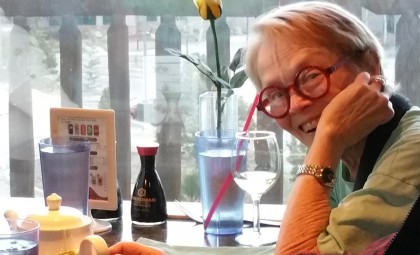 Kate’s wanting to get out and not just visits to medical facilities. Her stamina has improved some, she’s eating more. She’s still in the 80-82 zone, but I’m looking forward to her cracking 83. Then up from there. She’s laughing and smiling, things I didn’t see often over the last three months. Enjoying these moments. Both of us.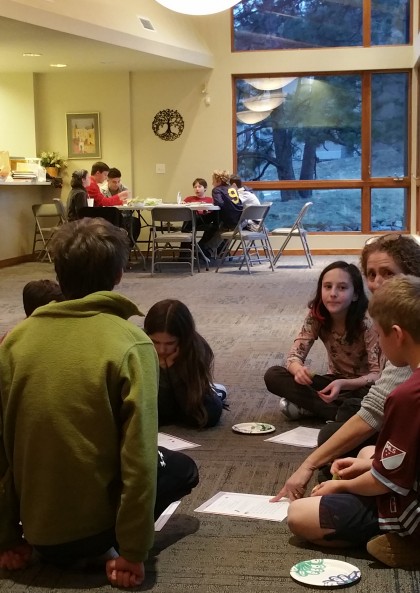


 Even as I write this I can feel it lifting. Writing can be therapy, taking what’s inside, putting it outside where its outline clarifies, where it doesn’t rattle around contaminating the rest of the mind. There’s a stress element. There’s also an oh, I’ll just lean back and let things go past inertia. I can’t be on all the time. And, if I’m honest, I sometimes hit this slump without any outside influence.
 Richard Feynman, the physicist, had
  OK. Let’s start with food. Where does food come from? The grocery store. Well, that’s where we buy it. But where does the grocery store get the food? From trucks? OK. How about the trucks. Where do they get the food?
 Did you notice that a lot of the food the animals eat comes from plants? Acorns, grass, roots, tiny plants that live in water? What about the rest? Insects, other fish? What do insects eat? Some do eat other insects, that’s right. Praying mantises, for example. But most insects eat plants. Grasshoppers do. Leafchewers. Some eat plant roots. Some eat the nectar, like bees.
 How do they do it? Even scientists have a hard time explaining it, but somehow the leaves take sunlight, water, and other things from the soil and make what the plant needs to live. Amazing, right? Sunlight, water, and nourishment from the soil. Nourishment? What does it mean? It just means anything that helps you live, or helps plants live. And you know what’s also amazing? Guess what the plants send out into the air when they’re done making food? Oxygen! That’s right, plants feed animals and they give off the thing we need to breathe to stay alive. Wow. Go, plants!
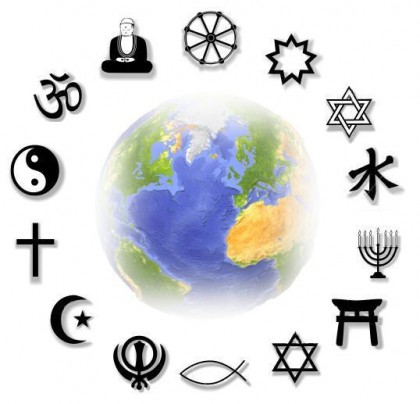 I used to be a Christian, a while back. But, not anymore. What is a religion, do you think? There’s so many different ones that it’s hard to say. To me religions are about what is most important to you. What matters. It might be your relationships with your mom and dad, or Ruth, or your friends. How are you supposed to treat those close to you? It might be about animals and how you’re supposed to treat them. Do you remember when Herschel died? Your great-grandma? Your great-grandpa? Did you ever wonder what happened to Herschel and your great-grandparents after they die? Me, too. I’m not sure, but it is a question most religions try to answer.
 Think of it, Gabe. The sun, that distant star that gives us daytime, the one we see everyday, provides us with the heat and energy to live. Mother earth, the ground we walk on everyday, that holds us up, that we see in parks and farm fields and mountains, provides a home for us and nourishment for the plants. The plants provide food for animals. And animals and plants make food for us. They also make our oxygen. You just breathed some in right now.
 I think of the holy as something both amazing and mysterious. Imagine all the time you spent inside your mom’s womb, growing from two cells into the boy you are now. Amazing and mysterious. Think about a plant’s leaf taking energy from sunlight, mixing it somehow with water and nourishment from the soil to create food, give off oxygen. Amazing and mysterious. Or, how about the change from winter to spring when the cold goes away. Flowers come up. Trees put out their leaves. Grass turns green. Up here in the mountains you see fawns and elk calves. Amazing and mysterious. All holy.

 10 degrees on Shadow Mountain. A couple of inches of fluffy powder fell over night, a minor storm compared to what had been predicted earlier. The lodgepoles have white flocking. Black Mountain hides behind a gray blue cloud. The neighbor’s Christmas lights, now past their expiry date, still glitter.
 The learning curve in both astrology and oil painting slopes almost straight up for me. My mind gets short of breath at times. I remember this from Latin. Slog. Slog. Slog. Oh! “Confusion,” I read, “is the sweat of the intellect.”
 At almost 72 I’m no longer naive enough to think I can master anything, but I’ve proved to myself over and over that with patience (difficult for me at times) and either a good teacher or a lot of autodidactic effort, I can learn new things. Even new things that might seem unusual for me. Organic gardening. Beekeeping. Raising perennial flowers. Writing novels. Teaching Jewish religious school. Living at altitude. Cooking. The downside of this valedictory life, that’s a thing, is that I’ve not become Tolstoy or a commercial beekeeper or Top Chef, certainly no Latin scholar. But I have had the chance to peek behind the curtain of numerous activities I might have once thought, like German, beyond me.


 Not long after my December 1st, 2016, knee surgery, I had an odd moment. It was Hanukkah. Gabe and Ruth were plowing through their presents, and I sat on the couch, my leg up and some combination of pain meds circulating, morphine and oxycontin, I think. Ruth lit the menorah. A sudden, overwhelming (undoubtedly drug accelerated) sense of dislocation came over me. Sadness, too. What was I doing in this house? No Christmas tree. No decorations. This exotic holiday had pushed all that away and left me on the outside.
