Beltane Sumi-e Moon
- I know how well you have succeeded in making your earthly life so rich and varied, that you no longer stand in need of an eternity. Having made a universe for yourselves, you are above the need of thinking of the universe that made you.
- On every subject, however small and unimportant, you would most willingly be taught by those who have devoted to it their lives and their powers. … How then does it come about that, in matters of religion alone, you hold every thing the more dubious when it comes from those who are experts?
- Friedrich Schleiermacher, On Religion: Speeches to its Cultured Despisers, 1799
 Faith. The middah of the month for Beth Evergreen. Emunah. Last night at MVP, the mussar vaad practice group, we talked about emunah. Rabbi Jamie and Marilyn said that in the early days of mussar classes at Beth Evergreen, some time ago, the middah that caused the most consternation was this one.
I can see why. Faith is a word often used, but little understood. Faith is also a word often abused both by religion’s adherents and by religion’s cultured despisers. (Friedrich Schleiermacher) Faith is a sine qua non inside any mega-church in America. Either you have faith or you don’t. Black and white. It was true for me as a clergyman in the Presbyterian church. When I could no longer claim with authenticity that I had faith in God (whatever conception of God I was using at the time), I could no longer serve in that role.
Religion’s cultured despisers, a term coined by Friedrich Schleiermacher in 1799 in his book of the same name, often use faith as a straw concept with which to flog the irrational religious. Faith makes people blind. Faith makes people malleable to cult leaders. Faith makes people believe in a magical world. Faith blots out a person’s capacity to see the world as it is.
 One of us in the group last night said, “The universe is for me.” I have other friends who believe the universe is a place of abundance, or, as author Gabrielle Bernstein titled her book, “The Universe has my back.” I don’t buy it. This abundant universe will kill you. It will kill you. This is not a matter of faith, but of oft repeated experience. The universe offers up all we need to live, then takes it all away.
I don’t believe the universe gives a damn. The problem for me is placing a value judgment on the actions of this vast context into which, thank you Heidegger, we were thrown. I don’t believe the universe is out to get me; nor do I believe it has my back. I’m a part of that universe and I can choose to live into my part, follow the tao as it manifests in my life, or I can resist it and struggle, but in either case the universe will keep on evolving and changing. Maybe what I’m saying here is that I’m not willing to shift the religious notion of God’s agency to the universe, no matter how construed.
If the universe is, as I believe it is, neutral to us and our lives, or, said another way, if we are no more privileged than any other part of the world, the cosmos, then what can faith mean? What is there in which to have faith?
 Turns out quite a lot. Another of us last night told a story of night diving. A favorite activity of hers. She said she turns off her diving light and floats in the night dark ocean. While she’s in the dark, she imagines a shark behind her. The shark may kill her in the next moment, but until that moment she is keenly alive. This is, for me, a perfect metaphor for faith. Each day the shark is behind us. A car accident. A heart attack. A lightening bolt. A terminal diagnosis. Yet each day we float in the dark, suspended between this moment in which we live and the next one in which we are dead. And we rejoice in that moment. There is faith.
 This is the existentialist abyss of which Nietzsche famously said, “If you stare into the abyss, the abyss stares back at you.” Living on in spite of its direct glare, that’s faith. This sort of faith requires no confidence in the good or ill will of the universe, it requires what Paul Tillich called the courage to be. I would challenge that formulation a bit by altering it to the courage to become, but the point is the same.
Here’s the interesting twist. Doubt and faith are partners. As a quote Rabbi Jamie offered last night says, they live in the same apartment building. Here’s the big learning I got last night. Doubt is the true sine qua non for faith. And to the extent that we have doubt, I would identify doubt with awareness of the shark, we have faith. There is, and this is the aha for me, a frisson between doubt and faith that makes life vital.
 So. My practice for this month involves, in Rabbi Jamie’s phrase, sharpening my doubt. I will remember the shark as often as I can. I will recognize the contingent nature of every action I take, of every aspect of my life. And live into those contingencies, act as if the shark will let me be right now. As if the uncertainty of driving, of interacting with others, of our dog’s lives will not manifest right now. That’s faith. Action in the face of contingency. Action in the face of uncertainty. Action in the face of doubt.
I want to sharpen doubt because I want to taste what it feels like to live into doubt, to choose life over death, to have the courage to become. If I only use the automatic responses, make money, achieve fame, watch television, play with my phone, immerse myself in the needs of another, or several others, then I blunt the bravery, the courage it takes to live. I do not want a life that’s but a walking shadow, a poor player that struts and frets his hour upon the stage. I do not want a life that is a tale told by an idiot, full of sound and fury, signifying nothing. (Macbeth, Act 5, scene 5)
I want a life that flourishes not in spite of the uncertainties, the contingencies that are all to real, but because of them.
 After sledging and searing the meat and softening the vegetables in the fat, I put a three or four pound hunk of chuck roast in the slow cooker along with potatoes, carrots, onions and celery. It cooked all day, coming out fork tender. An easy meal. Jon and the kids got stuck in traffic so they ate later.
 So. Couldn’t get the mower started. Last year’s fuel still in there. Don’t know how I missed that, but I did. Gonna have to siphon it out, didn’t feel like it yesterday. I did run the snowblower out of fuel last week, so that won’t be a problem come winter. I also got all the chairs and the table moved, the swinging chair and the yellow lounger, too. An outside space for eating, hanging out. Not happy with it yet. Also picked up a lot of loose wood, not all of it, but a good chunk. By the time I got to the chainsaw I was tired. And I don’t do the chainsaw when I’m tired. Too damned risky.
 In writing the short story Jail Break yesterday, I found myself tapping memories of my day at the Plaza del Toros in Mexico City. Hadn’t expected that, but it is a good example of how much travel can offer to writing. That trip was in 1994, I think. Still clear and present.
 A big Beth Evergreen week. Tomorrow is an adult ed session on linguistics. On Wednesday afternoon Tara, Alan Rubin and I meet with Rabbi Jamie to discuss the curriculum for the 6th/7th grade religious school. Tara (director of religious ed) started her note to us with, “You brave men.” Oh, my. Turns out the curriculum focuses on bar/bat mitzvah preparation. I’m honored that they trust me. This rite of passage is important, though not universally observed. Wednesday night is the MVP, mussar vaad practice group, Thursday has mussar and qabbalah.
 My presentation on time falls under the sumi-e moon and I plan to use sumi-e. I’m taking my brushes, ink, ink stones, red ink pad, Kraft paper, and rice paper. As well as my hourglasses. I will do Shakespeare’s soliloquy from Macbeth as a counter point. Each person will first practice an enso on the Kraft paper, then do one on rice paper.
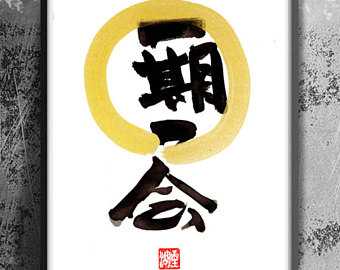 What is an enso? The word means circle in Japanese. In Zen it has a much more expansive meaning.* Zen is, of course, Chan Buddhism, a curious blend of Taoism and Buddhism created in China. Monks from Japan went to China to learn about Chan and brought it back to Japan. They also brought back the practice of drinking tea, which initially was a stimulant to help with long meditation sessions. It later transmogrified into the Japanese tea ceremony with its beautiful idea of ichi go ichi e, or once in a lifetime.
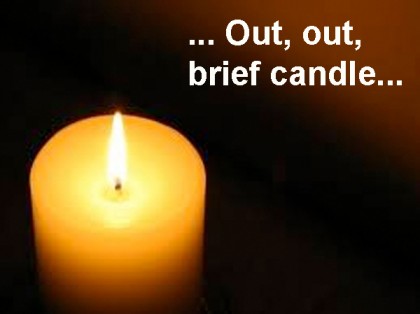 “Tomorrow, and tomorrow, and tomorrow,
 We’ve been pulling at the strands of various ideas about time, from measured time to eternal time to shabbat moments and the radical obvious, time is only ever the present. The past and the future have no reality, no agency, save in the present.
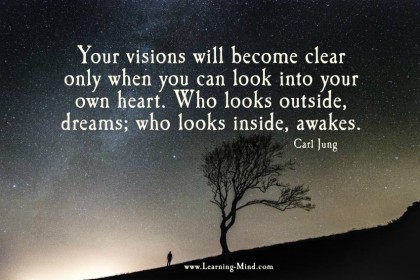 The answer he gave to his own question, with which I agree, was this. I’m not quoting. We do it to hold our notion of self more lightly, to give the ego a rest from its orientation to survival, to making it in the world. At the soul level, the most basic level of our human existence, we all connect. Think the collective unconscious, the divine spark, in the image of the sacred. In effect qabbalah posits an Oversoul, or better, an under or inner soul, the quality of which is the same for all humans.
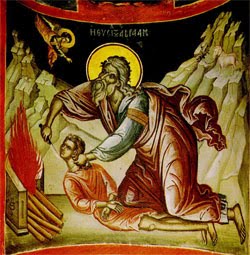 Been thinking about revelation. In a way I’m not sure is new, but I don’t recall seeing it anywhere. So, we have all these sacred scriptures. What makes them sacred? The claim is their autographic nature, written in some mysterious way by the hand of a god or gods. I’m going to bracket the claim of divine authorship and ask not about the content of the tales, at least not the content usually involved in exegesis and hermeneutics, but about the way revelation shows up in them.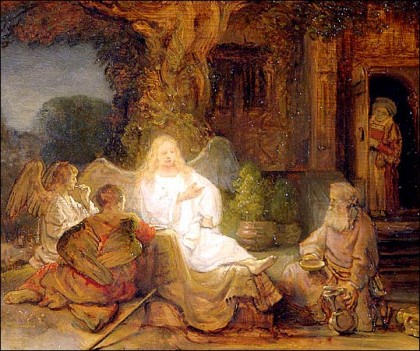

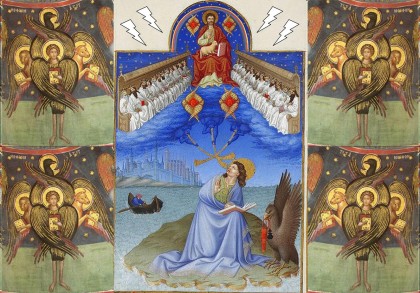 My first suspicion is that it is much like the nativity story, and perhaps the crucifixion and resurrection narratives, too, ex post facto events created to explain the origins and influence of remarkable individuals. Who would receive communications from beyond this reality? Individuals who’ve already been established as significant, powerful, influential. Like that guy Abraham, warlord, father of many children, father of our nation. How did he get where he is? He heard the still small voice. He understood things others of us missed. He was in touch with, what? Something many of us ignored, perhaps.


 Some of the more complete scrolls may have been the equivalent of library reserve. They could also have been retired scrolls which, like Buddha statues in Southeast Asia, are never destroyed. This visit left me wanting to know more, to return to the show before it leaves during the week for a quieter and lengthier visit.