Category Archives: Torah

What was/what is/what will be

Beltane and the Bar Mitzvah Moon

Monday gratefuls: Bar Mitzvah in two days. Paul and Tom coming. Ruth and Gabe. The gold Mogen David, shield of David, from BJ. Writing my D’var Torah. Interpretation of my Torah portion. See below. My Lodgepole Companion eating from Great Sol’s buffet of light. Rain yesterday. A cool night. The Rockies. The Appalachians. The Sierra Nevada. The Sawtooths. Kilauea. Mt. Etna. Yellowstone. Krakatoa. Mauna Loa. Mauna Kea. Haleakala. Magma. Lava. The living Earth.

Sparks of Joy and Awe: Altitude and depth

One brief shining: Rough bark on the Lodgepoles, no running your hand over it appreciating the surface as on the Aspen, the Lodgepole grips your skin, makes it sticky with resin; no smooth bark at the top either, it’s rough all the way up to the Lead, so I placed my palm on it feeling its ridges and wide spots, its less welcoming configuration, wondering why Trees make the Barks that they do.


Wanted to share the first draft of my d’var Torah.

My bar mitzvah Torah portion:

Exodus 19:25-20:1-2

19:25 So Moses went down to the people and said [this] to them.

20:1 God spoke all these words, saying:

20: 2 I יהוה am your God who brought you out of the land of Egypt, the house of bondage:


God self identifies here with the word, יהוה. Yud Heh Vav Heh. YHWH. Rabbi Lawrence Kushner writes: “…in truth these letters are unutterable. Not because of the holiness they evoke, but because they are all vowels and you cannot pronounce all the vowels at once without risking respiratory injury. The word is the sound of breathing. The holiest name in the world, the name of the creator, is the sound of your own breathing.”

Another turn on the sense of this God name that shows up thousands of times in the Torah is that it is a verb. That God is a verb, not a thing, not an entity. We might consider this as a translation: what was/what is/what will be. God evolves from the past into our present moment and on with us into the future.

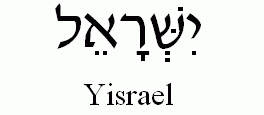
We can turn back now to the Shema: Shema Yisrael.  יהוה eloheynu. יהוה echad.  A translation with this definition of יהוה : Listen, God-wrestler. What was/what is/what will be is our God. What was/what is/what will be is one. (Pause)

Martin Buber famously suggested that there are two kinds of relationship: I-It and I-Thou. “The I-It relationship is one based on detachment from others…in which one uses another as an object. In contrast, in an I-Thou relationship, each person fully and equally turns toward the other with openness and ethical engagement. This kind of relationship is characterized by dialogue and by “total presentness.”[i]

Returning to the Shema and we God-wrestlers. What was/what is/what will be is one. An I-It relationship imagines we can detach a person, a Tree, a Mountain, an ocean from the one that we know as what was/what is/what will be. Alfred North Whitehead called this a fallacy of misplaced concreteness. It is a violation of the interconnectedness we proclaim every time we say the Shema.

Rabbi Rami Shapiro calls the move from I-It to I-Thou a change from narrow mind to spacious mind.[ii] In narrow mind we foreclose on possibility, limit our understanding. Most dangerous of all, we deny the interconnected reality of the One.

Here’s an example of narrow mind. A commentary on the American Dream, especially in the West: “Propelled by our ambition to remake ourselves, we careen past one another, oblivious to the fact that we’re following a pattern as old as our country.”[iii] 

(Pause)

Mizrahim. Egypt. Or, the narrow place. Or, the place of bondage. It is godly to move from the narrow mind, the narrow place in our psyche, to the spacious reality of our true bond, our literal oneness with all that becomes and is becoming.


We can now understand, I believe, Rabbi Rami Shapiro’s reframing of this first commandment:

“I יהוה am your God who brought you out of the land of Egypt, the house of bondage”

as a kavannah, an intention:

  1. “Spirituality is a source of liberation. Aware of the suffering caused by enslavement to things and ideas, I set my intention to free myself from all addictions and compulsive behaviors, both material and spiritual.”[iv]

This is teshuva as Shapiro defines it, returning to the whole you, the one  made in the image of what was/what is/what will be, and knowing all of you lives embedded in a glorious reality always evolving and becoming something new.


[i] Lucy Fishbein on Sefaria

[ii] p. 80, Judaism Without Tribalism, 2022, Monk Press

[iii] NYT article about Ted Kaczynski

[iv] p. 129, op cit


In the Weeds. Skip if not interested

Spring and the Moon of Liberation

Wednesday gratefuls: Marilyn and Irv. Spinal stenosis. Pain. Writing. Art date. Morning pages. Great Sol blasting us with fusion energy. Green Lodgepole Needles. Black Mountain. Blue Sky. Shadow Mountain strong. Our lives and the challenges we face, the moments that define us. Our favorite places. Earth. Our orbit around Great Sol.  Yod Heh Vav Heh. The ineffable. The unutterable. The necessary name. I was. I am. I will be. YHWH is one.

Sparks of Joy and Awe: the tetragrammaton

One brief shining: There is a moment, an eternal moment, one still entrained in the vast sweep of eternity, when we find ourselves, know who we were, who we are, and who we will become, in that moment we instantiate the four letter name of God, we are godly, god corporeal, god within the world, god as hands and feet and heart for justice, mercy, and love, this moment is always and long, extending over your whole life.


Feeling theological today. Here’s my torah portion in English:

19:25 So Moses went down to the people and told them.

20:1 Then God spoke all these words:
2 I am the Lord your God, who brought you out of the land of Egypt, out of the house of slavery
I can now say this in Hebrew, pronouncing it from the Torah text which as I said a few days back has no vowels and no punctuation.
Will also have to write a brief dvar Torah. An interpretation of these verses. Look forward to that. Going to concentrate on the word translated Lord here, the yod-heh-vav-heh name, YHWH, and which by long custom is usually pronounced in Jewish readings as either Adonai, Lord, or Hashem, the name.
Plan to refer to Rabbi Arthur Green, Rabbi Jamie’s mentor and former President of the Reconstructionist Rabbinical College. He suggested a version of the Shema in which the word Adonai is said aloud while picturing YHWH in the mind. Jamie told me about this. This is now and has been my practice since I learned about it. Not sure what Green’s notion is, but here’s what I get from doing it over and over.
 Adonai and Hashem are sort like cover bands for the tetragrammaton. They show a certain level of respect for YHWH, but in fact obscure it and its power. The true name of God, in Jewish tradition, is unpronounceable and unwriteable. Therefore, as Ludwig Wittgenstein once said, or almost said, “Of it we cannot speak.” YHWH can be pronounced and written. Its meaning may be obscure. Rabbi Jamie teaches that it is a mashup of verbs, not a noun, and many agree with this reading. Including me.
If we follow the verbal idea, the name means something like I was, I am, I will be. Sorta makes sense as a description of the one, the unity that is all things according to Jewish theology. How I view this “name” lies not in its identification purpose-this is God’s name-rather in its process and metaphysical claim. What was, what is, and what will be is in fact the source of Torah, the claim that an interconnected, interdependent whole best expresses the reality in which live, and move, and have our becoming.
We are bound up in the pastness, the presentness, and the futureness of reality. Inextricable from it, contributing to it, having to interact with it. If we enter into a covenant with reality, saying that we will not separate ourselves from each other or from the world around us, then we act consciously and creatively to advance the whole, not pretending that certain people are different and therefore bad, not pretending that the world outside our homes and offices is not also our home, not pretending that we have a way to wall ourselves off from each other through towers of wealth or knowledge or power.
Humility and awe. That’s the what all this suggests to me. Live with humility and awe.

Shabbat

Shabbat post. Wrote one I decided to keep private, but I’ll be back later today with a new post.

Imbolc and the 77 Moon

Shabbat gratefuls: Snow. Cold. Winter Storms. Bringing Water we need. My own tiny Aquifer. A steel blue overcast Sky. Black Mountain gone. (I suspect it’s still there, though) Lodgepole Branches gathering Snow. The Supreme Court. Alan. Relationships. My life’s focus these days. Including with myself. Bereshit. Mishpatim. Parshas I’m studying now. That Shabbat feeling. Candles.

Sparks of Joy and Awe: The Eye

One brief shining: The Lodgepole out my window has Branches focused toward the east, toward Great Sol’s return appearance after a Mountain night; on Their west side, where Their colleagues grow, the Branches never emerged, the same true for Others who face out toward the open air with an eager reach, why waste energy where it’s all shade anyhow?


Shabbat once again. Interesting for me since the shabbat rules focus so much on not working, on relaxing from the daily grind, on staying home. Gee, sounds every day of the week for me. That does create an odd problem. How can I keep the spirit of shabbat if its traditional focus no longer seems appropriate. What does it mean to me to rest from my “regular” obligations? Or anyone retired, for that matter.

So far I’ve focused on a few aspects of shabbat, like lighting the candles at the time indicated by Chabad. That does have an interesting grounding effect. The time, 18 minutes before sundown, gradually moves, during this season, later and later in the day. Yesterday it was 5:11 pm for the Denver area. Saying the prayer, reconstructing its meaning, and lighting the candles makes for a defined starting point for shabbat. Ritual.

Reading the parsha for the week is another aspect. This week it’s mishpatim or Exodus 21:1–24:18 which contains many rules and regulations plus Moses’ ascent into the cloud on Mt. Sinai. My favorite commentator, Aviva Zornberg has a commentary, The Particulars of Rapture, which analyzes and interprets each parsha. In weeks past I’ve read her commentary after reading the parsha.

This week though I’m also reading the very first parsha, bereshit, or beginning. Genesis 1 through the story of Cain and Abel and the lives of those who preceded Noah. Also reading Zornberg’s commentary, The Beginning of Desire.

A nap has been part of most of my shabbat’s so far. For those of you who know me well, I’ve stopped taking naps for the most part. I also watch some TV. Eat breakfast and lunch. Workout.

This week, yesterday, I also attended a torah study on reproductive rights online. Rabbi Jamie. The Jewish position is clear, a fetus does not become a person until the first breath or, according to some rabbi’s, when the head crowns. In most cases of pregnancy it is an obligation to save the mother’s life first if an emergency occurs.

Shabbat has a different texture from the other days of my week. The priority on not doing worklike activity does color it for me. So does the candle lighting ritual and the emphasis on torah study. It is harder for a single person, retired and living alone, to fit into even a modest version of the traditional shabbat with its focus on family and nearby friends. Not my goal, though I appreciate the feel of that one.


Fire

Imbolc and the Cold Moon

Friday gratefuls: Alan. Snow incoming. Joanne. Marilyn and Irv. Rabbi Jamie. Leo and Luke. Mindy. Ginny. Janet. Ellen. Carol. Thursday mussar. A steel gray Sky. The yellowback running for President. Old Joe Biden. Democrats. Those who used to be Republicans. The Electoral College. To its demise. Mountain roads. Wild Neighbors. My Indiana home. The Sycamores.

Sparks of Joy and Awe: New Harmony, Indiana

One brief shining: Luke asked me if I had gotten my extra ear back off the table from Thursday mussar, the Roger he meant, the small flying saucer like device that glows green when it’s on, taking in speech from my left or across a table in a noisy restaurant, cleaning it up and delivering it via Bluetooth to my fancy schmancy hearing aid; Amy my audiologist says it reduces fatigue from straining to hear and understand. Believe she’s right.


I’ve written before about collecting my medical guardian, my hearing aid, my phone, my fitbit before I head out. Old age and technology add accessories to wallet and keys. Now I have to remember my Roger, too. The watch pocket on my jeans. Perfect fit. I also have to remember to pick it up, too, since I lost my first one at Gaetano’s with Alan. Getting more used to using it when I’m out. Especially since my ability to filter ambient noise has deteriorated.


The metaphor we’re discussing in Thursday mussar is fire. We began with a general conversation about fire itself, how humans have, uniquely among all living creatures, learned to use it. How it requires destruction. How it takes three things: fuel, spark, oxygen.

The most interesting aspect of Thursday’s session focused on the burning bush. This episode in Exodus occurs fifty years after Moses left Egypt, having killed an Egyptian overseer. Moses has become a shepherd and has herded his flock into the desert around Midian. He notices a fire burning off to the side of his path. Curious about it he turns from the path he was on to take a look. At some point he realizes the bush is on fire but not being consumed. God notices that he has turned aside to look and calls to him from the bush: Moses, Moses. Moses replies, “Here I am.”

If you recall, I wrote earlier about the difference between the higher criticism I learned in seminary and the Jewish approach to the Torah. The conversation yesterday at Beth Evergreen highlighted that difference. The question was not where was Mount Horeb, near which the bush burned. Or what was the history of Midian, beyond what the Torah offers as the place where Moses met his wife Zipporah while in exile from his homeland, Egypt. We didn’t examine the form of the text or its history at the hands of redactors or in the various historic texts of the Book of Exodus.

No. We discussed what was going on first. Moses turned and looked. He noticed the bush was not consumed. A messenger of God appeared to him, then God himself. In this episode Moses receives his call to return to Egypt and confront Pharaoh. To initiate the liberation of the Hebrew slaves.

Here’s what fascinated me about our conversation. We went from Moses observing a burning bush to the burning bush as metaphor for Moses’ own enlightenment. Moses had been on fire since leaving Egypt with a passion for his enslaved people. But he didn’t know what to do, if anything. Suddenly, while in the desert alone, in a place of solitude, it comes to him that he has to return to Egypt and do what he can to liberate them. Even though he feels inadequate to the task.

We then discussed the nature of revelation and how metaphor gives us a language to speak of our own experiences of revelation and the capacity to more deeply and personally understand the Torah as revelation. This is it. Emerson’s a religion of revelation to us in our time.

With this twist and one with which I agree. That the Torah and the Upanishads and the Tao de Ching and the New Testament and the Quran are not the dry bones Emerson found them to be, but a history of others who have walked the path of openness to the vast and sacred reality in which we live. They are our spiritual ancestors who have much to teach us about how to recognize and integrate those mystical moments when our own Reed Sea parts, when we stop from herding the sheep of our life to look at our bush that burns but is not consumed.


Oh, Colorado

Winter and the Winter Solstice Moon

Sunday gratefuls: Ancient Brothers. Rat Zappers. Predictions. Black Mountain. Gray white Sky. Cold. Good sleeping. Reading. Zornberg. Pendergast. Tanakh. Will Harris. Adaptation to climate change. Fiction. The Sun Brothers on Netflix. Antisemitism. 45 loses. Goes to jail. Brothers. Beef. Fish. Vegetables. Fruit. Chicken. Salads. Soups.

Sparks of Joy and Awe: Sharp knives

One brief shining: With reluctance the Rat Zappers all four came out of their comfortable resting place after slathering a bit of peanut butter into each one they deployed to the kitchen counter top and the two runways of note in the lower level not long before red lights started blinking signaling an electrocuted mouse and I had to shake them out dropping dead mice in the snow.


Yes. A Mouse assassin. The night of the long knives for Shadow Mountain mice. What tipped me over? Salmonella and hanta virus. At my age? Not a good thing. Chewing through electrical wires. Also not good. So. A small electrocution chamber for each and every one. Also, a commitment to put the Zappers out at the first new sign. Type to act like a responsible home owner and less like a sensitive guy. Reality. Bah, humbug.


Shabbat yesterday. Saw Ginny and Janice for breakfast at Primo’s. Read Zornberg on the first parsha in Exodus and the introduction to her commentary, The Particulars of Rapture. Began the shabbat with lighting the candles yesterday at 4:30. Saying the bracha, the blessing. Still not in the rhythm of shabbat. The old restrictions seem/are outdated, yet a certain mix of expectations and behaviors set shabbat apart from the other days of the week. Haven’t gotten mine fully figured out yet. It will come.


Not taking classes right now, self-guided reading and the reading for conversion. Don’t want even the gentle prods of classes, regular times. I’m not a recluse though I have my Herme/hermit qualities. Seeing friends or family on zoom and in person is important to me. Not a cloistered dude high in the Mountains. Yet if I can have whole days alone, maybe most of my days alone, I smile.


Getting ready to go pick up groceries. Worked out this morning after the Ancient Brothers zoom.


Paying attention, brief attention to two weird news stories. That Alaska Airlines Boeing that popped open a door shaped hole in its fuselage. I mean, wow. Minimal safety standards include no holes in the airplane while it’s in flight. A lot of clenching going on in the fearful flyer group. Also, Boebert. Punching her husband while out to eat? He called the police. She says nothing happened. Oh, Colorado passing strange you are at times.


The Name

Winter and the Winter Solstice Moon

Friday gratefuls: Luke’s hug. Ginny. Jamie. That dream last night. Ooph. Leo. Eleanor. Kingsley. 3 sweet dogs. Gracie, too, of course. Emunah. The Shema doubled Adonai and Yod Hei Vav Hei. Mezuzahs. Snow last night. 13 this morning. More Snow on the way. Clouds: transience unveiling permanence. Water Vapor. The Sacred. Rock, steady safe reliable foundational. Godly. Snow, too.

Sparks of Joy and Awe: Emunah

One brief shining: Hands over my eyes I say the Shema pronouncing Adonai but seeing the tetragrammaton, Yod Hei Vav Hei, my intention a moment of seeing things as we want them and things as they are, saying with the saying of it that I now travel along that dusty desert road that leads out of Jerusalem and into Europe, to the United States, to anywhere we Jews have gone since the days of the Second Temple and before.


Art Green, Jamie’s mentor and still close to him, either created this practice or told Jamie about it. Pronouncing Adonai and at the same time in your mind’s eye seeing the tetragrammaton or YHWH. Jewish tradition is to never pronounce YHWH but replace it when reading the Torah with Adonai, master or Lord. This practice began in the third century and even applies to English translations of the word. The notion is that the name is too sacred to say aloud.

Not sure about that myself though names in the ancient world had magical power. If you knew someone or something’s true name, you could control it through spells. Blasphemy wouldn’t be a big enough idea to cover trying to control God. So, better to err on the safe side.

What Art Green’s practice offers is a chance to see the resonance between this covering of the true name and the convention used to honor its sacred nature. Or, seeing things as we want them and as they are. Not only applicable to seeing the sacred even when clothed in a Lodgepole Pine or a house or a person or a Dog, but also to remembering that we most often do not see truly, but see as we wish to see. And also note that neither word is anything more than a metaphor for the great swirling sacred mass that is us and our Earth and our universe and our past, present, and future. Some may call that God. Others YHWH.

Some Jews these days say Hashem instead, the Name, instead of even using Adonai. I like that, actually. Hashem takes away the hubris that repels so many of us when we see the word God and turn away from that oh too baggaged word trailing with it patriarchy, militarism, hierarchy, oppression, outright manipulation. Then maybe we can entertain the idea of our unique and precious part in the whole, a living creative becoming that wants each of its parts, all connected, to know and support one another.

Well. This site will not turn into a Jewish practices site, I promise. Yet from time to time things that have struck me will appear. Today was one of those.

Faith

Winter and the Winter Solstice Moon

Wednesday gratefuls: Marilyn and Irv. Tara. The dark. Gradualism. Getting things done, slowly. Surrender. Emunah. Faith. The Jewish Way. Mussar. Torah. Shabbat. Holidays. Zen. Taoism. Easy Entrees. Kavanah for 2025. Choosing a way forward. Including surrender. On signs and portents. Trash day delay. Mark, mail carrier. Ana and Lita, housecleaners. Vince, handyman and Snow plower. Helping me live independently.

Sparks of Joy and Awe: Surrender

One brief shining: Opening my arms and leaning back, letting 2025 come at me with all its got while I smile and wait knowing this next year is the one I’ve been waiting for, the one when magical and miraculous things will happen, when love will be the only thing left, when I will once again live as I’m meant to with human and wild, life and death, intellect and ignorance.


I could explain it with cognitive bias. Or whatever it’s called when you have something front of mind and you keep seeing references to it in newspapers, books, hear it come into conversation, happen upon a magazine article that features it. But I won’t.  Let me give an example. Long ago I bought an Anne Rice book featuring angels. This maven of the vampire world decided to write a book about goodness instead of evil, I guess. I liked Lestat and the Mayfair witches so I’d give it a go. It was on my Kindle and I never got around to it.

This week I picked it up. It has, in the beginning, a heavily Roman Catholic emphasis and if you know Anne Rice that won’t surprise you. What surprised me was the main story line about Jews in thirteenth century England. It would have been a curiosity to me when I bought the book, now it has existential meaning. This is not a great book by any means, though an offhand comment by Fluria, a bright and capable Jewish woman, struck me. She spoke about Jews in Oxford being harassed, their homes burned, “It spreads like a plague,” she said, worrying about her community in Norwich. Oh, just like Israel v. Hamas affects Jewish life in the U.S.

My inner life has taken a new direction and my mind reinforces it whenever it can. Yes. But why did I pick up the book now? Why did my decision to convert coincide with the Israel Hamas tragedy? I chose emunah, faith, as my mussar evening long before I chose to convert. Now it challenges me, as I wanted it to, in a way much different to what I intended. How did it happen that I would have a bar mitzvah?

I’m choosing to surrender to the notion that cognitive bias works in mysterious ways its wonders to perform. That my new, dare I call it faith, in a Jewish life comforts and supports me, gives me confidence that my life will grow in purpose and love. That’s what my conversion meant. For me, Judaism evokes faith in a grounded experience, one rooted in the soil of Mother Earth and in the souls of my sacred community, nourished by compost from a rich and varied tradition.


In Shabbat

Winter and the Winter Solstice Moon

Saturday gratefuls: 6-8 inches of new Snow coming tonight and tomorrow. White Christmas. And, yes, it still matters to me. The dark. The long Nights. Christmas Eve. Christmas Day. Chinese restaurants. Home movie. Quiet days. Shabbat. Today. Till 5:52. Leonard Bernstein. Maestro. Love stories. Action films. Art house cinema. Vayigash. This week’s parsha. Zornberg. Green. Ellis. New blinds. John Ellis. Evergreen Shutter and Shade.

Sparks of Joy and Awe: Christmas

One brief shining: Down the hill to Evergreen at night and after Thanksgiving some Lodgepoles and Ponderosas become pillars of light with bright multi-colored bulbs running from crown to base, how they do it I don’t know, I drive past following the curves and watching the lights, trying to remain on the road, sometimes it’s hard to do both.


I’m in my version of Shabbat until 5:52. Still working on what it means for me. Probably going to breakfast at Aspen Perks, see the wait staff there before Christmas. Seeing and being with friends is part of mine. I also read the parsha, Vayigash this week. Each parsha gets its name from the first word of the passage. This week Joseph reveals himself to his brothers and Jacob/Israel makes the journey to Goshen. I’m reading some commentaries, too.

Hang on here. I’m gonna get a bit into the weeds.

Avivah Zornberg writes commentaries that are rich in psychoanalytic and midrashic thought. Midrash are commentaries written by rabbis, mostly from a long time ago though they’re still being written today, too. Jewish encounter with the biblical text differs a great deal from the hermeneutical method I was taught in seminary. Higher criticism.

Exegesis came first. That meant using various critical methodologies like redaction criticism, seeing how various texts were edited, form criticism, sussing out whether the text conformed to, say, a prayer or a covenant or a song form, historical criticism, what was going on in the time period in which the text was written, textual criticism, how had this text fared in different editions of the bible over time. As well as others. The exegetical task was to find what the text meant in its day, sort of an originalist approach to the text.

Then came the hermeneutical task. How did this passage and its message, as determined by exegesis, relate to our time. After that the homiletical work, writing the sermon, could begin.

The Jewish approach can include the exegetical approach. Rabbis learn what critical methods have discovered about biblical texts. And, there is a lot of material to access. However, the Jewish approach that I have come to appreciate relies very little on higher criticism. Higher criticism seeks the best information about what the text meant in its day. Jews play with the text. Search in it for hidden meanings, word play, the human story. Or, the way the sacred reveals itself.

In the story of Joseph, for example, Joseph’s brothers throw him in a pit, then take his coat, dripping with blood from a lamb, and give that to Jacob, his father, saying they don’t know what happened to him. Jacob says it looks like a wild beast has torn him apart.

Instead of spending time on exegesis Zornberg dives right in. The pit can represent nothingness, ayin, the same nothingness from which God created the world. Joseph’s brothers consign him to ayin both by throwing him in the pit and by taking his blood soaked coat to Jacob. Jacob though is not completely taken in. He says it looks like a wild beast has torn him apart. He leaves open whether Joseph is dead or alive.

But. Joseph is now absent from him and will be until the revelation comes to them about Joseph in Egypt. So, Jacob experiences Joseph as being in nothingness. Because of the blood. Zornberg then riffs on blood and what it can mean like bloodline, life, sacrifice. There are also the themes of sibling rivalry, deception, a father’s deep love for his son, as well as the parallel story of Joseph’s journey into Egypt and his rise to power there.

I like the focus on longer passages, on whole narratives within the text. I also like an approach that seeks multiple meanings in the same text, acknowledging that we all approach not only Torah but everything in our life from distinctive places. That we see differently and conclude differently. It’s the frisson among the differing ideas raised in the Jewish encounter with the text that is the point. Not finding the meaning or message of the text, no, finding the messages and meanings of the text. A prismatic truth rather than a single truth.


Prismatic Truth

Samain and the Choice Moon

Saturday gratefuls: Gabe. Legos. Night 2, Hanukah. Lighting the candles. The electric menorah. Snow. lotsa Snow. Spaghetti. That free car wash. Blizzaks. Big O. Starbucks. Evergreen. Ruby in the Snow. Kate of blessed memory. Jon, who would have been 55 tomorrow. Mussar. Books, all books big and small. Stacked and unstacked. Read and unread. Reading. What a joy.

Sparks of Joy and Awe: Ritual

One brief shining: That Arcosanti bell Kate got so long ago on a visit to her Dad in Phoenix, the one we decided to use as a memorial bell for all of our dogs which now rings in the high Winds of the Mountains for her, too, and Jon, has a large white cap of Snow in the quiet weather of this morning.


This holimonth I’ve been getting gifts from strangers. The Thanksgiving meal at Urban Farmer. Yesterday the car wash. An attendant flagged me through saying I didn’t have to pay right then. The owner said, I’m ok with free. However. Just looked up on my credit card and I did get charged. Well, it was nice when I thought it was free.

Had my new Blizzaks replace the 4 mm tread tires on the back. Good thing. Right now there’s more than 5 inches, maybe more like 8, of fresh new Snow. Have to head over to Safeway for a pickup order which is delayed. I imagine fewer staff with the Snow.


Spent a lot of time reading yesterday. Finished Zornberg on the week’s parsha, the story of Joseph and his brothers, part 1, in which they toss him in a pit, imply to Jacob that he’s been killed, and he gets sold into slavery, bought by Potiphar. That one. Zornberg’s commentaries lean toward the mythic and the psychoanalytical. She sees themes of dismemberment and the power of blood in these stories. I do, too, after reading her.

Torah study is very different from the higher criticism I learned in seminary. In higher criticism the aim is to find the truth of a passage using language, history, the history of tradition and ritual, textual comparisons, how a text was originally received, to get at what was originally meant, then using that original meaning to comment on today.

In Torah study the search is not for the truth, but for the prismatic truth each parsha contains. That sort of truth depends on the interpreter, on what they see or don’t see in the text. Different points of view are not only expected but cherished. Commentators on the Torah argue with each other and their arguments often take on a status equivalent to the parsha itself. The mishnah records Torah commentators since the fall of the second temple.

In the Joseph and his brothers story for example Zornberg uses some of the mishnah as actual Torah text to make her arguments. And this is not unusual. The result is a playful approach that looks for things hidden, things inferred, things that have meanings because they intersect with the ordinary lives of Jews then and now.

The patriarchs are far from perfect. Isaac gives Jacob his birthright blessing and underwrites it even after he learns he’s been deceived. Jacob fears his encounter with his now grown brother Esau whom he cheated out of both birthright and inheritance. Jacob’s sons dislike their brother Joseph so much that they try to get rid of him. These are not, in other words, exemplars of truth and wisdom, but people faced with difficult decisions and sometimes, even often, choosing poorly.

This approach makes Torah study a much more human endeavor, not requiring the power of revealed truth, rather requiring careful and attentive reading done with both living company and the thoughts of long dead Rabbis.

Love

Lughnasa and the Waning Crescent of the Herme Moon

Sunday and Monday gratefuls: The Trail to Cold Mountain. Off book. Kristie. Off meds? Sunday’s Ancientrails, forgotten. Unusual. The Ancient Brothers on love. A morning with Rich and Ron. Also about love. Burn away everything but love. Study today. Jewish identity. Cool and Foggy morning. Good sleeping. Ready for packing. Cable organizer. Reinforcing off book for the Trail to Cold Mountain. So many wonderful people in my life. Korea and Israel. Same continent. 5027 miles apart. [Osan to Jerusalem]

Sparks of Joy and Awe: Good friends

One brief shining: A bowl filled with strawberries, blueberries, black berries, and slices of mango sat by a wooden cutting board with lox heaped upon it next to a lazy susan with cream cheese, capers, cut onions, almonds warm cut bagels on my plate as Ron and Rich and I sat together talking mussar, parenting sons, writing, such a good morning.


I have now a surfeit of riches. Wealthier than I could have dreamed possible. And, yes, in terms of money, too. More important than money though friends and family who love me. Whom I also love. Who will open themselves to me and I to them. A wonderful morning yesterday as an example.

The Ancient Brothers gathered on zoom to talk about love. Ode talked about Robert Bly’s connected universe, all atoms linked to each other in a grand chain of becoming. As are the atoms in each of us. Bill added Buckminster-Fuller’s Cosmic Plurality:

“Cosmic Plurality”

Environment to each must be

All there is, that isn’t me

Universe in turn must be

All that isn’t me AND ME


Since I only see inside of me

What brain imagines outside me

It seems to be you may be me

If that is so, there’s only we

Me & we, too

Which love makes three

Universe

Perme — embracing

It-them-you-and we


Paul offered Rilke:

Widening Circles

I live my life in widening circles
that reach out across the world.
I may not complete this last one
but I give myself to it.

I circle around God, around the primordial tower.
I’ve been circling for thousands of years
and I still don’t know: am I a falcon,
a storm, or a great song?


Tom reminded us of the love we learn from the dogs in our lives, the angels of our youth and of our old age. Of kindness. Of the sweetness of vulnerability.


I spoke again of the gift given to me between Mile High Hearing and Dave’s Chuckwagon Diner: The purpose of life is to burn away everything but love. If we perfected a just society, we could live only in love with each other. So to burn away everything but love, seek justice. If we could see the ohr [the shard of sacredness, divine light] in each other, in all Trees and Rocks and Roads and Flowers that love Great Sol and Mule Deer and Elk and Mountain Lions and Bears and all Mountain Streams and all Rivers and Oceans and in the Air we breathe, we would cry out in revelation like Mohammed, like the writers of the Torah and like Matthew, Mark, Luke, and John, there, the sacred, it’s right there! And we could/would love it all.