By Textefuermedizin – Own work, CC BY-SA 4.0, Cyber knife (looks sort of ominous, doesn’t it?)
Cancer seems to move the wheels of medicine a bit faster than other things. My axumin scan will happen on May 14th. A radioactive molecule of an amino acid, leucine, cancer cells take up axumin “avidly” according to Blue Earth Diagnostics. PET scans can observe this activity through gamma ray emissions. According to one website, each dose of axumin costs between $3,000 and $4,000. My cost will be much less, probably around $200.
On May 17th I meet with the radiation oncologists at Anova Cancer Care. Dr. Gilroy will review the axumin scan and use it to recommend a treatment plan. Given the velocity of these matters I imagine the treatment itself will happen soon after.
How this effects Kate and me is uncertain right now. She still has a diagnosis of her lung disease ahead of her, which might entail a lung biopsy, as well as the surgery to place the j-tube. These may happen concurrently. If she’s recovering from surgery and I’m receiving radiation? Not sure how that will be.
Geez. Downbeat. I know. Wish my reality were different. Oh jinn of the lamp where are you? Even so, it’s life. Kate asked me if I was thinking, why me? I said no, never. Why? Because I’m human and we’re frail creatures, our bodies a compromise between life and entropy. Entropy always, always wins.
Korea Hydro and Nuclear Power has started up its new Shin Kori 4 reactor
The technology involved in all this fascinates me. My buddy, nuclear engineer William Schmidt, studied the underlying physics of it all, utilizing nuclear power to create electricity. Now it will find those little bastards that want to advance the entropic time schedule for my body. When my prostate was cancerous, I wanted it out. In this situation there is no thing to cut out, no organ to remove. It’s similar, I think, to a forest where small fires have been ignited by lightning. None of the small fires, in themselves, will destroy the forest, but they have the potential to kindle whole forest consuming wildfires.
I looked at myself in the mirror yesterday. The same. The seven small scars from the DaVinci robot in a jagged curve, hardly visible. Yet, somewhere inside something nasty is happening. My former internist, Charlie Peterson, said we’re all black boxes to a certain extent. Right now, hanging between my psa numbers and the axumin scan, I’m in a limbo where all I know for sure is that there is some cancer, some where in that torso.
Not depressed, but melancholy. A heaviness settles in at some points, some staring. Numb, like my whole body rests on my crazy bone.
Had to go at this head on, today, while it’s fresh. When I got to my appointment with Anna Willis, Dr. Eigner’s P.A., the first person in the room was Eigner himself. Grayer and thinner, he smiled, shook my hand. When I said it was good to see him, he said, “It’s good to see you, too, but I’m not happy about the reason.” When I told him my anxiety made me move the decimal place on my PSA, his relief was obvious, “Thank god.” Anna came in about then.
They both remembered me. Anna remembered my glasses and our visits. Eigner remembered me partly because I’d sent him a couple of emails over the years thanking him, telling him about my life. It was one of the warmest visits I’ve had in a doctor’s office and that felt good.
Davinci robotic arm, Sky Ridge (where I had my surgery)
Turns out though. “When you’ve been perfect (a .1 psa which means essentially undetectable) and that changes, it’s scary.” He went on to say that it most likely does mean a recurrence, a relatively rare thing for those who choose prostatectomy, even rarer if the pathology report read, as mine did, clear margins. Clear margins means no cancer was found on the outside of the prostate. The best news.
Dr. Eigner took out a piece of paper and drew a sort of oblong on it. “This is the prostate. They can’t take sections from every part, so they take representative slices. If the cancer is between those slices, it won’t show up on the path report.” Oh, shit.
Since it is three and a half years since my surgery, and since the number for the uptick is relatively small, it means the recurrence is probably local, that is, in the area where the prostate used to be. That’s good news, much better than metastasis.
The plan is to redo my PSA in three months, doing the super sensitive one that can take the numbers 3 or 4 places rather than just two. If it’s still rising, I’ll get a referral right away to the oncologists to discuss radiation. “We’ll just go in there and kill it,” he said. “If you were older, I’d tell you not to do anything. This will take ten years to manifest anyhow, but at 72 you’ve still got a lot of life ahead of you.” That’s my opinion, too.
the Prostate Specific Antigen
Radiation has some potential downsides, so I hope we don’t have to go that route. But, as I said to Kate, I’ve always chosen treatments that offer the best chance to remain active, and alive. I chose repair for my torn Achilles even though it means two months of no walking and crutches for a good while after. I chose knee replacement over other treatment options because I wanted to continue exercising. I chose a radical prostatectomy because that gave me the best shot at a cure. Likewise here, if radiation is the option that gives me the best chance to survive and thrive, I’ll choose it. No doubt.
All that’s the rational side, and that’s pretty damned important because these are high risk, high reward decisions. But they’re not all of it.
On the way back from Eigner’s I drove through Deer Creek Canyon. When my biopsy confirmed my prostate cancer in 2015, I drove Deer Creek Canyon, too. Going through there I felt the rock, rock so old that our human scale word ancient is quaint. This rock rose millions of years ago and it will slowly soften, the rough edges frozen and thawed, rained on, plant roots will crack them, and Deer Creek will carry the pebbles and sand to the Platte River on its way to the Gulf. Not only will I be dead long, long before then, it may be that the human race will have ended itself well before then, too. This comforts me.
Laramide Orogeny, 70 million years ago, begun. 35 million years ago, ended. Built the Rockies
William Cullen Bryant’s “Thanatopsis” came to mind. See the opening stanza below.* He goes on to make the point that the earth itself is a great tomb, holding all those who once lived. Again, this comforts me. Death has not chosen me for a special fate. No, death itself is a universal for all who live. It seems harsh and cruel, yet it is, rather, the opposite. Death ends suffering. Allows the world to carry many creatures, but not all at once.
Here there were Utes and Apaches, Comanches, too. And even they were not the first. Older humans preceded even them. And before all came the Rockies, then the trees, the lodgepole pines and the ponderosa and the bristle cone, the aspen. Mountain lions, deer, elk, rabbits, raccoons, pikas, prairie dogs, bison, moose, wolves, fox, martens, fishers, beaver. All here before humans, most will be here after we are gone. I can look at the lodgepoles in my front yard and know that their direct ancestors flourished here thousands of years ago and will do so after I’m dead.
All this brackets whatever troubles I may experience, even cancer. And cancer may be that friend that carries me off to the mighty sepulchre. Or, it might be something else. Whatever is my death-friend will not be an enemy, but the specific cause of my life ending. And that is, for all of us, in spite of our fears, a good thing.
Kindred Spirits by Asher Durand William Cullen Bryant and Thomas Cole
* “To him who in the love of Nature holds
Communion with her visible forms, she speaks
A various language; for his gayer hours
She has a voice of gladness, and a smile
And eloquence of beauty, and she glides
Into his darker musings, with a mild
And healing sympathy, that steals away
Their sharpness, ere he is aware. When thoughts
Of the last bitter hour come like a blight
Over thy spirit, and sad images
Of the stern agony, and shroud, and pall,
And breathless darkness, and the narrow house,
Make thee to shudder, and grow sick at heart;—
Go forth, under the open sky, and list
To Nature’s teachings, while from all around—
Earth and her waters, and the depths of air—
Comes a still voice—
Yet a few days, and thee
The all-beholding sun shall see no more
In all his course; nor yet in the cold ground,
Where thy pale form was laid, with many tears…
The oak
Shall send his roots abroad, and pierce thy mould…
Whoa. Tiger Woods won the Open. After 11 years of shame, rehab, shambling along. A victory for aging. For never letting go of the dream. For living into the present and the future, not being bridled by the past. I’m glad, for all of us.
Tax day. Still puzzled by the acrimony taxes create. Taxes express our solidarity as citizens of this nation. They do the work of road building, of feeding the hungry and housing the homeless, of war fighting, of space exploration, of consumer and environmental protection. Or, at least they do under reasonable, non-tyranny leaning Presidents. I’m happy to pay them, federal and state and property. Always have been.
Do I always agree with the use to which my tax dollars are put? Of course not. I understand the nature of politics. It’s about compromise, about negotiating the differences we have. Politics define how we live together as a people, at least in the public sphere.
No taxation without representation. That was the Boston Tea Party demand of King George. Its corollary is that when you have representation the taxes are legitimate, whether you agree with their aims or not. If not, change your representation.
There’s an article in this morning’s NYT titled, “Is America Becoming an Oligarchy?” I wrote a comment, “Whaddya mean, becoming?” That is, of course, the trouble with our government and with the notion of representation. I know that. It doesn’t make no taxation without representation inapplicable, rather it defines the struggle ahead.
Further down the page was an article titled “Want to Escape Global Warming?” It features Duluth as a climate-change proof city. Which, I imagine, makes Canada look pretty good, too. With decent forest management Conifer could be such a place, as well. Duluth’s a great town, situated between the Twin Cities and northern Minnesota, sitting on the largest body of fresh water in the world save Lake Baikal in Siberia. Kate and I considered moving there when she left Metro Peds.
Menu from a 1999 visit
60 today here in Conifer. Snow later in the week. Colorado.
And, my appointment with Anna Willis. I have some anxiety though my rational side says it’ll be fine. At least I’ll get a professional opinion about my rising PSA. What’s life in the third phase without a little medical frisson every once in a while?
Friend Tom Crane and Roxann have returned to Minnesota after several days on Maui. To snow and cold. Of course. They stayed at the condo near Duke’s restaurant on Kaanapli beach while the grandkids and their parents were with them and moved to Mama’s Fish House Inn after.
Mama’s has been a favorite spot of Kate and mine’s since our first trips to Hawai’i. Celebrated several birthdays there. Mine, since Kate’s CME’s often fell in February, a great time to be someplace else other than Minnesota.
Go now, the illness has ended. Feeling 95%. Still something in my lungs, not much. So seven weeks after the molasses filled drive back from Denver, I feel able. Still got workouts and stamina to increase, but I enjoy that. Imagine me doing a little dance on the balcony of the loft, a dance of thanksgiving for a strong constitution and a return to the unremarkable state of health.
What’s next? Call a plumber to fix the toilet leaking from its seal to the floor. Get our hair done. An appointment for teeth cleaning. Mail the taxes. Send Mary the letter confirming her part ownership of that oil well in Canadian County, Oklahoma. Finally get to my trainer for a new workout. Follow up on that PSA increase. Kate’s hi-res ct and visit to the pulmonologist. Get back to regular cooking. You know, stuff. Stuff that we do when we’re not occluded by an internal war between our immune system and some inner space invader.
I also have a lunch with Alan Rubin on Wednesday. Slowly getting back to some contact with CBE. It’s been a long while, but I miss those folks. I was still besnotted during the chicken cook soup cook off and not fully there.
If you want, you can insert a youtube video of Leonard Cohen’s “Hallelujah” here.
Remember the Producers? Zero Mostel? In it was the classic hit, “It’s Springtime for Hitler”. Well, it’s springtime in the Rockies and all of Colorado. Here’s another pirouette for great comedies and a plié with arm extended for the beauty of Black Mountain.
Not to go too far with this but there is a certain element of resurrection here. I used the word occluded, another word could have been buried. During a long and severe illness we turn in on our selves, our world becomes a primal struggle over which we have little if any external control. By primal I mean just that, a fight waged between cellular creatures so small we cannot see them, entities that have more in common with that first molecule that wiggled in the primordial soup than they do with us. During this conflict the body focuses on the struggle, not on errands, to do lists, future dreams, present possibilities. We become buried by the constant back and forth of immune system versus virus, immune system versus bacteria.
Now, sometimes, but only once, our body doesn’t win. That’s true burial or cremation, or going green into the ground, whatever carcass disposal mode suits you or your survivors. However, most of the time we emerge, as if in a Hammer film, from our undead state to once again walk among the tribe of the still living.
And, yes, in that state now, I feel resurrected, reborn, renewed. A little shaky perhaps but that fits such a state doesn’t it? What’s next? Not in the quotidian sense I mentioned above, but what’s next in the sense of “Tell me, what is it you plan to do with your one wild and precious life?” Mary Oliver was the poet of our intimate relationship with mother earth. She listened, saw, felt what it meant to be embodied, to be embodied in this amazing natural state, this gift, this once in a lifetime reality that we are.
This one, my wild and precious life, my one wild and precious life, has been returned to me, or at least that’s how it feels. What, as the city planners say, is its highest and best use? I’ve had ideas before, but this is a chance to consider what that means now: 72, mortality signals falling like rain, yet invigorated and experienced, befriended and befriending, not alone, well read, ready. What will I do?
With Spitlers and Zikes as two family lineages that feed into mine (Dad’s mom and Mom’s mom), I have plenty of German blood. And even more German culture because it seems to be the one that influenced my upbringing the most. I’m punctual, a bit obsessive about intellectual matters, have a very defined view of physical property and its sanctity, duty and commitment are bedrock for me. Of course there are other influences, too, that Irish and Welsh blood, the majority English ancestry, but those cultures didn’t seem to carry as much weight in my childhood.
Over the course of time I’ve read many German authors and loved them Goethe, Hesse, Mann, Kafka (Austrian), Rilke among them. In spite of my philosophy degree though I only found one German philosopher with whom I resonated and that was Heidegger. The German penchant for systematic thought stuck somewhere in my head, making my think I should produce at least one work in that vein. And, I’ve never been able to do that. Although systematic thought attracts me as a thinker, doing it I find too restrictive, a prison for the mind. It tends to be very culture bound no matter what wonderful insight kicked it off. (Hegel discovered that 19th Germany was the pinnacle of human development, for example.)
When friend Tom Crane passed torschlusspanik along to me, it vibrated down those personal paths: the ancientrail of ancestral culture, the ancientrail of philosophical thought. I felt it more than understood it.
It’s real. I love the image. Death as a gate closing off possibility. I suppose you could say that it’s another version of fear of death, one pressing a bit more against the bone as time passes. The third phase notion I’ve played with for years now is the domain of torschlusspanik. As we pass out of the family and career oriented second phase, our life necessarily includes the reality of approaching death.
What I call mortality signals begin to crop up more frequently. Kate’s bleed, for example. The struggles with oxygen. Glaucoma testing. That 3rd phase kidney disease. Sure, we get these earlier in life, too. When my hearing went in my left ear, I realized my body would not always work as it had. Death is the ultimate expression of the body no longer working as it had. At 38 though I could take the hit and diffuse it over the number of years I imagined I had left. At 72, a different matter.
I watched “Free Solo” this week on Hulu. In it Alex Honnold, the man who free soloed Yosemite’s famous El Capitan, the best wall in the world according to Alex, says, “I don’t want to be happy and cozy. Nothing great ever came from happy and cozy.” You have to hear him because he’s about to climb without rope, with nothing more than his hands and feet and chalk dust, a 3,000 foot plus sheer wall of rock. One mistake and you’re dead as he and others say many times. In another scene, talking Sanni Candless, his girlfriend, who wondered out loud about the danger he faced, he said, “Are you asking if I’m going to optimize my lifespan? No.”
Doesn’t seem like torschlusspanik is going to be much of a problem for Alex. He represents, I think, one end of a continuum. On his end he lives in to the opportunities that present themselves. That’s his raison d’être. On the other end of the continuum are the procrastinators, the never leave the couch (happy and cozy) types. There also the ones stunned early on by social convention, who live their lives according to someone else’s script, looking to external values for legitimation. And, the fearful ones. Who let anxiety about what might happen, or what might not happen clog up their days. Many other types, too. Narcissists. Psycho and sociopaths. You know who they are. Or, perhaps, who you are.
The rest of us fall somewhere between Alex and the damaged folks. On the damaged end of the continuum (and remember we’re talking only about the degree to which torschlusspanik is likely to impact you) it’s not to difficult to imagine a lot of regrets, of disappointments, of wish I could have and it might have been me. That gate might have started closing early, keeping them on the other side, or; it might be starting to close now. What can I do?
And so we return to the question of success that I broached several weeks ago. As I’ve written this piece, I realized that success fits into the stunned early by social convention trap. It is an external value against which we can evaluate our actions, our work, our marriage, our domestic life, our work. Alex, our exemplar, knows what he wants to do. He know how to do it. And, he wants to be great. To do great things. He did. Scaling El Capitan without ropes has been called the greatest athletic achievement of our time.
But I don’t get the sense that he’s measuring his success against other climbers. Rather he seems to be in competition with himself. To be better. To try harder. To reach for the edge of his limits. And, there we are. The answer to the success question. It’s not about external values and evaluators; it’s about the inner drive to know who we are, who we can be. It’s about the sometimes desperate need to express our truth, in whatever medium or context, or shrink away from our life and begin to die. If we have done that, lived into our truth, worked to express it, given ourselves to it time and time again, then the question of success fades away.
I guess you could call it a free solo approach to living.
OK. You guys win. Extreme Minnesota macho points earned these last few days. And, I saw that Paul Douglas predicts a 100 degree temperature swing! 100 degrees. You wouldn’t want to hear that if it was 52 outside and the direction was up, but in this situation, hallelujah brothers and sisters! Thank you, Jesus. And, Mohamed. And, Moses. Meanwhile up here in the tropical Rocky Mountains we’ve had mid-40’s for highs.
Yesterday. OMG. I pushed myself past some inner limit, way past. When I got up, it wasn’t a hop of bed, ready to greet the day moment. It was a let’s pull the blanket back over my head, switch the electric blanket back on and quit the world at least for the morning moment. Not a good time.
I had to make chicken soup with matzo balls (made by Kate). I had to take the soup to Golden with Kate. I had to go to CBE and teach the first hour of religious school, then head out for Aurora and Jon’s show. While down there, I had to go to Maria’s Empanada’s and get a dozen for Kate. I could head back up the mountain.
Any of these things separately, happy, joyful tasks. All of them on the same day, a day that started with fatigue on waking? The happiness and joy would have to be in retrospect. I make chicken soup from scratch, with a whole chicken, cut up celery, onions, carrots, and garlic sauteed first. Wine to deglaze. Add water, lot of water. The chicken in its wire mesh cage. Wait for it to boil. Up here, longer than normal. An hour or so of simmering, then a package of frozen peas and one of frozen corn. Another ten minute. Retrieve the chicken, set it out to cool. Later, pick the meat from the bones. Put it in the soup. A lot of standing.
Got a lie down while the soup boiled, but it didn’t prove very restful. Back at the stove I finished the soup. At that point, time to go to Golden. About a 40 minute drive there, 40 minutes back. Dropped off the soup, 18 cups of it plus matzo balls. Back home to let Kate out. On the road right away to CBE. Spent a couple of hours there, getting food ready, talking to the kids as they came in. This was a first semester review. That went ok.
When Irene came to lead the dreams workshop, I left to go Aurora. This was at 5:00 pm. After a brutal hour and twenty minutes, I was in the gallery, talking to Jon about his new work. When I hit the big traffic on 6th street, congestion that lasted all the way across the city, my body began to resist what I was doing. I got sleepy, inattentive, restless. Just wanted to go home. Felt miserable. Wasn’t even close to my destination. Denver does not have a way to travel from east to west, west to east without encountering either dense urban traffic, or dense, worse freeway traffic on I-70. At 5 pm, that missing artery makes the lives of any one going either way awful.
I’m not describing this well. I was a runner in a marathon. My resources had tapped out around 5 pm. As I got onto 6th street going east past Santa Fe, I hit the wall. Still had to cross Denver, get into Aurora, see Jon, then Maria’s. By the time I pulled out of the Stanley Marketplace parking lot, empanadas steaming in their cardboard box, I had half the marathon to finish. But I was already finished. My bed, however, was over an hour away, 45 miles, the first 20 miles back across the Denver metro. No choice.
Leaving Highway 6 going west, merging onto I-70, then 470, I began to wonder if I was going to make it home. My attention was split between fatigue and the road. At 72 there are many parts of driving that are essentially automated. They took over. I tried to remind myself to watch that car ahead, find the Fairplay exit, slow down in Morrison. It felt like I was carrying the car up the hill toward Shadow Mountain.
Kate, bless her heart, cleaned up most of the kitchen, something that was weighing on me. Get home, beyond exhausted, and clean up? OMG. Usually I clean up right away but the time frame of the day made that impossible. She’s doing better, not gaining weight yet, but she’s willing to pitch in now and again. This time it really mattered.
This morning I’m still bushwhacked, wrung out, sleepy, but I finished the marathon and slept in my own bed. A good start. Read a Harvard Business Review article, Resilience is not about enduring; it’s about recharging. That’s my job today, maybe tomorrow. Recharge.
Wednesdays have a tendency to get busy. Today, for example. Make soup, eat some, deliver the rest. Drive Kate back home and myself over to CBE for religious school. At 5 pm Irene will do a class on dreams. I’d love to stay for it; but, when she comes, I’m leaving and heading over to Aurora for Jon’s opening. Looking forward to seeing his new prints. As I’ve mentioned before, Aurora (the sun rises first on the Denver metro in Aurora) is almost as far away as the airport. Drive home, then. This is retired busy, of course, with much more choice involved than obligation.
Monday was 4 months since Kate’s bleed and subsequent hospitalization. Weight gain still eludes her, possibly because shortness of breath, waking up nauseated (some days), lack of stamina, and her dry mouth from Sjogren’s Syndrome make eating a chore, a have-to, not a want-to. Whatever it is, we both feel stuck, wheels spinning on the icy surface of recovery. Not sure where we go from here; but, it’s life; so, moving forward even without clear direction.
Gertie’s healing up from her latest experience as a pin-cushion for Kep’s canines. She’s still a little down, a little sore, but she’s up and moving around. Dogs typically don’t linger over insults. Look at all the tripods. Kep has no remorse, that’s part of not lingering over results. Rigel, our healthiest big dog ever, has developed a strange habit. She eats some out of her bowl, walks away from her food to the glass in the outside door, looks outside, then returns to eating. This may happen a couple of times in a feeding.
After a mussar friend did a short riff on responsibility, I began to wonder about my role here. Her husband died of a lingering illness, took months. She says, “I look back and am certain my husband and I would have fared better had I interpreted my responsibility as being his wife rather than his nurse (just commenting in broad strokes).” She went on about a party. “I recently hosted a large party and, in contrast to my usual MO, relinquished some of the logistics in favor of engaging and having fun with my guests; to a person, each told me it was the best ever.” And she finished, “It makes me reconsider the languages of love: gifts, acts of service, quality time, words of affirmation, and physical touch.”
Am I really doing what I need to be doing? I’ve emphasized cooking, laundry, some cleaning up, grocery shopping, being present with Kate at the hospital, rehab center, doctor’s appointments, taking care of the dogs, other home related chores. Am I replacing doing with graceful being? Not an either or. The domestic chores have to get done, but am I not husbanding enough? This is not an abstract question. It’s present to me right now. Do I need to learn new languages as my friend suggest?
These are difficult questions that every couple has to answer throughout their marriage. Illness can make them fraught.
Kate’s wanting to get out and not just visits to medical facilities. Her stamina has improved some, she’s eating more. She’s still in the 80-82 zone, but I’m looking forward to her cracking 83. Then up from there. She’s laughing and smiling, things I didn’t see often over the last three months. Enjoying these moments. Both of us.
My Jewish Studies January event is past. My solo act as teacher of the 6th and 7th graders was yesterday. Both of these, the Jewish Studies and the religious school class weighed on me. In both cases I had the full responsibility for them and that old bugger, what if things don’t go well and what can I do to take make sure that they do syndrome. Not a bad thing under normal circumstances, even ordinary, but in these two instances I felt exposed, reluctant. I suppose it was garden variety anxiety, but it clouded my days for a week plus.
Tara teaching Hebrew with my class
When I went to H-Mart with SeoAh, I picked up ingredients for an Israeli salad. I had collected stories of loving-kindness, made a plan for using them. When I got to CBE, the vegetable dicer came out, a knife from the drawer and I got to slicing and dicing. Red pepper. Crunch. Whack. Roma tomatoes. Deseed, cut. Whack. Crunch. Persian cucumbers. Garlic. Parsley. Whack. Whack. Whack. A little olive oil, some lemon juice, a bit of mint. Toss. All the time I was talking to Leslie, a retired architect and city planner. She wanted to know how Kate was doing. The conversation veered to art. Leslie’s a docent at D.A.M., the Denver Art Museum. She offered to sponsor me when the next docent class comes up.
The kids began to come in. Isaac and his brother from the charter school up the hill. Sam from gymnastics. They trickled in, signing their names in Hebrew as an attendance check. Ryan, always on Ryan, came in with his mischievous smile. Robbie, tall Robbie. Charlie Mulvihill, whose bar mitzvah is on the 16th of February. Gwen. Liya. Jordan and Adam. Aaron. Gabe, who keeps bees with his dad, Dan.
Ryan, Tara, Liya
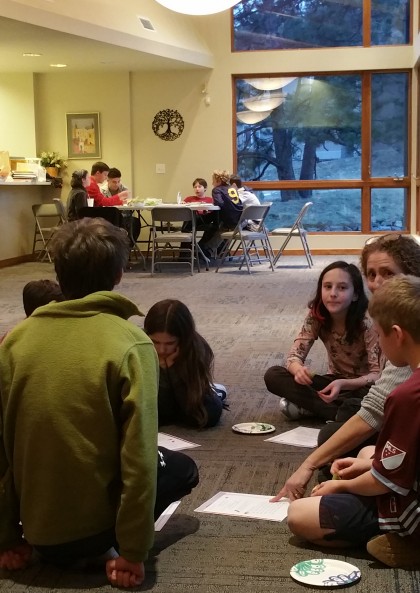
The class went well. The kids were attentive during a discussion of loving-kindness. I read stories of kindness from within the Jewish tradition and asked them to match me story for story. Soon they were pulling out stories from movies, books, their personal lives. Several mentioned Hunger Games. Witness. Wonder. One girl bought her sister a toy her sister couldn’t afford. Another gave $20 he’d received for toys to a homeless man. Tara, the director of religious education, then came in and did a Hebrew class on chesed, loving-kindness, reinforcing what we’d experienced from stories.
At 5:30, we start at 4 and finish at 6, they’d been so responsive, I suggested we play games. These are 6th and 7th graders and they have a lot of energy. They come to religious school directly from school so they’ve also been behaving all day. Fortunately we have the whole carpeted social hall for our class. We played (yes, I got down on the floor, thank you work outs) duck, duck, goose. Statue. And zap, the rules of which I never understood. At 6 they weren’t ready to leave.
My point in recounting this is to say why I continue to do these things. They bring such joy, if I can manage my anxiety. Which I usually can. With a little help from Zoloft, years of analysis, and a generally positive disposition. It’s a balance, taking responsibility and living a retired life. It can, and does, get out of whack like it has for me recently. When other matters keep up a drumbeat of stress and vigilance, the teeter totter can suddenly take a dive.
A good class, for example, reminds me why I put myself out there. Sheer joy.
Over to the second H-Mart with SeoAh yesterday. This one is smaller than the one in Aurora, but is much better organized. It’s more like a US supermarket though with very different stock. The Aurora H-Mart is more like an Asian market. I love the produce, the array of seafood, and whole cold storage displays filled with things I can’t identify. As you might expect, there is also an amazing range of sushi, sashimi, (left) noodles, soy sauces, frozen dumplings, other prepared foods like soups and sauces. The beef is all Kobe beef, wagyu, but raised in the U.S.
At the checkout I said to the cashier, “You have to be able to recognize a lot of different produce items. Do they train you?” “Yes, we have two weeks of training.” She smiled. They have parsley, garlic, onions, sure, but also rambutan, dragon fruit, jack fruit, many varieties of mushroom, persimmons, young coconut, bok choy. I’m going to get over there once a month since I’m beginning to understand how SeoAh cooks. It’s straightforward but requires ingredients you can’t find at King Sooper. (Krogers)
I enjoy the time with SeoAh. Her English has improved so much. We had Pho for lunch, one of her favorites.
Cousin Diane wrote a “why don’t you slow down some, just be for a while?” e-mail. Interesting. When I had no choice, during Kate’s first hospitalization, I did prune out many things, but that was necessity. Daily trips into Swedish or Brookdale, occasionally more than one, left me too exhausted to do much more. My friend Mark Odegard made a similar comment on Sunday during our Zoom session. “Your life is always complex, lots going on.” Also interesting because Mark’s got a lot going on, too, but he sees my life, perhaps as Diane did, as having more going on than is necessary.
Gonna chew on this one. No question that I keep many balls in the air: novels, painting, teaching, cooking, housework, grocery shopping, canine care, exercise, writing this blog. Why, you might ask? That’s the part I need to chew on. Partly it’s a sense of responsibility, not just to Kate and our marriage, our home, but also to that ground-in cultural norm of living up to your potential. Yes, even at 72. Still. Another part, and I picked this up from Elisa in our first session on my birth chart, may be numbing. One way to avoid the feelings involved in this crazy period, or, if not avoid, attenuate is to distract myself. Since I no longer drink, having a lot of things going on is, can be, a socially acceptable equivalent. I do have an addictive personality so numbing is native to my personality.
I would like a rest. Just not sure how to go about getting one. Maybe when Mark and Tom come out next week we can talk that through.
Dull Knife/Sharp Knife, William Wegman (American, born 1943), Gelatin
A dull glaze coats my mind. Not all the time, but some. Forgetting things. Urgency softened, what to do next unclear. Forgot Deborah was doing the meditation at Jewish Studies. Slower at prepping for my Wednesday class. No painting. No writing. Drifting. Even with SeoAh and Murdoch’s energy infusing the house. Don’t like it, but it goes with the steady beat down of uncertainty, of traumas large and small. Yesterday, for example, I sat down in my reading chair, closed my eyes for just a minute. Woke up an hour and a half later. I’m getting good sleep at night.
We need good news unalloyed with hesitation or new symptoms. Though I feel Kate’s beginning to recover, she’s not gained weight. She had three days with nausea unrelated to eating. She sleeps several hours at night and naps often. I suppose chronic illness puts this patina on any couple after an extended time.
A friend from mussar has a vicious, rare degenerative disease called multiple systems atrophy, MSA, in its end stage. Another CBE friend is in the middle of seventeen weeks of chemo for cancer. Yet another is still recovering from a fall that broke her femur. Another CBE friend cared for her husband for several months until he died. We’re not alone. This is the present.
Even as I write this I can feel it lifting. Writing can be therapy, taking what’s inside, putting it outside where its outline clarifies, where it doesn’t rattle around contaminating the rest of the mind. There’s a stress element. There’s also an oh, I’ll just lean back and let things go past inertia. I can’t be on all the time. And, if I’m honest, I sometimes hit this slump without any outside influence.
Maybe it’s melancholy, a low grade version. Whatever it is, I’m tired of it. Exercise helps a lot and I’m back to that. Writing helps, but I’m stuck there right now. New novel trying to come to life; Jennie’s Dead still incomplete. Submissions stalled. Had the painting time with Ruth, then stopped. I feel guilty about this since SeoAh’s here taking off the cooking load.
Going to regain my verve. How’s not exactly clear, but I’m going to. Sorry for the Debbie downer tone here, but it’s where I am right now.



 Tax day. Still puzzled by the acrimony taxes create. Taxes express our solidarity as citizens of this nation. They do the work of road building, of feeding the hungry and housing the homeless, of war fighting, of space exploration, of consumer and environmental protection. Or, at least they do under reasonable, non-tyranny leaning Presidents. I’m happy to pay them, federal and state and property. Always have been.


 Go now, the illness has ended. Feeling 95%. Still something in my lungs, not much. So seven weeks after the molasses filled drive back from Denver, I feel able. Still got workouts and stamina to increase, but I enjoy that. Imagine me doing a little dance on the balcony of the loft, a dance of thanksgiving for a strong constitution and a return to the unremarkable state of health.
 Remember the Producers? Zero Mostel? In it was the classic hit, “It’s Springtime for Hitler”. Well, it’s springtime in the Rockies and all of Colorado. Here’s another pirouette for great comedies and a plié with arm extended for the beauty of Black Mountain.
 And, yes, in that state now, I feel resurrected, reborn, renewed. A little shaky perhaps but that fits such a state doesn’t it? What’s next? Not in the quotidian sense I mentioned above, but what’s next in the sense of “


 Any of these things separately, happy, joyful tasks. All of them on the same day, a day that started with fatigue on waking? The happiness and joy would have to be in retrospect. I make chicken soup from scratch, with a whole chicken, cut up celery, onions, carrots, and garlic sauteed first. Wine to deglaze. Add water, lot of water. The chicken in its wire mesh cage. Wait for it to boil. Up here, longer than normal. An hour or so of simmering, then a package of frozen peas and one of frozen corn. Another ten minute. Retrieve the chicken, set it out to cool. Later, pick the meat from the bones. Put it in the soup. A lot of standing.
 I’m not describing this well. I was a runner in a marathon. My resources had tapped out around 5 pm. As I got onto 6th street going east past Santa Fe, I hit the wall. Still had to cross Denver, get into Aurora, see Jon, then Maria’s. By the time I pulled out of the Stanley Marketplace parking lot, empanadas steaming in their cardboard box, I had half the marathon to finish. But I was already finished. My bed, however, was over an hour away, 45 miles, the first 20 miles back across the Denver metro. No choice.
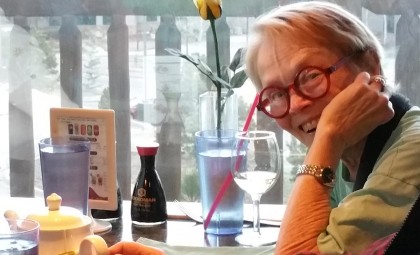 Kate’s wanting to get out and not just visits to medical facilities. Her stamina has improved some, she’s eating more. She’s still in the 80-82 zone, but I’m looking forward to her cracking 83. Then up from there. She’s laughing and smiling, things I didn’t see often over the last three months. Enjoying these moments. Both of us.

 Over to the second H-Mart with SeoAh yesterday. This one is smaller than the one in Aurora, but is much better organized. It’s more like a US supermarket though with very different stock. The Aurora H-Mart is more like an Asian market. I love the produce, the array of seafood, and whole cold storage displays filled with things I can’t identify. As you might expect, there is also an amazing range of sushi, sashimi, (left) noodles, soy sauces, frozen dumplings, other prepared foods like soups and sauces. The beef is all Kobe beef, wagyu, but raised in the U.S.
 Cousin Diane wrote a “why don’t you slow down some, just be for a while?” e-mail. Interesting. When I had no choice, during Kate’s first hospitalization, I did prune out many things, but that was necessity. Daily trips into Swedish or Brookdale, occasionally more than one, left me too exhausted to do much more. My friend Mark Odegard made a similar comment on Sunday during our Zoom session. “Your life is always complex, lots going on.” Also interesting because Mark’s got a lot going on, too, but he sees my life, perhaps as Diane did, as having more going on than is necessary.

 Even as I write this I can feel it lifting. Writing can be therapy, taking what’s inside, putting it outside where its outline clarifies, where it doesn’t rattle around contaminating the rest of the mind. There’s a stress element. There’s also an oh, I’ll just lean back and let things go past inertia. I can’t be on all the time. And, if I’m honest, I sometimes hit this slump without any outside influence.