Category Archives: Great Work

Bee Diary: The Ruth Entry

Summer                                                                              Solstice Moon

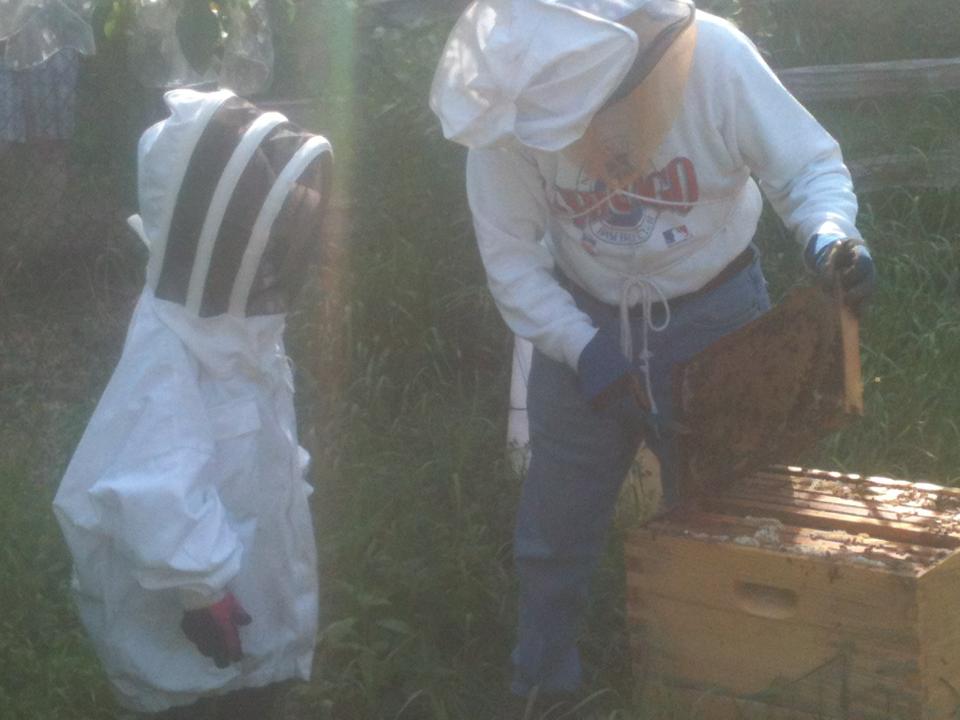
Took grand-daughter Ruth with me on a hive inspection today.  I showed her how to fire up the smoker, use a hive tool, check for brood and move slowly when working with the bees.  She hung in there, saying a couple of times, “Now it’s making me really afraid.” but not moving away.  Gradually her fear receded.  Now she can back me up when I need help.

There’s something profound about sharing a passion with a grandchild, as Kate has done already with Ruth and sewing.  Whether they choose to pick it up or not, the indelible memories, for both Ruth and me in this instance, speak of today and tomorrow walking the ancientrail of life together.

Because, like most current beekeepers, I have 9 frames to a 10 frame hive box, the frames are easier to manage that way, the bees often fill up the empty space with comb and honey.  I harvested a lot of this today, so we have fresh comb honey, both comb and honey made in the last week.


No country or corporation has the right to pollute the air at the expense of Singaporeans’ health and wellbeing.

Beltane                                                                                     Solstice Moon

Linking the story from Singapore to this article in the New York Review of Books,  Collapse and Crash, JUNE 20, 2013, Bill McKibben, gives me a chance to promote your reading of Bill McKibben’s fine review of a book by engineer Henry Petroski, To Forgive Design: Understanding Failure.

(our very own engineering failure)

Though the book sounds interesting in its own right, it preaches failure as the great teacher, it’s McKibben’s context for his review that made me really pay attention.  In it he observes that many failures, perhaps most engineering failures, result in serious questioning of existing standards and often their revision.

And that’s just the rub now.  Mother Earth no longer acts according to the rules of the Holocene, the period since the end of the last Ice Age.  Temperature has risen on average about 1 degree around the globe.  And will rise more.  One thing this does, McKibben points out, is add energy to meteorological phenomenon, producing more tornadoes, more severe thunderstorms and, take just these two, increases stress on buildings, dams, sewer systems, stresses that were previously adjudged to be 50 year or 100 year or 500 year events, now occurring much more frequently.

How do engineers design structures safely and, a critical point, economically in such a plastic environment?  Then, as McKibben also points out, those who travel with the engineers, bond agencies and insurance companies, face an uncertain and novel setting for their work, too.

My sense is that McKibben, a well known environmentalist, has begun to point out the real time effects of global warming, not just the overall, omg the ice is melting, but it will also cost us money and lives and create a unique, unknown future.

It’s the Bomb!

Beltane                                                                           Solstice Moon

Friend and Woolly Tom Crane read my reference to the nuclear option (pulling pants down) in a previous post and reflected:  “Some folks in the fifties saw the results firsthand [of the nuclear option] and got up from the table saying “we just can’t do this, cause look what we are doing:  we could destroy the planet in just an hour or two!”

See this clip from a test of the first H-bomb.

He then went on to observe that we can’t go somewhere, say the Bikini Atoll of the Marshall Islands, and watch the degradation of the atmosphere by carbon pollution or the over fishing of the oceans or consumption of fresh water at a rate the skies cannot replenish.  If we could, he wondered, might we come to the same conclusion, that this, too, is madness?

And could we, also, become aware of our co-creative powers in that very destruction as we switch on the air conditioner, drive to the store for a loaf of bread or eat cod?  An intriguing and thoughtful idea.

Beaver kills man in Belarus

Beltane                                                                            Early Growth Moon

I read this breathless title and clicked through to see what was going on.  The article refers to it as one of several animal attacks turned deadly.

Posting this because it illustrates wrong use of language, you know, like War on Terror.  How much different would your reaction to this be if the article had this title:  Beaver defends self against human attack.

These paragraph are about three-quarters or more down in the article:

“The fisherman, who has not been named at the request of his family, was driving with friends toward the Shestakovskoye lake, west of the capital, Minsk, when he spotted the beaver along the side of the road and stopped the car. As he tried to grab the animal to have his picture taken, it bit him several times. One of the bites cut a major artery in his leg, according to Sulim.

The man’s friends were unable to stem the bleeding, and he was pronounced dead when he arrived at Sulim’s clinic in the village of Ostromechevo.

He is the only person known to have died from a beaver attack in Belarus.”


Roots

Beltane                                                                                  Early Growth Moon

“To be rooted is perhaps the most important and least recognized need of the human soul.”
Simone Weil


Not surprising this is an unrecognized need because for most people for most of human history being other than rooted was not an option.  You were born within the sound of a church bell or a muezzin or a farm dinner bell and never got beyond them.

(Jean-Léon GérômeA Muezzin Calling from the Top of a Minaret the Faithful to Prayer (1879)

It is only as the world has begun to urbanize that we have had to consider our roots, or the lack of them.  In the US only 5% of the population lived in cities in 1800, but 50% did by 1920.  80% do now.  This trend is global.  In 2008 for the first time in history over 50% of the world’s population live in cities.  Interestingly one website on urbanization made this point, since no more than 100% of a population can live in cities, urbanization will come to a foreseeable end.

It is, though, this great hollowing of rural areas that underlines our need for roots just at the point when we realize we no longer have them.  Or, rather, it is this realization that makes the need for roots evident.

Let’s stick to the vegetative metaphor.  Roots say where we are planted, where we have pushed organs for receiving nourishment deep into the soil, even into the subsoil of the place where we live.  Yes, you might want to talk about relationships and regular shops and schools and sports teams, yes, those things are part of a broad understanding of the metaphor, but I’m wanting to stay closer to the plant.

(I worked in this factory when I was in high school, 1968.  Johns-Manville)

If we eat local food, our bodies themselves become literally one with the earth in a particular locale.  Knowing where we are, not only in terms of street names and legalities, but also in terms of trees, food crops, fish, game, local meats, birds, flowers, grasses, even the so-called weeds is also part of having roots.  Embracing the weather, the local changes, as in part defining who you are, that’s having roots.

It is, I think, these things that disorient us the most when we move away from our home.  We think it’s the people or the customs or the new boulevards and highways, but in a deeper place, in the place where you know you are, it’s the Indian paintbrush that no longer shows up, the alligator not waiting in the pond,  the summer that fades too soon or lasts too long, these things make us not only feel disconnected from the place where we are; they are in fact the evidence of our disconnection.

(fall harvest, 2011, Andover)

If we have roots, we usually don’t know it; if we’re missing them, well…
 

Ogallala Blue

Beltane                                                                                Early Growth Moon

A post written this time by Woolly Bill Schmidt.  My comment below.

From Bill:

We may be able to ignore the effect that humans have on global warming or even deny that it is happening.  It is difficult to explain away the effect that we humans (farmers in this case) are having on an important earth resource.  And the farmers are crying because they can no longer farm in ways that don’t make sense relative to what they are given.  Maybe it is time to pay attention to our local environments and live/farm within the limits of what is provided by earth environments.  Tapping the aquifers to irrigate farm land is like shooting yourself in the foot.  The aquifer is not infinite and pretty soon you don’t even have enough water to drink.

Here’s a link to a New York Times article about the plight of Kansas (Midwestern) farmers who have robbed the aquifer and now it is drying up.

“And when the groundwater runs out, it is gone for good. Refilling the aquifer would require hundreds, if not thousands, of years of rains.

The irony of using insane amounts of water for fracking to get more oil would be laughable if it were not so sad. Literally hundreds of millions of gallons of water per day are being used for this process, poisoned by who knows what chemicals and with a fraction, if any, of that water being recovered.”


This is the cost of pumping 1,600 gallons per minute to irrigate farm land.  And on page 2 of this article, the same farmer is continuing to drill more wells.  Reminds me of a song:  Pete Seeger “Where have all the flowers gone” —  “When will we ever learn.”


My Willa Cather Moment With This Problem

I’ve told this story to the Woollies and others many times, I imagine, a sort of recurring tale like so many offer to others, unaware of their repetitiveness.  But, it’s worth retelling.

Twice I’ve visited Red Cloud, Nebraska, a small town on the Kansas/Nebraska border, and home to Willa Cather, a favorite American regional author of mine:  Death Comes for the Archbishop, O’ Pioneers, The Professor and many others.

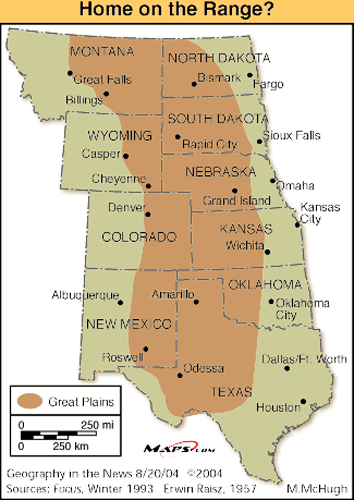
In the Willa Cather Center there I remember, back in 2005 or so, speaking with the folks behind the desk.  It was really hot, 107 or so, and we got to talking about climate change and agriculture.  Since I have a long standing interest in the Ogallala Aquifer, I asked about irrigation.

The conversation became animated because it turned out that in the spring, when the farmers began irrigating their fields, the towns wells would go dry.  It seems they’ve pumped the aquifer out enough that the volume of water available in their area can’t sustain the needs of both town and country.

Here’s a good resource on this issue, which nuances it:  Ogallala Blue.

A Grounded Faith

Beltane                                                                         Early Growth Moon

I walked through the garden alone, while the dew was still on the beet seedlings and apple blossoms.  Oh, wait.  That was roses, wasn’t it, from the old gospel tune.

If you want a moment of intense spirituality, go out in the morning, after a big rain, heat just beginning to soak into the soil, smell the odor of sanctity, in this case fertility, coming up from the plants and their medium, see the beets and kale and carrots and cucumbers and sugar snap peas on the rise, look at the onions and garlic and leeks filling out, getting greener, taller and fatter.  Take a stroll past the cherry blossoms, the pear and plum blossoms, the apple blossoms that came out yesterday, past the bee colony hard at work, over to the blueberries and check out the new growth on the hard pruned wild grapes.   The sand cherries and quince and even the currants with their modest, tiny green flowerettes, all showing to the bees their best and sweetest offerings.  Each petal, each flower, each stalk, each leaf is a miracle, a wonder of the evolutionary path on which that particular organism travels, its genetic ancientrail.

(our quince)

That walk, by the way, is not the walk of an individual, self-reliant and independent, but of a dependent creature glorying in the symbiotic relationship between his cells and these plants.  This is a community enterprise, the humans here, Kate and I, in partnership with the vegetables, the flowers, the fruit, the bees.

(our honeycrisp tree in bloom)

Which reminds me of the other partners, or co-habitaters at least, all the wild animals that live in the soil here, the gophers and earth worms and grubs and snails and voles, those who use the trees the squirrels, the woodpeckers, pileated and red-tailed, crows, hawks, Great Horned owls, robins, chickadees, blue birds, those who live on the land, under buildings and in brush piles the rabbits, chipmunks, woodchucks, opossums, raccoons, mice, the interlopers the wild turkeys, the deer, the coyote.  And of course, the woods themselves the ironwood trees, the poplar, ash, cottonwood, red oak, burr oak, cedar, spruce, yes even the black locust and the buckthorn.  The grass, yes, the dogwood yes, the amur maples yes, the alicanthus yes.

(a baby opossum in a dead tree in our woods)

We all share this land, to which we have the deed, but so little else.  When Kate and I leave, as we will one way or the other, the rest will continue, unaffected, unmoved by our passing.  Land is not for owning, but for cohabitation.  We know this, if we bother to look.

Welcome, Growing Season!

Beltane                                                                                  Early Growth Moon

We have turned the corner on winter it seems and now will begin the gradual invasion of a more southerly clime, with heat and humidity climbing like kudzu broken free from the Confederacy.  We are two distinct climates in one here in Minnesota.  The one for which we are best known and with which most of us here identify is the polar influenced late fall, winter and early spring.  Cold, often severe, snow and a long fallow time typify this one.

The second, one for which we are not known at all, but which we know well, is the briefer Northern summer in which all signs of that polar influence wane then disappear, giving way to temperatures often reaching the 90’s and sometimes into the 100’s–this has happened more lately of course–and dewpoints moist enough to make being outside like wrapping yourself in one of those turkey cooking bags sold around Thanksgiving and sticking yourself in your oven.

This means, the good part, that we can grow crops that mature in under 120 days or so, leeks stretch that, but I’ve done it consistently.  This is long enough to get most garden vegetables including tomatoes, peppers and others that require frost free conditions when planting. (which shortens the season).

The bees, long adapted to cold climate, are fine with these temperature swings; it’s the multivalent attack of pesticides, mites, loss of habitat, mite borne viruses or viruses aided by the mite weakened bee and reliance on bees not bred for hygienic behavior (cleaning out diseased larvae before they can infest the colony).

Our cherry, plum and pear trees all blossomed in Monday’s record heat.  The apples have not, yet, and I’m glad because once their blossoms fall I have to get out the ladder and bag each fruit set.  And, this year I’m getting more aggressive with the damned squirrels, those tree bandits.

It’s time to get out there and dig several holes in the ground, mash it up, put it in a plastic baggy and send it off to the lab.

Gotta Get Out More

Beltane                                                                              Early Growth Moon

My docent class is on a 5 day jaunt to Chicago.  Were it not for Kona’s vet visits, I’d be there, too.  This is a full week now since I sent in my resignation to the MIA.  Nada.  Silence.  Nothing.  12 years.  Almost as weird as the weather.  It’s like the Institute has organizational autism.

It’s been a full day with work outside and inside, a quiet evening reading.

Though I can see that the chained mornings and the Latin in the mid-afternoons is very productive, I’m also seeing a desire in myself to get out more.  Kate had to sort of drop kick me into it, but now that she has I realize the path I’ve chosen will increasingly isolate me and us, if we’re not very intentional about getting out.

To that end I signed up us for a fund raiser for CSA Roots, apparently the former Community Design Center with which I did a lot of work in the late 70’s and early 80’s.  This fund-raiser features a hand-crafted, all locally sourced meal at the Heartland Restaurant across from the former site of the St. Paul Farmer’s Market.  Appropriately enough the dinner is on June 21st, the Summer Solstice.

We’re also planning a trip into the American Swedish Institute this week to see the Sami exhibition and eat at the Institutes new restaurant.  Hmmm.  Do most of our activities involve food?  Which by the way is ok since I’ve lost at least 14 pounds on this lower carb diet in addition to increasing the nutrient load of my food consumption and, the point of it, lowering my blood sugar well below levels of concern.


Soil

Beltane                                                                            Early Growth Moon

The soil temps have exceeded 50 so I’ve got to get out there with the carrots and chard, hoping the tomatoes and peppers come soon.  They need to get in the ground.  I’m going to look at soil improvement over the next few years.  I’ve always done some amendments, composted manure goes on all my beds at the end of the growing season and I often lay it down as mulch once the temps get hot, then cover it with leaves, but I’ve not done any other fertilizing or soil supplementing, largely because I grow organic and I just don’t understand the organic soil supplement process.

Bill Schmidt hooked me up with some e-mails from an outfit in Farmington, International Ag Labs, and their stuff looks doable, though still somewhat complex for me.  I’ll need to look into it further, but it seems to have a focus that makes sense to me.  The basic thrust? Biosustainability created through soil improvement toward optimum soil health.  When you see the thin layer that is our atmosphere, the post below with the astronaut video, and then when you consider that it is the top six inches or so of soil that make plant life possible, you begin to understand how tiny is our margin of safety.

We can take active steps that ensure a healthy atmosphere and a healthy topsoil, why wouldn’t we do that?