Category Archives: Great Work

Reimagine

Samain                          Moon of the Winter Solstice

Jon sent these two links.  Wish I’d had’em when I owned that farm up near Nevis, Minnesota.  I might still be up there, motoring around on some of these very clever inventions.  They show what an ingenious mind can do when rethinking what appear to be over and done with ideas.

http://opensourceecology.org/
http://www.ted.com/talks/lang/en/marcin_jakubowski.html

Makes me wonder what other ideas need a complete rethink.  Computers have followed a pretty standard architecture up to now, one based on a central processing unit.  I read an article in Scientific American last week about a neural computer which, in essence, gives each unit of a computer a cpu, allowing for massively parallel processing as an integral part of the design. It’s modeled on, but not attempting to replicate, the human brain.

How about housing?  Cars?  Or, my personal quest and long time obsession, religion?  The family?  Electrical generation?  I’m interested in distributed generation where a cul de sac or an apartment building or a couple of blocks city residential units might get their electricity from, say, a combination of wind, solar and geo-thermal units sited in their immediate vicinity.

Here’s another one that could use a complete overhaul, reimagining:  nations.  The nation state is a relatively new phenomenon, most experts date its rise somewhere around 1800, perhaps a hundred years earlier in the instance of Portugal and the Netherlands.  In the wake of the globalization of economic life national boundaries have much different meanings that they did, say, 50 years ago.

Let’s go back to religion for a second.  Over the last several years, 23 to be exact, I’ve wrestled with the hole left by Christianity in my life and sought to fill it through what I call a tactile spirituality, one wedded to the rhythms of the seasons, of flowers and vegetables, of bees.  This direction took its initial impetus from an immersion in Celtic lore while I sifted for writing topics.

Then, I began to follow the Great Wheel of the seasons, a Celtic sacred calendar focused on 8 seasons, rather than four.  That led me to integrate gardening with my sacred calendar.  In the wake of these two changes in my life, I began to see the vegetative and wild natural world as more than tools for food or leisure, rather I began to see that they were my home, that I lived with them and in them, rather than having them as adjuncts to my anthropocentric life.

This whole change, this rethink of what sacred and holy mean, what the locus of my spirituality is and where it is, has had a long maturation, much thought and experimentation.  My hope is that my reimagining might provide a common religious base, a sort of ur-religion, which all humans everywhere can embrace.

As in times past this base religion could certainly have others layered on top of it, its essence after all is to be non-exclusive.  What I hope further is that reasserting, inviting, even luring others to see the sacred and the holy in our planet and its other living beings, they will be more likely to join in to see it healthy and vital.

Art and Politics

Samain                              Moon of the Winter Solstice


In to the city to meet with Justin, Sierra Club’s lobbyist and policy wonk.  We’re putting together a campaign strategy for this upcoming session.  I love the ins and outs of politics, the practical, no nonsense nature of the analysis, the calculations.  The realities of power, not its dreamy possibilities.

It is though, at this stage of my life, not as exciting as taking in a new painting, wandering through a new exhibition, revisiting a print I’ve seen many times.  Even so,  politics are deeper in my life, started earlier, continued throughout my life while the arts have been only a once in a while thing until the last ten years.

The man I am now, the man I am becoming, loves the museum gallery more than the legislative chamber, the exhibit hall more than the voting booth, research for a tour more than campaign planning.  Part of me is not sure what to make of this change, but that it has happened there is no doubt.

Perhaps these later years have bent the knee toward beauty rather than the lady justice.

No, of course it’s not either art or politics, of course not.  There is, though, a real matter of how much time I want to devote to life outside our home, how much energy I want to give to projects for others and how much I need to spend on my own work.

These are not easy matters for me, questions I’ve juggled my whole life, but I’ve always tried to remain true to what my inner life tells me.  Just now, it says open that new book with all the paintings in the Louvre.

Where Have We Been? Where Are We Going?

Fall                                                                 Waning Autumn Moon

“Trying to determine what is going on in the world by reading newspapers is like trying to tell the time by watching the second hand of a clock.” – Ben Hecht

Keyhole history.  A standard assumption among historians.  Decades, even centuries, must pass before we can determine the relevance of particular events in the flow of human history.  Anything said, for example, about the George W. Bush presidency, relies more on bias and hunch that on historical context.

We judge poorly when we judge matters in which we have had some part, even if the part were only reading newspapers.  Hecht’s comment tells the story with a great metaphor.


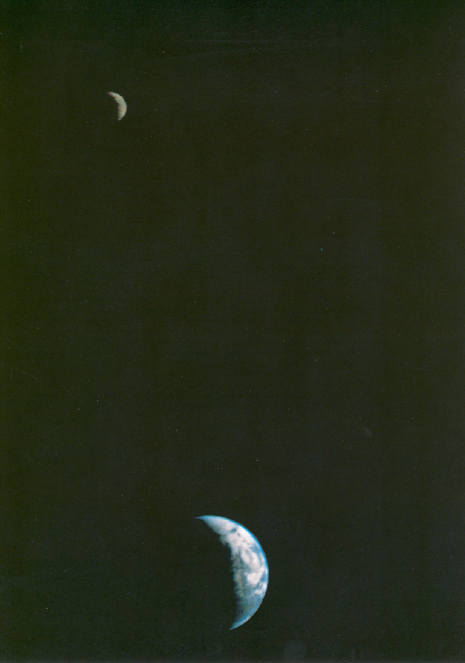
(This picture of the Earth and Moon in a single frame, the first of its kind ever taken by a spacecraft, was recorded September 18, 1977, by NASAs Voyager 1 when it was 7.25 million miles (11.66 million kilometers) from Earth. The moon is at the top of the picture and beyond the Earth as viewed by Voyager. In the picture are eastern Asia, the western Pacific Ocean and part of the Arctic. Voyager 1 was directly above Mt. Everest (on the night side of the planet at 25 degrees north latitude) when the picture was taken. Voyager 1 was launched September 5, 1977 and Voyager 2 on August 20, 1977. JPL is responsible for the Voyager mission.)

Having said all that, let me give you two instances in which keyhole history does not have wait.  These photographs, amazing images, show historical moments that need no time to pass before their significance becomes clear.  

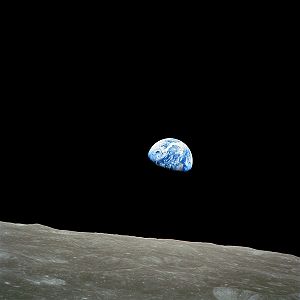
Here humanity achieves a perspective never before possible.  Ever.  Not in the entire history of the human race.  A view of earth from the surface of the moon, the famous 1968 shot by astronaut William Anders, and a God’s eye perspective, looking at our home and its sole satellite in one and the same moment.

Around 60,000 years ago or so homo sapiens left Africa, bound for other continents.  Over the next 45, 000 years this African animal had made its way onto all the continents of our planet and many of its islands.  Since then, we have populated these land masses.

(World map of human migrations, with the North Pole at center. Africa, harboring the start of the migration, is at the bottom right and South America at the far left. Migration patterns are based on studies of mitochondrial (matrilinear) DNA.  Numbers represent thousand years before present.  The blue line represents area covered in ice or tundra during the last great ice age.  The letters are the mitochondrial DNA haplogroups (pure motherly lineages))

Over the last 60,000 years our species has explored the planet’s nooks and crannies (at least those above the surface of the ocean), but in all that time we could never look at our planet whole.  We saw only parts at any one time, we looked at the second hands of earth’s totality.

We could see the moon whole, sort of, but we could never see our own home in the same way.  With William Anders earthrise photograph and the Voyager shot of the earth and moon, our human perspective could position earth and its satellite in the cosmos not through abstract conjecture but by simple visual observation.

Not only were we finally and truly out of Africa, we had gone beyond our planet’s comfortable precincts and into the unimaginable distances of space itself.

No, there is no need to wait on the historical significance of these photographs, we knew it the instant we saw them.

Breaching the Walled Garden of the Self

Fall                                               Waning Harvest Moon

Prepping for a presentation on Spiritual Resources for Humanists.  Reading books, articles, letting ideas slip past as I get ready to sleep, keeping my antennae out for what feeds me now.

The book I mentioned before, All Things Shining, has convinced me of one thing.  It’s important to know why we need resourcing in the first place.

The title offers a rationale, unpacked.  Humanism embraces a world shorn of its medieval metaphysics; the Great Chain of Being has met Nietzsche’s Bolt Cutter, God is dead. God is dead, of course, was not an argument, but an observation, a sensitive man’s awareness that the God drenched era of the ancien regime had been drained by the empirical method, reason and the strangely acidic effect of the Protestant Reformation.

This world, a world with a strangled sense of the sacred, gave birth to the angst and anomie of the existentialist 20th century, a world with no center, or rather, a world with millions of centers, each person a godhead struggling with their own creation.

What can buttress the Self that must navigate these empty places?  Does our supernatural vacuum hold enough air to nourish the isolated self?

We stumble toward wonder, toward joy, hope for a glimpse of the sacred, of the moment that can lift us out of our isolation and put us in communion with others, with the natural world, with the stars which birthed the very atoms which constitute us.

These things we seek not out of some vestigial institutional memory, an anachronistic impulse to live again in a God drenched world.  No, we seek these things because the essential paradox at the heart of our lives is this:  we live alone, the only one with our world; yet we live together, up against galaxies of other worlds, sometimes with other worlds so close that they seem to intersect with ours.  We seek the venn diagram, a mandorla labeled self and other, where the other is another person, a flower, a sky, a lightning bolt.

So, spiritual resources in this context, then, would be those fragments of culture that can weaken or penetrate the walled gardens of our Selves, not in order to breach the walls, but to let in companion armies, allies in our quest.

The quest seems to similar to the one Sir Gawain faced when he beheaded the Green Knight and, in a year and a day, had to bend his own neck before the Green Knight’s sword.  That is, we somehow must will ourselves into a vulnerable, ultimately vulnerable position, to those we have beheaded.  Interestingly, as the story of Sir Gawain and the Green Knight proposes, this vulnerability is not only, perhaps not even mostly, a human to human one, rather, it is human to the whole Green world.

So we seek allies who will keep us strong in our vulnerability, mighty in our humility.  We seek at least love.

Partners and Co-Creators

Fall                                                       Waning Harvest Moon

Went out and picked raspberries for pancakes this morning.  With a definite chill in the air the garden felt different, a bit sleepy, ready to bed down for the cold season.  After a month or so of feeling burdened by it, wanting it to disappear, my spring affection reappeared.  This patch of earth, these beds, work together with the plant world and Kate and me.  We share a joint stewardship of this property, each in our way committed to making it healthy, beautiful and bountiful.

The soil has given of its nutrients, its water holding capacity, its sturdiness as a base for roots and stems.  The plants have combined the chemicals of the soil with that water and pushed themselves up and out of the earth, then blossomed and in many cases fruited.  Kate and I weed, tend the soil, watch the plants, picking bugs off of them, pruning, replanting.  We also harvest and, when the harvest ends, we replenish the soil with composted manure and mulch.

When we use the plants and their produce, we take the leaves and stems and other unwanted parts and put them in a compost bin to return to the soil.

This complicated working partnership among many different parties here is, in microcosm, the partnership we humans have with the natural world and the world of soils, air, water and sunshine.  It’s significant to note that the one unnecessary party to this the work is the human race.

Plants will grow.  Rain will fall.  The sun will shine.  Soils will improve.  Fruits and vegetables will be made and distributed, all whether humans enter in or not.  We exist only as part of a richly integrated chain of being and we exist as its wards, not benefactors.

We do have the capacity to intervene, but too often, far too often, when we do intervene, we disrupt what nature does willingly and foul the process, in the end harming ourselves.

I wish our gardens and our orchard were more than supplements to our diet, but that is all they are, to be otherwise would require a commitment to the work I no longer feel able or willing to give.  Even so, as a supplement, this growing of flowers, potatoes, tomatoes, beets, carrots, leeks, beans, onions, lettuce, chard, spinach and peas, this caring for bees and harvesting honey, does keep us intimately engaged as partners with the natural world, a partnership so often hidden from view in this, the most capitalistic of all possible worlds.

The Normal Extraordinary

Lughnasa                                       Waning Harvest Moon

Just back from the grocery store.  Kate went along, a nice treat.

On so many levels the grocery store speaks to privilege.  We have food, fresh food, all year round.  Kate and I can buy food all year round.  The U.S. has fields of grain, feeder lots with cattle and pigs, chickens and turkeys, fruit grows in many places, nuts, too.  Vegetables grow within miles of every major metro area and within them, too.

As citizens of a powerful country, albeit one in economic struggles, we have so many things available to us, things we consider normal, that are extraordinary in most of the world.

It’s not to early to start thanks giving.

For Me and My Gal

Lughnasa                                                    Full Harvest Moon

Hay wagons filled with laughing teenagers.  Plants beginning to go brown in the garden.  Root cellars and pantries filling up from a growing season almost over.  Thoughts of how to handle snow removal begin to occur.  The first few leaves begin to turn, russet and gold tips on some maple trees.  Evening cool downs and chilly nights.

All under a harvest moon.  The harvest moon is the full moon closest to the autumnal equinox, sometimes landing in September (usually), but occasionally in October.  Those who have any rural roots at all here in the Midwest know the scenes of hay baling, corn pickers mowing down corn stalks with their military grade blades, golden streams of corn flowing into the grain truck following nearby.

Bulky combines in the wheat, moving castles of iron and computers guided by the cyber harvesters mounted in air conditioned cabs far above the fields.

Farm implements move now from field to field, 20 mph obstacles on the back roads and highways, one set of tires, the right side, often on the shoulder, as these field creatures crawl along pavement, out stripped by cars and trucks whizzing by, creatures of the highway.

All hale the gods and goddesses of the harvest, of reaping, of bounty.  This is the American advantage.  We have food, acre after acre of food.

Yes, this September issue of Scientific American praises cities as efficient, creative, green.  Cities are the future hope.  Even the present hope.

But let me tell you this.  No farms.  No cities.  Rural counties may be depopulating, and they are, but the need for the products of the country only increases as the greener, efficient, creative cities thrive.  It will always be so on this earth.

So this harvest season maybe we should all put a temporary bumper sticker on our car:  Hug a farmer.

At The Char House

Lughnasa                                                    Waxing Harvest Moon

Politics.  A strange animal.  A mixer for a congresswoman at Mancini’s in St. Paul.  Milling around, drinks in hand, small plates of meat balls, chicken wings and tomatoes in the other, men in suits talked to women in dress clothes, all vying for a bit of notice, a nod of recognition, perhaps from the congresswoman, or, if not her, then others, the back roomers, the money folks, the union business agents, an environmentalist or two.

These strange rituals collect money and influence, this time in a Char House, a place where a burnt steak and a baked potato, a wedge of lettuce and a Bud chased by Jack constitutes supper.  A joint out of the 50’s with naugahyde booths, no sunlight and dark wood.

In such places all across the country the odd beast that is American democracy begins its biennial slouch toward Washington.  Those of us with interests to further make sure we show up, run our flag up the pole, shake hands, smile and then flee, glad to go home, back to the family we left behind.

Most folks don’t see these rites of fall, as dependable as high school football teams and marching bands.  They think politics consists of the voting booth, then Congress, repeat.  Any of us who work political interests come to know at least some of these tribal gatherings and go to play our part.

Organize

Lughnasa                                                                      New Harvest Moon

“You must be the change you wish to see in the world.” – Gandhi

OK.  Heresy moment.  Being the change you want to see in the world will not change the world.  Paraphrasing Patton’s famous quote:  You don’t change the world by changing yourself, you change the world by getting other poor bastards to change it.  Change is a political as well as a personal process and for any personal change to become larger than one person, you have to engage others.

Additionally, even if you change yourself, the world will not change along with you.  Here’s an example.  Let’s say you desire a greener world.  In order to achieve a greener world you decide to drive a Prius or a Volt, compost your household organic waste, put solar panels on your roof next to the wind turbine and grow your own vegetables.  Maybe even throw in chickens and bees to round things out.  You’ve changed yourself.

Is that a bad thing?  Of course not.  Did it contribute to a greener planet?  Yes, but in a very, very small way.  Are you setting a good example for others?  Yes.

Do people follow good examples?  Not so much.  People follow marketing, neighbor’s status symbols and their own values.  If others don’t voluntarily buy a Volt, compost, create renewable energy and grow their own vegetables, how will we get to a greener world?

By government incentives on solar panels and wind turbines.  Feed in tariffs.  A city or county owned compost pile available to residents.  A government that creates more public transit and fewer roads.  National standards for mpg.  A carbon tax.  Any of several wedges that can create enough change to ratchet down the pace of climate change.

How do we get these things to happen?  How do we get these changes to happen in the world?  Not by changing ourselves (though it won’t hurt), but by becoming strong enough politically to change how government and corporations treat carbon emissions.

Even though Ghandi become the change he wanted to see in the world, he also organized and led a large non-violent resistance movement against the might of the British Empire.  It was the British Empire that changed.  And not because Ghandi changed himself, but because thousands came along with him in a political movement.

To make the change you want to see in the world, organize.

Bee Diary: August, 2011

Lughnasa                                                                   Waning Honey Extraction Moon

Checked the honey supers this morning.  On the two package colonies that I do not intend to overwinter, we have approximately four full honey supers.  That is, we have for harvest the amount of honey they would have needed for the winter, close to 200 pounds.  Figure that 40 pounds is not recoverable due to drips, stuck on honey comb even after extraction then that should leave around 16o pounds to harvest.

If we chose to sell it at, say $7 a pound, that would create around a $1,ooo in sales after keeping some back for own use and gifts.  After the bee packages at $60 each and amortizing the honey extractor, supers and hive boxes, syrup, hive tools, smoker, pollen, queen excluders, honey jars, top and bottom boards and telescoping covers, we’d still be in the red for the first three years.  Don’t know what we’ll do with it this year, probably give away a lot again.  It’s good for barter and gifts for sure.

Artemis Hives has produced honey two years in a row now, an artisanal honey created by bees aided by the beekeeper, me, and the bee equipment and harvest partner, Kate.

Looking at the gardening year in total we will have a good, not great honey harvest, a good potato harvest, leeks, beets, chard, beans and possibly a decent tomato crop.  Kate has good success with her zucchinis and the decorative gourds have bloomed but produced no fruit yet.  The gardening and beekeeping year will wind down in September, just in time for us to finish our cruise preparations.  Caring for gardens and bees requires a lot of face time with the plants and hives, visits to nurseries, attendance at Hobby Bee Keeper meetings, not to mention all the work of harvesting and putting food by.

I’m at the point in the year when my enthusiasm has run out a while ago and the only thing that keeps me active now is the need to finish, to harvest.  When it’s done, it’s over for the year.