Category Archives: Great Work

Water, Water, Not Everywhere. But, Here.

Beltane                                                                                       Waxing Garlic Moon

Spent most of the day at an event focused on implementation of the Great Lakes Water Compact, an unusual and comprehensive agreement among the 8 Great Lakes States and two Canadian provinces.  It was held at the REI in Bloomington, the one with the very tall climbing wall.  It also has nicely landscaped grounds with native plants and water falls.-

American political processes have wheels within wheels attached to gears that trip levers and start small balls rolling down tipping boards which fall and in falling create a cascade of effects near and far.

The Great Lakes Water Compact Council consists of the 8 states signatory to the agreement.  There is a larger group that contains Ontario and Quebec.  This outfit has the responsibility for overseeing the implementation of the accord reached in 2008.   On a budget of roughly $100,000.  Which dries up this year.  Who funds this group?  The 8 states.  Will the 8 states raise money from themselves to move this body forward?  Remains to be seen.

This meeting today, which included DNR folks, environmental groups and legislative types wanted to push the Compact forward in spite of its very real limitations, both political and fiscal.

It has the stated aim of stopping diversion of water out of the Great Lakes, period, and to regulate water diversions within the watershed.  It began when folks concerned about the Great Lakes discovered that an Ontario agency had approved a permit for a Chinese company to ship millions of gallons of Lake Huron water back to China for bottled water.  The furor over this (the diversion, not the fact that it was China.) caused Ontario to back down and an odd coalition of businesses, chamber of commerces, enivronmentalists and politicians to sit down and hammer out a way to ensure that such diversions never proceed and to create a framework for monitoring and regulating Great Lakes Water.

This all makes sense to me and I’m glad to see all the various political, environmental and regulatory folks working earnestly to make it happen.

This circling of the Great Lakes wagons does beg the question of how a fresh water rich region will fare in a world gone thirsty.  The compact sets up a governing body to handle matters within the total Great Lakes watershed and the smaller watersheds that constitute it, but they do nothing to prevent Arizona, Nevada, China, Saudi Arabia or any other water poor region from looking at us with envy and perhaps a little hostility.

You might say, what about what we tell all 5 year olds?  “You just have to learn to share.”

Here’s the problem.  The average recharge rate for the Great Lakes is 1% a year.  What that means is that any diversion over 1% will actually draw down the volume of waters in the lake.

In case you think this is a far away problem consider the poor Aral Sea.  In 1989 it was full, but supporting multiple farming operations, most of them growing cotton.  In 2008 it had barren lake bottom with ships sitting of what had been lake bed.

In the Garden

Beltane                                                                           New  Garlic Moon

One of those nights last night, unable to get to sleep, still rolling around awake at 1:00 a.m.  Up a little bleary.  Wrote  few e-mails, then out in the orchard, first.  I’ve had tent caterpillars on two trees.  Each time I have removed the tent and stepped on it or crushed the worms.  This is non-chemical pest control, a route I prefer and, as long as I’m not running a commercial operation, one I can pursue.

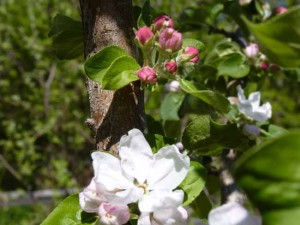
Now I wander in the orchard, looking at seed pods (fruit) beginning to develop from the last of the blossoms which dropped this week.  I’ll try to find worms and moths before they do 2011-05-17_0805early-spring-2011damage and as long as I can I’ll follow pinch and destroy.  After that, I think, right now anyway, that I’ll go with Gary Reuter, the bee rangler for Marla Spivak.  I’ll just put up with wormy apples.  This is partly out of regard for the bees who have enough pressure of them and they don’t need an added pesticide load from our orchard, but it’s more out of a commitment to no pesticides, grow strong plants and let them fend for themselves.  It’s worked reasonably well for me so far.
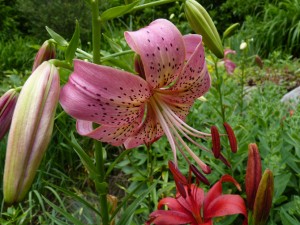
(before the fall)

After the orchard the potatoes were next.  Now that the soil has warmed up the potatoes have begun to grow, their dark lobe shaped leaves appearing atop a fragile looking stalk.  At this point the basics of potato culture involves mounding earth over the stalk as it grows.  That’s what I did today.  In the long raised bed where I have most of the potatoes this year, I also have a bumper crop of asiatic lilies and tulips.

I planted this bed originally as a cutting garden, years ago.  The same fall the bed was built I went out to the Arboretum to a lily growers sale and bought Minnesota hardy bulbs.  They’ve been in that bed ever since, maybe 10 years.  Boy, have they enjoyed that bed.  They’ve started lilies all over the place.  That means that as I mound the potatoes I have to move around the lily bulbs that have generated.  I hate to just throw them away because they’re so hardy and have been with me so long.  I’m trying right now to raise vegetables and flowers in the same bed.  That’s also worked reasonably well for me.06-28-10_earlylilies

I also mounded the leeks as my last action in the garden this morning.  In the case of leeks the mounding blanches the stalk, keeps it white underground and increases the usable part of the leek.

That done, I’ve come inside to work on my Latin.  Pentheus, now, Book III:509-to the end.

An Unforgivable Sin?

Beltane                                                                    Waning Last Frost Moon

“Man is the only creature who refuses to be what he is.” – Albert Camus

Dogs behave like dogs.  Ticks like ticks.  Ravens steal.  Osprey fish.  Shark keep moving.  Even the heart beats, the liver and the kidney detoxify, the stomach and the gut digest and eliminate.  The nose smells.  The ear hears.

We are the only creatures who, at a super-organism level, can refuse to be what we are.  It is both our glory and our damnation.  When we resist the impulse to violence, the credo of self first and the will to domination we become creatures of wonder, covered with grace and filled with light.  When, though, we take more than we can eat, steal more than we need from mother earth, use our evolved brain to imprison other creatures when we do not need them for food, then we walk to the mouth of the River Styx and throw ourselves in Charon’s boat.

Here is the first and greatest sin, perhaps the unforgivable sin.  We imagine ourselves apart from nature, as unique and special beings, exempt from evolutionary history and immune to natural consequences.  While it is true that our great technical and scientific skill seems to partition us off in our own special province, it is not so.  Why not?  Read an article about peak oil.  Consider the consequences of peak water.  Look at the struggle to find precious and rare metals, needed for sophisticated electronic devices.  It leads the Polymet Corporation to the conclusion that not only could they find them in our wonderful northeastern Minnesota, they must mine them.  Must.  Or else.  What?  No more cell phones, laptops, tablets?

Consider the moment of peak rare earths and metals.  What then.  Mother earth only has a certain cache of elements and their combinations, a cache configured in the fires of solar fusion and flung out in the processes that created our solar system and our world.  We do not, can not, make more copper, barium, lithium, nickel.  What gives corporations the arrogant assumption that they can use this store of minerals for their own private purpose?  What gives humanity the temerity to arrogate to our uses all the fossil fuels, all the stored carbon, all the metals gathered in mother earth’s body?  If this question seems naive, then ask how extinction might feel, extinction because we refuse to recognize our limits and our real location in the community of creatures and the world of things?

So, I invite you to go outside this memorial day weekend and find a flower, a tree, a bird, a dog.  Sit with them for a while.  Notice if they try to take more than the universe has allocated for their use?  Notice how they appreciate the water, the sun, the sky, a friend.  Then watch one of us.

Clay

Beltane                                                                      Waning Last Frost Moon

“We can make our minds so like still water that beings  gather   about us that they may see, it may be, their own images, and so live for a moment with a clearer, perhaps  even with a fiercer life because of our quiet.” –W.B. Yeats

Surprises.  They come unexpectedly.  That’s no surprise.  I had one tonight.

Kate signed us up for a couples clay class at the Northern Clay Center.  It ran from 6:30-9:00 pm.  Matt, a BFA grad from the U, teaching during a gap year before graduate school, lead us clay novices.

( Kiln Prayer)

It was fun.  Maybe more than fun.  The clay had a vitality, a presence I hadn’t expected.  The pieces I made ranged from uh-oh to not too bad.  One, a tea bowl, had some promise.  Since they won’t be fired and ready for two weeks, it’s tough to say just what happened.  But I liked it.

Talking with Matt, who began discussing sodium trees versus calcium trees and how those differences affect the wood ash impact on ceramics, a realization began to dawn on me.  This is clay.  Clay.  It’s part of mother earth.  Part of her body.  Working with clay is not only like working with soil, it is working with soil.  Glazes can be totally organic, using plant and mineral materials available anywhere.  In fact, the properties of the clay differ from region to region.  So do the types and variteies of plant and mineral materials available to fire kilns and use in glazes.

Ceramics, in other words, is a sister activity to permaculture, bee keeping, flower gardening and native plant use.

Every once in a while I like to push myself outside my comfort zone.  Tai Chi and Latin are my current excursions.  I can’t see getting into clay until after our cruise in the fall, but I want to do it.  By that time the learning curve for both Latin and Tai Chi will be manageable.  After that, though, I can see taking a class or two, maybe more.

Manual dexterity is not my thing, at least it hasn’t been, but why not?  No practice as much as anything.  So, if I can learn basic techniques and practice.  Well…

Horticulture

Beltane                                                              Waxing Last Frost Moon

Gardening commends itself in several ways, but two are most important to me.   Having life tuned to the seasonal and daily rhythms of heat, light, rain, snow, even frost like we have predicted for tonight, grounds me.  If the frost comes and I have nothing outside to protect, it is a passing phenomenon of little interest.  With delicate plants to protect I know what it means, cold enough to cause ice crystals inside plant cells to burst.  Likewise drought is of no notice to me if I live in a condominium or on a city lot where my grass and a tree or two are my only contact with the plant world.  With a vegetable garden, though, the plants dry up, don’t produce.  I have to consider the drought, see that my plants get adequate water.

When the rains come, followed by warming days and the seeds leap up through the soil, when the potato eyes push a stalk and early leaves through to the surface, when those leeks nurtured since early April stand up and begin to fatten, it matters to me.  Their work, much like the bees, comes from their essence, not from anything I do, but, also like the bees, I have a role, to protect them, to see they have what they need.  We work together, the vegetables, the fruit trees, the currant and gooseberries bushes and the bee colonies.

The food that comes from our garden does not see us through the winter, though some of our crops, like potatoes and garlic for example last that long, but eating close to the land, lower down the food chain, happens more naturally when some substantial part of the diet comes from home.  So, the food alone serves as a final link to the growing process, but as a present symbol of the food available in the vegetable world, it paints into our world color that needs to be at our table all year round.

This, then, has come to pass as my new faith, a link with the earth and its fruits, a role in caring for them and the constant reminder of our dependency, our interdependency on it all.  When I began to work with the Sierra Club three plus years ago, I did it to put my political experience to work on behalf of the living world, in part at least as a thank offering for the sustenance I have received from it all these many years.

Busy Friday

Beltane                                                                                           Waxing Last Frost Moon

Finally.  One chunk of the Metamorphosis finished in a literal (sort 0f) version.  That’s Book III:138-250.  My learning curve has been steep, sometimes so much so that I thought I might tip over backwards, but I seem to have reached a point where moving forward goes faster now and the hill no longer looks quite so daunting.  The next step is to take it apart and put it back together in idiomatic English, then compare it to other translations, see what insights that adds.  As a guy who thought the world of language had invalidated his passport years ago, I’m pleasantly surprised and pleased with myself.  It means a lot to do something at 64 that I’ve spent a lifetime imagining I couldn’t.

After that I drove into Little Sezchuan and had lunch with Justin and Margaret, the Sierra Club’s lobbyist and Executive Director.   We discussed evaluating our legislative work this year, wrapping things up and getting ourselves squared away for the 2011-2012 session.  This has been a difficult year and it’s not over.

Came home, ready for my nap.  But.  Vega lay in the kitchen, scrunched up in pain and bloodied from some kind of a fight.  No clue what happened, but we first examined her, then took her over to the vet who sewed her up, gave her antibiotics and pain pills and we brought her home.  She’s resting now, but the vet says she be very sore tomorrow.  She’s such a sweety, she just let them work on her.

Now, I’m sleepy, but can’t get my nap because it would interfere with going to sleep.

What Get’s You Up In The Morning?

Beltane                                                         Waxing Last Frost Moon

Several years ago, maybe twenty, I sat down with my friend Lonnie Helgeson at the Walker cafe, a table overlooking downtown Minneapolis and the Sculpture Garden.  Lonnie, I said, I could die now.  I feel good about what I’ve done with my life and would have no regrets.

Lonnie looked at me, thought a moment, then asked, “But Charlie where’s your passion?”

Oh.  Yeah.  A passionate man would not declare he was ready to die, he’d be asking, what’s next!

Now, at 64, I can honestly say, “What’s next!”  Not sure what was going on at that moment in my life, but I think I’d hit a caesura, a pause in the melody of my life, a rest stop on the way.  While there, I mistook the rest stop for a destination, rather than a place to catch my breath, consider what direction my path now lead.

Older now and several caravan serai of the soul moments later, I welcome those times when life ceases to press with urgency, when the TV or  a novel or a long vacation beckons.  These are moments of consolidation, a time perhaps to welcome the god Janus for a good look back and a strong gaze forward.

It feels like one may be coming.  Last night I finished my literal translation of Ovid’s story of Diana and Actaeon.  The legislature ends this session (we think) on May 20th or so.  The touring season begins to loosen as schools close down for the summer.  Then I’m left with the bees and the gardens, the novel, too, of course.

These kind of moments when the pacing changes dramatically often yield breaks.  Often, as I’ve looked back over my life, I’ve responded to these breaks with melancholy, a drifting down, moving into a sense of purposelessness.  What do I do now?  I might die.  That would be ok.

Probably where I was that afternoon long ago having lunch with Lonnie.

The melancholy is ok, too.  It’s an old friend, one I’ve come to appreciate as a gathering in, a time to be with myself, in myself.  The melancholy slows down my appetite for life, forces me to pay attention to subtler, inner things, so when I reemerge, I’m ready for another road on this one-way trip.

So, if you talk to me a month from now and I seem a bit distracted, maybe a little down, you’ll know I’m really just resting, getting ready to come out of my corner.  Again.

That Old Achievement Bugaboo

Beltane                                                                Waxing Last Frost Moon

Deciding to take a gamble on the weather, with the aid of the forecasters, Kate planted some frost sensitive plants today:  coleus, especially.  She also planted artemisia, Jacob’s Ladder, alyssum and purple wave petunias.  Mark weeded.  Meanwhile I was in St. Paul doing my next to last session with Leslie.

Tonight was Tai Chi.  When I arrived, there was no one else there except the first teacher I encountered and an advanced student.  Nobody else showed up, presumably due to mother’s day.  That meant I had a personal class with two teachers.  It was a revelation.  This teacher, the one I met the first night of class, has a style that connects with me.

She spoke about learning Chinese, listening to the words at night before she went to bed and in the morning before class and recommended, again, since she had done the same thing at the one class she taught, that I practice morning and night.  Just immerse yourself, she said.  We come to these things with such an achievement orientation and we have to jettison it, let go of mistakes, think of them as occurrences, concentrate on the process.

Tai Chi has 13 different moves, a vocabulary of movement, a style of movement rooted in another culture.  I’ve learned 5 of them so far.  Well, sort of learned them.

It was a good class. What I needed at this point.

Real Religion

Beltane                                                     Waxing Last Frost Moon

“The real religion of the world comes from women much more than from men – from mothers most of all, who carry the key of our souls in their bosoms.” – Oliver Wendell Holmes

Especially true if you insert mother earth for mothers and nature for women, viz.  The real religion of the world comes from nature much more than from men-from mother earth most of all, who carries the key to our souls in her bosom.

I am just back from seeing Leslie give her final presentation at Groveland.  Ran into Bill Mate.  He’s been doing work for the Methodist Church in New Orleans.  Sounded fun.

Wow.  No nap yesterday plus 5 hours driving, then up early for going into St. Paul to see Leslie.  Got hit by a sudden need to lie down and sleep.  Did so.  Better now, less foggy.

When I got back, Kate was in the front, raking and planting, earth mother to mother earth.  I made pizza, then crashed.  Still waking up.

Light rain, warm.  80’s in the forecast.  Spring, it seems, may have finally arrived, well after it has come and gone as a Celtic season.

The Great Lake

Beltane                                                  Waxing Last Frost Moon

Have you ever had a love affair that ebbed and flowed like embers in a fire wavering between bursting into flame and dying out?  I have.  Today I visited that other lover in my life, Lake Superior.  A bookshelf full of books rest in a room not ten feet from here, each one of them related to Lake Superior in some way.  An entire file drawer of a vertical file drawer contains carefully organized files, each an eco-region in the area around Lake Superior and its watershed.  In another spot sit the maps, some USGS, some others representing the land around the Lake.  There are, too, files of notes from two circle route trips I took, each time stopping in various county historical societies:  Ontanogon, Marquette, Thunder Bay to pursue research about this phenomenon less than 2 and half  hours from my front door.

My brother Mark and I drove up there.  He wandered Park Point and hiked all the way up Lake Street to the top, turning then for a magnificent view of the lake.  While he discovered Duluth, I attended a conference on Sulfide Mining on the Mesabi Range.  This was a large group, 70 plus folks, gathered to hear experts discuss various aspects of sulfide mining’s impact on the waters of three watersheds and the communities of people, trees and wildlife that would share the land with this toxic producing form of mining.

It was one of those clear northern spring days.  The sun flashed off the lake, bouncing off the crests of waves made by lakers going in and out of the Duluth Harbor.  The temperature was cool by the lake, warmer up the slope of the hillside where St. Scholastica sits; it’s fortress like main building dominating the surrounding the area.

The drive was long and the stay short, a combination I try to avoid, though this is my second time recently.  The drive out to Lincoln, Nebraska to get the dogs was also a long drive, short stay, quick turn around.

Not sure where Lake Superior and I stand.  The old spark was there as we crested the hill and looked out over the St. Louis River toward Superior, Wisconsin and the lake spread out below us.  My research, though, sits unused, as it has for several years.  What’s the status of this relationship?  Not sure.