Putting Away Last Season

Lughnasa                                                       Harvest Moon

A chilly morning, great weather for sleeping.  September rolls along, the harvest moon in the sky.  This weekend will see all the honey extracting materials put away until next season.  Some weeding in the perennial bed.  The last of the candles made.  Putting away last season, getting ready for the next.

My Zojirushi came yesterday.  At low wattage it keeps water at the right temperature for tea.  Green 175.  Oolong 206.  Black 212.  It will simplify gong fu cha.  I plan to set it up this afternoon.  Getting ready for the next season, which includes a lot of writing time.

It’s the middle weekend of September.  The kids are back in school.  The Great Wheel turns.

Man Picks Raspberries, Spacecraft Sails Through Interstellar Space

Lughnasa                                                        Harvest Moon

“We have been cautious because we’re dealing with one of the most important milestones in the history of exploration,” said Voyager Project Scientist Ed Stone.


This morning while I waded through the raspberry canes, scratching my hands as I plucked red-purple and golden white fruit, putting them in the small basket I use for such work, Voyager 1 sailed on through interstellar space, out beyond the solar wind.

A professor from Iowa University asked reflexively if it was the equivalent of landing on the moon, maybe not he thought, but it’s still ‘Star-Trek’ stuff.  No question in my mind.  It’s beyond the equivalent; it triumphs.  Since those same raspberry picking hands held number 2 lead pencils in the first weeks of elementary school, space has been on my mind.

In 1957 Sputnik pushed us all into the Space Age.  And things moved pretty fast.  The dog. Yuri Gagarin. John Glenn.  Neil Armstrong’s one small step certainly a highlight, an enormous imaginative leap.  A man.  Up there on the Hiroshima Moon.  How about that?

Enough landings that few recall the last person to set foot on the moon. Harrison Schmitt, who followed Eugene Cernan of Apollo 17 off the landing craft.  Cernan, by the way, was the last to set foot off the moon.  This was in 1972.  All that moon walking in three brief years, 1969-1972.

Yet.  5 years later Voyager 1 and 2 launch.  Now 33 years later Voyager 1 has reached a point where its messages home take 17 hours to arrive.  17 hours at the speed of light.  Three times as far away as Pluto.  Remember Pluto?  In the cold of space, beyond the barrier where the chill of the universe presses hard enough to push back the solar wind, Voyager 1 now travels.  A piece of us.  Put together by hands like mine picking raspberries.

Kate’s former brother-in-law, now retired, worked as an engineer on Voyager 1.  He had has career, resigned.  But his work continued on, becoming in the process a signifier for persistence, for the turtle outpacing the hare.  The hare quit in 1972, satisfied with space-going trucking delivering supplies and few passengers to a space station doing, what?

All hail rocket science.  A tip of the raspberry bucket to the little spacecraft as it carries human will physically where the mind has gone for so long.

Gong fu cha diary: Second Day

Lughnasa                                                           Harvest Moon

Beginning, slowly, to get the hang of the chinese way of tea.  Yes, it requires a bunch of beginning moves like warming the pot, the pitcher, the cup and rinsing the leaves after that.  It also involves a quick count to pour the water on the tea, then over the pot, then pour the tea out of the pot.

But.  The tea tastes great and you can keep using the same tea leaves for at least six infusions.  That means after the first pot, the next five are straight forward and one pot of tea can last almost a day.

Still a long way from having the nuances, especially when it comes to buying the tea itself, but that will come with time.

Friends

Lughnasa                                                            Harvest Moon

Friends Tom Crane and Bill Schmidt offer some alternatives to the paradox of time and learning I wrote about in Prospective Nostalgia.  Tom urges stretching the notion of the humanly possible: “Do not think that what is hard for you to master is humanly impossible; but if a thing is humanly possible, consider it to be within your reach.” Marcus Aurelius.  I agree.  It was just this attitude that let me take up Latin even though I felt languages were beyond me.   A helpful reminder.

Bill recommends reading for the hell of it.  Walking in the woods for no purpose.  I read a lot just for the hell of it.  A lot.  And I agree that it helps open up human experience.  I’ve fallen away, recently, from walking in the woods to no purpose.  Used to do it quite a bit.  Likewise a helpful reminder.

I appreciate these thoughts.  Thanks, guys.


Gong Fu Cha diary: 1st tea

Lughnasa                                                             Harvest Moon

OK.  I have my yixing teapots made from the special clay of that region.  I have seasoned them both in the removing of the wax and boiling them in a pot full of the type of tea they will make.

Finally this afternoon I felt I had the uninterrupted time to begin learning this ancient art.  It was the Chinese monks of Chan Buddhism who introduced cha or tea to visiting Japanese monks in the 12th century.  The tradition in China was old, very old, at that time.  The character for tea, thought to have originated in Burma, was simplified in the 8th century BC.

The Chan monks practiced a Taoist influenced Buddhism that would translate itself in Japan into Zen Buddhism.  They used tea to help them stay awake in all night meditation settings.

Here are the steps according to the guide I’m using right now.   First, fill the teapot with boiling water of the right temperature.  This heats the pot.  Pour this water off.  Then, add the amount of tea appropriate for your teapot.  In my case three large Chinese tea scoops or approximately three Western tablespoons.

Add boiling water to the pot, letting it run over the top until clear.  Then pour off the water immediately.  This is rinsing the leaves.  Tilt the lid on the pot so the heat does not cook the leaves.  Now add water again, again letting it run over the top.  Put the lid back on and count 6 seconds, pouring boiling water over the pot to equalibrate temperatures.

At the end pour the tea into a small pitcher.  Serve.

One of the aspects of gong fu cha that differs from all other tea making methods I know is that you reuse the tea leaves as many as six times.  The process repeats but the steeping times vary from pour to pour, going down for the second and then up slowly through the 5th or sixth.

When I finished this process this afternoon, I couldn’t honestly tell whether all of that was helpful.  I have several different kinds of tea and many tea pots so I’ll try different teas in different pots with different methods.  I’ll eventually hit on a method that makes my palate happy.


Prospective Nostalgia

Lughnasa                                                             Harvest Moon

Do you ever have a twinge of regret or a moment of disappointment about all the things you won’t be able to read, to learn?  I do.  And sometimes the ache is terrible.  It can be non-specific.  The library, that is my library, has more threads than I can follow in one life time.  My own library.  What about the UofM library?  The internet?  A good bookstore?

(Amour, Foi, Esperance – Maurice Denis)

It can be specific.  I won’t be learning Mandarin this time through.  I’m not going to get a good feel for geology either, or biochemistry.  Even sociology, beyond a brush in college, is out.  So are most of the world’s literatures and all those paintings and sculptures I just can’t get to see.  It could be, of course, that I wouldn’t want to know the sociology of Poland, but I bet I would.  I’m sure I’d like to understand the working of plate tectonics at a deeper than cursory level, but I won’t.  The same for the chemical exchanges that make life possible.  Nope.

This makes me sad.  Not in a terrible sadness way, not grief, not even really regret, more a prospective nostalgia for something that will not happen.  I can fell it creeping up on me when I look at book, say a history of Japan, and wonder if I’m really going to devote time to reading that.  If I’m honest and say to myself probably not, that’s when the feeling rises.  Oh.  But if only I could give some time in the evening.  Maybe then.  But no.  Not likely, not really.  Oh.

(Psyche’s Kin Bid Her Farewell on a Mountain Top – Maurice Denis)

Most of us have, I imagine, a small collection of sayings that recur to us, sometimes often, that help guide us in making decisions.  One that comes to my mind a lot is this:  Purity of heart is to will one thing.  When I have to prune, to focus my life, to move my attention toward some task that will take a long time, I remember it.  It feels important to me, true.  Right.

Yet.  To will one thing is to rule out all those others.  To leave them on the shelf, to abandon their discovery, the excitement of learning what they may have to teach.  Thus I have this difficult (to me) internal contradiction between wanting, even needing, to focus my energy and desiring broad as well as a deep learning.  This is one of those paradoxes with which I have to make my peace, I suppose, but I don’t find it easy.  It may not be possible.

Herbicides

Lughnasa                                                                     Harvest Moon

I use herbicides sparingly, for problems I can’t eliminate by hand.  Those problems include an invasion of rhizomatous creeping charlie, poison ivy and the stumps of felled trees.  The creeping charlie (no relation) was a mistake on my part.  I didn’t recognize it and advised Kate not to pull it when it could have been controlled.  Somehow it got over a large section of ground.  I sprayed it this morning.

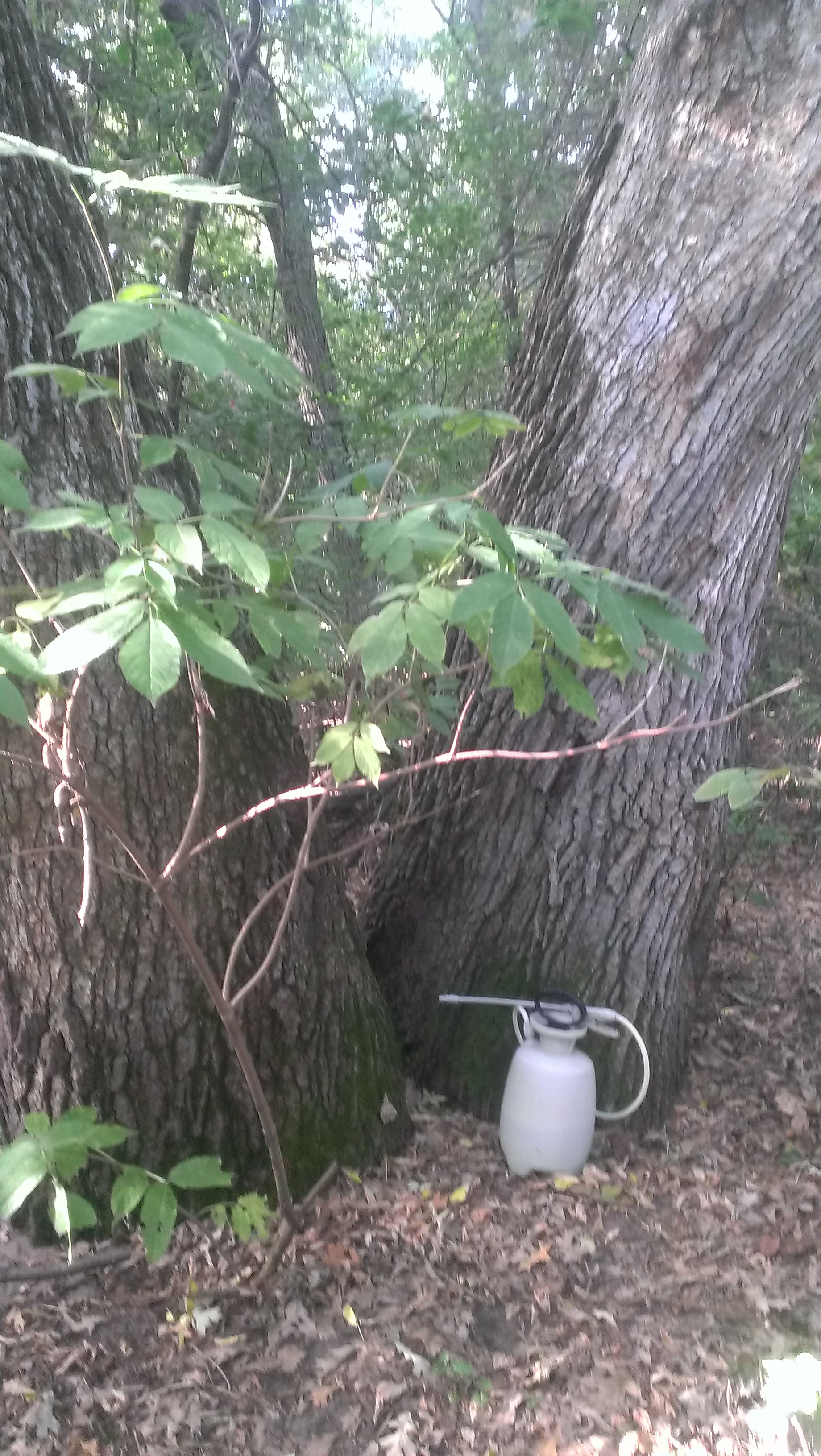
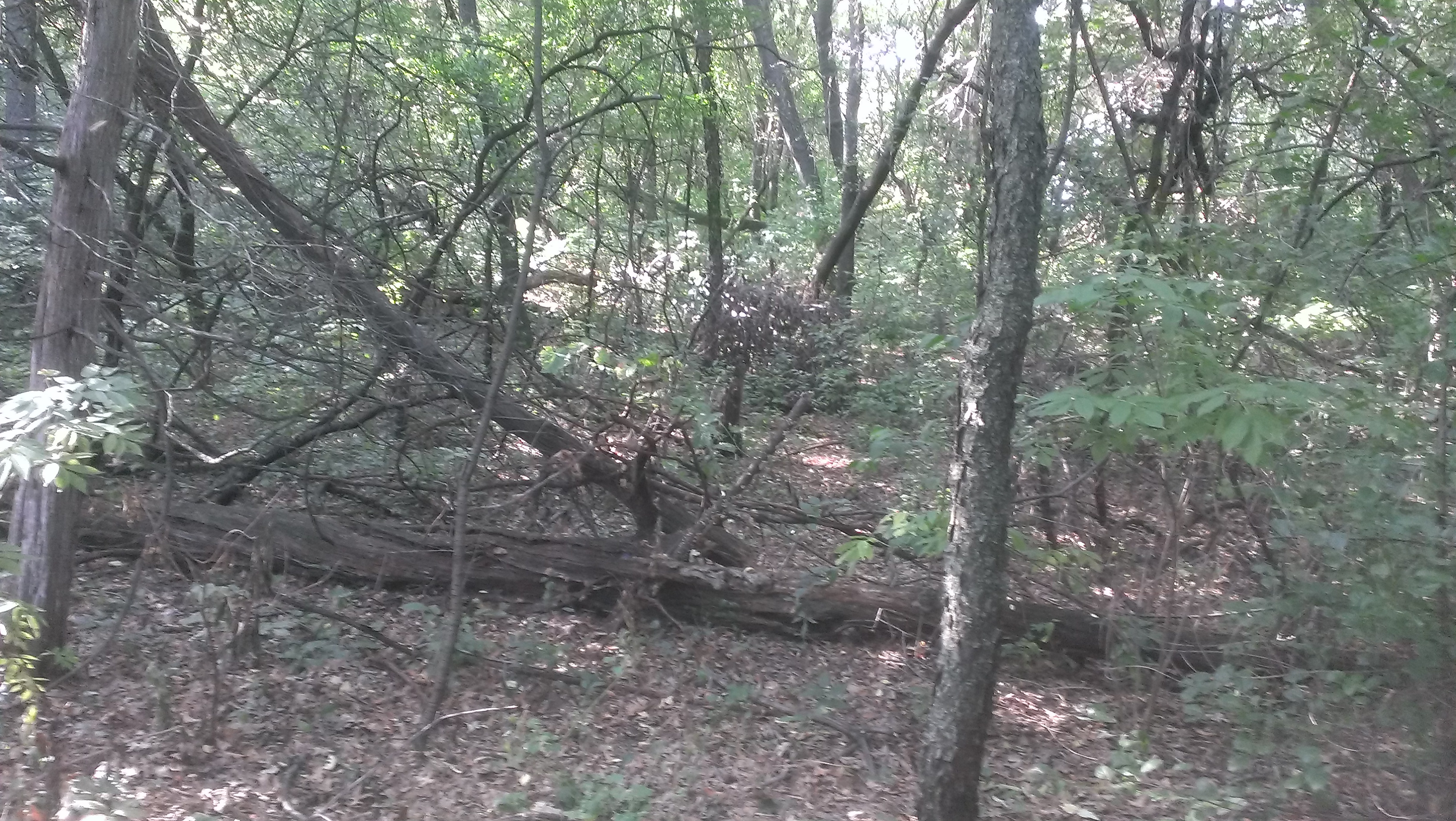
Poison ivy.   My earliest adventures with industrial strength herbicides (triclopyr) began soon after IMAG0944our purchase of this property.   Doing research I discovered Rhus radicans likes the ground around oaks.  We have lots of oaks in our woods.

My first efforts with roundup (glyphosate) had no effect.  Ha, ha.  Like rain water to me.

The first time I used triclopyr, as brush-be-gone, a dilute solution sold for ornery shrubs and could-be-tried as adult weeds, failed, too.  Back to the research.  Ah.  The best time to spray them is in the fall when the plant stores energy in its roots for the coming winter season.

(Gog and Magog)

Today (it’s fall, you may notice) I sprayed the creeping charlie because of this information.  I also went hunting poison ivy. I’ve been after it off and on for 15 years.  This year I had trouble finding any.  A good sign.  The ones I did find I coated leaves and stems.  The word on triclopyr is that it vanishes after three months in the soil.  You don’t want to use it around things you want because it’s effective.

Last I’ll use it on stumps.  The problem with stumps, especially ash and black locust is IMAG0949that the tree immediately sends up new treelets to replace the missing one.  Unless you grind the stumps, which I no longer do, you’ll have a clump of new trees instead of an eliminated old one.  I don’t cut down many trees, but when I do it means I have a specific purpose in mind:  more sun for a growing area, more space for the bees, an area for our fire pit.  New trees are not part of the plan.  Using a paint brush to coat the stumps with triclopyr, a less dilute version than brush-be-gone, solves the problem.

(in our woods near the big oaks, Gog and Magog)

In all cases I use integrated pest management to reduce and/or eliminate the need for pesticides.  I use hand removal, physical barriers like landscape cloth and careful selection of plants to reduce the need for herbicides.  I don’t like using them, but in some cases I’ve not been able to come up with other solutions.

Is It the End, My Friend?

Lughnasa                                                                         Harvest Moon

The singularity is near.  Can we prevent the takeover of the machines?  Will technology devour us, turning the master-slave relationship upside down in Nietzschean irony?  Life with intelligent machines has become a reality already.  Are we too late, doomed to follow our lemming-like path of one more gadget to disaster?

Doubt it.  First.  Depictions of the apocalypse have been failing since the notion first muscled its way onto the human imaginal stage.  We’re very good at predicting the end and equally talented at forgetting that it never happened.  In the Hebrew scriptures there was only one way to tell a good prophesy from a bad one.  Did it foretell events?  If so, good prophecy.  If not, bad prophecy.  And prophecies of  the end time have, so far at least, been wanting.  As proof, I offer the fact that I’m writing about
them.

Second.  Events do not occur in a vacuum.  That is, even if a singularity event or its near cousin came to pass, it would have been preceded by other advances outside of its ambit and the fact of its occurrence itself would shift matters in ways unpredictable.  These interacting variables would almost certainly create a less dire circumstance than techno-gloomy gusses anticipate.

Third. Remember Malthus?  He had a simple idea about food production and the carrying capacity of the earth.  He bet we would return to subsistence level agriculture once the population outstripped the food supply.  Hasn’t happened.  Why?  Agriculture advances, logistical advances, economic advances.  Simple ideas tend to leave out the complicated world in which we actually live.

Finally, will the end come?  Yep.  It will.  There are astrophysical forces at play in the solar system that will finish off life on earth and after that earth itself will be absorbed as our chief ally, Sol, expands into a red giant.  Will humanity have figured out how to live among the stars by then?  My guess?  Yes.

My sense is that we muddle along more often than anything else.  And the singularity will be a curiosity of our era.  Remember 2012?

Soil Test

Lughnasa                                                                     Harvest Moon

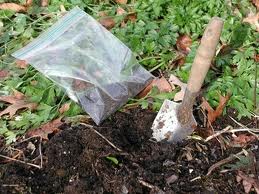
Soil tests create the information base for deciding on what products and what amount of soil testthem to use next year.  Fall is the best time to do them since the broadcast fertilizer can be laid down before winter.

I used a clean trowel, a plastic bucket and my knees.  To do a soil sample involves a clean cut into the soil of six inches, then a small slice of that cut, top to bottom, into the bucket. This process repeats several times in different areas, then you blend the soil and take 1.5 cups of it and put it in a plastic bag.  I did this twice, once for the vegetable garden and once for the orchard.

A soil test sheet, provided by International Ag Labs, takes down garden size and what kind of testing you want done.  That all gets mailed to lab in Farmington and a while later, a recommendation comes back with very specific amounts and products.

My dealer, Luke Lemmer in Plato, Minnesota, will compile the broadcast according to the labs recommendations and will also supply the other products.  The soil test goes in today.

Dismiss what insults your soul

Lughnasa                                                                         Harvest Moon

I too am not a bit tamed, I too am untranslatable,

I sound my barbaric yawp over the roofs of the world.

Walt Whitman, Stanza 52, Song of Myself


The journey into gong fu cha continues.  Today I bought some new teas at Teavana.  Still have made no tea in my yixing teapots.  I want to be ready to do it, able to be in the moment with it and there’s been too much going on.  Probably tomorrow, too, since I plan to take soil test samples from the orchard and the vegetable garden. Maybe Wednesday.

Today has been a modern and contemporary poetry day, focusing on pre-modern poets, Emily Dickinson and Walt Whitman.  The class proceeds by reading a poem, then a video of the professor and six U. Penn students doing a collaborative close reading of it.  This is a very rich process.  I’ll post one of the videos here along with the poem, so you can see how much you can get from careful attention.

This morning I sprayed brixblaster for the reproductive vegetables.  Maybe one, no more than two more.  No more drenches.