Out of place. Then, not.

Fall                                                                                       Falling Leaves Moon
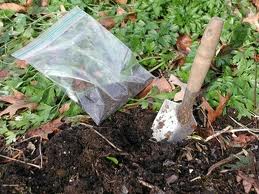
soil test
soil test

A primary text in my rethinking, reimagining my faith is Becoming Native to This Place by Wes Jackson of the Land Institute. It’s not the content of the book-though it has useful material about new ways of agriculture-but the gerund phrase it has as its title.

Becoming native. What an idea. The very notion of native is that you can’t be native unless you’re born to it. So what can this mean, becoming native? In my understanding it’s about a process, a careful listening and seeing. Casey Reams, a soil scientist, was notable for saying, “See what you’re looking at.” So often we don’t.

We will never be native to a place where we were not born, but we might enter a state of grace with the land, a “becoming native” state, an ongoing increased intimacy and sense of co-creation. When Kate and I landed here in Andover 20 years ago, I was far from what I understood then as my native turf, the streets and inner city neighborhoods of Minneapolis and St. Paul. But, as I wrote here a few days ago, I’ve actually spent most of my life in small and medium sized towns of the midwest, 47 of 67 years. So, I became native, or entered into a state of becoming native to the city.

Becoming native is not achievable from the couch or from books or from yearning. It 07 10 10_ahabegins when, as the New Testament says of Jesus’ disciples, you shake the dust off your sandals and finally leave the other place behind. Whatever it is. Becoming native begins when you commit, often unconsciously, to the new place.
After 19 years in Indiana, where I was raised; I lived in Wisconsin for a year, Appleton, and never felt like I landed. By the time 20 years of residency in Minneapolis/St. Paul came and went, its streets were my streets, its future my future. Becoming native happened gradually and unconsciously.

Here in Andover, where I initially felt out of place (a cliche I use deliberately here), becoming native followed a somewhat more conscious path. We decided to put landscaping work into the mortgage and added terrain features such as boulder walls, a tiered perennial garden and several plantings of trees and perennial flowers and shrubs. Initially, the gardening work was bulbs and annuals, almost exclusively in the tiered bulbs above our brick patio.

There were though, several black locust trees in a grove about 40 feet off our back deck. That area, sort of a backyard, had weeds and these trees. Black locust is a dense wood and one often used for fence posts in the 19th and early 20th century. They also have thick, wicked thorns. It was the work of a couple of years, with chain-saw and step-son, before those trees were gone and the stumps had been ground away.

After the bulbs and the annuals, the felling of the black locust grove, attended by sweat and days of heavy labor, including sessions with a rented industrial quality wood-chipper, began to reel me into this place. The soil and manual labor, outdoors work, gave me an intimacy with the grounds I’d never had anyplace else.

Add in the dogs of those years, the planting of this garden and that, the eventual creation of the raised beds, the orchard, the fire-pit and we began to become one with the land here. The bees provided a collegial work force from the insect world.

The house hosted birthday parties, holiday meals, meetings with the Woolly Mammoths, the Sierra Club and parties for Paul Wellstone’s first campaign. Over time this land became home.

Then, becoming native to this place could truly begin. I would mark the moment of crossing the threshold late one fall night, perhaps in November when I heard a scratching outside the study window. Turning off the light in the room I moved closer to the window and looked out at a bird feeder then set up nearby. There, scratching among the fallen seeds was an adult opossum. This was the first opossum I had ever seen live outside of a zoo. He came back several nights, then disappeared, perhaps eaten, perhaps gone into hibernation.

In thinking about the possibility of hibernation I began to see this property in a new way. According to the Minnesota Extension Service and the DNR, there were likely thousands of animals: chipmunks, voles, opossums among them hibernating here in our woods. An image, a vision really, of our land with many, many lives lying below ground or in tree hollows came to me.

It was that vision that awoke me to the fact that we shared this property with so many others. It was not our property anymore than it was theirs. We were cohabitants. And not only with animals. The jack-in-pulpit, the columbine, the wild grape and wild cucumber, virginia creeper, the lilies and the iris, the tulips and the daffodils, the garlic and the asparagus, they all rested here over the winter waiting springs touch to come out into the sun.

An anthropocentric notion of ownership, amplified by deeds and by the very process we go through now, selling this property, creates an illusion of our habitation here as the only significant one. Many people would, without much thought, identify humans as the only inhabitant of the land. And it is not so.

Here there are whistle pigs, raccoons, squirrels, chipmunks, voles, the occasional wandering muskrat and rat, salamanders great and small, newts, garter snakes, toads and frogs, snapping turtles at certain seasons, pileated woodpeckers, great horned owls, crows and geese. There are millions, probably billions, of microscopic flora and fauna that keep our soil vital and nourishing for the larger plants that live within it.

This is a hectare of land, 2.5 acres. It has oak, ash, poplar, ironwood, elm, cedar, buckthorn (grrr), snowberry, river birch, maple, pine and spruce. There are many native and many domesticated plants and six domesticated animals, four dogs and two humans.

Once this umwelt settled into my conscious and unconscious awareness I knew I was 500P1030676becoming native to this place. I will never be as native to it as the generations of rabbits that have lived and died here. Nor will I be as native as any of the other animals or the native flora. Perhaps I have become as native here as the daffodils in our gardens and the lilies, both flowers that thrive on this land just as Kate and I have.
And now we are selling. What does that mean? Really? A certain sum of money, often transferred from one mortgage bank to another, changes hands. Legal documents get signed. Keys handed over. On some day we see our goods loaded onto a truck, we get in our Rav4 and pull out of the driveway never to return. But our cohabitants will remain, snugged into their tree cavity, their underground burrow, their nests beneath the shed. The major natural character of this place will remain largely intact. Sales are about humans, mostly, unless new “owners” abuse their trust.

We will, I think, go through a process of denativizing in which we gradually let go of the sensibilities shaped by these woods, these plants, these animals, these cohabitants. Even if we visit someday, just to see how the old place is getting on, we will return not as natives but as travelers, historical tourists.

We will, I hope, be becoming native to a new place, one with hard rock and high peaks, faraway vistas and remarkable spring snows. But it will not be easy. We will have to earn our place there, just as we have here. Frankly, it’s the part of this journey that most excites me. Yes, the grandchildren. Of course. Yes, Jon and Jen and Barb. Of course. But as to my life and its daily turn, becoming native to the Rocky Mountains is the big joy ahead of me.
 

Becoming native to the city


I became native to Minneapolis this way. While in seminary, I followed a graduating friend in his job as a maintenance man and weekend program staff for Community Involvement Programs, an innovative program for developmentally disabled adults focused on independent living skills.

This was the first time I had ever lived in a city. I had a basement apartment in the Mauna Loa, an old brick three story building right next to I-94. Abbott Hospital was across the street, still functioning as a hospital. The Stevens Square Neighborhood had many buildings like the Mauna Loa, most built earlier in the century to house clerical and retail staff for downtown businesses. By the time I moved to Stevens Square, they were run down and filled with the sort of folks who seek lower rents in any city: the poor, college students, people working downtown in low paying jobs and outliers like the disabled, the elderly and small time criminals.

Continuing to live in the building, I became a full-time program staff person.  CIP moved a few blocks further south to a larger three story apartment building on Stevens Avenue, diagonally across from Stevens Square Park. I stayed with them.

Milestones

Fall                                                                                Falling Leaves Moon

Explanatory signs along the way west. This is the meeting with the realtors and their stager. In this meeting the homeowner learns the best way to present their home, a symbol of their uniqueness, in as bland a way as possible so that others can project their own uniqueness upon it. When imagined as one’s own, a home is sold.

Tomorrow we get guidance on the interior work from a person whose expertise lies in arranging homes for sale. We’ve now done as much as we intend to do with the outside, have packed maybe 60% of the things that will go with us, decumulated (yes, that’s a word. Surprisingly, I rediscovered in a much older post, one from October 2005) multiple items of furniture, art and objets d’art, books, files through sale, discarding and donating.

There are, too, the many other matters, financial and insurance matters in particular, that need attention, some of which we can do now and some of which have to wait until we change residence.

Each one of these milestones could have its own little sign, like the text next to an art object in a museum or a plant in an arboretum. Here the mover learns the art of letting go. Here the mover often tears out individual hairs one by one. Or, here a look of glee often passes over the mover.

What Lies Beneath

Fall                                                                          Falling Leaves Moon

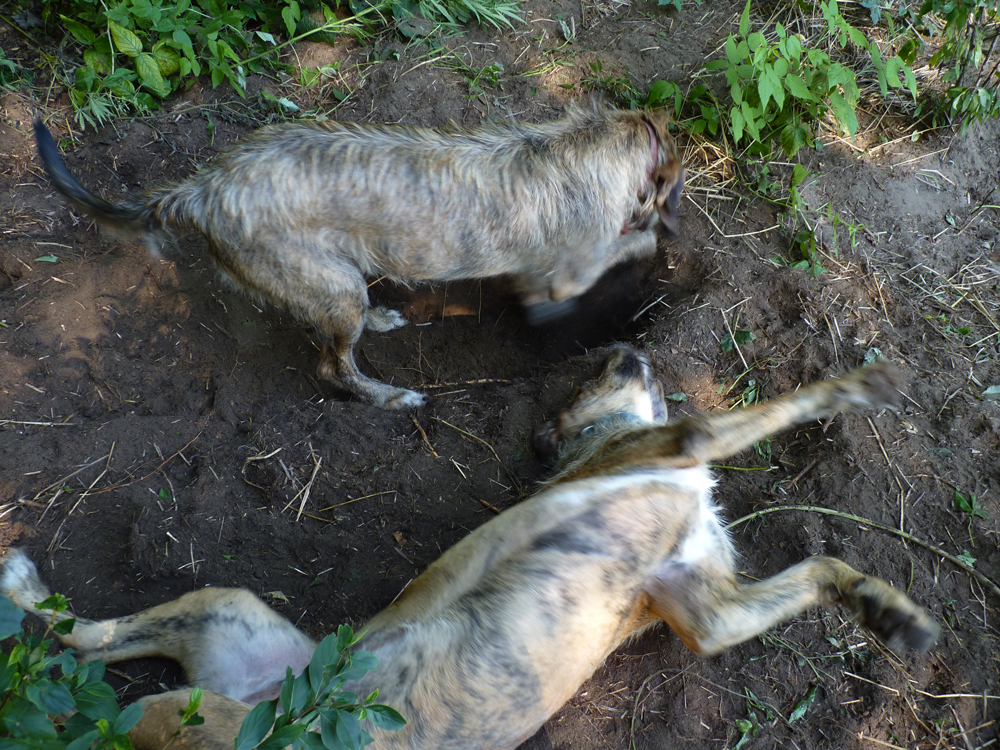
100008 28 10_late summer 2010_0180So. After we hired Charles Dehn and his bobcat to fill in the holes made by Rigel and Vega over the years, we put up fencing around the newly filled in areas. We used silt fencing, since it’s cheap, $20 for a hundred foot run with stakes included. Why? Because Rigel would have found the new, soft soil even better for digging. And I would have given a strangled sound when she did.

Does this solve the digging? No. After all, there’s still all that property outside of the fence. But we waited as long as we could into the fall. Eventually the ground freezes here. Then, but only then, does Rigel stop exploring what lies beneath. Once the ground freezes we’ll remove the fence. We plan to be out of here before it thaws next spring.

Something’s Happening Here

Fall                                                                                       Falling Leaves Moon

50008 28 10_late summer 2010_0199I’m having these flashes of insight, as if some larger realization lies not far from view, but still below the horizon of awareness.

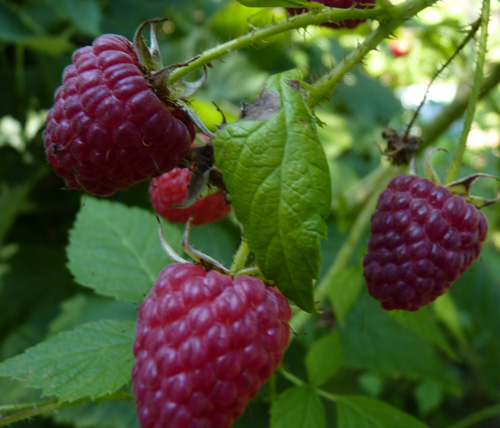
Raspberries have something to do with it: wading into the thorny brambles, canes curved low with hanging fruit and picking off the sweetness. So do those blue skies and the chill in the air while I engage in the oldest human method of obtaining food-gathering it from plants.  That symbiotic trade between the food value of the fruit and our inadvertent willingness to bear its seeds to a new place places me there, so firmly there. No where else but picking raspberries.

I will say it with caution, because I don’t want to be confused for a transcendentalist, but I do look into the raspberry when I pick it. But, I also look into myself. When I look into the raspberry, I see water siphoned up from the soil, having fallen in rain or come sprinkled in from the aquifer below our property. I see colors, beautiful and rich, each fruit a miniature, reminding me of those Persian paintings. The seed is evident there, encased in a small cell filled with water and nutrients, so that when it hits the ground it will have what’s necessary for a healthy transition from top of the plant to the soil which is its natural home.

The raspberry itself is the Great Wheel, all of it. It comes on the plant after Mabon, after Michaelmas and left on its own will fall to the ground, probably before Samain, where it will lie on or just under the soil through the cold months of Winter and the days of Imbolc. Sometime in Spring it will begin to move, to thrust a small green stalk toward the sky and another, darker filament into the ground, seeking stability and food for its above ground presence. Over the course of Spring and Beltane the stalk will grow and the root deepen and strength its grip on mother earth. In the heat of Summer the stalk will grow into a cane, thorns will pop out and leaves, all moving fast toward the sky, the sun. Then it will reach Lughnasa and the strength of the cane and the roots will be at their optimum, ready to press out on tiny branches, flimsy and delicate, heavy dark-red fruits which will, once Mabon is past, once again droop toward the ground.

And so in the raspberry is millions of years of evolution, an evolutionary path older even than the one we humans have made, an ancientrail indeed. When I see the raspberry, this is what I see. When I look through the raspberry, I do not find revealed another metaphysical layer, a layer transcending the mundane and making it somehow special. No, I find the story of this stuff, these elements, this reality, a story which spans billions of years for this universe (and who is to say how many universes there are?), a story which spans millions of light years of space (and who can say how many miles there are in places we cannot see?).

If I wanted to introduce the religious into this conversation, I would tend toward the Hindu pantheon with Brahma the stretched out space in all its extensions and Shiva as the creator and destroyer of worlds and universes and maybe I would add in Vishnu so that this time in which I exist has an image of stability and permanence, even though such an image is an illusion. For which there is, of course, a wonderful Hindu idea, Maya.

I find Brahma, Shiva and Vishnu only useful as metaphor, as analogy but I do find them valuable in that way-as stand-ins, avatars, for the mystery that is what all this is.

These flashes, just out of sight. Something’s coming. And I’m satisfied to wait on its arrival.

Worthy

Fall                                                                                  Falling Leaves Moon


Finished the article on Why I Hope to Die at 75. The more I read, the more I felt it revealed an uneasiness about worthiness. We are worthy only if we are productive. If we can be remembered as vital and incisive. If we remove ourselves from our children’s lives, quit being their shadow. If we don’t use resources better focused on the young or the demented. If we are not ill. If we are not disabled. If we are not operating at peak power.

This is what Christian theologians call works righteousness. You can only be saved if you do good works and abstain from bad ones. It was Luther who said, no, we are saved by grace alone. We cannot earn worthiness through good works.

Translated to this secular argument, I would say that we are not worthy because of our potential, our health status, our role as parents-no, we are worthy as a result of our humanness, because of our unique and precious life. Worthiness, in other words, is the wrong category to bring to the table. We live and have worth because of our existential situation. No one else, ever, will be the human that you are. No one. In this case I stand by analogy with Luther, we are worthy by the gracious act of our creation and remain so up to and even after our death.


None of this is to say that Ezekiel Emanuel can’t decide to refuse therapeutic medicine after 75. Of course, he can. Might be the right thing to do for him. I don’t know. I only know that his worth will not be any less because he’s no longer in the office at U Penn. His worth will not be less to his children and family because he may have a faulty heart. His worth will not be decided by others, nor, in fact, by himself. It was decided at the hour of his birth.


Memories

Fall                                                                                     Falling Leaves Moon

Tom Crane, Bill Schmidt, Scott Simpson, Mark Odegard and Frank Broderick and I gathered at the Black Forest for the Woolly Mammoth first Monday restaurant meeting. We had gone to the Black Forest regularly for many years, then, partly at my urging, had moved onto other cuisines and other locales. Now, though, as my time here has become limited I find myself wanting to return to familiar places.

The Whittier Neighborhood was the site of my year-long internship while in seminary-part at Bethlehem-Stewart Presbyterian (only two blocks west of the Black Forest on 26th) and part at South Central Ministry just across Lake Street from Whittier in the Longfellow Neighborhood. In 1976 the Presbyterian church ordained me to the ministry of word and sacrament at Bethlehem-Stewart, an ordination I held until 1996 when, in Phoenix, Arizona at the Unitarian-Universalist General Assembly, I entered the U-U ministry.

So a lot of person history intersects at the corner of 26th and Nicollet, where the Black Forest is. Not far from there toward the north and east three blocks, too, is the Minneapolis Institute of Arts. A nexus for me in many ways.

Frank’s back from Ireland, looking much better and feeling no pain in his legs. Tom’s hand has mostly healed. Mark and Elizabeth have decided to spend three months  or so in southern France, staring mid-January. Scott admitted he had spent time in his youth a mail-man substitute. And worked as a Lamplighter while sleeping in People’s Park in Vancouver, B.C. Bill Schmidt’s becoming Spinozified and finding this Dutch Jew a very compatible thinker.

On the drive home, a drive I’ve made more or less regularly from Minneapolis or St. Paul to Andover for the last 20 years, I realized that though I spent 20 years in the city and consider myself an urban guy, I’ve really only spent 20 years in cities. The other 47 years have been in smaller to medium sized towns or the far burbs. Interesting how a place can impress itself into our sense of who we are.

Speaking Against

Fall                                                                                          Falling Leaves Moon

Psalm 90:10 (RSV)

10 The years of our life are threescore and ten,
    or even by reason of strength fourscore;
yet their span is but toil and trouble;
    they are soon gone, and we fly away.

In the middle of reading this long article by Ezekiel J. Emanuel in the Atlantic, “Why I Hope to Die at 75.” The argument so far has a rationale based on increasing life being linked statistically with a longer period of disability and illness. Why suffer yourself and why suffer the costs to your family and society? Why not just die at 75? The Jews believe 3 score and ten is a full life and anything beyond that is bonus time, so from that perspective 75 is within one metrics range.

How you respond to this article is of interest to me, and I’ll reserve my final opinion until I’ve finished, but here is my first response.

Emanuel has a lot of information about these issues as Professor of Health Care Management and Professor of Medical Ethics and Health Policy in the Perelman School of Medicine, University of Pennsylvania. I’ll stipulate his data. And, I’ll stipulate that all of us will have opinions on this issue whether well-informed or informed by anecdote alone or, more likely, some combination of the two.

What’s unusual, of course, is Emanuel’s bald claim that he has a limit in mind for his lifespan. The exercising, right-dieting, medically attuned crowd (put me squarely here) are what he calls The American Immortals. That is, a group of folks who want to believe in life everlasting, or at least life lasting as long as possible. This clever phrase says a lot about Emanuel, but is not so illuminating for its target group.

Here’s what I think is wrong with Emanuel’s position. He seems to have an instrumental view of human life, spending considerable time showing how creativity, cognition and overall productivity decline after peaking anywhere along a broad bell curve with its flattened top extending between 30 and 60. After 60, unless you are an outlier, (and he says American Immortals believe they are all, or will be, outliers) it’s a long slump toward vagueness and discomfort.

In other words, as I read him, Emanuel doesn’t want to go into the process of decline. He’d rather phase out before that all gets too far underway. He wants to be remembered as vital, productive, keen. So say we all. But. Life is about more than productivity, creativity, thinking.

It is also about loving, about following the journey where it leads, about mystery. The Great Wheel speaks in analogy about this exact matter, the journey from birth to maid to mother to crone, then across the veil. Or, from birth to youth to adulthood and the third phase. I suppose you could say Emanuel is a latter day Stoic. I can see him in his chair, slumped with his toga around, arms dangling, veins open. As for me, I’m following this ancientrail as far as it goes, not for immortality, not for more productivity, but for life itself.

It is, I think, too easy to make shibboleths of work, of peak performance, especially in American culture. What of the supper table around which sit mechanics and waitresses, toll-booth operators and farm hands? What of the holiday meal with its small table for the young ones, their parents and their parents eating together? What about the grandchild who still wants to hold grandpop’s hand, even though he’s infirm? Life is about more than work, more than vitality, even. Life is not individual only; life is also embeddedness in the lives of others.


Chain Saws

Fall                                                                                          Falling Leaves Moon

And the sound of chain saws was heard on the land. The landscaping work has begun. A bobcat, pulled by a truck filled with mulch sits just ahead of a white pick-up with an enclosed trailer. The dogs announce, over and over again, that there are strangers here. Strangers here. Strangers here.

The steady rate of work toward Colorado goes on. We’ve been at this now since late April. It can feel like we’ve always been moving. Always will be moving. But an end exists and it’s much closer now than it was when we first decided to give the whole process two years. As we grabbed hold of this project, various aspects of it have conspired to make moving early next year the best plan.

Though not eager to leave Minnesota, we are eager to start establishing a new life in the mountains. We’ve lived here over well over 40 years, both of us, and our Western life will take time to flourish, just as this one did.

We will have the grandkids, Jon and Jen, and Barb (Tennessee grandma) to help us ease in. Kate says there’s a top 10 quilt shop (in the U.S.) within 40 miles of Idaho Springs so that will give her a place to make new friends. The Sierra Club and other environmental advocacy groups are strong in Colorado, as are certain brands of progressive politics, so I’ll have some places to meet new people, too.

But none of this until after the landscaping is done.


Finished

Fall                                                                                Falling Leaves Moon

While Kate and Anne worked in the perennial garden, I moved things: the aluminum siding, hoses, plant supports, saws, garden art all into the garage for disposal or eventual packing. We’ve pretty much cleaned up and picked up the outside. With Dehn’s landscaping tomorrow, we can put finished to it for the foreseeable future.

The dogs enjoyed having us outside all day. They’re worn out and sound asleep, snoring away. So is Kate. Me, more of a night owl, not so much.