Summer                                                      New (Most Heat) Moon

strawberries600 2011 06 22_0973Sprayed the orchard and the vegetable garden this morning and picked strawberries. Holding a 2 gallon sprayer filled with liquid taxes my biceps. I could lift it, no problem at all, but carrying it with the muscle flexed to keep the sprayer wand closer to the leaves? That begins to ouch the bicep. Hate to think what I’d be like if I didn’t work out regularly.

A Dull, Gray Day

Summer                                                           New (Most Heat) Moon

It is what my Aunt Roberta would have called a dull, grey day. For my Aunt Roberta, Aunt Barbara and Aunt Marjorie most days were dull and grey. All three had a bipolar diagnosis. Aunt Barbara remained hospitalized for most of her life. Aunt Roberta was in and out of the state hospital as she got older and after her divorce from Uncle Ray. Aunt Marjorie starved herself to death after a career as a dietitian and a life long reputation as the family’s best cook by far.

(where the grocery store used to be in Aunt Roberta’s tiny community of Arlington, Indiana)

This is the set up for my vasectomy story which I’ve recounted briefly here before. It was 1973 and the feminist movement had begun to flow through academic institutions like the wave at a baseball game. When it hit United Theological Seminary, where I was a second year student, I was already committed to women’s liberation. (And, yes, I know I still carry my sexist upbringing with me and make my slips.)

This was also before I went through treatment at Hazelden’s outpatient program so drinking was still part of my life, as were the exaggerated mood changes that go with it. As a result, I wondered then about my own sanity, though after treatment it was clear the mood changes were chemically enhanced.

Being sexually active (this was still the 60’s culturally) and aware of the imbalance between women’s responsibility for contraception and men’s tendency to exploit it, I began to consider a vasectomy.

What made the decision sensible to me, even though 26, single and childless, was the history of bipolar illness in my mother’s family. I saw then and see in the same way now no need to pass those kind of genes along in the collective pool. Neither did I have then nor do I have now any need to reproduce my self, the selfish gene be damned. It was then that I committed myself to adoption if I ever wanted a family, though having a family felt unlikely at the time.

My decision was made without consulting any one else. It was my responsibility and I would see to it. A clinic on Rice Street in St. Paul found time on their schedule and I went in around 4 o’clock on a spring afternoon. The procedure is simple and was so in my case save for too little anesthetic as we began. Which a quick indrawn breath and a wince remedied.

Since that time 41 years ago, I have been functionally infertile. I’ve never regretted the decision though I did try to have it reversed in my mid-30’s. My second wife wanted a child of her own. The reversal failed and we reverted to the adoption plan which had been my preference since 1973.

(I put this in for our dogs.)

It’s not something I think about very often though it does come up. It surfaces usually when I recall the agony of my three aunts, how much I cared about them and how little the family’s love could do to quiet their inner life.

 

New Feelings

Summer                                                                       Summer Moon

New feeling today. Got outside and moved some mulch into place, took some prunings back to the fire-pit for use during bonfires. It was hot since I got up late, making up for lost sleep yesterday. So I came inside to work.

Under the usual circumstances I would have done some Latin, then moved on to other tasks, perhaps starting the book about our life here. But as I sat down, I had this restless feeling (not unusual for me) and it led me to the bookshelves in the exercise area.

Soon I had books about the civil war in my hands, then in boxes. Green tape. Many books about old travels, a 1985 Guide to Living In Washington, D.C., a similarly aged guidebook to Mt. Vernon and Monticello. Books about Savannah, Charleston, the Piedmont, the Coastal Lands of the south. Red tape. Then, Willa Cather novels, Ambrose Bierce, Mark Twain, Theodore Dreiser, Richard Ford. Green tape. More boxes. Affluenza. Crocks of Gold. Medieval Village Life. Town and Country in the Middle Ages. Calvin’s Institutes. The Future of Religion. Red tape.

Clearing out the six bookshelves that form an L in the area where I work out has become important to me, important to finish before Thursday when the SortTossPack folks come with their truck and their crew. That was the new feeling. An aspect of the move had some urgency in my mind. Living in the move has become my home. This is different than methodically knocking down visits to financial counselors, interviewing real estate agents, or dismantling the dog feeding stalls.

This work took priority for me this afternoon.

When I finished, around 4 pm or so, I came into the office, sat down and wrote 1,000 words of what I’m provisionally calling: Seven Oaks and Artemis Honey.


Summer                                                           Summer Moon

The heat has begun to build, more solar energy per square foot available. Many vegetables jump up in height and shade of green, reaching for even more, getting a tiny bit closer , spreading leaves out for maximum absorption. They’re running their photosynthetic processes as long and as hard as they can, taking advantage of the sun. The result will be foods with high nutrient value.


Border Patrol

Summer                                                          Summer Moon

A contemporary philosopher and novelist, Rebecca Goldstein, defends philosophy as a discipline whose task is “…to render our human points of view ever more coherent.” Chronicle of Higher Education, April 14, 2014. In order to do that she says, in the same article, that philosophy must patrol “troubled conceptual borders.” 

This perspective attracted me. A discipline that walks between worlds, the worlds of physics and that of biology, say, or that law and justice, literature and culture, anthropology and privacy or of worlds within worlds, say, between baseball fans and football fans, or materialist scientists and vitalist scientists. It is, as used to be said, the queen of the sciences.

Her examples in the article are abstruse, philosophical all, but her point extends well beyond the the lives of the mind and into the streets. Who negotiates the place between color theory as a branch of optics and the application of it by a painter? Who walks along the lines Wagner proposed long ago, those lines attempting to make a wholistic art form, one using music, painting, literature, poetry, acting all in one, a meta-art? Who mediates between the anti-free will and the free will camp in the borderlands of psychology, experimental psychology and neurology?

Long ago in my college days I found sort of border realm thinking very attractive. I took psych theory, anthro theory, soc theory, philosophy and might one day have gotten around to econ. My interest lay in the roots of these disciplines, in their founding ideas, how those shaped their work, limiting them while defining a discipline’s proper area of study. These areas of thought still fascinate me though I have less opportunity to investigate them.

Not even sure what I’m saying here, just throwing up a flag that says, hey, I’d like to talk more about this.

And on a lighter note

Summer                                                        Summer Moon

found in the Denver Post

BERLIN (AP) — An American exchange student who got stuck in a giant vagina sculpture was freed by firefighters in southwestern Germany.

Tuebingen fire service official Markus Mozer said Monday that the young man slipped as he tried to climb into the stone sculpture to pose for a photo.

He couldn’t free himself, so the fire service was called. Four firefighters eased him out of the sculpture.

The incident happened on Friday and the student’s name wasn’t released.

Mozer says no damage was done to the sculpture, created by Peruvian-born artist Fernando de la Jara.


Changing from Chronos to Kairos

Summer                                                         Summer Moon

Bill McKibben’s voice has been raised in anger, in intelligent discourse, in pleading before the public and the government and recently in organizing a mass movement 350.org. He has an article in this week’s New York Review of Books elegaic opening paragraph:

We may be entering the high-stakes endgame on climate change. The pieces—technological and perhaps political—are finally in place for rapid, powerful action to shift us off of fossil fuel. Unfortunately, the players may well decide instead to simply move pawns back and forth for another couple of decades, which would be fatal. Even more unfortunately, the natural world is daily making it more clear that the clock ticks down faster than we feared. The whole game is very nearly in check.” NY Review of Books, July 10, 2014.

This article reviews a book on changes in Antarctica, Antarctica: An Intimate Portrait of a Mysterious Continent, and two reports: What We Know: The Reality, Risks and Response to Climate Change from the American Association for the Advancement of Science and Climate Change Impacts in the United States: The Third National Climate Assessment by the US Global Change Research Program. Both of the reports are available in full at the links.

(Ice cores going back 800,000 years, drilled from Antarctic ice show there has never been a time in earth’s history when the carbon load in the atmosphere was more 290 ppm. The current level, updated monthly from a sensor on Mauna Kea, is above.)

The news is the same as the material I wrote about here while taking the Climate Change MOOC last fall. The Supreme Court today upheld the right of the Federal Government to regulate emissions from stationary sources. In yesterday’s paper Henry Paulson, Secretary of the Treasury under George II, and no Earth Firster proclaimed climate change as the problem of our time and proposed a tax on carbon emissions as a solution. All this does indicate climate change may soon become a matter of real, and painful, policy changes. And not just here, but across the globe.

It is the painful part that gives McKibben his dark tone. Changing over from a carbon fuel based economy will not be easy, cheap, or quick. In other words it’s not politically palatable. Just like social security and medicare reform. Policy makers have Pavlovian resistance to votes that may lose them support in their constituency. It will not be a simple matter to overcome that resistance. And yet it must be done. And it must be done now.

A portion of Paulson’s piece I liked a lot was his opening point “...if there’s one thing I’ve learned throughout my work in finance, government and conservation, it is to act before problems become too big to manage.” He echoes Thomas Berry’s much earlier work when he says, “Climate change is the challenge of our time.

It is our work and one we must do together.

A House With A History

Summer                                                         Summer Moon

IMAG0531Why not write a history of this spot, this hectare? An ecological history. It can start with the glaciations, consider the flora and fauna since then, focusing in more tightly once the first nations began to arrive, then even more tightly as Minnesota began to emerge.

Another starting spot would be today, or from Kate and mine’s presence here. How we decided to be here, why. Go over decisions we made early on like hiring a landscape designer at the beginning. Recount our twenty years, the good decisions and the bad ones, the easy ones and the hard ones. The other historical and geological material could be worked in as backstory.

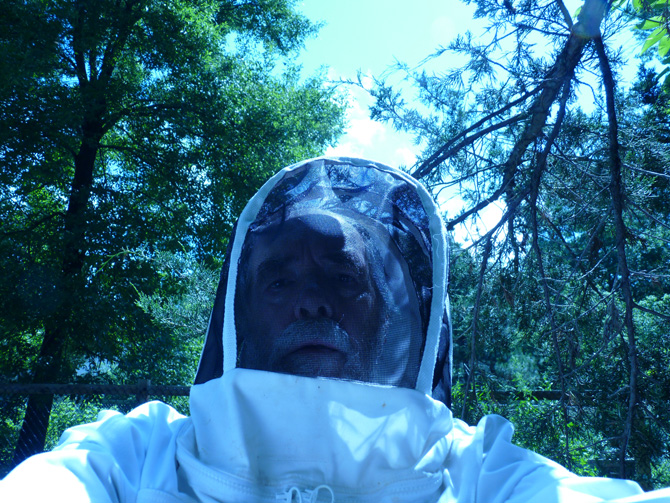
It would be good for people to view an average approach to the land, one which changed over time (though its roots were indeed in the back to the land movement) and which took advantage not of a particular approach, but of many. An approach that is dynamic, 06 27 10_beekeeperastronautchanging with new knowledge, the seasons, aging, new plants and new desire.

The flavor of “Return of the Secaucus 7” with some Scott and Helen Nearing, Wes Jackson and Wendell Berry thrown in, too. Ah, perhaps it could be a sort of third phase update of the movement years, an upper middle class idyll moving against the grain of upper middle class lifestyles.

Not sure whether to pursue this or not, but it could be interesting. Might even help sell the house. A house with a history.

A structure based on the Great Wheel might be interesting.

One is silver and the other gold

Summer                                                           Summer Moon

Visiting old friends. Saturday I walked through quiet galleries at the MIA, luxuriating in quiet spaces filled with Chinese sculpture and painting, then over to the Japanese collection. There were, again, no visitors while I spent a moment with the fine ukiyo-e prints hanging now.

Then I found myself heading up to the third floor to the newly restored Blind Man’s Buff. I love the gallery, which also holds a Kandinsky, a Cezannesque Braque, some Matisse, an Ensor and this painting. Beckmann is a wonder to me each time I see a piece of his. Blind Man’s Buff is a major work, one of his triptychs and one of the best of those. Its central panel arouses in me a sense of the mythological, the grand forces at work just beyond the veil of our daily life, a life represented by the two panels in this painting.

Even in daily life though there are mysteries and one of them, a common yet profound one, is love. A blindfolded man stares across a crowded room toward a woman, kneeling. Are they lovers? What mythic forces have been set in motion by them? Or what did they start? What separates them? While daily life is a hurly-burly of figures and symbols mashed together, the gods jam. Even time seems different there. Look closely at the clock.

After this I went to the contemporary galleries and found gallery 374 an eye opener. It now has works previously shown at other spots in the museum like Shonibare’s “Sleep of Reason”, Kehinde Wiley’s “Santos Dumont-The Father of Aviation” and Nick Cave’s “Sound Suit.” Seeing these works together, especially with Zang Huan’s “Text” and the etchings by Glenn Ligo helped me get a feel for the Baroque nature of some contemporary art, a feel I might not have gotten without seeing these works in companionship.

Old friends. And new ones, too.

The Sleep of Reason Produces Monsters (Australia) Yinka Shonibare

Keep Working

Summer                                                                   Summer Moon

When the student is ready. This writing stuff is hard. At least for me. I’ve been collecting rejections (which, believe it or not, is an advance) and wondering whether it makes any sense to keep at it.

Then, I ran into Megan Hogan again.  Megan, a red-headed sprite of a museum guard, andMegan I started exchanging personal stories about the artist’s life three years ago. She’s trained as a portrait and fine artist and works at her art when she’s not reminding two young ladies who came into the museum while I was talking with her that they could not bring their non-fat, decaf cinnamon mochas into the museum.

“Yes, when I just got out of art school, I went around to galleries, trying to get in and kept getting rejection after rejection.” Megan has a friendly, warm smile, but with this story she shook her head, bemused, not smiling.

“I know,” I said, “and it’s hard not to take it personally, after all they’re rejecting your work. Your work. I know you’re supposed to let it go and keep on, but I start to doubt my own judgment.”

“I know,” she said, “I know.”

Her lesson, the lesson I took from Megan on Saturday, was the old one, one I need to relearn quite often it seems. Keep working. Whether for an audience or not for an audience. Whether the owl comic she’s working on right now will be worth the four-color print run or not. Whether the people at the comic convention, when offered a chance to buy her comics, say, “Meh.” Keep working.

“In the end,” I said, “We have to please ourselves.” She smiled. My teacher. This day. Did I mention Megan is in her late twenties? Age is no barrier to self-awareness.