Kate’s in Gilpin County right now, or on her way there, looking at the house we both liked. She’ll see several others over today and Monday.
Meanwhile I slept from 11 pm last night until 10 this morning. All that house hunting energy that kept me awake yesterday morning dissipated and left me sleep deprived. Got up at 5:45 am to feed the dogs, back to bed at 5:59. Being sleep deprived is difficult for me, I don’t like the feeling, call it sleep stupid, and my backup personality comes closer to the surface. That is, impatient, easy to anger. Well, it’s my backup personality in my estimation.
Maybe, it just struck me, that sleep deprivation puts me in a particular mood and keeps me there for the duration. I’ve become intrigued with moods recently. Moods are the local weather of the psyche while personality is the climate. Maybe I experience temporary global warming heating up my weather during sleep deprivation.
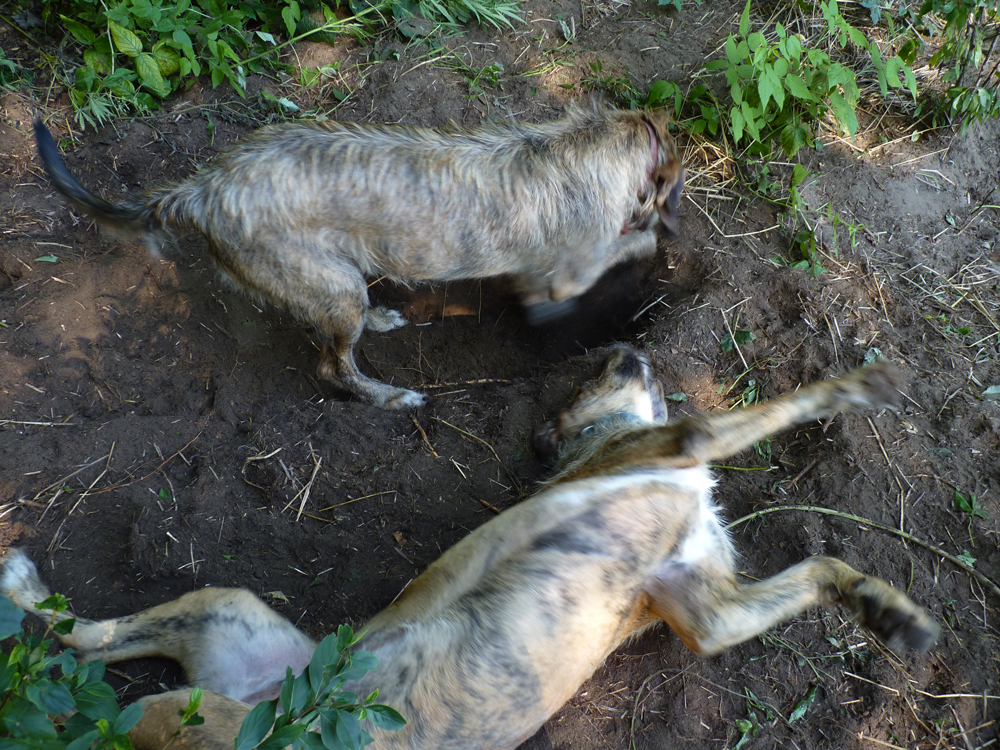
Gotta go outside and strengthen the silt fencing again. Rigel, and in her trail, Vega were playing in the resurfaced area, the part where we had to have a bobcat take care of their efforts over the last three years.
In this moment Kate’s the scout and I’m the homesteader. Gotta go done homesteader stuff.
Saw an ad for Army Strong. Well, I’m move stupid. There seemed little room this week for Latin or leisure reading or relaxing into an idea, letting the mind drift. Yes, a bit of time for art but even at the Walker I felt rushed. Thank goodness the garden has gone to bed. Sleep tight, baby.
These pursuits, which I consider my normal activity, the stuff that gets me up in the morning and excited about the day after, have been crowded out by movers, mortgages, the hunt for a new home, diving-Scrooge McDuck like-into our finances, tweeking and checking, ordering the septic tank pumped out, figuring out medicare when we move, a long list of things, intensified by meeting with the stager and the realtor on Wednesday.
These are all boxes that require check marks. So, it’s not like this is optional activity.
And, yes, the move gets more exciting as we press further along. It got very real last night and this morning.
Poking around on a real estate website, I found a house I wanted. Kate agreed. It was in our price range, in a location we considered desirable, with an idiosyncratic design. It’s sort of a conch shell turned broad side down with smaller areas as you move up.
Last night I got so excited I had trouble sleeping. We had to move on this right away. I just knew it. That was where the tweeking and checking came in. And so. When we did move on it around 9:30 am, we found that an offer had gone in earlier this morning. And, most likely, was accepted. But, we could make a second offer. Since we’d only seen pictures we couldn’t do that blind.
Kate left this afternoon for Colorado for a viewing of this house and a few others. We probably won’t get it, just a half-inch too late. But we have no chance if Kate doesn’t evaluate it and decide whether we put in a second-place offer. We got her on a Spirit airlines flight scheduled to leave at 2:07. She called me at 3:45 to say, “Guess where I am?” Terminal 2? Yep.
All this made the whole process more intense for a few hours. More imminent. I imagine I’ll be move stupid for days, if not weeks to come.
At the Walker. Shocked out of my move fixation, gladly so. What I hoped for. A major exhibition covering years when art turned over on itself and the Walker made its reputation as a nationally significant contemporary art space, Art Expanded, 1958–1978, challenges boring old representational painting, stiff granite sculpture, and anything else considered traditional or usual at the time.
It got me immediately into careful looking, following disinhibited artists as they struggled to use a radical new freedom, going with them to places absurd and funny. An example of the latter is a small notation for a happening: Turn the radio on, turn it off at the first sound. This zeitgeist was mine as a young adult, traditional sexual mores, traditional career paths, traditional power structures, traditional decorum was all suspect and suspect in such a way that the burden of proving itself useful to the human project lay on tradition.
The Walker is an osmotic membrane, the world of art pushes at its curators and they try to let through only the most innovative, most balls against the wall, most beautiful, most lyrical of the very new. It is an antidote to burying myself in the minutiae of moving. So easy to do. Artists trying to replace sculpture with three video screens, two larger and one smaller between them, stacked vertically, with strings like those of a bass arranged in front of the screens and a stool behind for the screenist to use while playing push me away from the taskiness of the move and back into the realm of, “Oh! What’s this?” A place I consider my natural habitat.
So it did not surprise me when I sat down to eat lunch that my mind strayed to a mind-full meal. It went like this. I had a fruit salad and a grilled cheese and bacon sandwich. Fork into grape. Huh. Roots captured water, distributed it up a vine and into the developing fruit, swelling this taut case until it was full. The leaves captured solar energy and created carbohydrates. Sweet. Wine. Kate and I at the KSNJ dinner on Kate’s 70th. Mogen David. A melon. Kate makes melon salads every summer, puts them in a long plastic container and we eat them throughout the week. Pineapple chunk. A happy worker makes good fruit. The Dole plantation philosophy on Lanai, now abandoned to the techno-baron Larry Eliot and his desire to create a sustainable, profitable community. Strawberry. California’s Central Valley. Drought. The precious water contained in this strawberry might have come from last year’s snow pack in the Rocky Mountains. Then, the bread. I don’t eat bread anymore, but half a grilled cheese sounded so good. I went ahead. Diabetes. Why do the things I like a lot turn out to be bad for me? Days of grilled cheese and Campbell’s tomato soup. An Alexandria, Indiana gourmet lunch.
Now this is not mindful in the way of savoring the grape as a tight oval, bursting with juice, breaking the skin with sharp front teeth and feeling the first squirt of liquid on the tongue sort of mindful. No, this is a mind-full lunch in which I allowed free association to guide and slow my eating. The blueberries. Those Augusts on the North Shore wandering through burned over or clear cut forests, gathering wild berries, eating as many as I picked. The blueberries we have outside in our orchard. That sort of mind-full.
This calendar, circular, with the sun’s hourly presence each day indicated in the middle by a somewhat squashed circle, displays a yearly calendar that conforms to my understanding of time. Rather than day running after day in small squares, linear fashion, on this calendar the days and the months follow each other in curved segments of a circle, finally rejoining, December 31st and January 1st. As opposed to most Westerners, I privilege the circularity of time, the Great Wheel, which, like this calendar, follows the earth around the sun and, like this calendar, begins again where it has been artificially ended.
It’s easy to forget, in our casual way of saying what hour it is, or what day it is, or what year it is, that none of this segmentation has any but the most abstract relationship to the natural world. The year, for example, marks a spot in earth’s revolution around the sun, erects a flagpole, or, better, a timepole and says this is a lap marker. Each time we pass this timepole we’re going to add one unit to the last one. By not so common agreement we start counting units for calendar purposes on a date supposedly coincident with the death of a man claimed to be a god, two-thousand and fourteen laps ago. I say not so common agreement because the various numbers to put on this “year” vary a good bit among Jews, Muslims, Hindus, Chinese and Old Church Orthodox, just to name a few.
Though this is a very common human meme, the calendar and its year, it is not given in the nature of earth’s orbit. What observation of the orbit suggests is the linked nature of time, it’s non-divisable reality (perhaps even its non-reality). What I choose to emphasize is the turning of the Great Wheel, with its repetitive though not identical seasons, its warm periods and cool periods, its fertile days and its fallow days. In this way, too, I choose to emphasize the ongoingness of human life. The human cycle, which follows the Great Wheel by analogy, understands birth as the springtime of a life, adulthood in the fertile seasons, and the time of aging and death, analogous to the fallow time. And this cycle, though it apparently begins and ends in each individual’s life, in fact, goes on with births following deaths and deaths following births.
A primary text in my rethinking, reimagining my faith is Becoming Native to This Place by Wes Jackson of the Land Institute. It’s not the content of the book-though it has useful material about new ways of agriculture-but the gerund phrase it has as its title.
Becoming native. What an idea. The very notion of native is that you can’t be native unless you’re born to it. So what can this mean, becoming native? In my understanding it’s about a process, a careful listening and seeing. Casey Reams, a soil scientist, was notable for saying, “See what you’re looking at.” So often we don’t.
We will never be native to a place where we were not born, but we might enter a state of grace with the land, a “becoming native” state, an ongoing increased intimacy and sense of co-creation. When Kate and I landed here in Andover 20 years ago, I was far from what I understood then as my native turf, the streets and inner city neighborhoods of Minneapolis and St. Paul. But, as I wrote here a few days ago, I’ve actually spent most of my life in small and medium sized towns of the midwest, 47 of 67 years. So, I became native, or entered into a state of becoming native to the city.
Becoming native is not achievable from the couch or from books or from yearning. It begins when, as the New Testament says of Jesus’ disciples, you shake the dust off your sandals and finally leave the other place behind. Whatever it is. Becoming native begins when you commit, often unconsciously, to the new place.
After 19 years in Indiana, where I was raised; I lived in Wisconsin for a year, Appleton, and never felt like I landed. By the time 20 years of residency in Minneapolis/St. Paul came and went, its streets were my streets, its future my future. Becoming native happened gradually and unconsciously.
Here in Andover, where I initially felt out of place (a cliche I use deliberately here), becoming native followed a somewhat more conscious path. We decided to put landscaping work into the mortgage and added terrain features such as boulder walls, a tiered perennial garden and several plantings of trees and perennial flowers and shrubs. Initially, the gardening work was bulbs and annuals, almost exclusively in the tiered bulbs above our brick patio.
There were though, several black locust trees in a grove about 40 feet off our back deck. That area, sort of a backyard, had weeds and these trees. Black locust is a dense wood and one often used for fence posts in the 19th and early 20th century. They also have thick, wicked thorns. It was the work of a couple of years, with chain-saw and step-son, before those trees were gone and the stumps had been ground away.
After the bulbs and the annuals, the felling of the black locust grove, attended by sweat and days of heavy labor, including sessions with a rented industrial quality wood-chipper, began to reel me into this place. The soil and manual labor, outdoors work, gave me an intimacy with the grounds I’d never had anyplace else.
Add in the dogs of those years, the planting of this garden and that, the eventual creation of the raised beds, the orchard, the fire-pit and we began to become one with the land here. The bees provided a collegial work force from the insect world.
The house hosted birthday parties, holiday meals, meetings with the Woolly Mammoths, the Sierra Club and parties for Paul Wellstone’s first campaign. Over time this land became home.
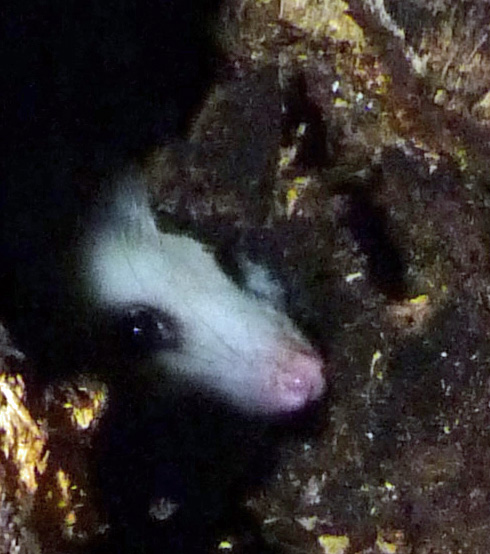
Then, becoming native to this place could truly begin. I would mark the moment of crossing the threshold late one fall night, perhaps in November when I heard a scratching outside the study window. Turning off the light in the room I moved closer to the window and looked out at a bird feeder then set up nearby. There, scratching among the fallen seeds was an adult opossum. This was the first opossum I had ever seen live outside of a zoo. He came back several nights, then disappeared, perhaps eaten, perhaps gone into hibernation.
In thinking about the possibility of hibernation I began to see this property in a new way. According to the Minnesota Extension Service and the DNR, there were likely thousands of animals: chipmunks, voles, opossums among them hibernating here in our woods. An image, a vision really, of our land with many, many lives lying below ground or in tree hollows came to me.
It was that vision that awoke me to the fact that we shared this property with so many others. It was not our property anymore than it was theirs. We were cohabitants. And not only with animals. The jack-in-pulpit, the columbine, the wild grape and wild cucumber, virginia creeper, the lilies and the iris, the tulips and the daffodils, the garlic and the asparagus, they all rested here over the winter waiting springs touch to come out into the sun.
An anthropocentric notion of ownership, amplified by deeds and by the very process we go through now, selling this property, creates an illusion of our habitation here as the only significant one. Many people would, without much thought, identify humans as the only inhabitant of the land. And it is not so.
Here there are whistle pigs, raccoons, squirrels, chipmunks, voles, the occasional wandering muskrat and rat, salamanders great and small, newts, garter snakes, toads and frogs, snapping turtles at certain seasons, pileated woodpeckers, great horned owls, crows and geese. There are millions, probably billions, of microscopic flora and fauna that keep our soil vital and nourishing for the larger plants that live within it.
This is a hectare of land, 2.5 acres. It has oak, ash, poplar, ironwood, elm, cedar, buckthorn (grrr), snowberry, river birch, maple, pine and spruce. There are many native and many domesticated plants and six domesticated animals, four dogs and two humans.
Once this umwelt settled into my conscious and unconscious awareness I knew I was becoming native to this place. I will never be as native to it as the generations of rabbits that have lived and died here. Nor will I be as native as any of the other animals or the native flora. Perhaps I have become as native here as the daffodils in our gardens and the lilies, both flowers that thrive on this land just as Kate and I have.
And now we are selling. What does that mean? Really? A certain sum of money, often transferred from one mortgage bank to another, changes hands. Legal documents get signed. Keys handed over. On some day we see our goods loaded onto a truck, we get in our Rav4 and pull out of the driveway never to return. But our cohabitants will remain, snugged into their tree cavity, their underground burrow, their nests beneath the shed. The major natural character of this place will remain largely intact. Sales are about humans, mostly, unless new “owners” abuse their trust.
We will, I think, go through a process of denativizing in which we gradually let go of the sensibilities shaped by these woods, these plants, these animals, these cohabitants. Even if we visit someday, just to see how the old place is getting on, we will return not as natives but as travelers, historical tourists.
We will, I hope, be becoming native to a new place, one with hard rock and high peaks, faraway vistas and remarkable spring snows. But it will not be easy. We will have to earn our place there, just as we have here. Frankly, it’s the part of this journey that most excites me. Yes, the grandchildren. Of course. Yes, Jon and Jen and Barb. Of course. But as to my life and its daily turn, becoming native to the Rocky Mountains is the big joy ahead of me.
I became native to Minneapolis this way. While in seminary, I followed a graduating friend in his job as a maintenance man and weekend program staff for Community Involvement Programs, an innovative program for developmentally disabled adults focused on independent living skills.
This was the first time I had ever lived in a city. I had a basement apartment in the Mauna Loa, an old brick three story building right next to I-94. Abbott Hospital was across the street, still functioning as a hospital. The Stevens Square Neighborhood had many buildings like the Mauna Loa, most built earlier in the century to house clerical and retail staff for downtown businesses. By the time I moved to Stevens Square, they were run down and filled with the sort of folks who seek lower rents in any city: the poor, college students, people working downtown in low paying jobs and outliers like the disabled, the elderly and small time criminals.
Continuing to live in the building, I became a full-time program staff person. CIP moved a few blocks further south to a larger three story apartment building on Stevens Avenue, diagonally across from Stevens Square Park. I stayed with them.
Explanatory signs along the way west. This is the meeting with the realtors and their stager. In this meeting the homeowner learns the best way to present their home, a symbol of their uniqueness, in as bland a way as possible so that others can project their own uniqueness upon it. When imagined as one’s own, a home is sold.
Tomorrow we get guidance on the interior work from a person whose expertise lies in arranging homes for sale. We’ve now done as much as we intend to do with the outside, have packed maybe 60% of the things that will go with us, decumulated (yes, that’s a word. Surprisingly, I rediscovered in a much older post, one from October 2005) multiple items of furniture, art and objets d’art, books, files through sale, discarding and donating.
There are, too, the many other matters, financial and insurance matters in particular, that need attention, some of which we can do now and some of which have to wait until we change residence.
Each one of these milestones could have its own little sign, like the text next to an art object in a museum or a plant in an arboretum. Here the mover learns the art of letting go. Here the mover often tears out individual hairs one by one. Or, here a look of glee often passes over the mover.
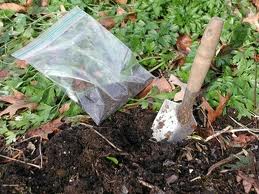
So. After we hired Charles Dehn and his bobcat to fill in the holes made by Rigel and Vega over the years, we put up fencing around the newly filled in areas. We used silt fencing, since it’s cheap, $20 for a hundred foot run with stakes included. Why? Because Rigel would have found the new, soft soil even better for digging. And I would have given a strangled sound when she did.
Does this solve the digging? No. After all, there’s still all that property outside of the fence. But we waited as long as we could into the fall. Eventually the ground freezes here. Then, but only then, does Rigel stop exploring what lies beneath. Once the ground freezes we’ll remove the fence. We plan to be out of here before it thaws next spring.
I’m having these flashes of insight, as if some larger realization lies not far from view, but still below the horizon of awareness.
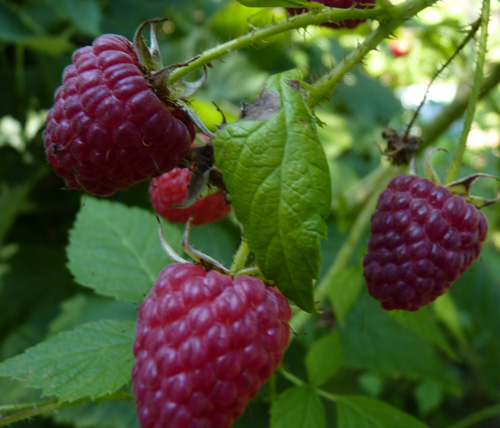
Raspberries have something to do with it: wading into the thorny brambles, canes curved low with hanging fruit and picking off the sweetness. So do those blue skies and the chill in the air while I engage in the oldest human method of obtaining food-gathering it from plants. That symbiotic trade between the food value of the fruit and our inadvertent willingness to bear its seeds to a new place places me there, so firmly there. No where else but picking raspberries.
I will say it with caution, because I don’t want to be confused for a transcendentalist, but I do look into the raspberry when I pick it. But, I also look into myself. When I look into the raspberry, I see water siphoned up from the soil, having fallen in rain or come sprinkled in from the aquifer below our property. I see colors, beautiful and rich, each fruit a miniature, reminding me of those Persian paintings. The seed is evident there, encased in a small cell filled with water and nutrients, so that when it hits the ground it will have what’s necessary for a healthy transition from top of the plant to the soil which is its natural home.
The raspberry itself is the Great Wheel, all of it. It comes on the plant after Mabon, after Michaelmas and left on its own will fall to the ground, probably before Samain, where it will lie on or just under the soil through the cold months of Winter and the days of Imbolc. Sometime in Spring it will begin to move, to thrust a small green stalk toward the sky and another, darker filament into the ground, seeking stability and food for its above ground presence. Over the course of Spring and Beltane the stalk will grow and the root deepen and strength its grip on mother earth. In the heat of Summer the stalk will grow into a cane, thorns will pop out and leaves, all moving fast toward the sky, the sun. Then it will reach Lughnasa and the strength of the cane and the roots will be at their optimum, ready to press out on tiny branches, flimsy and delicate, heavy dark-red fruits which will, once Mabon is past, once again droop toward the ground.
And so in the raspberry is millions of years of evolution, an evolutionary path older even than the one we humans have made, an ancientrail indeed. When I see the raspberry, this is what I see. When I look through the raspberry, I do not find revealed another metaphysical layer, a layer transcending the mundane and making it somehow special. No, I find the story of this stuff, these elements, this reality, a story which spans billions of years for this universe (and who is to say how many universes there are?), a story which spans millions of light years of space (and who can say how many miles there are in places we cannot see?).
If I wanted to introduce the religious into this conversation, I would tend toward the Hindu pantheon with Brahma the stretched out space in all its extensions and Shiva as the creator and destroyer of worlds and universes and maybe I would add in Vishnu so that this time in which I exist has an image of stability and permanence, even though such an image is an illusion. For which there is, of course, a wonderful Hindu idea, Maya.
I find Brahma, Shiva and Vishnu only useful as metaphor, as analogy but I do find them valuable in that way-as stand-ins, avatars, for the mystery that is what all this is.
These flashes, just out of sight. Something’s coming. And I’m satisfied to wait on its arrival.
Finished the article on Why I Hope to Die at 75. The more I read, the more I felt it revealed an uneasiness about worthiness. We are worthy only if we are productive. If we can be remembered as vital and incisive. If we remove ourselves from our children’s lives, quit being their shadow. If we don’t use resources better focused on the young or the demented. If we are not ill. If we are not disabled. If we are not operating at peak power.
This is what Christian theologians call works righteousness. You can only be saved if you do good works and abstain from bad ones. It was Luther who said, no, we are saved by grace alone. We cannot earn worthiness through good works.
Translated to this secular argument, I would say that we are not worthy because of our potential, our health status, our role as parents-no, we are worthy as a result of our humanness, because of our unique and precious life. Worthiness, in other words, is the wrong category to bring to the table. We live and have worth because of our existential situation. No one else, ever, will be the human that you are. No one. In this case I stand by analogy with Luther, we are worthy by the gracious act of our creation and remain so up to and even after our death.
None of this is to say that Ezekiel Emanuel can’t decide to refuse therapeutic medicine after 75. Of course, he can. Might be the right thing to do for him. I don’t know. I only know that his worth will not be any less because he’s no longer in the office at U Penn. His worth will not be less to his children and family because he may have a faulty heart. His worth will not be decided by others, nor, in fact, by himself. It was decided at the hour of his birth.