File under items that would not have showed up in Andover, Minnesota:
Lost black yak with white star on head. Last seen at S Baird Rd. call Trevor.
Big ol bear strolling down the road on Corsair just past Maurader at about 6:45am. Looked right at us and walked up the neighbors driveway. Cinnamon colored.
My once a year sighting of a moose
Just spotted a mountain lion near Shadow Mountain and Warhawk on side of the road.
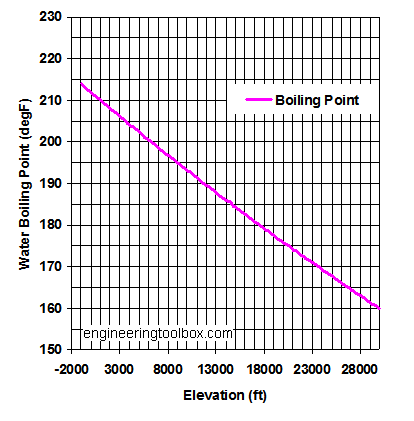
Gong fu cha requires specific temperatures for different sorts of tea. Black teas like pu’er, lapsang souchong, iron buddha require water temperatures of at least 203 degrees F. Unfortunately, these are some of my favorite teas. Unfortunately is easy to understand from this simple graph. We’re at 8,800 feet above sea level, call it 9,000 for this instance. Follow the line and you’ll see the problem.
Oolong teas require water temperatures between 194 and 206 F. I haven’t tried oolong yet, but it’s obvious that its needs are right at the cutoff point for our elevation. Water boils at around 195 F up here.
If any of my engineering oriented friends have an idea about how I can get water to the higher temperatures, barring use of a pressure cooker (too clunky), I’d love to hear it.
Baahubali 2: the Conclusion. OK. Some confessions first. I love costume drama. Sword and sandal. Victorian England. Crouching Tiger, Hidden Dragon. Gone With the Wind. Ben Hur. Movies like that. Or, television shows, too, for that matter. No, I don’t like them all, but when a movie combines a compelling story with the recreation of a period of time, I’m there.
I also love foreign films not made for an export market. In other words, I enjoy seeing how filmmakers and writers from other cultures choose to tell stories within their own cultural idioms. Seeing these and reading novels written and loved in a particular place, not the U.S., is the moral equivalent of traveling for me and I do all of these as often as I can.
I’ve also come to enjoy for its own sake the peculiar Bollywood film-making style. Technically, Baahubali is not Bollywood made, but it is in the Bollywood style. That style inevitably includes several elaborate song and dance numbers, often coming at odd junctures in the story, at least odd to this mountain man raised in the Midwest.
So, for me Baahubali was a perfect storm. Set in some mythic era of India, in the state of Mahishmati, a real ancient city, but here represented as the ultimate utopia, there are court scenes, love scenes, song and dance scenes, hunting scenes, battle scenes all elaborately produced and choreographed. Yes, the acting is often very broad, but this is not realism, it’s fantasy. There is also plenty of humor.
Though it was three hours long, the film never dragged, moving from one intense moment to another. One beautiful scene, the most fantastic, found a swan shaped ship sailing through the clouds as the two doomed lovers, Baahubali and Devasena, stood Titanic-like, at the prow.
There is a thoughtful review from the Indian entertainment press with which I largely agree. In essence the reviewer says the movie was a visual treat and thrilling, very watchable. But. It didn’t grab the heart, leave memorable characters or ideas behind. A glorious ephemera.
True that. Even so, it’s still worth seeing if you share even some of my cinematic quirks: love of costume dramas, a desire to see how other cultures express themselves in film, a jones for beautifully clad, colorful choreography and Indian musical vocals.
Irv Saltzman invited us to a performance by his singing group, the Renaissance Singers. It was held in a wooden Episcopal Church, St. Laurence’s, which is near our home. Directed by a Chinese national, Hannah Woo, who is finishing her Ph.D. in musicology, they were 8, four men and four women. As a group, they matched each other well. April, a soprano, had a lovely clear voice and a large range. Irv, formerly a tenor, has now transitioned into a bass/baritone role. Their performance was wonderful. At a meal afterwards we discovered April is our neighbor.
Renaissance choral music and instrumental renaissance music has always captivated me. It’s easy to see courtiers in colorful costumes listening to this music in a palace, brown robed and cowled monks hearing it in a morning prayer service, or small groups performing at home for their own amusement. It’s also the music most often heard at Renaissance festivals. Sorta makes sense, eh?
The sanctuary had a vaulted ceiling with exposed beams and two large, clear windows that looked out to the east, toward Shadow, Evergreen and Bear mountains. It rained while we were there and the mountains were in mist, the windows covered with raindrops slowly moving from top to bottom. There were individual chairs, padded with kneelers, arranged in a three sided configuration, making the sanctuary a sort of thrust proscenium stage, an ideal arrangement for a small group of singers.
A church artist had painted the stations of the cross and they were around the sanctuary, set off by bent sheet metal frames. A copper baptistry, large, sat over a cinerarium where the congregation deposits cremation remains and memorializes the dead with small plaques.
Between the two windows hung a large crucifix, a cross made of bare, light wood and a bronze Jesus hung by two nails. I had an odd sensation while listening to this music I’ve often heard in monastic settings on retreat. It carried me back into the spiritual space of an ascetic Christianity that often comforted me. This time though I came into the space as a peri-Jew, identifying more with Marilyn and Irv and Kate, with the still new to me spiritual space of Beth Evergreen, than the theological world represented by this spare, but beautiful sanctuary.
The crucifix stimulated the strongest, strangest and most unexpected feeling. I saw, instead of the Jesus of Christianity, a hung Jew, a member of the tribe. More than that, I felt the vast apparatus and historical punch created by his followers, followers of a man who shared much of the new faith world in which I now find myself. It was an odd feeling, as if this whole religion was an offshoot, a historical by-blow that somehow got way out of hand.
These feelings signaled to me how far I’d moved into the cultural world of reconstructionist Judaism. I see now with eyes and a heart shaped by the Torah and mussar and interaction with a rabbi and the congregants of Beth Evergreen.
This was an afternoon filled with the metaphysical whiplash I’ve experienced often over the last year, a clashing of deep thought currents, spiritual longings. This process is a challenge to my more recent flat-earth humanism, a pagan faith grounded not in the next world, but in this one. Literally grounded.
What’s pushing me now is not a desire to change religious traditions, but to again look toward the unseen, the powerful forces just outside of the electromagnetic spectrum and incorporate them again into my ancientrail of faith. This makes me feel odd, as if I’m abandoning convictions hard won, but I don’t think that’s actually what’s going on. There is now an opening to press further into my paganism, to probe further into the mystery of life, of our place in the unfoldingness of the universe, to feel and know what lies beyond reason and the senses.
I’ve found the Colorado equivalent of Minnesota’s Scientific and Natural Areas (SNA’s). Here they’re called Colorado Designated Natural Areas. “Designated Natural Areas contain a wide representation of Colorado’s rare plants and animals, unique plant communities, rich fossil locations, and geological features.” I enjoyed visiting these areas in Minnesota. Sounds like they’re a little more diverse here. Road trip!
Spring is grandkid viewing time. That is, the schools here put on multiple performances and grandparents can watch their kin perform in various ways. Gabe narrated a portion of Midsummer Night’s Dream. Ruth and her team, the Jaw Dropping Crunchy Brains, performed their original play twice in competition. This last Friday Ruth performed both in the chorus of a Sweigert Elementary musical and in a smaller group singing “Somewhere.”
Both Gabe’s performance during the William Shakespeare Festival and Ruth’s musical were at the Denver Center for the Performing Arts. There are many venues there from small to large. It makes accessing dance, opera, theatre and various types of musical concerts easy by concentrating them in one location and providing decent parking. Near by are both the Denver Convention Center and the Arts District which contains the Denver Art Museum and other, smaller museums. The liveliest art scenes in Denver are not, however, at these more conventional, institutional locations but at several spontaneously arisen art areas like the one along Santa Fe.
Two things. Turning left yesterday after visiting the Colorado Potters Guild spring show, I looked up and noticed I had executed a left turn in front of an oncoming SUV. We missed each other, though it could have been otherwise. Later, turning a corner onto 8th Avenue heading out of Denver, I banged the right rear of the Rav4 against a curb. It’s important to be honest about such a critical skill as driving and right now, I’m lacking something. Maybe it’s attention, maybe it’s an inability to drive and chew gum at the same time. I don’t know. But I need to do something about it.
Goya ‘I am Still Learning’
Second thing. When I was a little boy, my dad had two nicknames for me: tech and crit. Neither were positive. The first, tech, was short for technical. He said I was very precise, very techincal in an argument. I would pick at things that others wouldn’t notice or didn’t care about. True. Still do it. It is, for better and worse, the way my mind works.
The second, crit, summarized my tendency, linked to tech, to be more critical than most. True. If I see something, I say something. An irritating habit, I know, for those around me, but, again, it’s the way my mind sees the world. Over time I’ve become aware of the way these tendencies affect others, but being able to modulate them is very difficult for me.
Why? Well, later in life I found the Meyers-Briggs personality inventory and discovered my INTP personality type. It fits. Here is a recognized weakness of this personality type:
Insensitive – Oftentimes INTP personalities get so caught up in their logic that they forget any kind of emotional consideration – they dismiss subjectivity as irrational and tradition as an attempt to bar much-needed progress. Purely emotional situations are often utterly puzzling to INTPs, and their lack of timely sympathy can easily offend.
Oh? Well. Tech and crit-me-manifested very, very early. Dad focused on an interactive aspect of my personality that is designed to irritate others. It’s not the only aspect, hardly, but having it emphasized was difficult for me. Actually, it still is.
But here’s another way to look at it, this time as a strength:
Honest and Straightforward – To know one thing and say another would be terribly disingenuous – INTPs don’t often go around intentionally hurting feelings, but they believe that the truth is the most important factor, and they expect that to be appreciated and reciprocated.
This is a strength that has an obvious downside, or weakness. I want to modulate the hurtful aspect of this character trait through the middah of chesed, or loving kindness. This does not mean I will change the way my mind works. Don’t think I can after a good deal of experience. It does mean that I can introduce a pause between my observation, which will still exist, and its articulation. In that way I can assess whether the truth in a particular situation is helpful or hurtful.
My focus phrase for this will be: see the good, too. Always.
“People forget something: in climbing, it doesn’t matter what you’re doing,” he told Outsideonline.com in 2010. “If you do a speed ascent, you’re the fastest up the Eiger’s North Face, nothing’s going to change in the world. But maybe your world is going to change. In the evening, when you’re going to bed, you know exactly what you have done. And that’s what it’s all about….If it’s your challenge, and you’re happy with it, that’s the most important thing.” Ueli Steck, quoted in the Alpinist
*Yokoyama Taikan was the pseudonym of a major figure in pre-World War II Japanese painting. He is notable for helping create the Japanese painting technique of Nihonga. His real name was Sakai Hidemaro. Wikipedia
“Everyone sees the unseen in proportion to the clarity of his heart, and that depends on how much he has polished it. Whoever has polished more, sees more, unseen forms become manifest to him.” -Jalal ad-Din Rumi
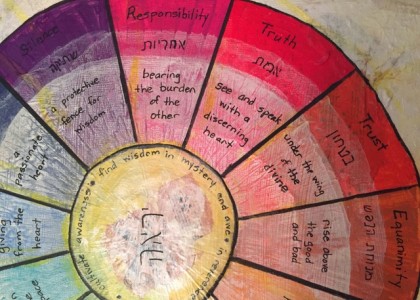
Bonnie, a rabbi in training and a former high level bureaucrat for the U.S. National Forest Service based in D.C., led our mussar class yesterday. Mussar is an odd (to me) blend of ethics and spirituality, a way of living the 613 mitzvot, or laws, found in the Torah. Since the laws themselves have the unified purpose of leading the faithful on a sacred journey that carries them closer and closer to God, mussar (ethics in Hebrew) is technically an ethical system with a spiritual aim, one embedded in the unique cultural experience of Jewish history.
Mussar intends to guide this sacred journey through measurable development of character traits, or middah. The measurability comes in as mussar students, like Kate and me, learn a particular middah, then decide on incremental steps we can take to increase its presence in our lives. We record our progress in a journal and reinforce it through the use of focus phrases. Well, that’s the theory anyhow. It’s taken me nearly a year to get my intellectual footing, so I’ve focused on learning about learning mussar rather than using those tools. I do see their value.
An intriguing pagan element runs throughout the Judaism I’ve been exposed to at Beth Evergreen. The Jewish liturgical year is on a lunar calendar. Shabbat begins at sundown on Friday and Friday shabbat services are held at night. Sukkot is a harvest festival, held outdoors in a sukkot booth. Tu BiShvat is new year for the trees. Judaism is also very body positive, actively opposing ascetic practices that exist in some forms of Christian monasticism, and encouraging the enjoyment of sex.
Bonnie highlighted that element yesterday in her mussar lesson on the middah of clarity, clarity of self and soul. Tahara is the Hebrew word for clarity. Her examples for achieving and practicing clarity focused on the medieval four elements: earth, air, wind and fire.
Water – Bonnie offered a quote from the novelist Julian Barnes: “Mystification is easy; clarity is the hardest thing of all.”
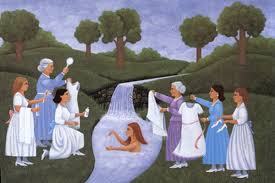
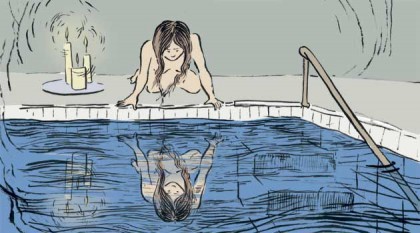
She then described still water, with the sediment settled out, as an instance of crystal clarity. Bonnie suggested three examples of how water facilitates clarity in Jewish ritual life: the mikveh, tevilah and netilat yadayim. The mikveh and the tevilah are ritual immersion in water, the first in a bath, the second in running water. Netilat yadayim is handwashing after contact with a corpse, burial or visiting a cemetery. The water carries away any tumah, spiritual impurity.
Finally, she gave ways of embodying this mussar practice:
Swim, float, dangle your bare feet in water. Take a dip in a bubble bath or a hot spring. Stay out in the rain, don’t run for cover, splash. Get out/in/near open water.
tevilah, immersion in running water
Interestingly, in Judaism the soul is pure. As the Psalmist says: The soul that you, my God, has given me, is pure. You created it, you formed it, you breathed it into me. No original sin here. The water rituals wash away shmutz, a film or a build up, spiritual impurity, that clouds the pure soul. Result: clarity.
Thinking of clarity, a clearly seen pure soul, in this way helps any encounter with water, air, earth or fire act as a spiritual practice, reminding us of the need for clarity while helping us scrape off the shmutz.
This marriage of the elemental and the spiritual resonates for me. I once referred to gardening as a tactile spirituality. These ideas expand that notion in a helpful way. The reimagining faith project intersects with this approach to mussar.
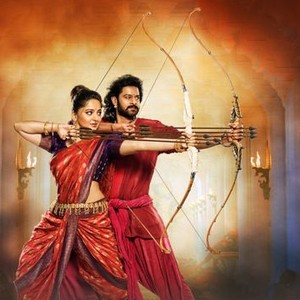 I’ve also come to enjoy for its own sake the peculiar Bollywood film-making style. Technically, Baahubali is not Bollywood made, but it is in the Bollywood style. That style inevitably includes several elaborate song and dance numbers, often coming at odd junctures in the story, at least odd to this mountain man raised in the Midwest.
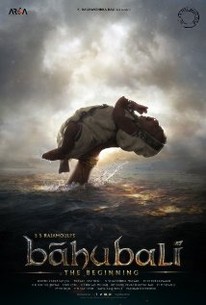 There is a
 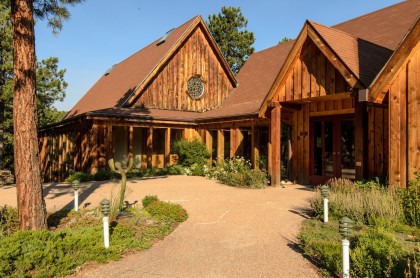 Irv Saltzman invited us to a performance by his singing group, the Renaissance Singers. It was held in a wooden Episcopal Church, St. Laurence’s, which is near our home. Directed by a Chinese national, Hannah Woo, who is finishing her Ph.D. in musicology, they were 8, four men and four women. As a group, they matched each other well. April, a soprano, had a lovely clear voice and a large range. Irv, formerly a tenor, has now transitioned into a bass/baritone role. Their performance was wonderful. At a meal afterwards we discovered April is our neighbor.
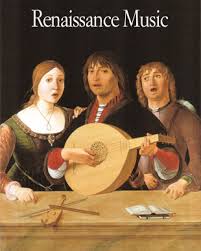 Renaissance choral music and instrumental renaissance music has always captivated me. It’s easy to see courtiers in colorful costumes listening to this music in a palace, brown robed and cowled monks hearing it in a morning prayer service, or small groups performing at home for their own amusement. It’s also the music most often heard at Renaissance festivals. Sorta makes sense, eh?
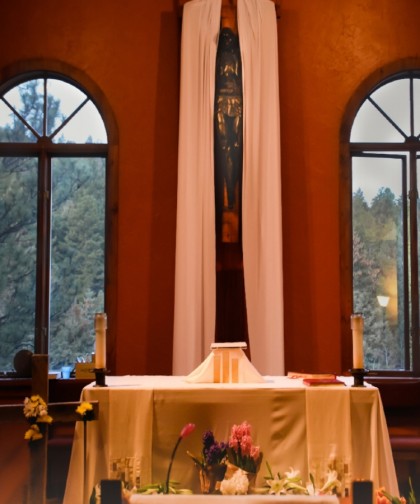 Between the two windows hung a large crucifix, a cross made of bare, light wood and a bronze Jesus hung by two nails. I had an odd sensation while listening to this music I’ve often heard in monastic settings on retreat. It carried me back into the spiritual space of an ascetic Christianity that often comforted me. This time though I came into the space as a peri-Jew, identifying more with Marilyn and Irv and Kate, with the still new to me spiritual space of Beth Evergreen, than the theological world represented by this spare, but beautiful sanctuary.
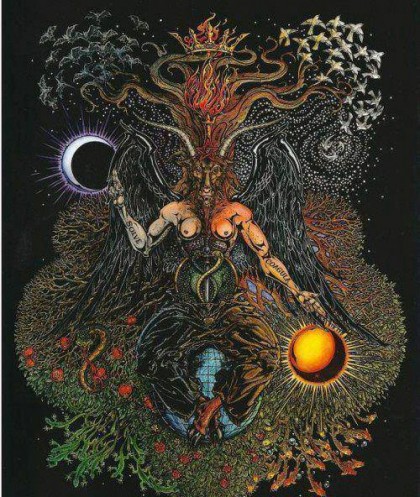 This was an afternoon filled with the metaphysical whiplash I’ve experienced often over the last year, a clashing of deep thought currents, spiritual longings. This process is a challenge to my more recent flat-earth humanism, a pagan faith grounded not in the next world, but in this one. Literally grounded.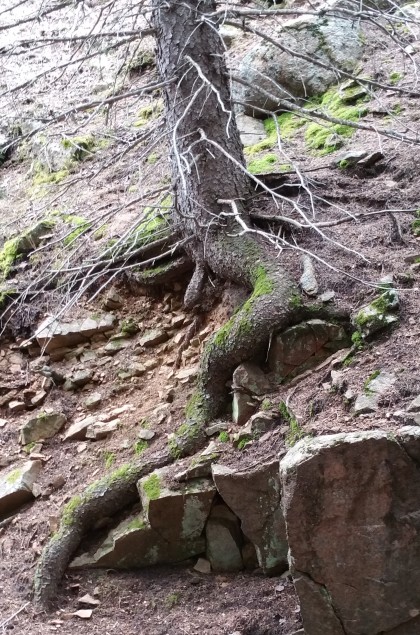
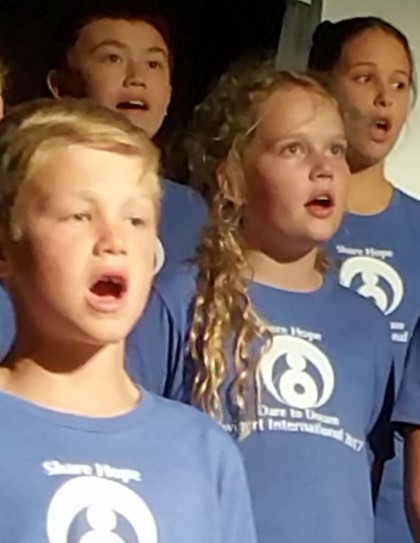 Spring is grandkid viewing time. That is, the schools here put on multiple performances and grandparents can watch their kin perform in various ways. Gabe narrated a portion of Midsummer Night’s Dream. Ruth and her team, the Jaw Dropping Crunchy Brains, performed their original play twice in competition. This last Friday Ruth performed both in the chorus of a Sweigert Elementary musical and in a smaller group singing “Somewhere.”
 Two things. Turning left yesterday after visiting the Colorado Potters Guild spring show, I looked up and noticed I had executed a left turn in front of an oncoming SUV. We missed each other, though it could have been otherwise. Later, turning a corner onto 8th Avenue heading out of Denver, I banged the right rear of the Rav4 against a curb. It’s important to be honest about such a critical skill as driving and right now, I’m lacking something. Maybe it’s attention, maybe it’s an inability to drive and chew gum at the same time. I don’t know. But I need to do something about it.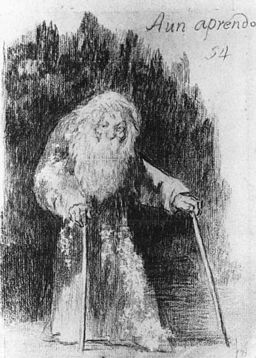
 Oh? Well. Tech and crit-me-manifested very, very early. Dad focused on an interactive aspect of my personality that is designed to irritate others. It’s not the only aspect, hardly, but having it emphasized was difficult for me. Actually, it still is.
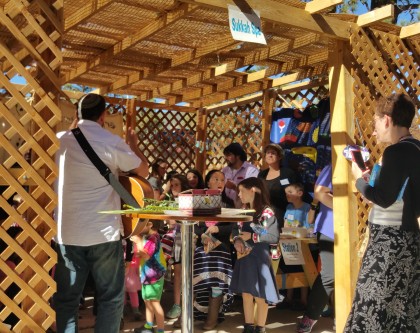 An intriguing pagan element runs throughout the Judaism I’ve been exposed to at Beth Evergreen. The Jewish liturgical year is on a lunar calendar. Shabbat begins at sundown on Friday and Friday shabbat services are held at night. Sukkot is a harvest festival, held outdoors in a sukkot booth. Tu BiShvat is new year for the trees. Judaism is also very body positive, actively opposing ascetic practices that exist in some forms of Christian monasticism, and encouraging the enjoyment of sex.
 Water – Bonnie offered a quote from the novelist Julian Barnes: “Mystification is easy; clarity is the hardest thing of all.”