Fall Harvest Moon

Been thinking about a new analogy for reimagining/reconstructing faith: the transition from representational to abstract art. I like the analogy because it reaches deep into prehistory to the cave art of Lascaux and Chauvet of 40,000 years ago. This tradition developed so powerfully that its underlying assumptions were simply not questioned. What would art be about but the reproduction of the human world in two-dimensions? Then, in 3, but still a man, or a god, or an animal. The introduction of perspective reinforced the representational, but did, I imagine, to the sensitive eye, give an inkling of the manipulation of space and color that really underlay art making.
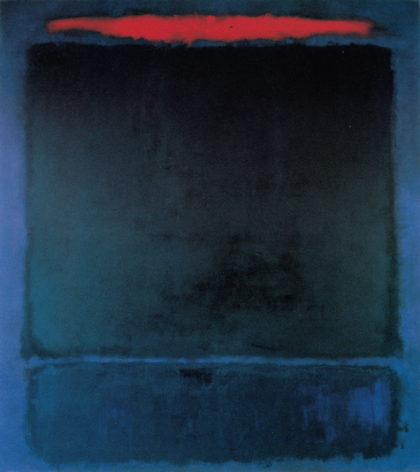
So called modern art was a radical break with this tradition. It happened as artists in many places looked at painting and sculpture with fresh eyes. They asked about the purpose of art, the purpose of paint on canvas, the purpose of reshaping wood and stone. What are the primary elements of the work? Color. Paint. Form. Space. Negative space. And perspective, did it have to be mathematical? Was there a perspective that developed simply through the use of color? (Cezanne) Did perspective have to be singular? (Picasso) Could a painting be nothing but color? (Morris Louis, Rothko, Kandinsky) What about painting or sculpting things that could not exist? (Man Ray, Dali, DuChamp)
As artists began to consider the fundamentals, the unexamined assumptions of making art that had shaped its global expression since humans began making marks, though, that other tradition, the old representational one, did not die out. There were still portraits, still landscapes, still still lifes, sculpted men and women and animals and mythical beings of all sorts. This reimagining, reconstructing of art itself seemed to displace the older way, but only because museums became so dominant. There were modern art museums like the Walker and the Guggenheim and the Modern and the Tate which seemed to position the older, encyclopedic museums like the MIA, the Metropolitan, the Kunsthistorisches, the Louvre as showplaces of what used to be. Even the development of ateliers, who imagine themselves as the heirs to the older tradition, seemed to be an admission that the reimaginers had swept the field.
 So what I’m proposing is not another religion with a different origin story, a different set of scriptures, different roots from, say, Hinduism, Zoroastrianism, Christianity, Islam. And what I’m definitely not proposing is a reductionistic attempt to find out what all religions have in common, nor am I proposing a sort of tolerance for all faiths, an attempt to learn from each of them (though this is a good thing to do) and out of that shape a new faith.
No, I want to play with the fundamentals of religion, those things that underlay the tradition of religious thought and practice. I say play advisedly because I think it was the playful aspect of the artists who questioned their tradition that made their work bearable. And, in making it bearable, made it accessible enough to thrive.
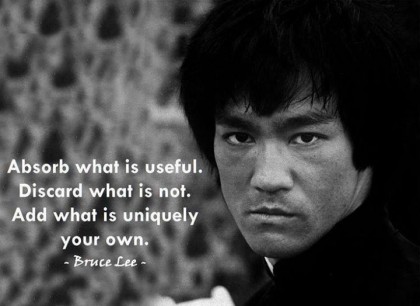 So, what are some of those fundamentals? Prayer, worship, gods, ritual, art, revelation, congregations, sacred space, the notion of sacred, divinity, after life, morality and ethics. How might a radical approach take the long history of prayer, for example, and reshape it, reconfigure it, reuse it for the person who chooses to stand outside particular traditions, but still wants to paint? Or, what about gods? How does the notion of powerful, unseen entities with various agendas fit into the life of persons no longer monotheists, no longer willing or able to see many gods?
I don’t even want to do what Emerson proposed. That is, have a religion of revelation to us rather than the dry bones of theirs. I want to examine revelation itself. What is revealed? Why is hiddenness so important to religion? What is revelation in a quantum mechanical world? Where is revelation? How are things revealed? How have things been revealed all along, but we didn’t notice? And why do we care about a world beyond the one we experience effortlessly?
 That’s especially important for workouts, which are easy to forego. On Mondays, Wednesdays and Fridays, I do 20 minutes of cardio, then resistance work, then 20 more minutes of cardio. On Tuesdays, Thursdays and Saturdays, I do the high intensity cardio plus 50 minutes or so slower cardio. If I miss a Monday, I go on to the high intensity, slow cardio day. If I miss a Monday and a Tuesday, I still go to the 40 minutes of cardio, resistance work day. For me, keeping the same workouts on the same days of the week keeps me from feeling guilty (I’ve missed so many workouts, it doesn’t make sense to even try and get back to my schedule.) and guilt stops the process altogether.
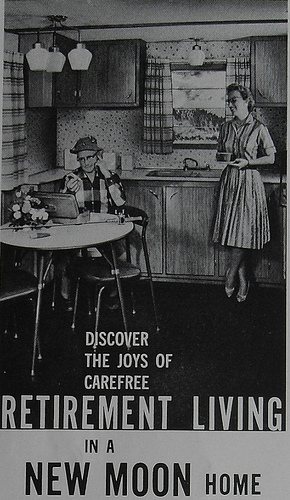 The third phase is new. It used to be that 65 or so meant the end of a working life, retirement happened, then death, often before 70. Those that made it into their seventies were often burdened with serious medical problems that drained energy and created obstacles to doing much else.
 70 is not the new sixty. It’s the new 70. What 70 is the new sixty really means is that for those raised in the 50’s, 70 now appears like age 60 did when we were kids. Big difference though…we’re in that sixties range of health, but we’re 70 and work has fallen away, the kids are gone. What do we do?
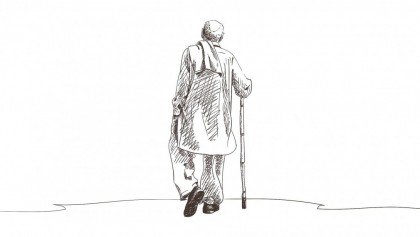 Yes, retirement and the life following it, the third phase as I call it, is just that, a new and different time of life, one in which the question of how do I live can have a radically different answer than in the first two phases. Who are you? Who do you want to be? If you want to be a person whose constant focus is recreation, who gets up in the morning for another day of adult recess, you can. If you want to be a dress designer after years as a forensic engineer, you can. Or, as in my case, the work before retirement age was satisfying, self-directed, so there’s little reason to change just because some age-related cultural turning point has been reached.
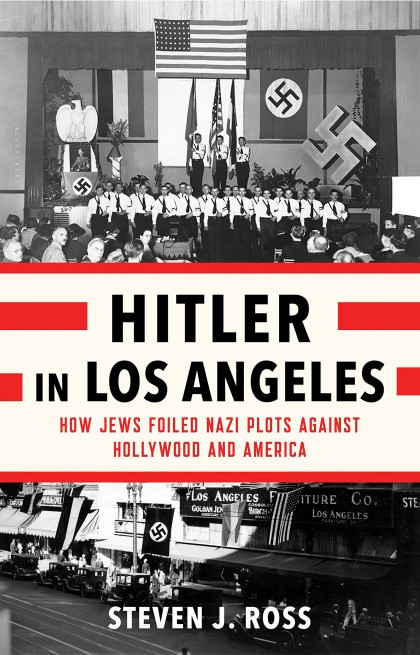 Sites of Los Angeles
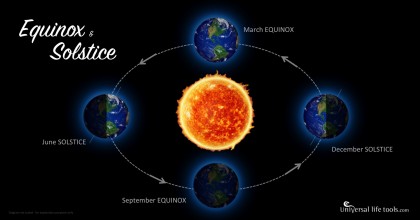 Here in the mountains the streams have long ago drained off last winter’s snowfall; the aspen have turned golden. The cervids have begun their annual procreational dance. Sex is in the air. We have snow in the forecast for Monday and night time temperatures are in the good sleeping weather range for Kate and me. In Minnesota we could hear the Andover marching band practicing and here the high school football season is already well underway. Coats become an item of consideration when leaving the house.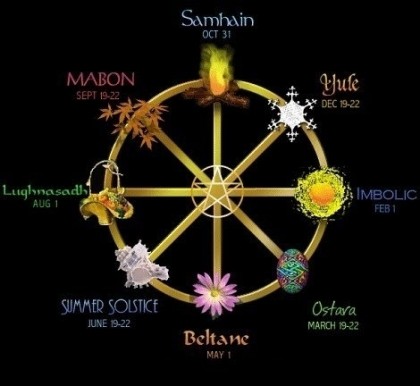
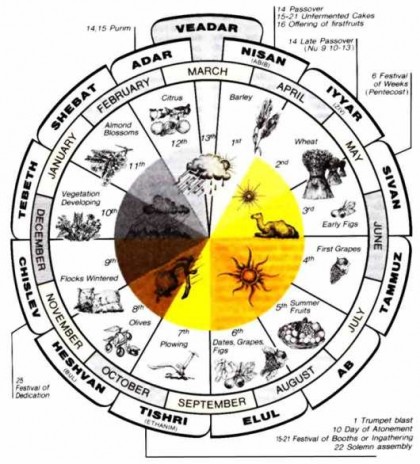
 “That’s us,” he said, sweeping his hand around the room. Of course, it’s not me, but I took the point. Israel, those Jews in the sanctuary at Beth Evergreen and in Rosh Hashanah services around the world last night, and those Jews not in the services, too, is a community which celebrates its most important memories every Sabbath with a parsha reading, a segment of the Torah.
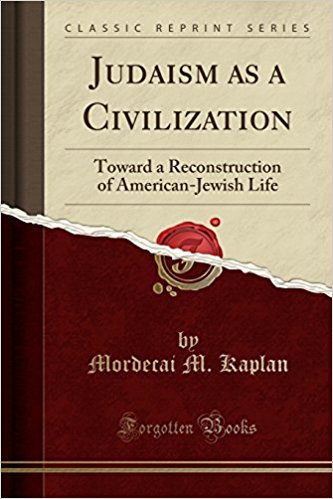 This is reconstructionist Judaism, an explicitly non-supernatural religion that nonetheless adheres to the traditions and customs of Jewish civilization, including Torah study, sabbath observance, comforting mourners, repairing the world and doing acts of loving kindness.
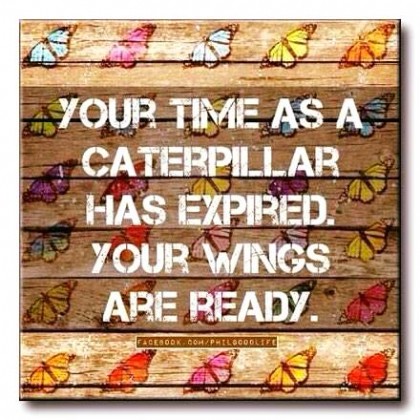
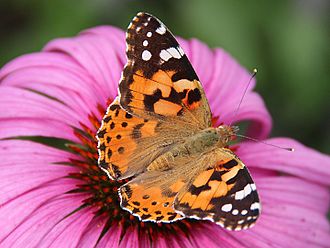 Under the category of awe. In passing I noted a reference to butterflies being around in some numbers. One commenter on pinecam.com referred to them as painted ladies migrating.
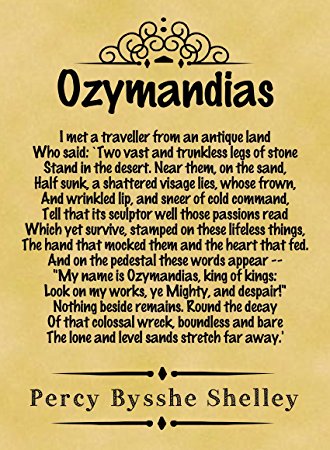 The last night of the Eclipse Moon, a disastrous month for North America from the eclipse to its waning moment. The wildfires are still burning in the West from the state of Washington to California, in Oregon and Montana and Idaho. Harvey and Irma related disaster cleanup has only begun. The same in southern Mexico for the victims of the 8.1 earthquake. Jose is still pounding around in the Atlantic and Maria, now a category 5, has just shattered Dominica, Guadeloupe, and is headed for Martinique and Puerto Rico. It’s not the apocalypse, no, but for those whose homes and forests are on fire, under water, battered by wind or destroyed by the movement of the earth, it may as well be.