Spring Passover Moon

Spring Passover Moon
Spring Passover Moon

In a long ago TV program, the name of which I can’t remember, a character said of his Porsche, “It’s my carapace.” Yes. The vehicle we choose is a statement about us, carmakers learned this from the carriage makers. Kate and I drive a Rav4. It’s functional, unexciting, and a mostly serviceable way of moving from point A to point B. We bought it in a hurry when our Tundra had a fatal seizure not long after I’d given the Celica to charity.
But we’ve added a bit to it. First, there’s that damage to the front end, unrepaired. Long unrepaired now, maybe 2 years. That’s a statement. We also have two stickers on the back: Our House Runs On Clean Energy and Fin Del Mundo: Ushuaia. During the presidential campaign, we also had a Bernie Sanders sign. There is a small sticker on the side window for the planetarium in Boulder. Gertie and Rigel ride with us from time to time. Another statement.
 I mention the Rav4 and the Porsche first because these thoughts often occur to me while I’m driving. Vanity license plates. Fancy wheels. Political bumper stickers. Coexist. Rainbow pride. If you’re going to ride my ass, at least pull my hair. Keep honking I’m reloading. Flagpoles on the back of the pickup: the red white and blue on one side, the yellow, Live Free or Die flag on the other. Gun racks. Lowriders. Bentleys and Priuses. The occasional Maserati or Ferrari. Maybe you’re on a motorcycle wearing colors. Maybe you’re pulling a boat, or a camper, or a horse trailer.
As a culture we have chosen our vehicles as a prominent way to signal to others who we are, or who we would like to be. I read an article that said the political leanings of a particular area could be sussed out by the number of pickup trucks on the road, the more pickups the redder the politics. I’m sure you could find a similar metric by counting Cadillacs or Hummers or expensive sports cars.
I used to have a ponytail and I’ve had a beard almost all of my adult life. Look at a woman’s nails, at earrings, necklaces, bracelets. All semiotics.
 At home. Even the dogs with whom we live. Semiotics. Furniture. Art. Books. Rugs and window treatments. Semiotics. Both to others, but also, and often more importantly, to ourselves. Reminders of who we are. Or aspirational signals about who we want to become. Or, false flags, representing how we wish others to see us. The solar panels on our roof. The well maintained exterior of our home. Even the stumps of the trees cut down for fire mitigation. All messages to the world.
We are opaque. Who we are, what we mean in the world, is not evident from our bodies. We want to know, need to know, what others are like, but we’re very poor judges. That’s why stereotyping exists. It attempts to add semiotics to skin color or body shape. Because we want some advance clue as to the nature of the other. Are they are a threat? Are they a potential mate? Might we agree with them on something important? Could they be trusted?
 We all know this, at least at a subconscious level, so we offer clues. Those Grateful Dead Dancing Bears. The menorah lit in the window. The stylized fish. The stylized fish with legs and Darwin in the middle. A Bronco’s sticker. A Viking’s sticker. A lacrosse stick. Somehow we feel these things reveal a portion of who we are. Make us less opaque, perhaps a bit more transparent.
As a long ago student of anthropology, these kind of things fascinate me. I offer no conclusions, other than what they reveal about our essential opacity and our desire to be known in spite of it. The wide range of these semiotics are perhaps more necessary in a diverse nation with no tribal traditions, no single ethnic heritage, no long history as, say, Franks or Germans or Spaniards.
Spring Passover Moon
I may have found a way back into the art world, one I can sustain even from here on Shadow Mountain. A couple of weeks ago I decided to add links to several prominent museums to my bookmark bar: the MIA of course, the Chicago Art Institute, the Met, the Vatican Museum, the Uffizi, the Asian Art museum in San Francisco, the Getty Open Content site and the Google Cultural Institute. I’ll probably add more.
This started as an effort to collect places from which I could draw interesting images for Ancientrails. Many of these museums have made their collection’s images or significant portions of them available as open content. As far as I know, the Rijksmuseum in the Netherlands was the first to do this thoroughly. Every image on this museum’s website can be downloaded, used in any way. This even includes uses like those of Richard Prince, the well known appropriater of other folks’ work to create his own.
You may recall that I got myself in a bit of a twist over just this issue last year, so I’ve been eager to find image sources that won’t send me threatening letters from their lawyers. This growing movement among museums seemed like a solution. What better images could I find than great art?
Then, while poking around on these various websites, I clicked on the Google Cultural Institute. On its home page it has various teasers to get a viewer to go deeper. One of them up at the time I visited was a collection of works on mountains, some 4,000 +. Aha. Mountains. In art. I live in the mountains. There could be something here.
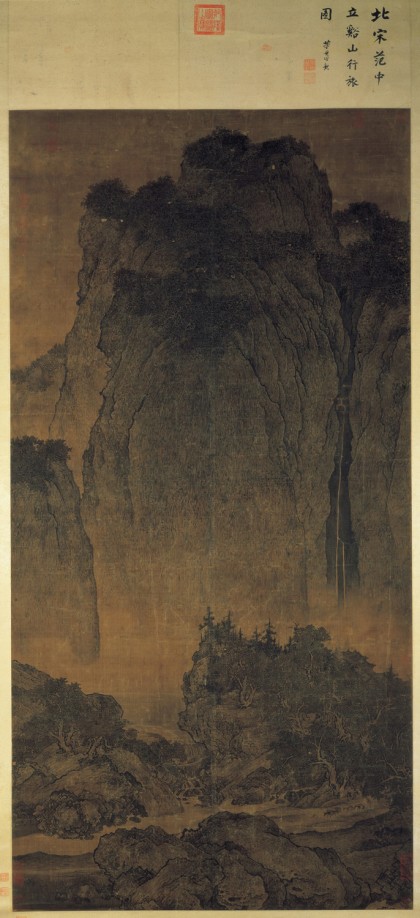
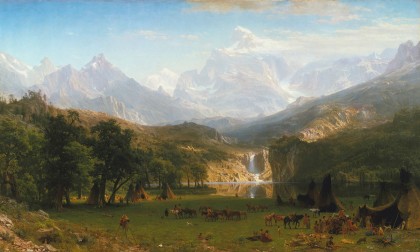
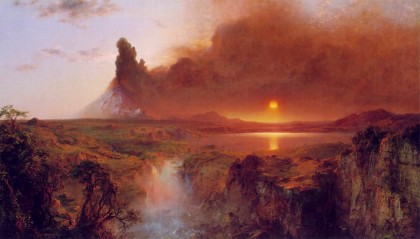
Yes, it occurred to me, I could investigate art focused on mountains. Hokusai’s “Views of Mt. Fuji.” Fan Kuan’s “Travelers Among Mountains and Streams.” Bierstadt’s views of the Rockies. And so many more. This could enrich my experience of my home terrain and provide a vein of exploration, a way to study art again with a purpose. Not to mention that I flirted briefly with the idea of becoming the Mountain Docent. This idea could add a double entendre to mountain docent.
We’ll see if the idea sticks, but right now I’m excited about it. It connects well with the notion of becoming native to this place, too, and could serve as a resource for reimagining faith.
As I turned the idea around in my mind, it struck me that I have an intimate knowledge of another form of landscape, too: agriculture and horticulture. So, I may expand this project to include images of farming, of fields, of gardens, of seasonal change, the experiences of which led me to immerse myself in the idea of the Great Wheel.
Not sure where this will take me, but right now I’m pretty excited about it.
Spring Passover Moon

Yesterday on my Lego store, IKEA, Dairy Queen outing-all in the interest of Ruth and Gabe-I saw an unusual and unusually striking sight. While waiting for the stoplight at Chester and Yosemite after visiting IKEA, a flash of mylar caught my eye. In a parking lot across Yosemite I saw a person struggling, or at least that’s what I thought it was, to put shiny objects into their vehicle. Since the same shapes moved in, then came back out a couple of times, I realized it wasn’t going well. Then, just as most of them disappeared inside, one broke loose and drifted up, up, up into the air.
It was a silvery colored mylar A. As it lifted out of reach, the person at the vehicle looked up. Turning once onto its side, it became a triangular aircraft, life a B2 bomber. Then some current of air turned it again and it faded away toward the north, a clear and flashy A, signaling itself as a familiar part of the alphabet on a journey all its own, freed from both words and the earth.
Spring Passover Moon
Snow yesterday and last night. Not a lot, maybe 2 inches. At most. But, all moisture is welcome. More rain and snow in the forecast for next week, too. Go, sky.
This week saw lab results and imaging results coming in over the threshold. Like getting final grades at the end of term though these matter, especially at this age, much more. All good for both of us, mostly. My kidney disease has actually improved some. No real trouble. Of course, there’s always the mortal yet that needs to be added here. But for now, still above ground and likely to stay that way for a while.
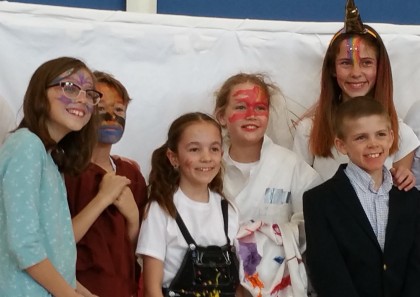
The weekend is grandkids. Ruth and her Destination Imagination team, the Jaw Dropping Crunchy Brains, compete in the statewide event tomorrow. We’ll be in attendance.
 Tomorrow, Earth Day, April 22nd, is Gabe’s 9th birthday. He wants to eat at Sam’s #3 and so we will. A good day to celebrate the grandkids.
Today I’m off to the Lego store to get a gift certificate for Gabe, then I’ll head all the way south on Hwy. 470 to Ikea. I’m picking up a chair frame and two stools. The chair frame is for a reading chair like mine. With it Ruth and I can read together in the loft.
Finally, I’ll swing by Dairy Queen for an ice cream cake for Gabe’s birthday celebration up here on Shadow Mountain. That should be enough for today.
Of course, all this driving will be in full view of the Front Range, making it seem like I’m really out here on vacation. Which is what it still feels like most of the time.
Spring Passover Moon
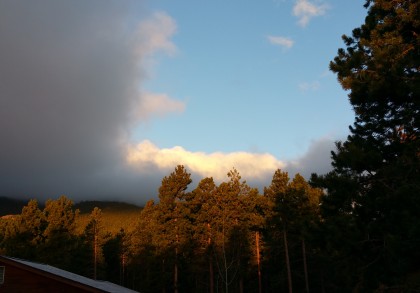
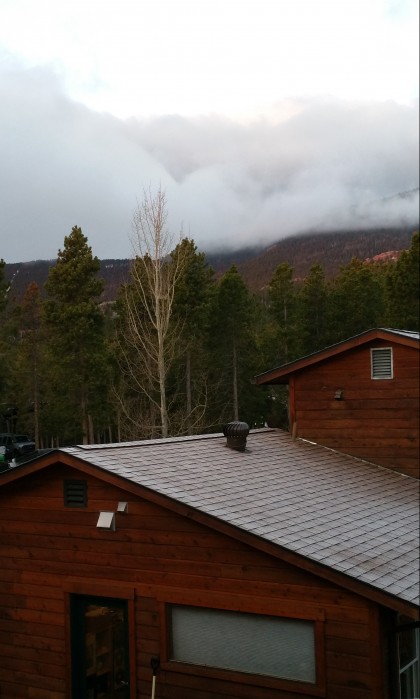
Black Mountain this morning.
Spring Passover Moon
 Monday. Physicals back to back. We do things together, like our physicals and our dental cleanings. So sweet. Very romantic. And it is, in its way. Sort of like dates. We go out to lunch afterwards.
This week is the slow drip after as test results and imaging work reveal their information. So far, generally good news. The usual deterioration occasioned by 70 + years on the planet, not a surprise, but not yet deadly.
The zen of Kate. One of the imaging tests could have returned something bad, but even in the weeks after she learned a second test, a cat scan, would be necessary, Kate didn’t flinch. “Can worrying about it make it different?” she said. A wise woman, my Kate. Of course, that didn’t prevent me from worrying about it, but I’m trying to learn from her on this one.
She’s bouncing back from a three/four month bout of low energy and shortness of breath. Nighttime oxygen (we live at 8,800 feet) and more calories each day have given her more pizazz. She’s also just had her second infusion of Remicade, a drug for rheumatoid arthritis. RA can also produce fatigue so the Remicade may be helping her energy level increase, too.
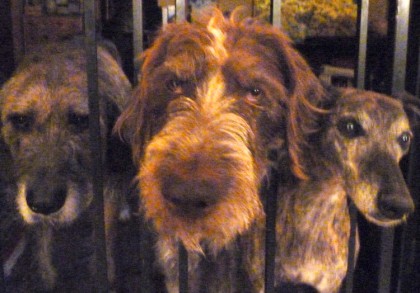 The zen of dogs. Over the last few weeks I’ve paid special attention to how the dogs in my life live: Gertie, Rigel and Kepler. We share moments often during the day and at night. A dog is always in the now, ready to take a nap, run outside, eat, get a head or neck scratch, some petting. They remind me of the brevity of life and how precious each moment, each interaction is, not only with dogs of course, but with family and friends. With the mountains, too. The clouds and stars. The snow.
Spring Passover Moon
 The waning passover moon is behind a faint scrim of clouds giving it a moonlit halo. Each moon cycle repeats the past, yet is unique to itself. The slow orbit (relatively slow) of the moon around the earth produces the same phases each month and in that sense repeats. But the lunar month and the sidereal year do not quite match up*, as all cultures that depend on lunar months for their calendars have long known. Judaism is such a culture.
Each lunar month happens at a slightly different place in earth’s orbit due to this irregularity over the course of sidereal year. In addition, our whole solar system is not static, but moves through the universe at a speed of 12 miles per second toward the constellation Lambda Herculis.** At the same time our solar system is also spinning around the Milky Way and the Milky Way itself is speeding toward a collision with Andromeda Galaxy in 4 billion years.+
 When you consider the irregularities in the lunar position occasioned by the sidereal/synodic difference and the speed of our solar system both moving on its own toward Lambda Herculis and around the Milky Way and then throw in the speed of the Milky Way itself, it becomes clear that no one phase of the moon every occurs in even remotely the same location.
Why belabor this? Becauses it underscores the irreproducibility of much seemingly regular phenomena. Now think about the long span of evolution on this moving planet, within this speeding solar system. This means that no animal or plant species has occupied the same cosmic location for even a short span of its existence. So, in this sense alone, each animal or plant species is unique. But, each animal or plant itself is also unique because it comes into existence and dies, having occupied only one small niche in the larger web of life.

Within this context regard human evolution. Australopithecus, considered the first instance of the Homo genus, has been dated to 2.8 million years ago. Since that time the genus went through many speciations until, about 200,000 years ago, our own species, Homo sapiens, emerges. So, for over 200,000 years individuals of our own specific branch of evolution have been born, lived and died. Each one of them are unique within just our species.
Each of us, then, from the moment of our birth and for the very brief span of our life (in cosmic terms), travels literally millions and millions of miles, speeding around the sun, the Milky Way, toward Lambda Herculis and as part of our galaxies own rush toward Virgo and Libra. In addition each of us represents a specific instance of an evolutionary branch with its own branch on the tree of life, a branch that split off on its own some 2.8 million years ago.
This means we are each unique in many different ways in addition to the obvious ones of parentage, genetics and personal development.
 Finally, the point. We are, each of us, unique and precious instances of over 2 billion years of evolution of life on Earth. We represent a moment in time, yet even our moment is not static. It finds us moving incredible distances.
A key insight of both Judaism and Christianity is the notion that we are all made in the image of God. This insight casts a bright light on both each person’s uniqueness while also revealing our oneness. This truth does not change no matter what content you put into the word God.
 Think about it. Out of all the billions of years since the Big Bang, moving in all the various ways discussed above and at speeds that make Formula One look slothful in the extreme, you and I exist in this special time together. How remarkable! We are in fact made as the conscious image of this whole universe, with all its reckless momentum and we have been given the chance to know each other and through knowing each other to know the universe that gave birth to us.
Camus talked about the river of life that flows toward death, what I have called in recent posts the Gulf of All Souls. He suggested that it was our common responsibility to make this journey as pleasant and peaceful for each other as possible. As Ram Dass says, we’re all just walking each other home.
*watch this short movie to understand the difference between the sidereal month, 27.322 days, and the synodic or lunar month of 29.531 days.
**solar system speed and the other measurements that complicate it
+This webpage shows the difficulties in measuring the speed of objects in the universe and gives a speed for the Milky Way as it moves in the universe–an amazing 1.3 million miles per hour!
Spring Passover Moon
 This weekend focused in part on grandson Gabe though he was absent from it. Gabe has hemophilia.
Many diseases have their own subcultures. Think HIV/aids, Hepatitis B, breast cancer, MS, cystic fibrosis. Hemophilia has its own. On Friday and Saturday Kate and I attended a hemophilia education event in Lone Tree.
A notable defining characteristic of the bleeding disorder subculture is how misunderstood the disease itself is, and how much others don’t appreciate the demands on both those with the disease and their family. I imagine other disease focused groups share this general attitude. While it is certainly true that most folks have never heard of the clotting cascade or what can go wrong with it and we don’t live with the day-to-day strain of possible bleeds or other serious complications, these attitudes create an us against them mentality.
Physicians don’t understand. Friends don’t understand. Grandparents don’t understand. The only ones who get it are those of us directly affected.
 And, ironically, Big Pharma. One of the oddities of the bleeding disorder community is its relationship with big drug companies. In most, perhaps all, other instances, the choice of medication for a particular condition or illness is the physician’s responsibility, often in consultation with the patient, yes, but just as often not. The physician’s job is to understand the patient and, if needed, the application of a certain pharmaceutical to their situation.
Not so in bleeding disorders. Parents of afflicted children and adults with a bleeding disorder have a personal relationship with drug representatives from companies like Bayer or Shire or CHS Behring and Octapharma. They have to learn about how molecular structure impacts the efficacy of a factor product. Factor is short for clotting factors which are missing or weakened in bleeding disorders. There’s also the issue of half-life. In recent time the choice about whether to use a product produced from human plasma or a synthetic product has tilted now toward the synthetic, recombinant, because human plasma derived products too often carried HIV-but they were all that was available. This necessity to choose among the various factors offered, taking on a role normally filled by a physician, no doubt empowers parents and afflicted adults, but it also makes the circle draw closer, tighter.
All of this reinforces a cult-like insularity. One couple spoke about their children’s grandparents as “clueless.” The laughter in the room indicated that most of those there shared that opinion. How could grandparents possibly understand? Now, you might imagine that didn’t sit well with me, Kate or Barb Bandel, Jen’s mother. There were other ageist moments when our commentary in group discussions were either ignored or diminished. We raised these very children who now see us as unable to understand issues that affect children. This is not only ironic, it’s damaging.
When the nuclear family becomes the stronghold against uninformed outsiders, a whole panoply of possible resources wither up. Parents don’t take time for themselves, at least at first, because who else could know what to do? Children don’t go away for the night, even to grandparents. The strength of the extended family is cut off to the detriment of all parties.
Spring Passover Moon
 Easter morning. Sunrise services somewhere. The celebration of the resurrection and, by implication, the incarnation. As Passover defines Jews, Easter defines Christians. Whether you find the idea of resurrection absurd or inspiring, it heralds, as does Passover, the coming of spring. It’s not difficult, at least for me, to see the power of resurrection in the emergence of spring ephemerals: daffodils, crocus, grape hyacinth, early tulips, snowdrops, pasque flowers, bloodroot.
The same flowers could be seen as passover metaphors, too. Their emergence from the long sleep of winter makes good on promises made the year before as the bulbs, corms, rhizomes all stored up energy from the sun, drank in nourishment from the minerals of the soil and sipped up water from the sky, all gathered below ground after the leaves and flowers of last year withered away. The hiddenness of these promises and the darkness in which they flourish is like the life of the Hebrew slaves in the Egypt of the Exodus.
 Moses reminds the slaves, and God, of the covenant made with Abraham long ago. That covenant is the bulb planted in the hiddenness and darkness of bondage. When God finally forces Pharaoh to let the slaves go free, the bulb begins to push its stalk toward the surface. Though it takes forty years of wandering for the stalk to break the surface in the Promised Land, the beauty of freedom’s flower has dazzled those struggling with their own personal or political bondage ever since.
My sister Mary’s friend, Anitha Devi Pillai, who teaches in Singapore with Mary, posted on facebook about the Kerala new year, Vishu, which is also celebrated right now. This was new to me, but it underscores the number of New Year holidays that honor the same rhythm of mother earth. The spring festivals in Korea and China, which come earlier, also mark the resurrection in fields and gardens.
These human holidays honor the emergent freedom from darkness and cold as each new flower and vegetable breaks the surface.  So on this great wakin’ up morn, I’m greeting the sun, the greening lodgepole pines, the daffodils, the pasque flowers and bloodroot with a religious fervor.
During my cancer season two years ago I wrote about the consolation of Deer Creek Canyon, the stolid, very long term lifetime of the mountains that create the canyon. Today I’ll make note of the consolation of spring, its power to awaken wonder. We will all die, this we know, but the mountains will continue and so will the daffodils. Blessed be.