Mowing the Fines

Fall                                                                 Harvest Moon

January, 2017
January, 2017

As the post below shows, we’re setup to get our first winter storm. We’ve had some snow, though it came and went in Colorado fashion, fast. This one will likely change things here by chilling the ground and preparing the way for snow that actually hangs around a bit. It’s early October, so that’s a bit of a surprise. Looking forward to it, in the way only retired folk can. No commute down the hill, slipping and sliding as everybody tries to remember how to do this. It is way too early to put on the snow tires, isn’t it?

Yesterday was beautiful and today is predicted to be the same. Highs in the 60’s. Mowed the fuel yesterday. Four times this year, I think. We don’t really have a lawn, just lodgepole pines, a few aspen, some rock and bunch grass, though the leach field has a nice plot of green. All those nutrients we send out each day. Reason to mow is to keep what the wildfire folk call “fines”, as in fine fuel, not trees or shrubs, from growing too high. When the fines dry out, they can spread a fire quickly and if there are low hanging branches (below 10 feet) fire can spread from fines to trees. This is known as ladder fuel. The grass burns, a branch catches, then the tree, then its neighbor. After that. Forest fire.

Mitigation, 2015
Mitigation, 2015

Wildfire mitigation has been a primary concern for me since we got here, but after reading Megafire, by Michael Kodas, I have a different perspective. Most of the wildfire mitigation strategies are for ecosystems lower than ours where the ponderosa pines predominate. They tend to have the lower branches, though they are also much more fire resistant than lodgepoles. Much thicker bark and generally bigger, more widely spaced trees. Kodas points out that lodgepole/aspen forests,  dominant in the higher elevations of montane ecosystem between 6,500 and 9,500 feet (we’re at 8,800.), tend to have forest clearing fires every 100 to 300 years.

That means we have less frequent fire risk than the lower elevations, but, when the fire comes it will likely be a crown fire, jumping from treetop to treetop in the closely spaced groves of lodgepole pine. No fire mitigation will protect against a crown fire. When I had the deputy chief of the Elk Creek Fire Department out here to talk about fire mitigation, he said when it comes, a fire will sweep up from the valley through which we drive to get to Evergreen. “Nothing will stand in the way of it,” he said.

crown fireIn a localized fire, mitigation can help a lot. Our house is now pretty well protected with the ignition zone, about 30 feet out from the house, cleared of trees and the trees just at that zone and somewhat further out have had their branches cut to above 10 feet. We have fire-rated shingles and I mow the fines. I’ve not had the gutters cleaned, which is a potential problem, but we’ll get to that next spring. With a flat, short driveway, access from a well tended county road and mitigation our house stands a very good chance of survival. In a crown fire though, no combination of mitigation strategies will keep it standing.

All this means we’ve done what we can. There’s not been a burn here for over a century so our risk, though not high, does exist. We have a lower risk of fire at any one point in time than our lower neighbors. But, when it comes, better be out of here.

So, the key for us now is to have a good disaster plan, a way to make sure we get out what we want and need if we have to evacuate. On Oct. 15th a member of Beth Evergreen is doing a presentation on just that. We’re somewhat of the way there, but we could use some sharpening up.

Weather Forecast Mountain Style

Fall                                                                   Harvest Moon

Jefferson and West Douglas Counties Above 6000 Feet/Gilpin/Clear Creek/Northeast Park Counties Below 9000 Feet Severe Watches & Warnings

Winter Storm Warning
Issued: 4:14 AM MDT Oct. 8, 2017 – National Weather Service
... Winter Storm Warning in effect from 9 PM this evening to 3 PM
MDT Monday... 

* what... heavy snow expected. Plan on difficult travel conditions,
  including during the morning commute on Monday. Total snow
  accumulations of 6 to 10 inches, with localized amounts up to 14 
  inches, are expected.

* Where... Rocky Mountain National Park and the Medicine Bow 
  range, the mountains of Summit County, the Mosquito Range, and 
  the Indian Peaks, the northern Front Range foothills and the 
  southern Front Range foothills

Your Honor

Fall                                                   Harvest Moon


I wrote about the middot (character trait, soul trait) kavod—honor, dignity, respect—a few posts below. With two evenings focused on it, Wednesday at the MVP group, mussar vaad practice group, and the Thursday night Tikkun Middot Havurah, and my preparation for the Wednesday night presentation, I’m ready for the practice.

After considering the trait in group, we then choose a practice for the coming month that will encourage to integrate the trait into our daily lives. As Marilyn said Thursday night, mussar is not self-help since its focus is on relationships with others, of being of service to others. Rabbi Jamie says, “learning how to bear the burden of the other.”

This is not Jewish power of positive thinking, or dress your mind for success. It’s about real change, in your own character, change that makes you better able to be present to the other, the other made in the image of God just as you are.

Practice involves a focus phrase, in my case, Your Honor, and a particular way of inserting kavod into my day-to-day experience. We commit to each other for a practice. I said I’d try—no, not try, I will—each time I read something in the paper that pisses me off politically, which happens a lot, I’ll focus on honoring the humanity of my opponent, or enemy.

Rabbi Jamie thankfully talked me off that precipice. “That may be too much. Try honoring the anger.”

That sort of whipped my head around. Say what? Honor the anger? I agreed with him that trying to honor the humanity of the Trump/Pence/Tillerson/Sessions/Pruitt crowd might be too difficult. But honoring anger? It seems so un-middle class. I mean, we’re supposed to swallow our anger, aren’t we? At least be ashamed of it. So… Honor it? Still, he’s an insightful guy, who has gotten to know me over the course a year plus now, and I trust him. I agreed.

Although I’m only a day into the practice, I’m already very surprised by it. I chose to go with honoring my anger in all situations, not just when reading the blankety-blank news. That means when the guy cuts in front of me and slows down, I honor the anger. “What the hell? You son-of-a-bitch!” Like that.

That last was not a hypothetical. It happened yesterday. I reacted. Hotly. But instead of going into the usual physical demonstration of my feelings, I honored the anger. What made me mad? His behavior put my life at risk and Kate’s life. He violated simple rules, both legal and commonsense ones, for a momentary, unnecessary advantage.

I realized my anger was referented. But in the moment it took to honor my anger, I also allowed a gap between my anger and my reaction. I got to choose how I reacted. That was different than letting the anger surface and take control of me. It put a small pause between a justified reaction and a response. I didn’t have to honk my horn, wave my middle finger, I could recognize the anger, own it, respect it and choose to act, or not.

When I did do the same while reading the news, in one for instance the NRA’s cynical admission that maybe bump stocks for creating automatic weapons require regulation, I noticed again that my anger was referented. Why do they think admitting that one egregious gun modification is too much means anything in the poisonous environment they have created? Why do they insist on adding more and more guns into our social mix? How dare they threaten me and mine with their medieval (sorry for the disrespect middle ages) attitudes rooted in fear?

But. Again, I didn’t have to let the referented anger boil over. It didn’t have to come to invective. To an emotional charge that might raise my blood pressure and not have any effect at all on the gun issue. Calm down and honor your anger. Seems like a good practice for the month


Gasthaus

Fall                                                                                     Harvest Moon

Bull and doe, Evergreen Lake, 2015

Coming out of Beth Evergreen last night the full harvest moon hung over the town, silver and wonderful. It limned the mountains, highlighted the blue in the spruce tips on the drive back up Shadow Mountain. Earlier in the evening we saw several mule deer on the way down the mountain, does and bucks, then five or six of the much larger elk wandering around, ironically, right below a flashing Elk Crossing sign.

The Arapaho National Forest wraps around Black Mountain Drive/Brook Forest Drive so as we make our way up and down the mountains into Evergreen we’re surrounded not by residential development, though there is some, but mostly by forest, lodgepole pines, aspen higher up, Colorado blue spruce and ponderosa pine lower down that come right up to the road, as does the slope of the various mountains we pass.

Black Mountain, 2017

At night this drive activates my fantasy life. I imagine the mountain lions and bears, the mule deer and the elk, the skunks, pine martens, pikas, Abert and red squirrels, an occasional bull snake all living there, either in hiding or bedded down or up and stealthily pursuing their next meal. Though the portion of the Arapaho National Forest where we are is not wilderness, it does abut the Mt. Evans Wilderness Area and Staunton State Park. Once in awhile moose come through our area, too, though they’re mostly toward the west, in Staunton and toward Bailey. This is the WUI, pronounced wooee, the wildlife/urban interface.

You could say we don’t belong here, we humans, that this mountainous land belongs to the mountain lion and the bear, the magpies and the Great Horned Owls. And you would be right, of course. Yet the truth is we humans do not have a place uniquely ours. We’re an adaptable species, able to live on islands, on the coasts of great oceans, lakes and rivers, on deserts and vast fertile plains. We’ve spread from Africa, where we roamed the veldt, hunting and gathering over vast stretches of land, to colder climates in the north and to all the continents of the planet.

Black Mountain, September, 2017

I say we do belong here, but only as guests, as itinerant cousins of the wild animals, the sturdy pines. But, then, we are guests, too, on the Great Plains stretching north and south in the center of North America. Guests, too, on Iceland, Greenland, Britain. Guests as well in the Himalayas, in the jungles of the Congo and on the Sahara. Guests in the high Andes and on the distant lands of Tierra del Fuego.

As guests we have to realize we share our living space with species not as adaptable as we are. As guests we owe it to our neighbors to make our presence as unintrusive as possible, as honoring as possible. One manifestation of this honor is driving with care, going more slowly than perhaps we might want because our neighbors could need to cross the road. Another part of it is to see that the land we own (ha. that we temporarily inhabit) is as friendly to the locals as it can be. That we don’t poison the land, that we don’t build more than we need.

I tend to think of it as living in a vast apartment building. Our noise level, our lights, our motors, our driveways all impact the folks living in the next place. So we need to be considerate. When we leave our apartment, when our time as guests of Shadow Mountain and the Arapaho Forest is over, the neighbors remain. They own the condos and they can’t move. Leaving the place better than we found it is the least we can do.

Behind the Texts

Fall                                                                            Harvest Moon

20-the-map-is-not-the-territoryThree nights in a row at Beth Evergreen. Challenging for this early to bed, early to rise guy. Though. Kabbalah fascinated me. I’m beginning to feel my way into the occult, again. The hidden wonders. This time around I may be able to actually hold at arm’s length the cultural vehicles and not resist the message because of the messengers. That is, kabbalah, in particular, has a poetic, evocative, confounding approach that speaks to my sense of absurdity. And, my in but not of relationship to Judaism also allows me a critical distance that I find very helpful.

At the mussar vaad practice group last night we had a discussion about the character trait kavod: honor, respect, dignity. It focuses on realizing the worth of each individual, of self and other, the god-in-me bows to the god-in-you.

There is a distinctively Jewish way of taking up this idea. For instance, a story in the Talmud has rabbi’s discussing whether a man on his way to hear the megillah, scripture written on a scroll (megile) but not part of the Torah, the story of Esther read at Purim being the usual example, must stop to bury a corpse he finds on the road. Yes, the rabbi’s conclude, he must bury the body rather than go hear the reading of the miracle of Esther. Why? Because of the honor due to any person, even their corpse. That transmits the message about kavod in way that’s hard to ignore. Teaching stories are a significant part of Jewish civilization.

BlakeThis story works for me. The imagery is something I can relate to because I’m human. Honor is so important and so often gotten wrong. Think, for example, about the instance of DJT honoring America First; just as Kim Jong Un honors himself and North Korea first. Or the gang member who feels dissed, disrespected, dishonored. A sense of kavod would have prevented the shooting in Las Vegas, the holocaust. It would prevent child abuse and domestic violence. Harming another whose dignity and respect is as worthy as your own is just not possible.

How we honor ourselves and, in turn, honor others is, therefore, a critical issue for our daily lives, our communal lives, our global lives. The kabbalistic conversation about Paradise hidden behind the wilderness of language allowed me, in a way I can’t explain, to peel away words and constructs and feel my way into the place where all pulses and throbs and lives and knows neither time nor space. The words for god, gods, goddesses point to this place, but like Hotei pointing at the moon, they are just fingers, not the moon itself.

Long ago, during the height of the sixties, many of my friends and compatriots were turning to Buddhism, to Hinduism, think Hare Krishnas and Zen. You might think, with my Asian bent, that they appealed to me immediately. No. I wanted, I said to myself, to go where they were going, but with Western cues, ones that were already woven into the fabric of my cultural inheritance. I was studying anthropology at the time and keenly aware of the way culture subtlety shapes our reality-the wilderness of language being no small part of it.

Abraham
Abraham

That’s how I ended up in Seminary. Eventually. And there were moments during sem, moments later during my time in the Christian ministry, when certain Christian traditions pulled me in in a manner similar to kabbalah: the Jesus prayer, lectio divina, contemplative prayer, retreats. The mystical side. As kabbalah is an important mystical tradition in Judaism. I got sidetracked, and yes I believe it was a side track, though, by my political commitments, by my nurture the institution commitments, by my always soft, but extant, commitment to the textual underpinnings of Christianity.

The quasi-Scholastic nature of the religions of the book, and most religions are, in one way or another, religions of the book: buddhist sutras, the tao te ching, the vedas, the koran, the bible, the tanakh, however, pushed me away, as it did Emerson. I want a religion, like him, of a revelation to us, not the dry bones of theirs. So I chose to read the book of nature, to step outside the textual traditions and the wilderness of their dogma, their stories. I’m still out there.

But. With the help of Beth Evergreen and the spirit of reconstructionist thought I’m once again able to be fed by those same texts without immersing myself in their interpretive world, at least not in a, I’d better get this or I’m lost (in the sense of geographically lost, not the metaphysical idea of salvation) sense. This is freeing for me, and Beth Evergreen has made it possible. I can take those cues from our Judaeo-Christian cultural inheritance and hear their powerful messages without becoming entangled in them, enmeshed.

As Leonard Cohen might say, Hallelujah.

Behind the Wilderness is Paradise

Fall                                                                           Harvest Moon

east of edenBehind the wilderness. Everett Fox is a Jewish scholar who did a translation of the Torah into English while preserving the Hebrew syntax. He  made some startling word choices, too, such as in this verse: Exodus 3:2 “He (Moshe) led the flock behind the wilderness–and he came to the mountain of God, to Horev.” Behind is such an interesting choice.

As our discussion went on last night in the first night of the second Kabbalah class taught by Rabbi Jamie, he referenced the expulsion of Adam and Eve from the garden. When they were gone, having eaten from the tree of good and evil (language in this interpretation), God installed an angel with a flaming sword to protect the entrance to Eden and the tree of life. The very language which allowed Adam and Eve to discern good and evil, or, to create it (!), now guards the pathway back into Paradise.

Here’s a leap, and one I made last night. Behind the wilderness is Paradise. The wilderness itself is language, is the angel with the flaming sword, protecting the entrance to Paradise. How do we get behind the wilderness? Behind language? Language, in an uneasy marriage to our senses, conceals and reveals. It reveals our sensations, our thoughts, and functions as a river flowing from prehistory to today, carrying in its waters the sum of written human culture. But. That same uneasy marriage also conceals what lies behind the wilderness, what Kant called the dinge an sich, the thing-in-itself.

eden-garden-of-god_1920x1080Behind the wilderness is the God who is, as Fox translates later in this passage: I-will-be-there howsoever I-will-be-there. It is this God whose messenger Moshe saw in the bush that burned without being consumed. This God’s name, a verbal noun composed of a mashup of past-present-future tenses for the verb to be, does not reveal. It conceals. It means, it does not describe. The messenger in the bush speaks for the vast whorling reality in which past, present and future are one, all experienced in the present and as part of which we are each integral, necessary and non-interchangeable.

A Moving Experience

Fall                                                                            Harvest Moon

This post is for my buddy who’s about to embark on a third phase move. I told him I’d go back through my notes (posts) and see if I could find helpful ideas. This is a very edited sequence, from near the first notion of moving through arrival in Colorado. They’re fragments of longer posts, all from the year 2014, starting roughly in April, when we decided Colorado was in our immediate future. The bold first word indicates an entry.

Two main ideas in here (IMHO) are live in the move and move stupid. Live in the move means, stay focused on what needs to get done, not fantasizing about the future or agonizing about the past. Move the process forward, don’t stew. Move stupid means that the tsunami of decisions, actions, even staying focused takes energy and makes you, at times, dull. Don’t beat yourself up over mistakes, differences of opinion, problem solving. It goes with the territory.

We used A1 moving, a Stevens Van Line company and were happy with them. We also used a local outfit, SortTossPack, that helped us develop a strategy for eliminating things, then helped us pack early. They took items we didn’t want to move and sent them to their consignment shop. We made a little money from that and got rid of things that were in our way.

Here are the fragments. They end in December 2014:

Since making the decision a little over a month ago, we’ve made concrete step after concrete step, each one headed west toward the Rockies. And each one makes a bit more excited. Living in the move, instead of Minnesota or Colorado, has let me go with the process as it flows, allowing my daily actions to flow with it, rather than struggling against difficulties. So far that seems to be working fine.

William Morris has proved helpful as I make decisions about what to move to Colorado and what we want to sell or donate. His principle, have nothing in your home which is not beautiful or useful, sound on its own in my opinion (and one I’ve honored in the breach for the most part), makes wonderful sense when sorting through, say, crystal.
All of this living in the move means staying in the flow toward Colorado, realizing where the energy naturally goes at this stage and following it. Putting our shoulders behind work at the time it needs to be done means we use the momentum of change to our benefit. Easier than fighting against it, trying to push things to move faster. Then the momentum of change works against us.

Both of us have experienced moving/gardening fatigue this week. Living in the move helps, but it doesn’t eliminate the stress of so many decisions large and small and the feeling of hanging over a precipice neither able to fall or retreat…

It’s a relief to share these feelings, to know that your partner has the slows as well as you. Of course, that’s the definition of a good relationship, sharing the journey, the ancientrail of marriage.

This is a chance to prune my work over the last third of my life, clear out the branches that have grown across each other. Take out that large branch that flourished then died.


It’s the decisions that slow me down. And the memories. And sometimes the memories make the decisions hard. Sometimes not.


Interesting. I’ve been living in the move. Too much. Pushing to get stuff packed, get the exterior work, house and grounds, underway, looking at movers and thinking about storage. Pushing. Turning on my phone and my jambox, listening to country music, Porgy and Bess, the blues, Coltrane while I fill boxes. Stuffing my life in liquor boxes, slapping on red or green tape, some packing tape, stacking them up. In the move. In it.


A weariness has affected both Kate and me. I think I know its source: the move. We’ve pushed in several directions: decluttering, packing, fixing up the house… Yes, we’ve chosen this. And, yes, perhaps even more important, we’re trying to pace ourselves. Which, btw, I think we’ve done pretty well. But the pace has been constant. Add in the growing season and four dogs. You get the picture. Not to mention that we both have had our medicare cards for more than a year.


SortTossPack

Kate said this morning that she had surreal moments with the move. Me, too. We both work along, packing, getting other matters taken care of but the move itself feels unreal, as if a mirage.


Saw an ad for Army Strong. Well, I’m move stupid.


When there’s a lot of details to sort out in something, I focus, a form of move-stupid, and become almost affectless, plowing through things I don’t like to do, but things that stand between here and there.


Our process continues to serve us well, keeping us just ahead of looming deadlines and schedules. It’s been a joint effort all the way.


Back to packing this morning, but the heart’s not in it. It’s not a reluctance to move on, not at all. Rather, it’s a weariness, evident today. Push, push, push.


The trick is to just stay in the moment. Let the day’s packing be sufficient there unto.


Packing takes a toll in these last days. Not sure why, but each day I spend a good deal of time packing really wears me out. Not physically, but emotionally. It’s not resistance to the move itself, as I’ve said here before, rather I think it feels as if the packing has gone on too long.


Things feel chaotic, not out of control, but easy to tip over in that direction. Then, there’s the I can see the other side from here feeling and things tip back into balance, or as much balance as this part of the move allows…


I don’t know whether the speed is good or bad, probably neither, but I do know that once the decision was firm, the desire to execute it swiftly grew. At the same time we have wanted a measured pace, one that allowed us to pack easily


Today packers will finish up what we didn’t get done or didn’t intend to get done. Tomorrow, too, if necessary.


This is, for me, a difficult stretch. Lots of strangers, lots of activity in the house, details. Unfinished business that has to get done by a deadline. Yikes.


Decisions now are summary. Yes, that goes in trash. No, we’re going to put that in the trash, too. Trash wins all ties.


The sleep deprivation demon has come out to play the last couple of nights. Wake up for any reason and, wham! … Just like that your mind is awake and generating a list of things you hadn’t even considered up to that point. How energetic of you, mind.


I’ve noticed, more in recent years, that physical activity which had once been, if not easy, at least doable, taxes me, makes my muscles quiver slightly. Weakness like this has a similar effect to sleeplessness. A doubled effect in this instance. The lowered ability to do work-decline in muscle strength-also affects my sense of maleness. I’m weak, unable to do (fill in the blank), and therefore less of a man. Do I know this is nonsense? Intellectually, yes. Politically, yes. Emotionally? Not so much.


We had help, lots of help. Two different companies helped us pack. Various individuals helped us get our property ready for sale. Realtors have helped us find this house we have now and are helping us sell the one in Minnesota.


And always packing. List making. Lots of communicating, mostly with each other, but with wider family and friends. E-mails, phone calls. More packing, always. Up to the day the movers came and finished the packing for us.


So many decisions, big and small. Working out how to live in the move rather than constantly projecting ourselves out of the present and into the future, so tempting, so damaging.


A major goal of living-in-the-move as an idea was to tamp down the holds and let the anxiety leak out in controlled doses.

Legacy

Fall                                                                              Harvest Moon

A friend is moving and he had me going back to the entries in Ancientrails made during the seven month process of our first deciding to move, then executing the move. Here are two that struck me:

From October, 2014

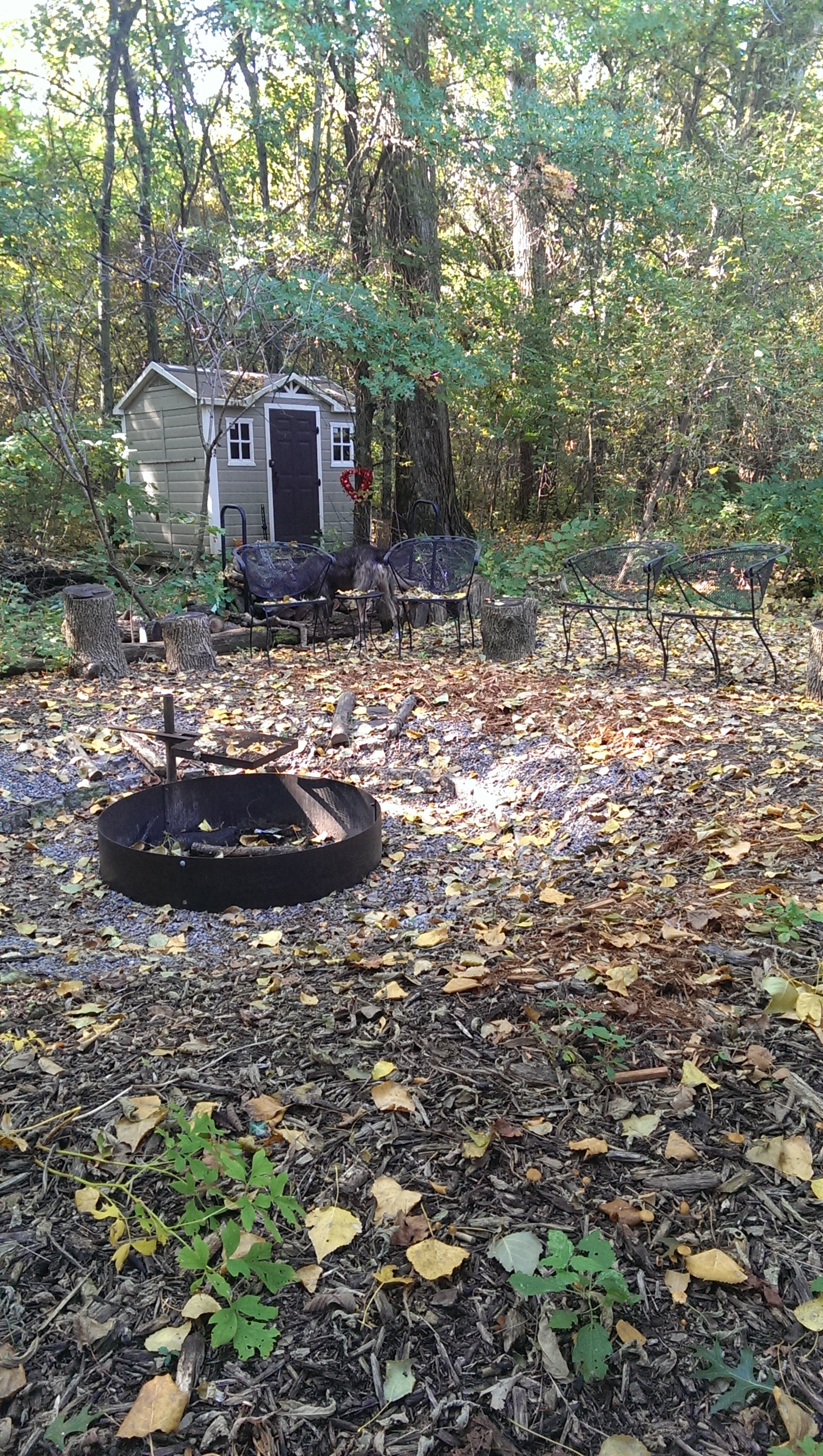
Going to lay down the broadcast in the vegetable garden and the orchard this morning, then mulch. Kate and Anne planted next year’s garlic crop while I was in Colorado. With no additional effort then, the new owners will have apples, pears, plums, cherries, currants, raspberries, gooseberries, strawberries, rhubarb, asparagus and garlic from their orchard and vegetable garden. In addition they will have daffodils, liguria, monkshood, many varieties of Asiatic lilies, iris and hemerocallis. Clematis, daffodils, tulips and fall crocus will IMAG0683bloom, too. Wisteria, lilac, bushy clematis and snakeroot put fragrance, delicate and sweet, in the air. They will have three different sheds in which to organize their outdoor life and a firepit for family evenings. There are, too, the separated plantings of prairie grass and wildflowers that bracket the front lawn, providing habitat for butterflies and other wildlife.

In addition the property has about 1.5 acres of woods, including a morel patch that shows up in the late spring. With the inground irrigation system this is a place for a person with an interest in living closer to the earth and harvesting the literal fruits of such a lifestyle.


From June or so, 2014

Today and until I’m done I will be packing the study in which I work every day. That means the sorting will get harder, green tape boxes outnumbering red tape ones. Probably by a lot. It also means the confrontation between time remaining (in my life) and the projects (intellectual and creative) that keep me excited will come center stage. I’ll try to sort out the ones I feel I can fruitfully engage over the next 20 years from the ones I can’t.

That means I’m considering active intellectual and creative work at least into my late 80’s. That feels like a stretch, maybe, but one I believe my health and potential longevity justifies.

Let me give you an idea of what I have in mind. Complete the translation of Ovid’s Metamorphosis. Write at least four more novels. Write essays or a book on Reimagining My Faith. Write and read much more poetry. Write essays or a book on matters related to the Enlightenment, liberal thought, modernism. Write essays or a book on matters related to the Great Work. Include in this work considered attention to Asian literature, art and thought, especially Chinese and Indian. Continue regular art historical research and write essays about aesthetics and particular art/artists.

Why? Because I can. I’ve no evidence so far that my thinking is strikingly original or unusually deep, but my intellectual maturation has taken a longer time than I imagined it would. So the best may yet be ahead. Or so it feels to me. Under any circumstances such work will keep me alert and focused.

Kavod

Fall                                                                            Harvest Moon

We’ve had snow. Again yesterday. Modest accumulation since the ground is still too warm. These are the days when snow mixes with the golden aspen leaves, throwing white into the green and gold colors of Mountain High. Go, Shadows.

Yesterday I finished my work on kavod. Here’s the end of it:

Text #3   “Kavod is translated as honour/respect. Kavod is way beyond good manners and saying please and thank you. It’s seeing the spiritual value of a human being and yourself. The greater sense of my own value, the more I don’t need to search for the approval of others and the more I am able to honour other people and see a sense of their value. If I give genuine kavod to another person than they in turn will value and respect me. We say “kodosh, kodosh, kodosh, the entire world is filled with the Kavod/honour of Hashem”.  http://www.shortvort.com/mussar/10450-kavod>

Rabbi Eliezer said: “Let the honor of your friend be as dear to you as your own.” Morinis, Everyday Holiness, p. 114

Before this text I added an image of Claude Monet’s:

Claude_Monet_-_Claude Monet, Haystacks, (sunset), 1890–1891, Museum of Fine Arts, Boston
Haystacks, (sunset), 1890–1891, Museum of Fine Arts, Boston

Monet, of course, was part of the Impressionist movement, committed to painting the colors as they were at particular moment in a particular place. They let the colors build the image rather than using color as a tool to build the image in a way that pleased their aesthetic.

This is similar, I think, to the notion of kavod. With kavod we look into the essence of ourselves and others, see that essence and let it build our image of ourselves and the other, rather than using our biases, our assumptions, our judgments. Just as the impressionists did, though, we have to know that our perceptions of that essence change from moment even though the essence, the imago dei, may remain the same. (I have some disagreement with the notion of soul, or essence, as a sort of Platonic archetype, constant and unchanging.)

Anyhow, I’m looking forward to this gathering of the MVP. I’ve done my awe work for the last month and am ready to get started on kavod.